
Medical Billing Outsourcing vs. In-House: Which Is Better for Your Practice in 2026?
Compare outsource vs in-house medical billing with real 2026 cost data, denial rates, and a decision framework to find the right model for your practice.
Medical billing outsourcing vs. in-house: which is better for your practice in 2026?
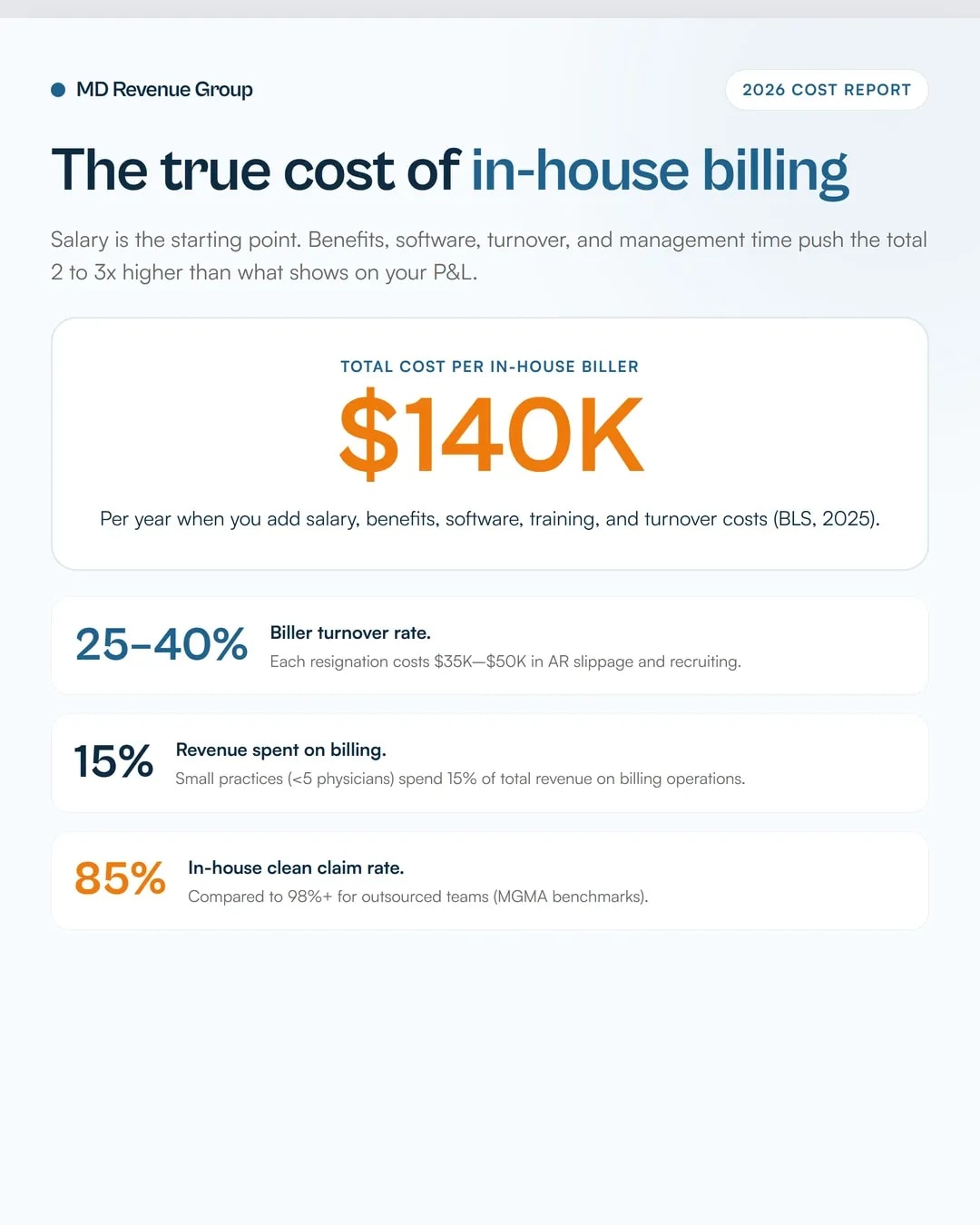
The choice between outsource vs in-house medical billing comes down to math, risk tolerance, and how much revenue you're willing to leave unworked. In-house billing gives you direct control but costs 140,000 per employee per year when you count salary, benefits, software, and turnover. Outsourcing runs 4% to 10% of collected revenue, with first-pass claim rates that regularly hit 98% compared to the 85% to 90% most internal teams achieve. For a practice collecting 60,000 to 35,000 to $50,000 AR slippage that follows every biller resignation.
Key takeaways
- In-house billing costs 140,000 per employee per year after factoring salary, benefits, software, training, and turnover.
- Outsourced billing fees range from 4% to 10% of net collections, with most mid-size practices paying 5% to 8%.
- Outsourced teams achieve 98%+ clean claim rates vs. 85% to 90% for in-house teams (MGMA benchmarks).
- Medical billing staff turnover runs 25% to 40%, and each resignation costs 50,000 in AR slippage.
- The global medical billing outsourcing market hit $18.5 billion in 2026, growing at 10% to 14.4% CAGR (Grand View Research).
What does in-house medical billing actually cost?
Most practice owners look at the salary line and stop calculating. That's the mistake.
The Bureau of Labor Statistics puts the median annual salary for medical billing and coding specialists at $50,250. But CPC or CCS-certified coders command a 20% to 35% premium, pushing base pay to 68,000 for experienced staff.
Salary is the starting point. Here's the full picture:
Cost category | Annual estimate (per employee) |
|---|---|
Base salary | 75,000 |
Benefits and payroll taxes (25% to 30%) | 22,500 |
Billing software and clearinghouse fees | 10,000 |
Training and certification maintenance | 4,000 |
Turnover and recruiting costs (amortized) | 15,000 |
Overhead (IT, office space, management time) | 5% to 15% of staff time |
Add those up. A single in-house medical biller costs 140,000 per year. The range depends on your geography, the complexity of the role, and how often you're replacing people.
Practices with fewer than 5 physicians spend roughly 15% of total revenue on billing operations. Larger groups (20+ providers) get that closer to 10%, but they're running 3 to 5 billing staff to get there. We broke down these cost tiers in more detail in our medical billing service cost analysis.
And there's a cost that never shows up in your P\&L: the practice manager spending 5 to 15 hours per week supervising billing workflows. That time has a dollar value, and it's coming straight from operations that generate revenue. Practices in states with higher labor costs feel this more acutely. A New Jersey practice paying Northeast wages for billers is looking at the top end of that $140,000 range, while a Texas clinic might land closer to $90,000 for the same role.
What does outsourced medical billing cost?
Outsourced billing converts your fixed overhead into a variable expense tied directly to collections.
The standard model: 4% to 10% of net collected revenue. Most mid-size practices land between 5% and 8%. Solo practitioners and low-volume offices pay the higher end. High-volume groups with clean coding can negotiate down to 4% to 6%. We published a full guide on what to ask before signing a billing contract that covers negotiation leverage points and red flags.
Here's what that looks like at different revenue levels:
Annual collections | Outsourcing rate | Annual billing cost |
|---|---|---|
$500,000 | 8% | $40,000 |
$1,000,000 | 6% | $60,000 |
$2,000,000 | 5% | $100,000 |
$5,000,000 | 4% | $200,000 |
Some firms offer flat monthly fees (2,500) or per-claim pricing (12 per submission). These work for practices with predictable volumes but can backfire during growth periods.
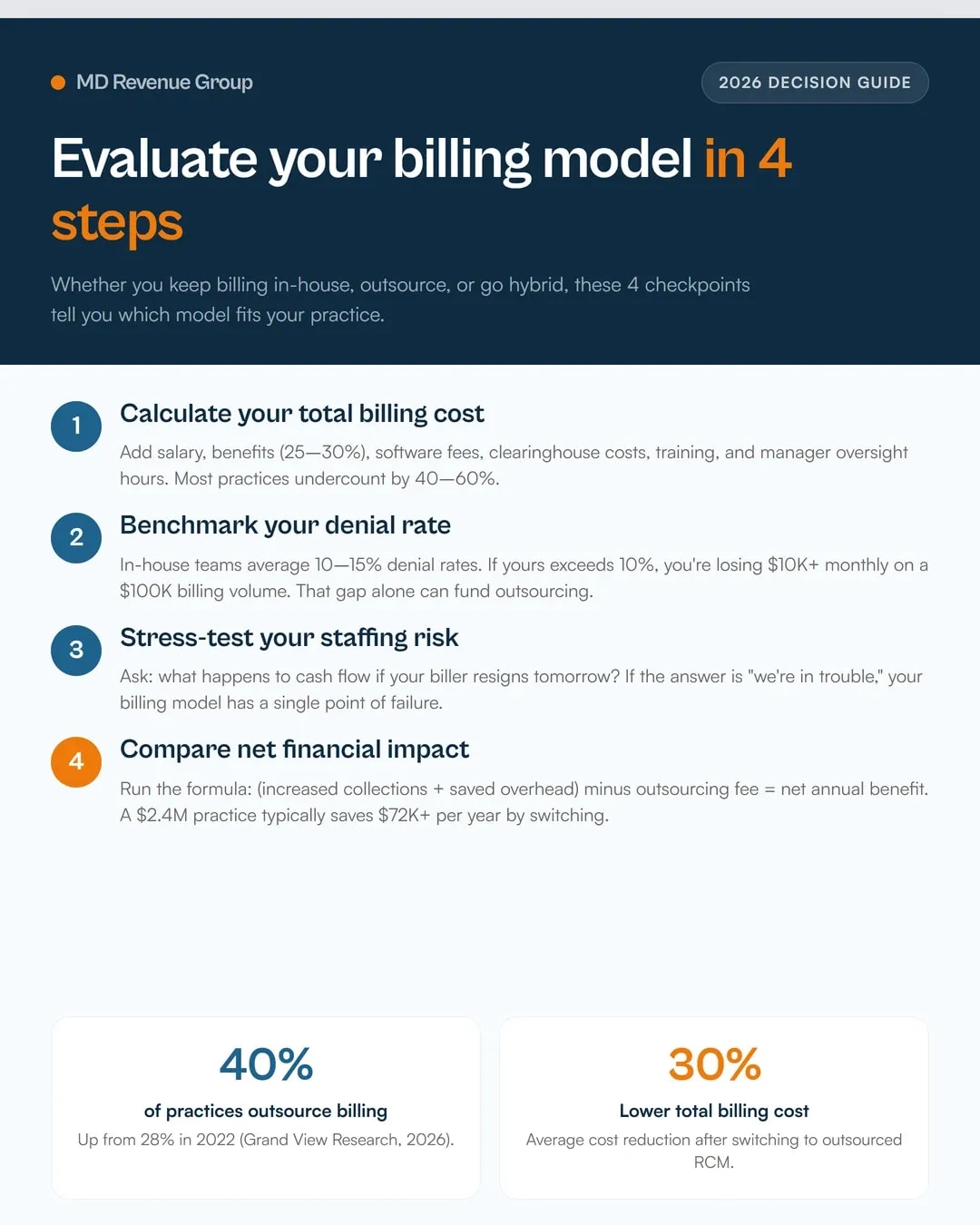
The cost savings are real. Practices that switch from in-house to outsourced billing report reducing their total billing expenditure by up to 30% while simultaneously increasing net collections by 10% to 25% within the first year. If your practice collects 60,000) while eliminating a 35,000 before you even count the revenue gains from better denial management.
The global medical billing outsourcing market reached $18.5 billion in 2026 and is growing at 10% to 14.4% CAGR through the mid-2030s (Grand View Research). That growth is driven by 40% of all practices now outsourcing some or all billing functions, and 70% of U.S. hospitals outsourcing at least one major RCM component. The RCM industry itself is consolidating fast, with private equity rolling up smaller billing firms at record pace.
How do denial rates compare between in-house and outsourced teams?
This is where the numbers get uncomfortable for in-house operations.
Metric | In-house billing | Outsourced billing |
|---|---|---|
First-pass / clean claim rate | 85% to 90% | 98%+ |
Denial rate | 10% to 15%+ | 3% to 5% |
Net collection rate | 85% to 90% | 97% to 99% |
Average days in A/R | 50 to 65 days | 25 to 35 days |
The industry baseline for a clean claim rate is 90% (MGMA). If your practice sits below that, you're hemorrhaging money on rework, appeals, and write-offs.
Outsourced billing firms regularly hit 98% or higher because they run automated claim scrubbing that catches errors before submission. That pre-validation boosts first-pass acceptance by roughly 25% compared to manual review processes.
The denial gap matters more than it looks. A practice billing 12,000 per month to initial denials. Drop that to 4% through outsourcing and you recover 96,000 annually, before accounting for successful appeals on the remaining denials. If you want the full playbook, our guide on how to reduce claim denials walks through every common root cause.
In-house teams leave 15% to 25% of potential revenue on the table according to RCM performance benchmarks. The reasons are structural: generalist billers handling multiple specialties, insufficient time for post-denial follow-up, and difficulty scaling during high-volume periods. Outsourced teams avoid these traps because their billing specialists focus on specific specialties with dedicated denial management workflows. A cardiology practice needs different coding expertise than a behavioral health clinic, and outsourced firms staff for that.
The turnover problem nobody budgets for
Medical billing staff turnover runs 25% to 40% annually. That's 2 to 3 times the overall national average.
An MGMA poll from May 2026 found that 28% of medical group leaders reported higher administrative turnover than in 2025. The problem isn't isolated. It's systemic. And it's forcing practices to look at staffing alternatives including AI-assisted billing workflows.
When a biller resigns, your losses go beyond recruiting and training. The real damage comes from AR slippage: claims that go unworked during the vacancy, appeals that expire past timely filing deadlines, and payer correspondence that sits unopened.
Each biller resignation costs 50,000 in combined recruiting expenses and AR slippage. That's a conservative estimate from RCM workforce analysts. For practices that have experienced a Change Healthcare-level disruption, combine that biller vacancy with a clearinghouse outage and the losses compound fast.
The drivers are well documented. Constant regulatory changes, EHR documentation burdens, and chronic understaffing create a cycle where remaining staff absorb extra work, make more errors, generate more denials, and eventually leave. A 2026 workforce report found that 67% of healthcare administrative workers report burnout symptoms.
Outsourcing eliminates single-point-of-failure risk. If one person leaves at your billing partner, you don't feel it. Their bench is deeper than yours will ever be. That stability alone justifies the percentage fee for many small practices, especially those with a single biller where one absence disrupts the entire cash flow cycle.
Decision framework: which model fits your practice?
The answer depends on 5 variables. Run through this table and tally where you land:
Factor | Lean in-house | Lean outsource |
|---|---|---|
Monthly claims volume | 500+ claims/month with stable volume | Under 500 claims/month or fluctuating |
Specialty complexity | Single, standard specialty (primary care, internal medicine) | Multi-specialty or high-complexity (surgery, oncology, cardiology) |
Staff stability | Tenured billing team with low turnover | Frequent turnover, difficulty hiring certified coders |
Technology investment | Already invested in advanced billing software and claim scrubbing | Using basic EHR billing module, no automated scrubbing |
Control priority | Compliance environment requires on-site data handling | Comfortable with HIPAA-compliant remote data access |
If you score 3 or more in the "outsource" column, the financial case for keeping billing in-house is weak.
Most practices with fewer than 5 providers don't have the volume to justify a full-time biller with benefits. For those practices, outsourcing at 6% to 8% of collections costs less than the loaded salary of a single employee while delivering better outcomes on every metric that matters.
Larger groups (10+ providers) with complex payer mixes and surgical billing often benefit from a hybrid approach, which we cover next. Practices in payer-dense states like Pennsylvania or New York face additional complexity from state-specific billing regulations that a specialized partner is better equipped to handle.
What about the hybrid model?
A growing number of practices run a hybrid: front-end billing processes stay in-house while back-end work goes to an outside partner.
What you keep in-house:
- Charge entry and clinical documentation
- Patient communication and payment collections
- Insurance eligibility verification
What you outsource:
- Claim submission and follow-up
- Denial management and appeals
- Complex coding and modifier assignment
- Credentialing and payer enrollment
The hybrid model costs more than full outsourcing because you're maintaining some internal infrastructure. But it solves the two biggest objections to outsourcing: loss of control over patient data and disconnection between clinical staff and billing workflows. Our NJ revenue integrity case study documented a multi-specialty group that recovered $287,000 in annual revenue by outsourcing denial management while keeping charge capture in-house.
Practices using role-based access control (RBAC) limit outsourced partners to the minimum necessary data access. Every action gets logged and audited. The billing partner sees what they need to see, and nothing more.
For multi-specialty groups handling 1,000+ claims monthly, this model often delivers the best risk-adjusted return. You get direct control over the patient experience and documentation quality while letting specialists handle the revenue recovery. A group running orthopedic billing alongside pain management gets two sets of coding experts from the outsourced side without hiring two specialty billers.
HIPAA and data security: what you need to verify
A signed Business Associate Agreement (BAA) is the legal minimum. It is not a security program.
Healthcare remains the costliest industry for data breaches. The average cost per incident reached $7.42 million in 2025. And the risk is growing: 772 large healthcare breaches were reported in 2025 (a record), with business associates' share of those breaches doubling from 15% to 30% over recent reporting periods (HIPAA Journal).
Outsourcing billing does not transfer HIPAA liability. You remain the covered entity. If your vendor gets breached, you share the consequences. The 2026 OIG Work Plan has specifically flagged third-party vendor compliance as a priority review area.
Before signing with any billing partner, verify these 5 items:
- Encryption at rest and in transit for all PHI
- Multi-factor authentication (MFA) on all systems accessing your data
- SOC 2 Type II certification or equivalent third-party audit
- Documented incident response plan with breach notification timelines
- Employee training records showing annual HIPAA compliance education
Ask for proof. Not a slide deck. Actual documentation. Run a billing audit that includes a security review of any revenue cycle partner before you grant system access.
Proprietary calculation: your real cost of keeping billing in-house
Here's a calculation you won't find in any other comparison article. It factors in the hidden costs that in-house advocates consistently ignore.
Scenario: 4-physician practice, 2 full-time billers, $2.4 million annual collections.
Line item | Annual cost |
|---|---|
2 billers at $55,000 base salary | $110,000 |
Benefits and payroll taxes (28%) | $30,800 |
Billing software (2 licenses at $350/month) | $8,400 |
Clearinghouse fees ($0.35 per claim, 8,000 claims) | $2,800 |
Annual training and CE credits | $3,200 |
Manager oversight (8 hrs/week at $45/hr) | $18,720 |
1 turnover event per year (amortized) | $42,500 |
Total in-house cost | $216,420 |
As percentage of $2.4M collections | 9.0% |
Now compare that to outsourcing at 6% of the same $2.4 million:
Line item | Annual cost |
|---|---|
Outsourcing fee (6% of $2.4M) | $144,000 |
Net annual savings | $72,420 |
But the savings don't stop there. If the outsourced team increases your net collection rate from 90% to 97% (a common improvement), you're recovering an additional $168,000 per year that was previously written off or left unworked.
Total financial impact of switching: $240,420 per year (168,000 in recovered revenue).
That's the real number. Use our revenue integrity tool to run this calculation against your own collection data and see where your practice falls.
FAQ
Is outsourcing medical billing worth it for a solo practice?
For solo practices, outsourcing almost always makes financial sense. A solo provider collecting 24,000 to 72,000+ total cost of one in-house biller, and you eliminate the risk of a single-person billing department going on leave or quitting with no backup.
How long does it take to transition from in-house to outsourced billing?
Most transitions take 30 to 60 days. The first 2 weeks cover system integration, credentialing verification, and staff training. Weeks 3 through 8 involve parallel running (both teams active) to catch anything that falls through the cracks. A good billing partner handles the heavy lifting of data migration. Your role is providing EHR access and charge entry documentation.
Will I lose control of my billing if I outsource?
You lose daily visibility over individual claims, but you gain better reporting. Reputable billing companies provide real-time dashboards showing claim status, denial rates, A/R aging, and collection trends. You see more data than most in-house teams produce, delivered in a cleaner format. And you can always run a forensic RCM audit if you suspect revenue leakage.
What percentage do most medical billing companies charge?
The standard range is 4% to 10% of net collections. Primary care and internal medicine practices with clean coding typically pay 5% to 7%. High-complexity specialties like cardiology and oncology pay 8% to 12% due to increased coding and prior authorization workloads.
Can I switch back to in-house if outsourcing doesn't work?
Yes, but plan for the same 30 to 60-day transition window in reverse. Ensure your contract includes a data portability clause that guarantees full export of claim history, patient records, and financial reports. The best contracts include 90-day termination windows with no penalties.