
Medical Billing for Small Practices: Your 2026 Survival Guide
Small practices lose more to billing gaps than any other line item. See 2026 costs, AR benchmarks, and the decision framework that protects your margin.
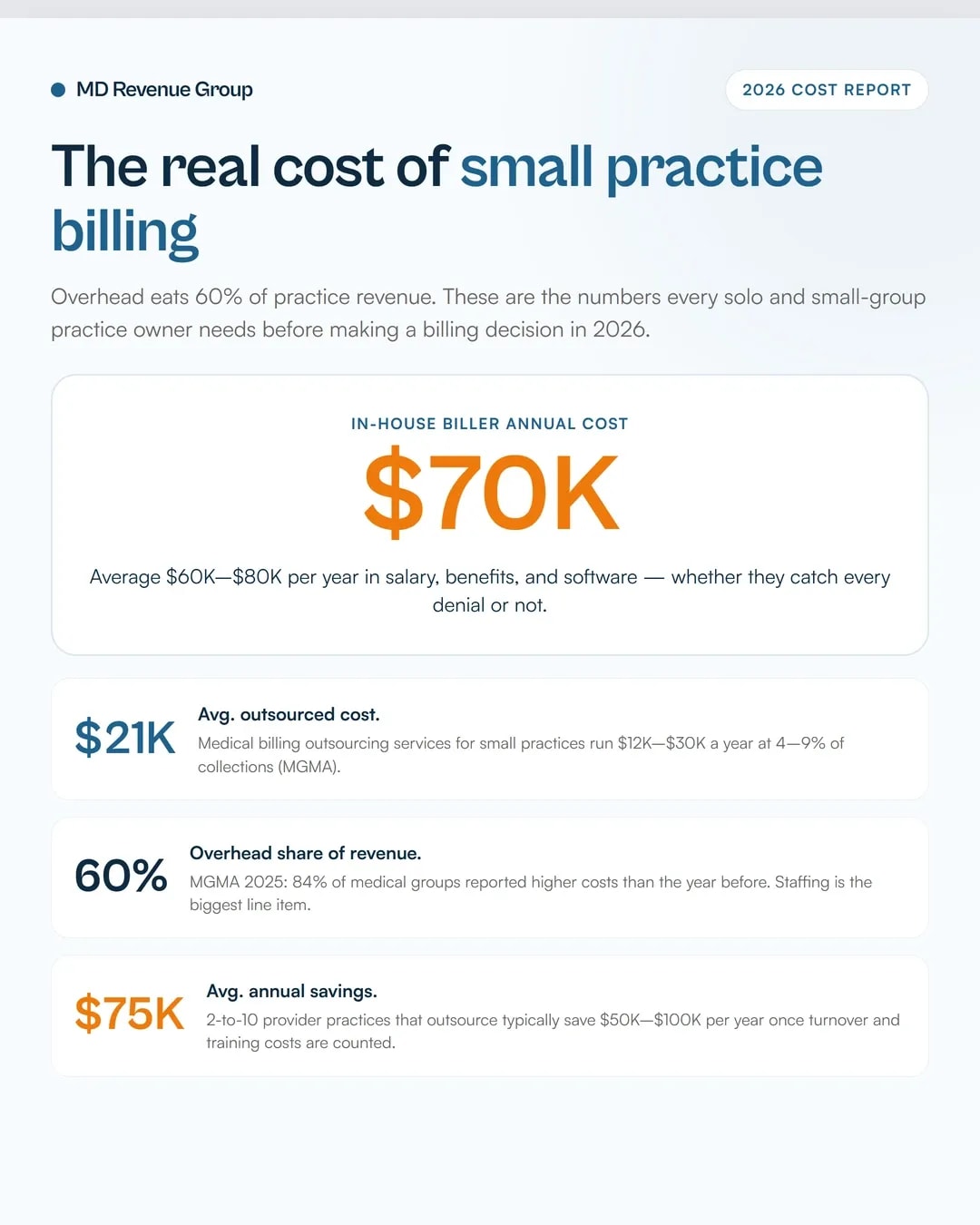
Medical billing services for small practices come down to 3 numbers: overhead typically eats 60% of revenue (MGMA), one in-house biller costs $60,000–$80,000 a year, and outsourcing the same function runs $12,000–$30,000. The medical billing service cost 2026 data is clear: for solo and small-group practices under $1.5M in annual collections, the math almost always favors outsourcing or a hybrid model.
This guide covers where the money goes, what "good" looks like on your AR aging report, how software compares to full-service billing, and how to decide between in-house, outsourced, or hybrid billing without guessing.
Key takeaways
- Practice overhead typically consumes 60% of revenue (MGMA), and staffing costs are the single biggest driver of that number heading into 2026.
- A solo in-house biller costs $60,000–$80,000 a year in salary, benefits, and software. The same work outsourced runs $12,000–$30,000 (medical billing service cost 2026).
- Practices with 2 to 10 providers that outsource typically save $50,000–$100,000 a year once software, training, and turnover costs are factored in.
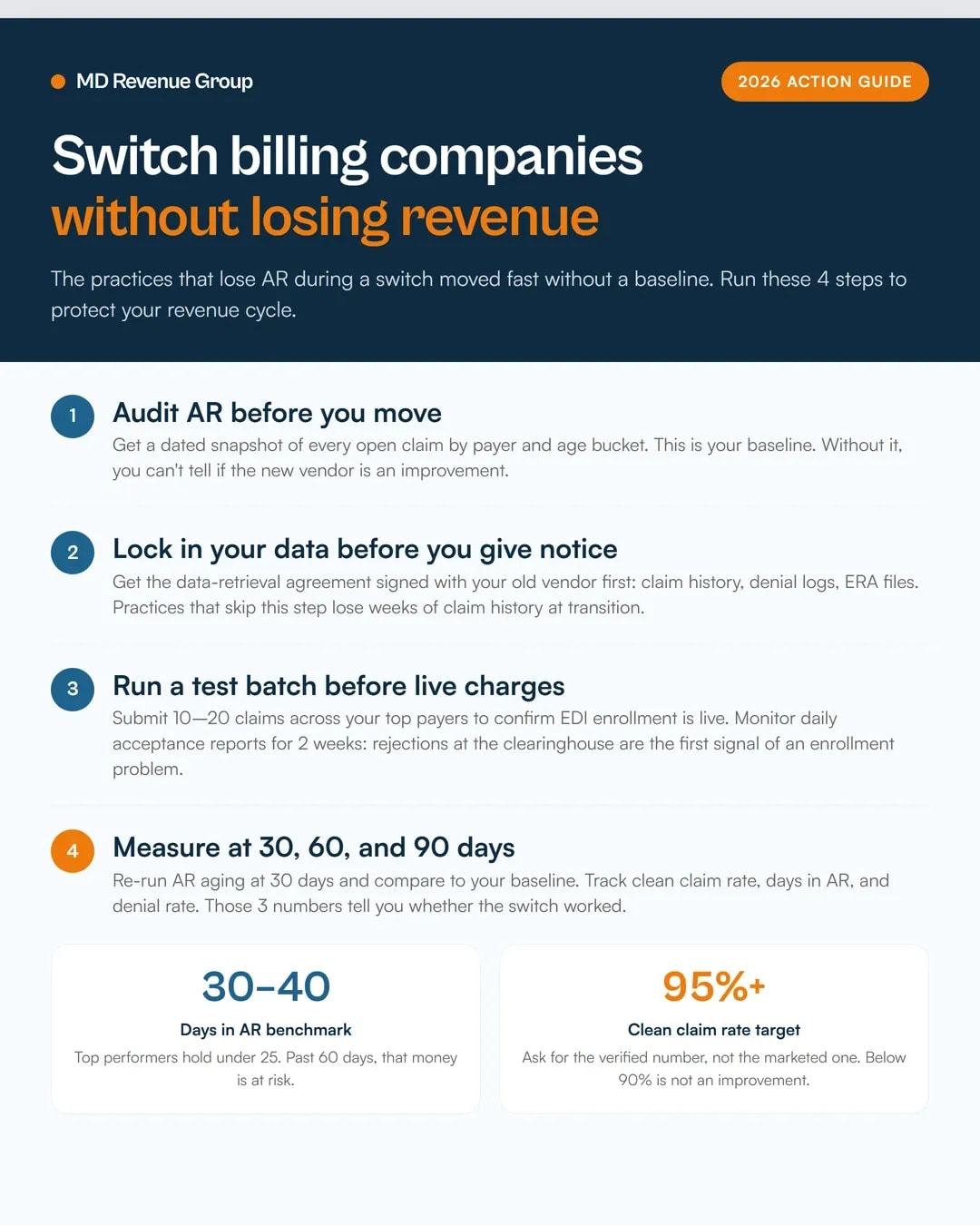
- Healthy days in AR sits at 30–40 days. Top performers hold under 25. Past 60 days, that money is functionally at risk.
- 36% of practices say automation is their top 2026 cost-cutting move, ahead of hiring freezes and vendor changes (MGMA).
Medical billing services for small practices: what you're actually paying for
Small practices don't lose money on bad medicine. They lose it on billing gaps nobody's watching. MGMA data shows 84% of medical groups reported higher year-to-date costs in 2025 than the year before, and overhead now claims 60% of practice revenue on average.
Staffing is the biggest line item inside that number. Salaries, benefits, and the pay bumps needed to keep a biller from walking to a better offer are the top reasons costs rose in 2026 (MGMA). Medical assistants split between clinical and billing duties are especially hard to retain, skills that transfer easily to higher-paying roles elsewhere.
A practice running one in-house biller carries $60,000–$80,000 a year in fixed cost, whether that person catches every denial or not. That's the number every small practice owner needs to compare against what medical billing services for small practices actually cost on the open market.
What type of billing schedule is often used in smaller practices? Four models dominate: percentage of collections (most common, aligns vendor incentives with yours), monthly flat fee (predictable but disconnected from performance), per-claim pricing (good for low-volume practices), and hybrid arrangements that combine a flat base with a performance tier. See MDRG's pricing page for how these structures compare across practice sizes. MGMA reports the median MGMA medical billing outsourcing fee percentage of collections runs 4–9% of monthly collections for small practices.
State considerations for medical billing for small practices
Billing rules vary meaningfully by location. Medical billing for small practices in Maryland, New Jersey, and California involves payer-specific timely filing rules stricter than the national Medicare default. Medical billing for small practices in Texas, Arizona, and Washington carries different Medicaid managed care payer mixes that affect denial patterns. Medical billing for small practices in Montana and New Mexico deals with a heavier percentage of rural health clinic billing and critical access hospital referrals, which carry their own modifier and place-of-service requirements. Your local payer mix, not just CMS guidelines, should drive which billing partner you choose and whether they have genuine experience in your state.
What most small practices get wrong about billing
The most common mistake isn't choosing in-house over outsourced. It's never comparing the 2 on the same numbers. Owners assume outsourcing is a luxury, then never run a true cost comparison against what their current in-house setup already costs.
The second mistake is treating billing as a fixed cost instead of a performance line. A biller who lets AR drift past 60 days is functionally more expensive than a pricier alternative that keeps AR under 30, because unworked claims are money already earned and not collected.
The third: no backup plan for turnover. When your one in-house biller quits, claims stop moving that week. Revenue cycle management built around a team, not a single person, doesn't carry that single point of failure.
The fourth mistake is slower to show up but just as costly: waiting for automation instead of adopting it. MGMA found automation is the top 2026 cost-cutting move for medical groups, cited by 36% of respondents, ahead of hiring freezes (18%) and switching vendors (9%). The RCM staffing shortage is accelerating that shift, as solo billers are increasingly asked to do manually what larger groups are already offloading to software.
Medical billing outsourcing services for small practices vs. in-house: the actual numbers
Here's how the 2 models compare for a typical 2–10 provider practice in 2026:
Factor | In-house billing | Outsourced billing |
|---|---|---|
Annual cost (per biller/practice) | $60,000–$80,000 | $12,000–$30,000 |
Pricing structure | Fixed salary + benefits | 4–9% of monthly collections (MGMA medical billing outsourcing fee percentage of collections) |
Clean claim rate (typical) | Varies widely by staff experience | 95%+ at established vendors |
Turnover risk | High, single point of failure | Low, team-based coverage |
Software and clearinghouse fees | Paid separately by practice | Usually bundled into service fee |
For most practices collecting under $1.5M a year, medical billing outsourcing services for small practices produce a clear financial advantage once you count salary, benefits, software, training, and turnover cost. Practices in the 2–10 provider range typically save $50,000–$100,000 annually by making the switch. See the clean claim rate benchmark guide for the specific performance thresholds to demand before signing with any vendor.
That gap narrows for larger, higher-collection practices where a percentage-of-collections fee starts costing more in absolute dollars than a fixed in-house salary. Above $2M in annual collections, run the percentage math against your own numbers. Don't assume the small-practice math still applies at your size.
A 4-physician family medicine practice we worked with ran a single in-house biller at $72,000 a year with AR days sitting at 58. After moving to a hybrid model (keeping front-desk eligibility checks in-house and outsourcing claims and denial follow-up), their front-desk eligibility checks in-house and outsourcing claims and denial follow-up, with their AR days dropped to 27 within 2 billing cycles, at roughly half their prior annual cost.
Medical billing software for small practices vs. full-service billing
The best medical billing software for small practices and a full-service billing company are not the same thing. Software (think Kareo, AdvancedMD, DrChrono) puts the submission, follow-up, and denial work back on your staff. A medical billing service takes over that labor entirely. That distinction matters before you buy anything.
How does medical billing software pricing compare for a small practice with 3 to 5 doctors? Typical medical billing software for small practices runs $300–$800 per provider per month (roughly $10,800–$48,000 a year for a 3-to-5 doctor group), plus clearinghouse fees of $0.25–$0.35 per claim and implementation costs of $2,000–$5,000. That figure doesn't include the staff hours required to work denials, which average 20–30 minutes per reworked claim. At 3–5 providers generating 400–600 claims per month, even a 10% denial rate means 40-60 manual rework hours monthly, a hidden labor cost the software quote never shows you.
If you're looking for home health billing for dummies, the core difference is episode-based reimbursement under PDGM instead of fee-for-service. Your billing cycle is 30-day periods, not per-visit claims, which changes your AR aging benchmarks entirely. Home health billing standard small-practice software often mishandles PDGM episode adjustments out of the box, so home health practices specifically need a vendor with documented PDGM experience.
The decision rule is simple: if your practice has a dedicated billing staff member who will actively work the software every day, medical billing software for small practices can work. If that person is also handling scheduling, phones, and front-desk duties, the software becomes an expensive claim-submission tool, and denial follow-up falls through the cracks. When you're evaluating the best medical billing software for small practices, ask vendors for their average denial rework time per claim, not just their submission rate.
What to look for in a billing partner
Evaluating the best medical billing companies for small practices in 2026 requires asking for specifics, not averages. Before signing anything, verify:
- Their actual clean claim rate (verified, not marketed). Below 90% is not an improvement over a struggling in-house setup.
- Specialty-specific experience: a generalist billing shop that treats a cardiology claim the same as a family medicine visit will miss device-related documentation and modifier requirements that drive most specialty denials.
- A named point of contact, not a shared support inbox.
- Reporting cadence: weekly AR and denial tracking, not a quarterly summary.
- Credentialing support, since enrollment gaps cause denials that have nothing to do with the claim itself.
- Transparent pricing with no software or clearinghouse add-ons buried in the contract.
If a vendor won't share their clean claim rate on request, that's the answer. The ones performing well lead with the number.
Get every contract term in writing before signing, specifically the termination clause and data-handoff protocol. Practices that switch billing partners without a clear data-handoff agreement regularly lose weeks of claim history during the transition, which shows up as an AR spike right when you're trying to prove the new vendor is working. The denial management guide covers how to audit your denial root causes before that conversation with any new vendor.
The switching checklist: how to change billing companies without losing revenue
Most practices that want to change medical billing service put it off for months because the transition feels risky. That risk is real, but it's manageable if you run a structured handoff. The practices that lose revenue during a switch do it because they moved fast without a baseline, not because switching is inherently dangerous. Here's how to switch billing companies without the AR spike. (One pre-switch note: if your current vendor had issues with timely filing windows, document the affected claim dates before you move, as those denials don't disappear when you switch vendors.)
Before go-live:
At go-live:
First 30 days:
Post-switch validation:
One note on timing: don't switch billing vendors in Q4 if you can avoid it. Payer holiday slowdowns and year-end processing backlogs mask whether your new vendor's performance is actually better or just riding seasonal payment cycles.
Revenue cycle management for small practices: your decision framework
Affordable medical billing looks different depending on your size, but the decision criteria are the same. Outsource if you're under $1.5M in annual collections, your current biller costs more than $60,000 fully loaded, or you've had turnover in that role in the last 2 years.
Stay in-house if you're a larger practice with a stable, high-performing billing team already hitting sub-30 AR days and your collections volume makes a percentage-of-collections fee cost more than an equivalent salary.
Choose hybrid if you want to keep patient-facing eligibility and scheduling in-house while handing off the claims-and-denials backend, which is usually the highest-labor, most error-prone part of the revenue cycle management for small practices cycle anyway.
Whatever you choose, put a number on it. Days in AR, denial rate, and clean claim percentage are the framework. Track those 3 for 90 days before and after any change, and the right answer becomes clear. "It feels like billing is fine" isn't a measurement.
There's no wrong answer that lasts forever. A practice that outsources at 3 providers may have the volume and staff to justify bringing billing back in-house at 12. Revisit the decision every time your provider count or collections cross a meaningful threshold, not just when something breaks. Full revenue cycle management with medical billing services for small practices scales with your practice; the goal is a model that doesn't require your personal attention to function.
The step-by-step review:
Step 1: Pull your actual numbers. Total in-house cost (salary, benefits, software, clearinghouse fees, training) against what an outsourced quote runs at 4–9% of monthly collections. Most owners have never done this side by side.
Step 2: Check your days in AR right now. The 2026 benchmark is 30–40 days, with top performers under 25. Past 50, you already have a working problem, not just a cost problem. A medical billing audit will show you exactly where claims are stalling.
Step 3: Look at your AR aging bucket over 90 days. MGMA puts the healthy ceiling at roughly 13.5% of total AR. Above that, you're carrying claims close to becoming permanent write-offs.
Step 4: Decide on a model before you compare vendors. Full outsourcing, hybrid, or in-house with better tooling. The model decision comes first.
Step 5: Verify the clean claim rate before signing. Ask for their actual number, not an average. A vendor running below 90% isn't saving you the trouble you're paying for.
Step 6: Build in a 90-day review. Measure AR days and denial rate against your pre-switch baseline. If the numbers didn't move, the model wasn't the problem you thought it was.
Get a clear read on your numbers
If you don't know your current AR days, or what your billing actually costs once turnover, training, and software are counted, that's the first thing to fix. Run our revenue integrity calculator to see what your practice is actually collecting versus what it's leaving on the table, with no assumptions, no guesswork, no sales call required.
When you're ready to compare specific vendors, request a free revenue audit and we'll show you exactly where your practice stands against the 2026 benchmarks for medical billing services for small practices.