
How to Reduce Claim Denials: A Step-by-Step Guide
Cut claim denials with a proven 2026 framework. See the root causes, the fix sequence, and the checklist MDRG uses to get practices under 5%.
To reduce claim denials, you need to fix the root cause, not the rejection letter. Most practices are stuck at an 11.8% initial denial rate (MGMA, 2024 data), while best performers run under 5%. Get there by auditing eligibility checks, tightening documentation before the claim ever leaves your office, and reworking denials within 30 days instead of writing them off.
That's the short version. The rest of this guide walks through why denials actually happen, what payers are checking for, and the exact sequence to bring your rate down and keep it there.
Key takeaways
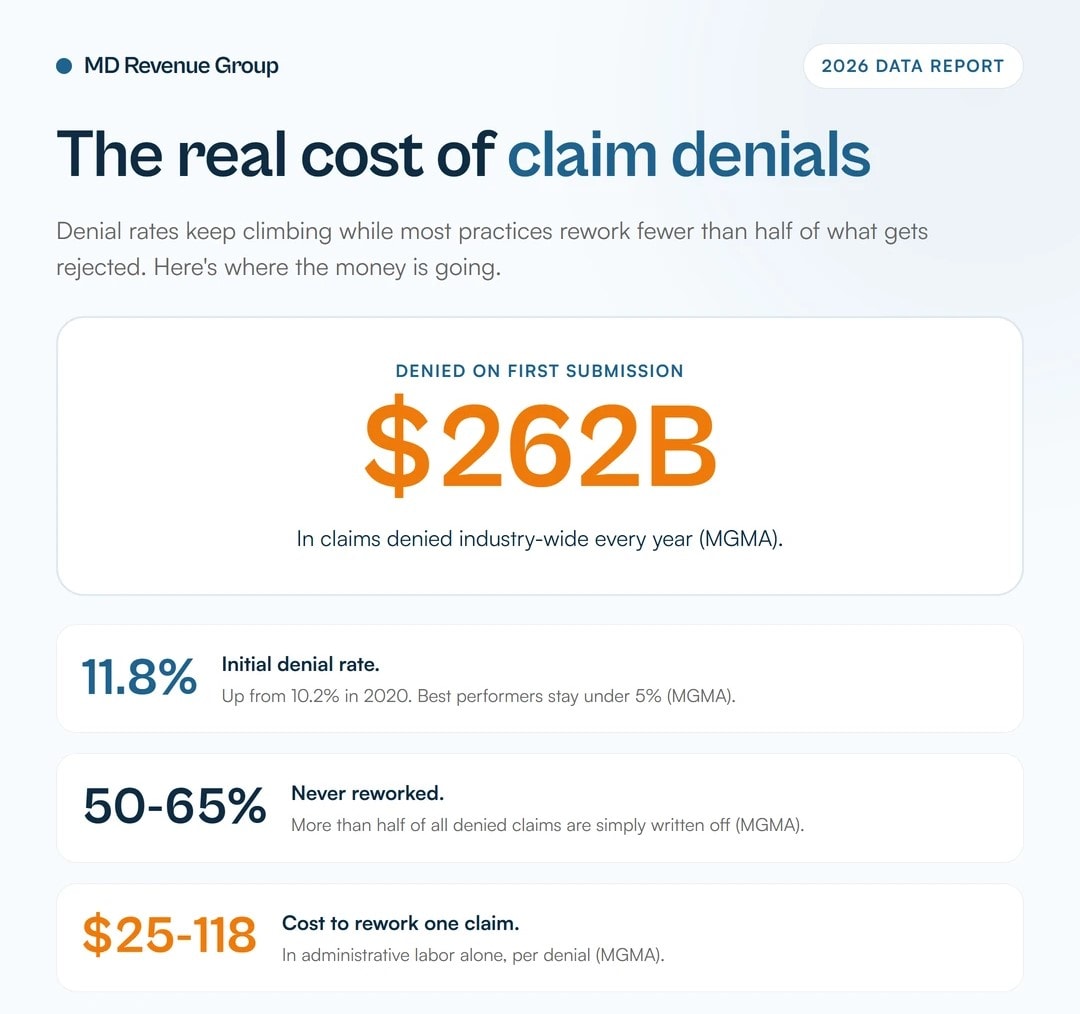
- The industry-wide initial denial rate hit 11.8% in 2024, up from 10.2% in 2020 (MGMA). Best-performing practices stay under 5%.
- $262B in claims get denied on first submission every year, and 50-65% of those denials never get reworked (MGMA).
- Reworking one denied claim costs $25-$118 in administrative labor (MGMA), or $47.77-$63.76 depending on payer type (HFMA).
- The top 5 denial causes in 2026: missing or incorrect prior authorization, eligibility errors, coding mistakes, incomplete documentation, and timely filing violations.
- Modifier 25 and modifier 59 are active 2026 OIG enforcement targets. Loose documentation here triggers denials and audits.
Why claim denials keep climbing in 2026
Denials aren't random. They cluster around 5 causes: prior authorization gaps, eligibility errors, coding mistakes, thin documentation, and missed filing deadlines. Payers didn't invent new rules to trip you up. They automated the ones that already existed.
Prior authorization is the biggest single driver. As more Medicare Advantage plans shift providers into HMO-style networks, retro-authorizations get harder to win. A service performed one day before final approval lands is now a denial, not a delay.
Modifier scrutiny is rising too. The OIG's 2026 Work Plan names modifier 25 as an active enforcement target, and a prior OIG review found 40% of code pairs billed with modifier 59 didn't meet program requirements. If your E/M documentation doesn't clearly separate the visit from the procedure, that claim is exposed twice: once at the payer, once at audit.
None of this means the system got harder to work with. It means the practices treating denial management as a monthly cleanup task are losing to the ones treating it as a daily discipline.
Here's how the top 5 causes typically break down across a mid-size multi-specialty practice:
Denial cause | Share of denials | Fastest fix |
|---|---|---|
Missing or incorrect prior auth | 30-35% | Payer-specific auth calendar |
Eligibility and coverage errors | 20-25% | Re-verify at every visit, not just intake |
Coding mistakes (CPT/ICD-10) | 15-20% | Annual code-set audit |
Incomplete documentation | 15-20% | Note templates tied to E/M level |
Timely filing violations | 5-10% | Payer deadline tracker, not a shared calendar |
Specialty matters here too. Cardiology and pain management practices tend to run denial rates near 10% or higher, largely because device-related claims and prior auth requirements are more complex than a standard office visit (MGMA). If you bill in a high-complexity specialty, your prevention checklist needs to be tighter than the industry average, not looser.
What payers are actually checking before they pay
Every payer runs the same 3 checks before a claim ever reaches a human reviewer: eligibility match, code validity, and medical necessity support. Miss any one, and the claim bounces before anyone reads the note.
Eligibility and coverage errors happen when front-desk verification runs once, at intake, and never again. A patient's plan can change mid-treatment. If your system checks eligibility only on day 1, you're billing blind by visit 3.
Coding mistakes are rarely typos. They're outdated code sets, ICD-10 crosswalks that didn't get updated, or CPT selections that don't match the documented complexity. Our medical billing audit process catches these before they ever reach a payer.
Medical necessity is where documentation and coding have to agree. The OIG found 13% of prior authorization denials that actually met Medicare coverage rules got denied anyway, and when providers appealed, over 80% of those got overturned. That's not a coding problem. That's a documentation-clarity problem.
The step-by-step fix
Fixing denials is a sequence, not a single tactic. Skip a step and the next one just catches the same errors later, at a higher cost.
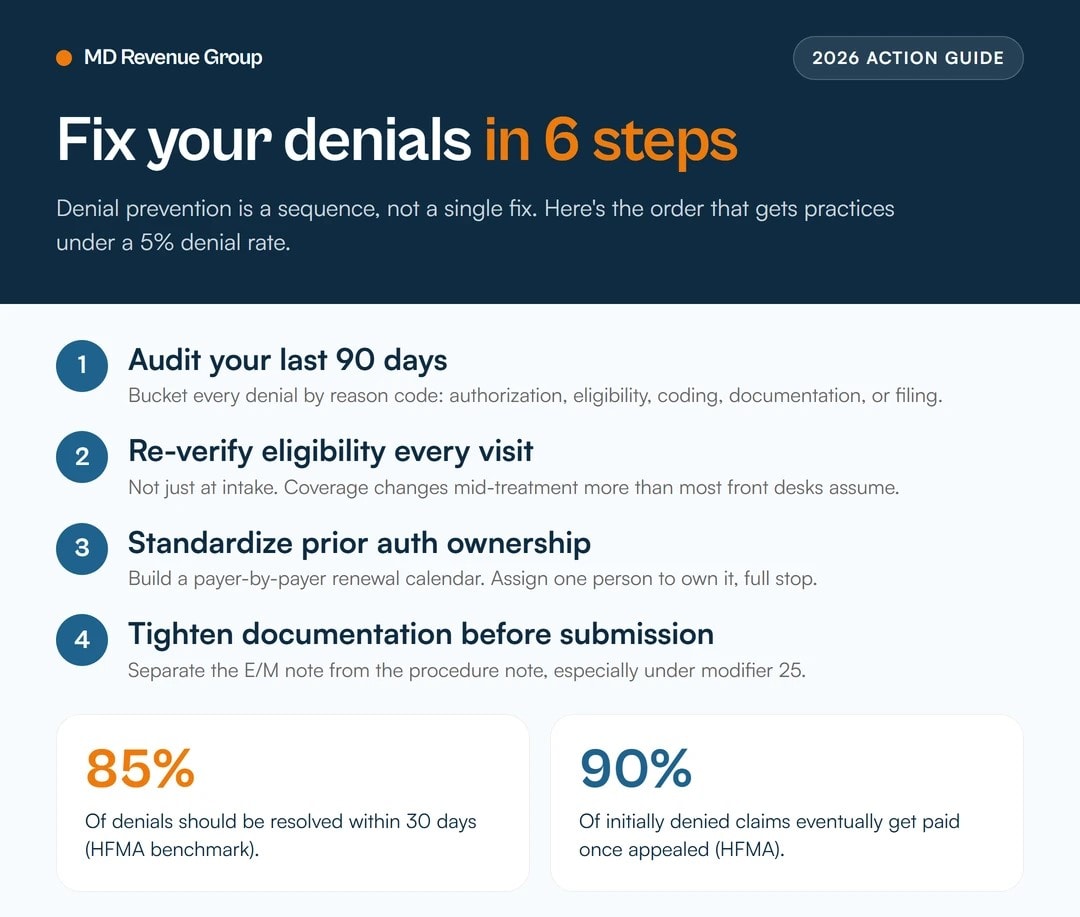
Step 1: Audit your last 90 days of denials by reason code. Don't guess where the leak is. Pull every denial from the last quarter and bucket it by root cause: eligibility, authorization, coding, documentation, or filing deadline. This tells you which step below to prioritize.
Step 2: Fix eligibility verification at every touchpoint, not just intake. Re-verify before high-cost procedures and at the start of each new authorization period. A 5-minute check saves a 45-day appeal.
Step 3: Standardize your prior auth workflow. Build a payer-by-payer authorization calendar (some require renewal every 30 days, others every 90). Assign one person to own it. Ambiguous ownership is how retro-auths get missed.
Step 4: Tighten documentation before the claim goes out, not after it comes back. Require your providers to document medical necessity in the same note as the E/M level, especially anywhere you're using modifier 25. This is the single fastest way to survive both a payer review and an OIG audit.
Step 5: Rework denials within 30 days, every time. HFMA's benchmark is 85% of denials resolved within 30 days. Beyond that window, appeal rights lapse and the claim becomes a write-off by default, not by choice.
Step 6: Track your rate monthly, by payer and by provider. A practice-wide average hides the fact that one payer or one provider is driving most of your denials. Revenue cycle management built around payer-specific data finds that pattern in weeks, not quarters.
Assign a single owner to this report. When denial tracking gets split across billing staff with no single point of accountability, the same reason codes resurface every quarter because nobody connects last month's pattern to this month's claims.
A 6-provider cardiology group we worked with ran a 13% denial rate for over a year before anyone pulled the reason-code breakdown. Once they did, 60% of denials traced back to one payer's device-related prior auth requirement that nobody had documented in the front-desk workflow. Fixing that single gap cut their denial rate to 6% in one quarter.
Your denial prevention checklist
Use this before you submit, not after you get denied:
- Eligibility verified within 24 hours of the appointment, not just at intake
- Prior authorization confirmed and documented in the chart, with the auth number visible on the claim
- CPT and ICD-10 codes matched to the current year's code set (2026 additions included)
- Modifier 25 and modifier 59 usage backed by documentation that clearly separates the services
- Medical necessity stated explicitly in the note, not implied by the diagnosis alone
- Claim submitted within the payer's timely filing window, tracked per payer, not assumed
Practices running credentialing gaps hit a version of this same problem from a different angle: a claim gets denied not because anything about the visit was wrong, but because the provider's enrollment record was out of date with the payer. Check that alongside your clinical documentation, not separately from it.
When to appeal a denial vs. write it off
Appeal if the denial contradicts your documentation, if the payer's own coverage policy supports the service, or if the dollar amount justifies the labor. Write off if the claim is genuinely non-covered, if the filing deadline has passed with no exception available, or if the appeal cost exceeds the claim value.
Most payer contracts spell out an appeal deadline, usually 90 to 180 days from the denial date. Missing that window turns a winnable appeal into an automatic write-off, so track it the same way you track timely filing on the front end.
Payers ultimately pay around 90% of initially denied claims once they're appealed (HFMA). That statistic alone should change how your team treats a denial letter. Most of that 90% is not overturned because the payer changed its mind. It's overturned because someone followed up.
The math is simple: reworking a denied claim costs $25 to $118 in labor (MGMA). If the claim is worth more than that and your documentation supports it, appeal. If it's a $40 line item with no supporting note, write it off and fix the process gap so it doesn't recur.
Build a simple decision rule into your workflow instead of deciding case by case. Any denial over $150 gets an automatic appeal review. Anything under that threshold gets appealed only if the reason code shows a payer processing error, not a genuine coverage gap. This keeps your billing team from spending 45 minutes chasing a $30 claim while a $2,000 denial sits untouched.
Track your appeal win rate the same way you track your denial rate. If you're winning fewer than 60% of your appeals, the problem usually isn't the payer. It's that your documentation wasn't strong enough to submit in the first place, and the appeal is just repeating the same gap.
Get your denial rate under 5%
If your practice is running a denial rate above 10%, something specific and fixable is driving it, and you don't need to guess which one. Request a free revenue audit and we'll show you exactly where your claims are breaking, payer by payer, before your next billing cycle.