
What Is a Good Clean Claim Rate? 2026 Benchmarks by Specialty
A good clean claim rate is 95%+, with top performers at 98-99%. See 2026 benchmarks, the metric most practices measure wrong, and how to improve it.
A good clean claim rate is 95% or higher, with top-performing practices and billing companies hitting 98-99%. HFMA sets the high-performance benchmark at 98%. But clean claim rate only measures whether a claim looked correct on the way out the door, not whether it actually got paid, and that gap is where most practices are misreading their own numbers.
This guide covers the real 2026 benchmark, the metric that matters even more than clean claim rate alone, what actually causes a claim to be "dirty" in the first place, and the specific concrete steps to close the gap between looking clean and getting paid in full.
Key takeaways
- A good clean claim rate is 95%+ on first submission. HFMA's high-performance benchmark for 2026 is 98%.
- Clean claim rate and first-pass resolution rate are not the same metric. A healthy first-pass resolution rate is 90%+, and it measures actual payment, not just pre-submission accuracy.
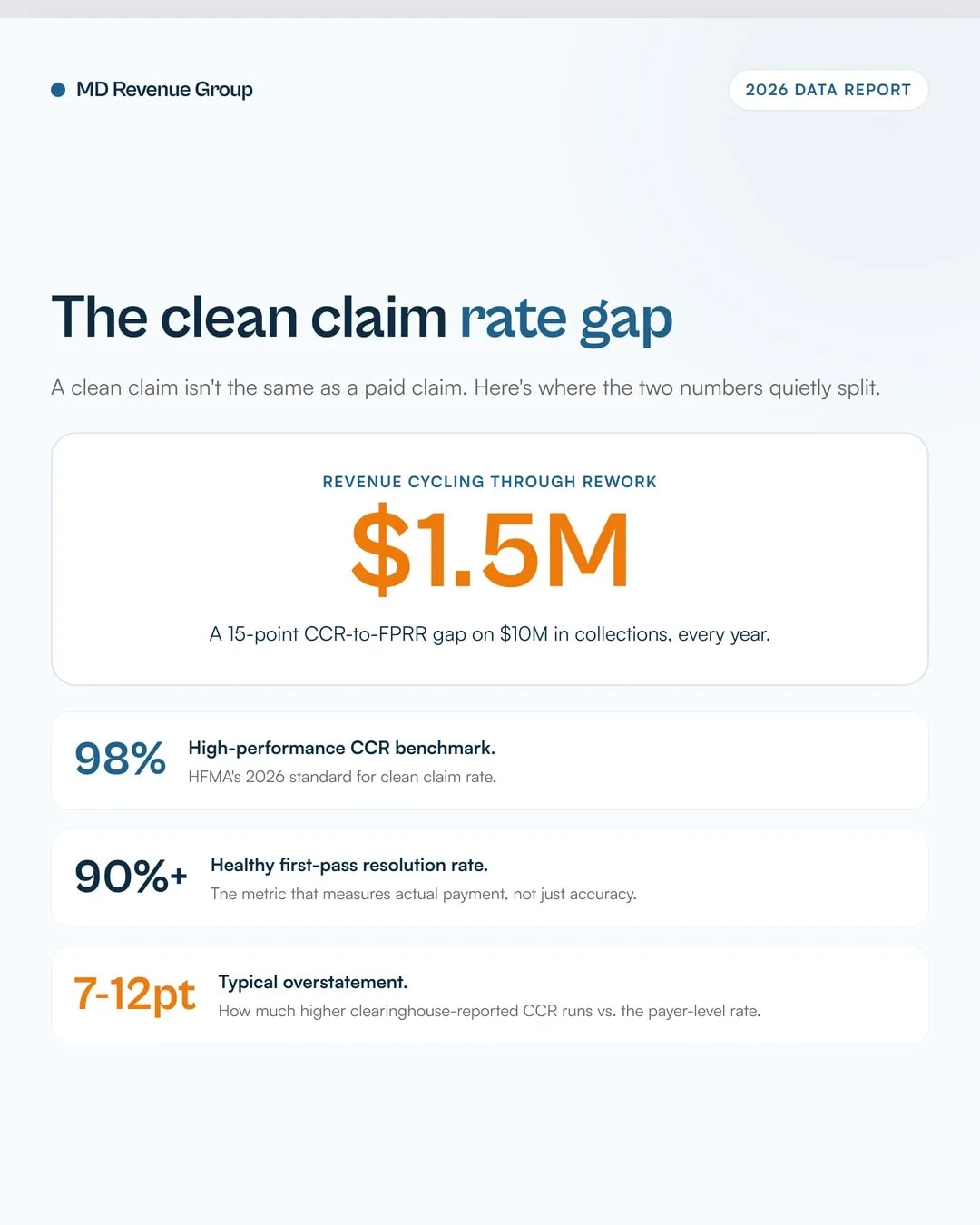
- Most practices measure clean claim rate at the clearinghouse, which reports 7-12 points higher than the real first-pass rate at the payer.
- A 15-point gap between clean claim rate and first-pass yield on $10M in annual collections represents roughly $1.5M cycling through denial management and appeals every year.
- Eligibility errors, coding mistakes, missing prior authorization, and incorrect modifiers are the 4 leading causes of dirty claims.
What counts as a clean claim rate benchmark in 2026
The industry benchmark for clean claim rate sits at 95% or higher, and HFMA's 2026 high-performance standard is 98%. Anything below 90% signals a systemic problem in front-end data collection or coding, not a run of bad luck with a few claims.
Clean claim rate measures the percentage of claims that pass payer edits and internal scrubbing without needing manual correction before submission. It's a pre-submission accuracy score, not a payment outcome. A claim can pass every scrubber check and still get denied downstream for eligibility or medical necessity reasons no scrubber catches.
That distinction matters more in 2026 than it used to, because more practices are relying on clearinghouse-reported clean claim numbers that look strong while their actual first-pass payment rate tells a very different story.
Specialty and practice size both push the benchmark in different directions. A single-specialty practice with a narrow, stable payer mix can realistically sustain 97-98% because the same handful of code and modifier combinations repeat visit after visit. A multi-specialty group juggling a dozen payer contracts and a wider range of CPT codes will naturally see more variation, and a rate in the low-to-mid 90s isn't automatically a red flag there.
Geography and payer concentration matter too. A practice sitting mostly inside one or two dominant regional payers can tune its scrubbing rules tightly to those specific edits and push clean claim rate higher than a practice spread across a dozen national and regional plans, each with its own quirks. Don't benchmark yourself against a specialty peer with a completely different payer mix and assume the gap is a performance problem rather than a structural one.
The metric most practices are measuring wrong
Clean claim rate (CCR) and first-pass resolution rate (FPRR) get used interchangeably, and that's the mistake. They measure 2 different points in the claim lifecycle.
Clean claim rate asks: did this claim look correct when it left the building? First-pass resolution rate asks: did this claim actually get paid in full, the first time, with no rework, resubmission, or appeal needed? A healthy FPRR is 90% or higher.
The gap between the two is where the real revenue leak hides. If your clean claim rate is 96% and your first-pass yield is 81%, 15% of the claims you're calling "clean" are getting adjudicated against you anyway. On $10M in annual collections, that 15-point gap represents roughly $1.5M a year cycling through denial management, appeals, and write-off decisions instead of landing in your account the first time.
Most practices don't see this gap because they're measuring clean claim rate at the clearinghouse level, which typically reports 7-12 points higher than the real first-pass rate measured at the payer. A medical billing audit that tracks both numbers side by side is the only way to know which one your practice is actually running.
What causes a dirty claim
Dirty claims trace back to 4 recurring categories, and none of them require a payer conspiracy to explain.
Eligibility and demographic errors happen when a patient's coverage changed since the last verification, or when a name, date of birth, or policy number was entered incorrectly at intake. This is the most common category and the easiest to prevent with a re-verification step before every visit, not just the first one.
Coding mistakes include wrong CPT code selection, diagnosis codes that don't support medical necessity, and invalid code combinations. These often trace back to outdated code sets or documentation that doesn't clearly support the level of service billed.
Missing prior authorization remains a leading cause across specialties, especially where retro-authorization is difficult to obtain after the fact. If a service happens before final approval lands, that claim is dirty before it's even submitted.
Incorrect modifiers cover wrong modifiers applied, missing required modifiers, and incorrect modifier sequencing. Our medical billing audit process catches modifier errors specifically because they're invisible to most standard scrubbers, which check for presence, not correctness.
A 5-physician internal medicine group we worked with was reporting a 94% clean claim rate from their clearinghouse dashboard, comfortably above the 90% baseline. Their actual first-pass resolution rate, measured at the payer, was 79%. The gap traced almost entirely to eligibility errors from a front desk that verified coverage once at intake and never again during a course of treatment. Adding a re-verification step before each high-cost visit closed the gap to 6 points within 2 billing cycles.
Duplicate claims and timely filing violations round out the list, and both are almost entirely process failures rather than clinical ones. A claim resubmitted because a prior status check never happened creates a duplicate flag that delays the entire file, not just the resubmission. A claim that misses a payer's 90 to 365-day filing window is dirty the moment the deadline passes, regardless of how accurate the coding was.
None of these 4 categories require better clinicians or better coders to fix. They require better tracking of information that already exists somewhere in the practice, just not in the place the claim needs it at the moment of submission.
How to actually improve your rate
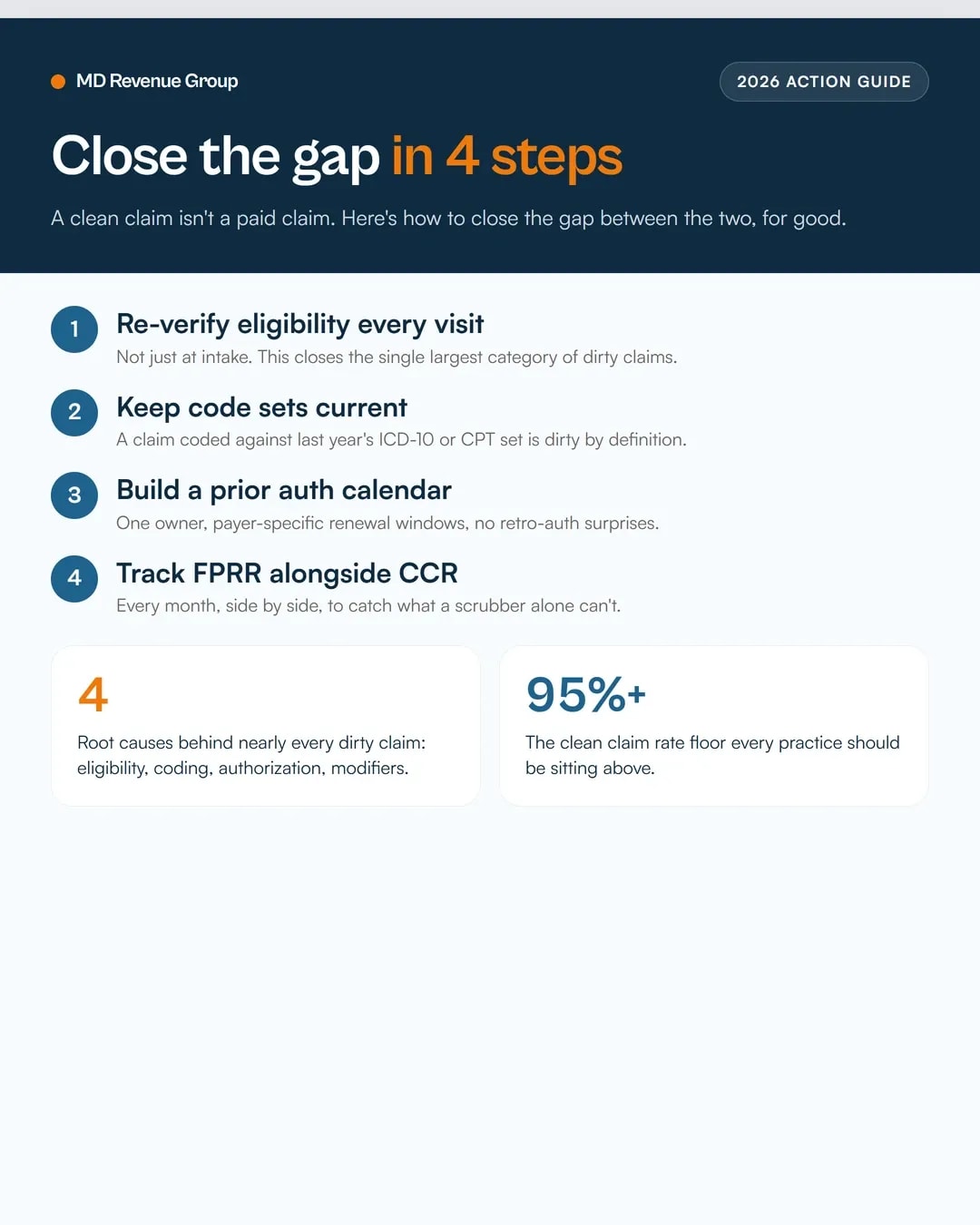
Verify eligibility at every visit, not just the first one. Coverage changes mid-treatment more often than most front-desk workflows assume, and this single fix closes the largest category of dirty claims.
Keep your code sets current, including annual additions. A claim coded against last year's ICD-10 or CPT set is dirty by definition, regardless of how carefully the visit itself was documented.
Build a payer-specific prior authorization calendar. Authorization requirements and renewal windows vary by payer. A single shared calendar with one owner prevents the retro-auth problem that turns an otherwise valid claim into a denial.
Audit modifier usage specifically, not just code selection. Modifier errors are structurally invisible to most clearinghouse scrubbers because they check for the modifier's presence, not whether it's the right one for the documentation on file.
Track first-pass resolution rate alongside clean claim rate, every month. Revenue cycle management built around both metrics catches the eligibility and medical necessity gaps that a clean claim rate alone will always miss.
Review your clearinghouse's definition of "clean." Some clearinghouses count a claim as clean the moment it passes basic field validation, before payer-specific edits are applied. Ask your vendor exactly which edits their reported number reflects before you trust it as your real benchmark.
Benchmarks by claim stage
Different specialties and practice sizes see some real variation, but the stage-by-stage benchmark still holds true across most settings:
Metric | Healthy benchmark | High-performance benchmark |
|---|---|---|
Clean claim rate (pre-submission) | 90-95% | 98-99% |
First-pass resolution rate (actual payment) | 90%+ | 95%+ |
Denial rate on first submission | Under 10% | Under 5% |
Days to resolve a denial | Within 30 days | Within 15-20 days |
If your practice sits above the healthy benchmark on clean claim rate but below it on first-pass resolution rate, the fix isn't more scrubbing. It's tightening the eligibility, authorization, and modifier accuracy that a scrubber was never built to catch.
Use this table as a monthly scorecard, not a one-time check. A practice that reviews all 4 rows together every month catches a slipping first-pass rate months before it shows up as a cash flow problem. A practice that only checks clean claim rate once a quarter finds out about the gap only after the write-offs have already piled up.
Get your real number
Most practices are more confident in their clean claim rate than the number actually deserves, simply because they've never once compared it directly to their first-pass resolution rate. Request a free revenue audit and we'll show you both numbers side by side, plus exactly where the gap between them is coming from.