
Behavioral-Health Payment Posting: How to Detect Underpayments, Recoupments, and Authorization Mismatches
Detect underpayments, recoupments, and authorization mismatches in behavioral health payment posting with 2026 benchmarks and payer data.
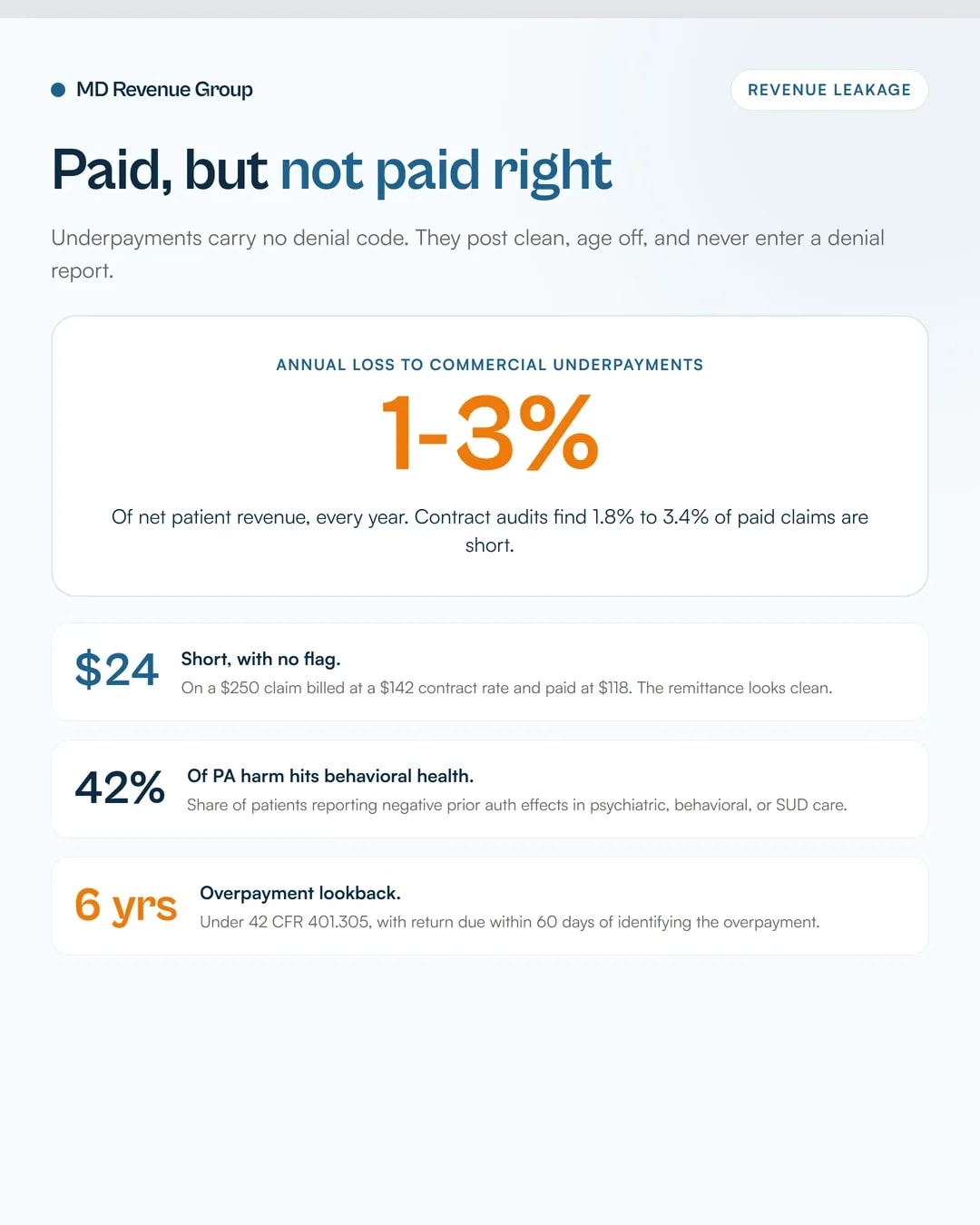
An underpaid claim arrives marked as paid. No denial code, no alert, no exception queue. The remittance looks clean and the balance posts to zero, so the claim leaves your aging report and nobody ever asks why $24 was missing. Payment posting is where a behavioral health practice loses money quietly, and it happens after every step your denial team already watches. Contract audits find 1.8% to 3.4% of paid claims contain an underpayment, and the industry-standard loss runs 1% to 3% of net patient revenue every year. Behavioral health practices carry a specific version of this problem: authorization mismatches, unit shortfalls on timed services, and recoupment exposure under the federal 60-day overpayment rule. Below is how to find each one, with payer data and regulation behind it.
Key takeaways
- 1.8% to 3.4% of paid claims contain an unrecovered underpayment, per contract audits
- 19.3% claims-processing error rate at commercial insurers costs providers $17 billion a year, per the AMA
- Underpayment dispute windows run 90 to 180 days from the remittance date, depending on payer and state
- 42% of patients reporting negative prior authorization effects were in psychiatric, behavioral, or substance use care, the highest rate of any specialty measured
- 6-year lookback on overpayments, with return required within 60 days of identification under 42 CFR 401.305
Why underpayments stay invisible
Denial management catches claims a payer refused. It does not catch claims a payer paid at the wrong rate.
An underpayment is different in a way that matters operationally. The allowed amount on the claim comes in below your contracted rate. The ERA still shows CO-45. The claim still nets to a payment. From every automated view, it looks like a normal paid claim that just wrote off more than usual.
The American Billing Association found contract audits surface underpayments on 1.8% to 3.4% of paid claims, with revenue that was earned, billed, and paid, then silently short. A typical case: 142 allowed under contract, 24 uncollected and unflagged.
Scale that to your practice. Net revenue per physician FTE recently hit $668,775, per Kaufman Hall's 2024 data. At a 1% to 3% underpayment rate, that is 20,000 a year lost per solo physician, and 100,000 for a 5-physician group. Practices with weak contract management can hit 5% to 7%, and some studies put the ceiling as high as 11%.
Three causes account for most of it. Fee schedule errors, where the payer applies an outdated rate or the wrong code table. Contract interpretation, where a negotiated reduction gets applied incorrectly or a cap gets enforced that isn't in your agreement. Rate escalation drift, which is the quiet one: your contract calls for a 3% annual increase, the payer pays it, and nobody updates the internal fee schedule, so your variance report shows a discrepancy that is technically your own bookkeeping error.
The AMA puts the commercial insurers' claims-processing error rate at 19.3%, an inefficiency it estimates costs providers $17 billion a year. Recovery rates run 70% to 85% when the appeal cites exact contract language and the rate exhibit, and 50% to 70% when the root cause is eligibility, coding, or documentation.
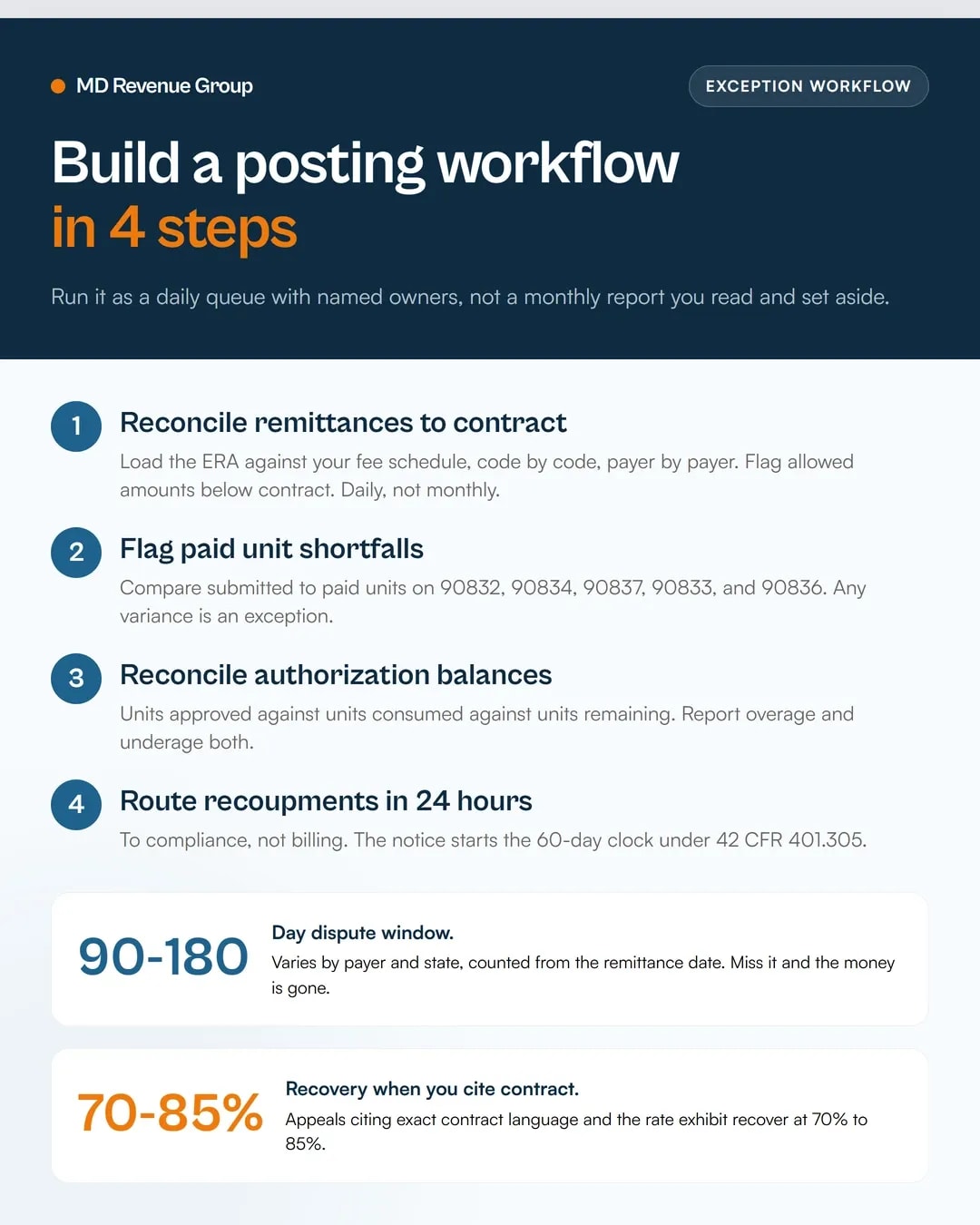
Timing is what makes this urgent. Dispute windows run 90 to 180 days from the remittance date, varying by payer and state. Miss the window and the money is gone regardless of who was at fault.
A manual audit of your top 20 procedure codes by payer, typically about 80% of your volume, will surface most of the material variance without reviewing every claim line by line. That's the entry point. For practices that want this run against their own remittances rather than described in general terms, our revenue integrity tool does contract-based variance detection across your full payment history.
Authorization mismatches in behavioral health billing
Behavioral health authorization is where posting errors cluster, because the approved unit count and the billed unit count frequently disagree, and the gap often surfaces as a recoupment months later.
KFF's 2025 analysis of prior authorization data from the largest insurers in each market segment found denial rates that vary enormously by payer. Standard request denial rates ran 12% in Medicare Advantage, 14% in Medicaid managed care, and 18% in the ACA Marketplace. Within those segments, the spread was far wider: Medicare Advantage ranged from 5% to 17%, Medicaid managed care from 2% to 23%, and the ACA Marketplace from 3% to 25%.
Those denials get overturned at high rates when appealed: 67% in Medicare Advantage, 47% in Medicaid managed care, and 43% in the ACA Marketplace. An overturned denial is good news and a posting problem, because the original payment posted short and the recoupment often arrives before the appeal resolves.
Behavioral health absorbs more of this friction than other specialties. A 2024 Health Affairs Scholar study found that 42% of patients reporting negative effects from prior authorization were receiving psychiatric, behavioral health, or substance use care, the highest share across measured specialties, against 15% in plastic surgery. Authorization cycles for higher levels of behavioral care, including residential, PHP, IOP, and inpatient psychiatric, are shorter than in most specialties, often 7 to 14 days, which means concurrent review at nearly every step.
Three mismatch patterns to catch at posting:
Approved units exceed billed units. A payer authorized 12 sessions, the provider delivered 9, and the claim submitted 9. The authorization balance sits unused. If nobody reconciles it, the unused units either expire or get clawed back on a later audit.
Billed units exceed approved units. The claim submitted more than the authorization supports. Expect a denial, and if the practice refunds the difference voluntarily, check whether the 60-day overpayment clock started.
Authorization valid on date of service, terminated before claim submission. A common retroauth failure in behavioral health, where the patient stopped attending and the claim went out after the auth window closed. Our behavioral health prior authorization workflow covers the front-end verification that prevents this class of mismatch.
Unit shortfalls on timed behavioral health services
Timed psychotherapy and psychiatric services are billed in time units, which is where behavioral health payment posting breaks in a way it doesn't in other specialties.
A claim for a 60-minute session coded as 90837 should carry 60 minutes. If the remittance shows 53 minutes, the payer has applied a rounding rule, a unit cap, or a math error, and the difference posts as a contractual write-off with no denial. A practice doing 300 sessions a month at an average 43,200 a year to a rounding rule nobody caught.
The fastest detection method is a paid-claim variance report by CPT code, payer, and unit count. Pull every 90832, 90834, and 90837 claim paid in the last quarter, group by payer and billed units, and compare the paid units against what you submitted. Most practices find a pattern within one payer before finishing the first page.
The second method is a dollar-denominated contract audit on your highest-volume codes. Behavioral health codes concentrate volume, so 20 codes will surface most material variance, the same way the 1.8% to 3.4% audit finding generalizes to any practice.
Watch for a related pattern: the payer paying a lower code than billed without denying the line. A 90837 submitted and adjudicated at 90834 is technically a processed claim. Your denial report will never show it.
Recoupments and the 60-day overpayment rule
Recoupment is the payer taking money back. It's the line item that should make every practice manager's posting process stricter, because the clock on reporting it runs whether you noticed it or not.
42 CFR 401.305 governs this. A person who has received an overpayment must report and return it by the later of 60 days after the overpayment was identified, or the date the corresponding cost report is due. The regulation defines "identified" as knowingly receiving or retaining an overpayment, with "knowingly" taking its meaning from 31 U.S.C. 3729(b)(1)(A). Any overpayment retained past the deadline becomes an obligation under the False Claims Act.
The lookback runs 6 years from the date the overpayment was received. If your posting process misses a pattern today, the exposure doesn't age out quietly.
Three suspensions exist, and one of them is worth knowing. The deadline pauses when a person files with the OIG Self-Disclosure Protocol or the CMS Voluntary Self-Referral Disclosure Protocol. It also pauses during a timely, good faith investigation into related overpayments from the same cause, and stays suspended until the investigation concludes or 180 days pass from initial identification, whichever comes first. That 180-day window is the difference between a manageable investigation and a reportable event.
For behavioral health specifically, the conditions that generate overpayments are predictable. Services furnished outside the authorized date range. Sessions that exceeded the approved weekly or annual visit cap. Services delivered after a provider's enrollment lapsed. Records that don't support the level of service billed, which matters more in behavioral health than anywhere else because the documentation lives in session notes rather than an objective test result.
The regulation also specifies what "sufficient information" means. Under 42 CFR 424.5, the provider must furnish enough information to determine whether payment is due and the amount. Under 42 CFR 424.55, a supplier accepting assignment agrees to limit charges to the beneficiary to the difference between the approved amount and the Medicare payment.
Medicare pays 80% of the approved amount for outpatient mental health services with 20% owed by the patient, per 42 CFR 410.155. The outpatient mental health payment limitation reached 100% of incurred expenses for CY 2014 and subsequent years. That same section excludes partial hospitalization and intensive outpatient services not directly provided by a physician, diagnostic services billed under 90801 and 90802, diagnostic tests under 96101 through 96125, and Alzheimer's medication management under 90862. A posting error on any of those exclusions is a payment you don't get to keep.
Practices that need a documented review trail across these regs usually find it faster through a structured medical billing audit than by rebuilding the process internally.
What behavioral health gets paid compared to medical
Payment variance in behavioral health has an upstream cause, and it isn't billing error. The rates themselves are lower, so the same percentage of error costs you less per claim and the same absolute gap in a contract negotiation matters more.
Behavioral health is roughly 2.4% of total US health spending, and it operates inside a documented reimbursement disadvantage. In-network behavioral reimbursement runs about 5% below Medicare, while medical and surgical reimbursement runs 11% to 15% above it, per Milliman analysis. Behavioral health office visits are paid 22% to 24% lower than medical and surgical visits, with the gap reaching 48% at the 75th percentile (RTI International, 2024). Medicare Advantage pays behavioral health providers about 5% below Medicare rate.
Practices billed at lower contracted rates have less margin to absorb a posting error, and commercial parity gaps mean a practice can be underpaid on an in-network claim while a benchmark says it should have been paid at a medical-equivalent rate.
One more structural factor. About 40% of the US population lives in a Mental Health Professional Shortage Area, and nationally only about 27% of need is met in those areas, per HRSA data. Shortages push practices toward higher-volume, lower-margin payer mixes, which is exactly the mix where a 3% underpayment rate does the most damage.
For practices managing multiple state footprints, the filing and appeal rules change by state, and so does the dispute window. Behavioral health billing in New Jersey and psychiatry billing services across payer contracts both turn on contract language that varies more than most practices realize.
How to build a payment posting exception workflow
Build this as a queue with named owners, not a monthly report you read and then set aside.
Step 1: Reconcile every remittance line against contracted rates. Load the ERA against your fee schedule, code by code, payer by payer. Flag any line where the allowed amount sits below contract. Do this daily, not at month end. Miss the window and the dispute right expires.
Step 2: Flag paid unit shortfalls on timed codes. Compare submitted units to paid units for 90832, 90834, 90837, 90833, and 90836. Any variance is an exception.
Step 3: Reconcile authorization balances monthly. For every active authorization, compare units approved, units consumed, and units remaining. Report both overage and underage. This is the single most valuable report in behavioral health posting and almost nobody runs it.
Step 4: Screen for code-level downgrades. Identify claims where the paid code differs from the billed code, regardless of payment status.
Step 5: Route recoupments to a compliance owner within 24 hours. Not to billing. Recoupment notices start the 60-day clock, and the person receiving the notice needs to decide immediately whether the underlying claim was correct.
Step 6: Report by exception type monthly. Underpayment dollars, unit shortfall dollars, authorization mismatch count, recoupment dollars pending appeal, and total recovery posted. Track recovery against the 70% to 85% rate that contract-cited appeals achieve.
Assign each exception type an owner and a target resolution date. Underpayment disputes go out within 30 days of remittance. Authorization balances get reviewed by whoever owns the prior authorization workflow. Recoupments go to compliance on receipt.
What to measure monthly
Six numbers, same definitions every month, so trends are real.
Payment variance as a percentage of net patient revenue. Target under 1%. Anything above 3% means your contract management has a gap, independent of any posting workflow.
Underpayment recovery rate. Target 70% or above. Lower means the appeals aren't citing contract language.
Authorization balance accuracy. Percentage of active authorizations where approved, consumed, and remaining units reconcile. Target 100%. This is the behavioral health-specific metric and the one that catches recoupments before they arrive.
Timed unit variance rate. Submitted units against paid units on 90834 and 90837. Target near zero.
Recoupments pending appeal, with days remaining on the clock. Any item past 45 days needs escalation.
Days in A/R on 90+ balances. MGMA's July 2026 poll found 43% of group leaders reporting days in A/R flat, 32% higher, and 22% lower. In a year where a third of practices are moving backward, this number tells you whether your posting accuracy is actually protecting cash.
If you want a second set of eyes on your posting accuracy before you build the workflow yourself, we score payment posting the same way we score a revenue cycle. Request a free revenue audit.