
What Questions Should I Ask Before Hiring a Medical Billing Service?
Protect your practice cash flow. Ask these direct questions when hiring a medical billing company to identify revenue leaks.
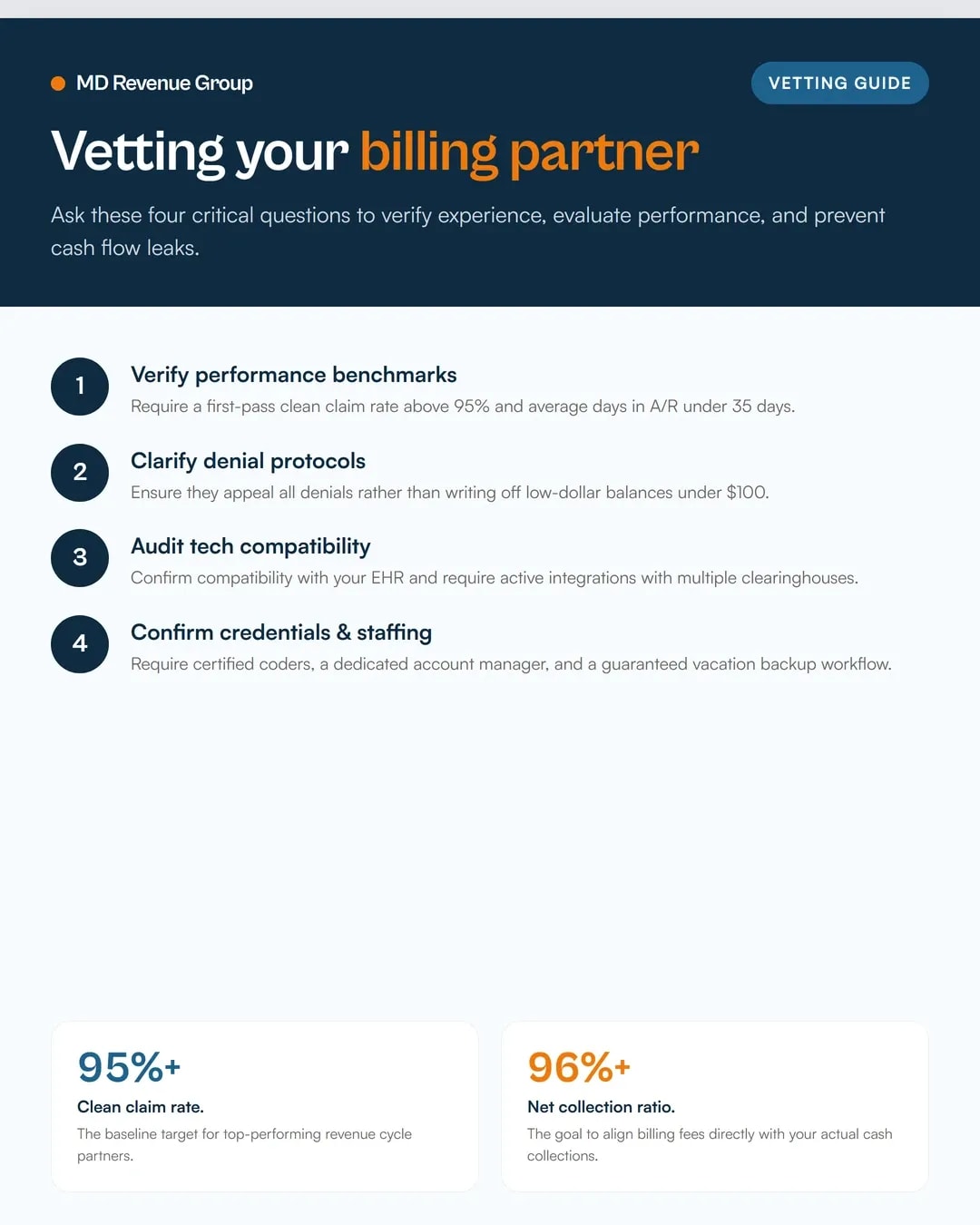
Evaluating potential revenue cycle partners requires asking specific questions to ask medical billing company representatives before signing any contract. Independent practices must verify a vendor's performance metrics, fee structures, system compatibility, and compliance protocols to prevent revenue leakage. According to Medical Group Management Association (MGMA) benchmarks, healthy practices maintain a clean claim rate of 95% or higher, a first-pass resolution rate of 80% to 90%, and days in accounts receivable (A/R) under 35 days [1]. If a billing provider cannot supply verified data demonstrating they meet these standards, your collections will suffer. Hiring an external team is a significant operational decision. You must identify hidden contract terms, clarify how they handle denied claims, and confirm their familiarity with your medical specialty. This guide outlines the exact questions you must ask to protect your practice cash flow and select a reliable partner.
Key takeaways
- Verify that the vendor achieves a first-pass claim acceptance rate of 95% or higher.
- Ask if their percentage-based fee applies to net collections or gross charges.
- Confirm that they appeal all denied claims rather than writing off low-dollar balances.
- Ensure their team has documented billing experience in your specific medical specialty.
- Request a dedicated account manager and a clear communication escalation path.
What performance benchmarks do you maintain?
You must establish if the billing firm operates at a high level of execution. Ask for their average clean claim rate, which measures the percentage of claims accepted by payers on the first submission. The national average sits around 75% to 85%, but top-performing medical billing services maintain a clean claim rate of 95% or higher [2]. Ask how they track these statistics and if you will have real-time access to dashboard reporting.
Another vital metric is days in accounts receivable (A/R). This number represents the average duration it takes for payers to reimburse your practice after a claim is filed. The MGMA benchmark for days in A/R is under 35 days, with top-tier performers keeping it under 30 days [1]. Ask for the average days in A/R they achieve for practices of your size and specialty.
Verify their collection rate. Specifically, ask for their net collection ratio, which is the percentage of collectable revenue that you actually receive after contractual adjustments. Do not accept gross collection rates, which are easily inflated. You want a partner that consistently delivers a net collection ratio above 96%. A low net collection ratio indicates that you are losing money to unworked denials or poorly negotiated payer contracts. You must audit these metrics monthly to keep your practice financially healthy.
How do you manage denied and rejected claims?
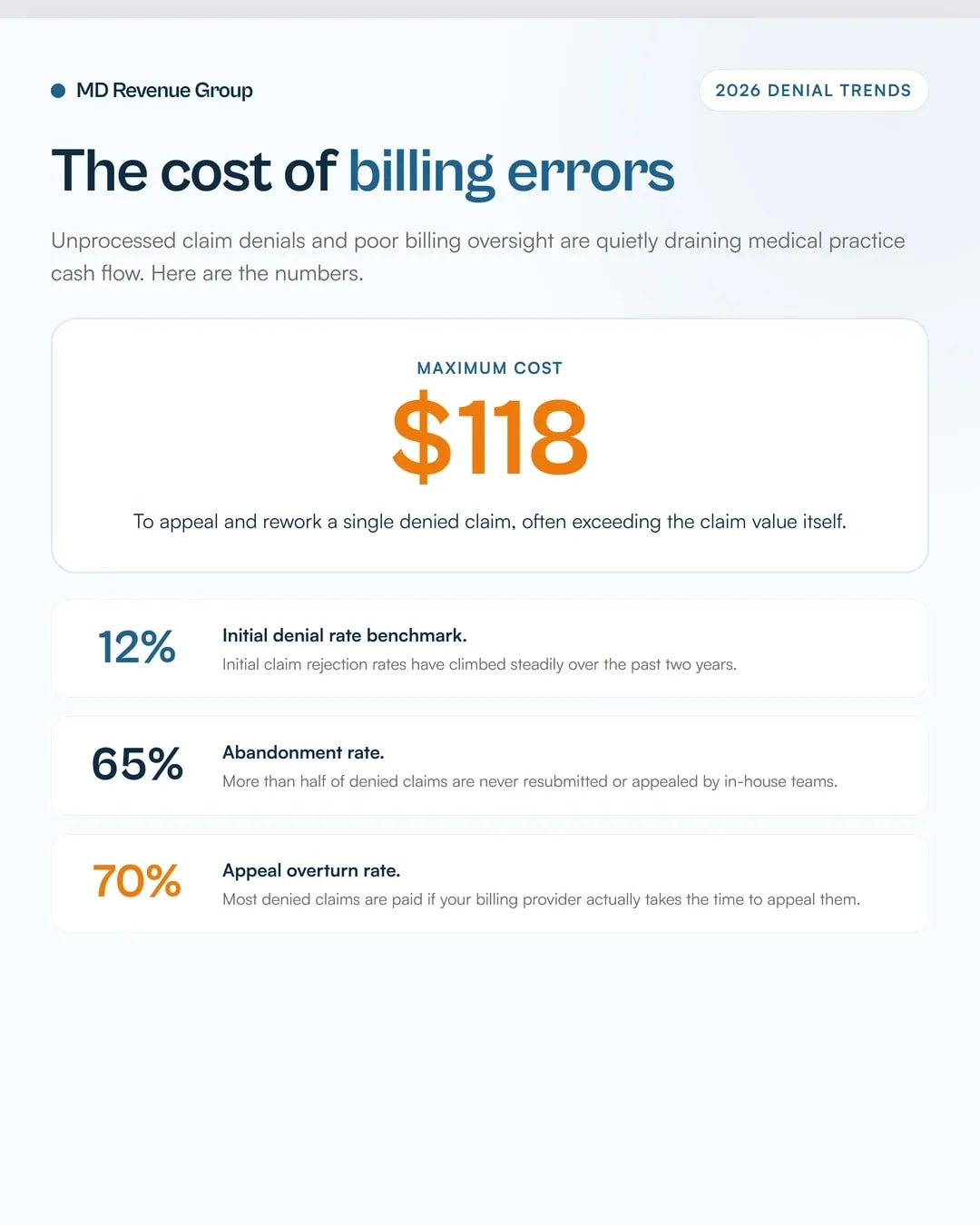
Payers deny claims constantly, with national initial denial rates rising to 12% in recent years [3]. Ask the company what their process is for handling these rejections. Some billing firms quietly write off denied claims under $100 because the labor cost to correct them exceeds their percentage fee. This practice drains your cash flow.
The administrative cost to correct and resubmit a single denied claim ranges from 118 depending on the complexity of the appeal [4]. Ask the vendor who pays this cost. A quality partner includes comprehensive denial management in their base fee. Ask if they track denial root causes to correct underlying documentation issues in your clinic.
Verify their appeal success rate. Statistics show that 70% of appealed claims are eventually paid, yet practices fail to appeal 50% to 65% of their denials [3]. Ask if the billing firm guarantees that their certified coders appeal every valid denial. Conducting regular independent billing audits will help you verify if your billing partner is capturing all collectable revenue.
What technology and system integrations do you support?
Ask if the billing company requires you to use their software, or if they will work directly in your existing Electronic Health Record (EHR) system. Swapping software platforms creates operational friction. It trains your staff on new workflows, delays billing cycles, and risks data loss.
If you choose to work in your own EHR, ask about their experience with that specific software. Verify who pays for the software licenses and connection fees. You must confirm that their team has the technical capabilities to manage your billing system without creating security vulnerabilities.
System redundancy is critical. The 2024 Change Healthcare cyberattack proved that relying on a single clearinghouse can freeze a practice's cash flow for months [5]. Ask if the vendor has active connections to multiple clearinghouses. Confirm that they utilize automated claim scrubbing and electronic prior authorizations to address common prior authorization automation issues before claims are submitted.
Who will manage our daily billing operations?
Many medical billing companies use a pool of off-shore billers. Your claims are processed by anonymous resources who do not understand your local payer policies. Ask if you will have a dedicated account manager based in the United States, or if your files are routed to a general ticketing queue.
Having a dedicated contact improves accuracy and communication speed. Ask how many accounts your account manager handles. A biller managing 15 practices cannot give your claims the attention they need. Look for firms that limit account manager workloads to 3 or 4 practices.
Ask about their staff credentials. Confirm that the coders assigned to your account hold active certifications from the AAPC or AHIMA. You must also ask how they handle staffing coverage when your primary biller is sick or on vacation. A gap in daily submissions will immediately delay your cash collections.
How is your contract fee structure calculated?
Medical billing companies typically charge a percentage of your collections, ranging from 4% to 10% [6]. Ask if this fee is calculated based on net collections or gross charges. A percentage of net collections is standard. You must avoid gross-charge billing, which forces you to pay fees on money you never actually collect.
Ask about additional costs. Many contracts contain hidden fees for setup, credentialing, patient statements, custom reports, or software support. Setup fees typically range from 1,500. Request an itemized fee sheet to understand your total billing cost. You can compare these fees against standard pricing schedules to verify if you are receiving a competitive rate.
Confirm the terms for contract termination. A standard agreement requires 60 to 90 days written notice to terminate. Ask if there are termination fees or charges for transferring your historical billing data. Some companies charge high fees to export your data, which traps you in an underperforming contract.
Fee Type | Standard Cost Range | Billing Basis |
|---|---|---|
Percentage Fee | 5% to 8% | Net collections |
Setup Fee | 1,500 | One-time charge |
Credentialing | 300 | Per provider, per payer |
Patient Statements | 0.85 | Per mailed statement |
What compliance and security safeguards are in place?
Protecting patient data is a federal requirement under HIPAA. Ask the billing company to provide proof of their security measures. They must use encrypted servers, secure file transfer portals, and maintain strict access logs. Ask if they conduct third-party security audits.
Payer compliance is equally critical. Billing companies must stay updated on changing CMS guidelines and state regulations. If your practice operates in multiple states, ask how they manage state-specific billing guidelines and regional policy variances [7].
Ask if the company has a compliance officer and a written compliance plan. Confirm that they carry errors and omissions (E&O) insurance and cyber liability coverage. This protection shields your practice if a coding mistake triggers a federal audit or a data breach occurs. You should verify if they provide payer credentialing services to ensure your providers are properly enrolled before billing.
You can learn about our team and our commitment to practice performance. We believe in complete transparency and provide detailed reporting every month.
If you are ready to evaluate your current billing company's performance, we can help. We will run a detailed analysis to identify hidden errors and show you where your revenue is leaking.
Please visit our contact page to speak with our billing specialists. We will answer your questions and help you decide the best path for your practice.
References
- Medical Group Management Association (MGMA). "MGMA DataDive Practice Financial Benchmarks, 2026." Accessed July 2026.
- Healthcare Financial Management Association (HFMA). "Map Keys: Performance Indicators for Healthcare Revenue Cycle, 2025." Accessed June 2026.
- Qualigenix Research. "National Claims Denial and Recovery Trends, 2025-2026." Accessed June 2026.
- Datarovers / Merits Appeals. "Administrative Cost-to-Rework Analysis for Denied Medical Claims." Accessed May 2026.
- American Hospital Association (AHA). "Change Healthcare Cyberattack Impact Report, 2024-2025." Accessed April 2026.
- Neolytix / Dr. Billing Service. "Outsourced Medical Billing Cost and Percentage Fee Standards." Accessed July 2026.
- EZMD Solutions. "State Medicaid and Commercial Billing Regulatory Compliance Guide, 2026." Accessed June 2026.