
How Much Does a Medical Billing Service Cost? The 2026 Pricing Guide
Learn how much a medical billing service cost will be in 2026. Compare percentage fees, flat rates, and hidden contract costs.
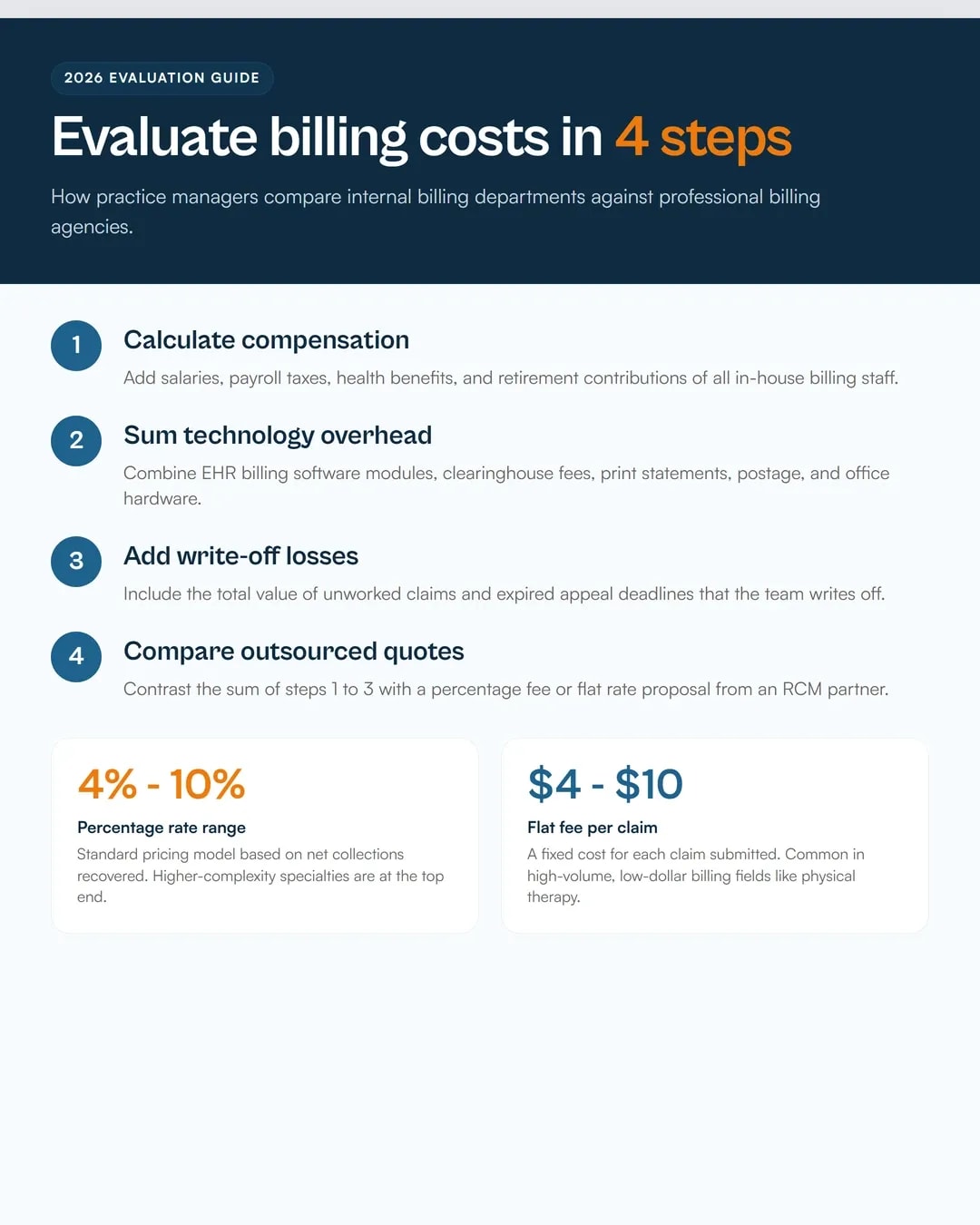
Determining your medical billing service cost requires understanding the primary pricing models used by healthcare revenue cycle management companies in 2026. Most independent practices pay a percentage of their net collections, which typically ranges from 4% to 10% depending on practice size, specialty, and billing volume. Alternatively, practices can select a flat fee model costing $4 to $10 per submitted claim, or hire dedicated remote billing staff starting at $800 monthly per full-time resource. According to 2026 industry benchmarks, maintaining an in-house billing department typically consumes between 7% and 13.7% of total practice collections when you factor in salaries, benefits, training, software licensing, and clearinghouse fees. Outsourcing generally brings that number down to 7% to 12% while providing better technology and more consistent denial management. While individual quotes vary, comparing these benchmarks against your internal billing expenses shows if outsourcing makes financial sense. If you want to know how to evaluate vendor proposals and identify hidden administrative fees, this pricing guide breaks down the numbers.
Key takeaways
- The standard percentage-of-collections model ranges between 4% and 10% of net monthly collections.
- Flat fee pricing charges $4 to $10 per claim, which is suitable for high-volume, low-dollar specialties.
- Hidden contract expenses include setup fees, software licensing, clearinghouse fees, and termination charges.
- The average cost of an in-house billing team includes salaries, benefits, office space, and billing software.
- Professional billing firms recover lost revenue from denied claims, which often covers the service fee.
Understanding medical billing service cost models
Medical billing companies package their services in different ways to fit different practice structures. The most common structure is the percentage-of-collections model, where you pay a fee based on the revenue the billing company recovers.
35 days in AR is the benchmark. Anything over 50 is uncollected revenue.
We conduct a forensic 90-day cash flow audit to identify unworked claims, fee schedule underpayments, and clearinghouse leaks.
Audit My Cash Flow Leaks →Payers pay your claims, and the billing firm takes a slice of the recovered funds. If they collect nothing, you pay nothing. This setup aligns the billing company's goals with your practice's financial performance.
The second option is the flat fee per claim model. Under this agreement, you pay a fixed amount for every claim the biller submits. It does not matter if the claim is worth $50 or $5,000. You pay the same flat fee regardless of the collection outcome.
The third option is the dedicated staff model, where you pay for remote billing resources. These billers work exclusively for your practice through a staffing partner. This structure costs $5 to $10 per hour, which equates to roughly $800 to $1,600 monthly for a full-time resource.
Understanding these pricing structures helps you choose the right model. You should look at your specialty, claim volume, and average claim value to find the best fit. Selecting the wrong model can lead to unnecessary expenses that erode your practice's profits.
Percentage of collections vs flat fee per claim
Choosing between a percentage fee and a flat rate requires a close look at your practice's billing metrics. For most practices, the percentage model is the standard choice. The 2026 performance benchmarks you should measure any billing partner against include a clean claim rate above 97% (best-in-class), a denial rate below 4%, a net collection rate above 96%, and days in accounts receivable under 25.
The typical percentage fee falls between 5% and 8% for primary care and general medicine. High-complexity specialties like cardiology or orthopedics pay higher fees, often reaching 10% to 12%. This increase is due to the coding expertise required to handle complex modifier combinations and documentation reviews. With over 400 CPT code changes annually and constant CMS policy adjustments, keeping up with coding requirements is itself a significant labor cost.
If you run a high-volume practice with low average claim values, a flat fee model can be highly cost-effective. For example, chiropractors or physical therapists often submit many claims with low dollar amounts. Paying $5 per claim is often cheaper than paying a percentage of their total collections.
However, the flat fee model has a significant drawback. Because the billing company gets paid when they submit a claim, they have less incentive to appeal denials. They might write off unpaid claims rather than spending time on complex appeals. This matters more than ever: national initial denial rates have climbed to between 11.8% and 15% in 2025-2026, driven largely by commercial payers deploying AI-driven adjudication engines that flag and reject claims faster than manual systems [2][3]. Each denied claim costs between $25 and $118 to rework in staff time, phone calls, and resubmission labor [3]. A flat-fee biller that writes off those denials instead of fighting them leaves real money on the table.
Under the percentage model, the billing company only makes money when you get paid. They will work harder to recover every dollar, which helps lower your outstanding accounts receivable (AR). Industry data shows that between 50% and 65% of denied claims are never reworked and become permanent losses [4]. A percentage-based partner has a financial reason to appeal every one of them. You can check our detailed pricing page to see how these percentage rates apply to your specific medical specialty.
Our team at MD Revenue Group manages all aspects of medical billing services using the percentage model. We do this to ensure we are incentivized to recover every dollar. We do not charge for submissions, only for successful collections.
Hidden fees in medical billing contracts
When comparing billing service proposals, you must look beyond the base rate. Many billing companies quote a low percentage rate and hide additional charges in the contract terms. The 2025 CAQH Index reported that $21 billion in industry savings remains available by transitioning from manual to electronic administrative workflows [5]. Many of the hidden fees below exist because vendors still rely on manual, fragmented processes and pass those costs to you.
A common surprise is the setup fee. Some billing companies charge $1,000 to $5,000 to configure your account, upload your fee schedules, and connect your electronic health record (EHR) system. Ensure you know if this fee is due upfront or spread over the contract term. Integration costs for connecting billing software with your EHR or practice management system can add another $300 to $1,500.
Another common charge is the software licensing fee. Some companies require you to use their proprietary billing platform and charge $200 to $500 monthly per provider. For context, practice management software for small practices (1-5 providers) typically ranges from $50 to $350 per provider per month, while mid-size clinics pay $300 to $1,200 monthly. This charge can quickly cancel out the savings from a low percentage rate.
You must also check who pays for clearinghouse services and patient statements. Clearinghouses charge fees to transmit claims. Per-claim clearinghouse pricing looks small (a few cents to a few dollars per claim), but it scales with volume. Subscription-based clearinghouses charge a flat $200 to $800 monthly, which is often more cost-effective for high-volume practices. Mailing patient statements costs money for postage and paper. Some contracts pass these costs directly to the practice, while others bundle them into the base rate.
Watch for denial and rework fees. Many contracts do not include claim resubmissions or appeal management in the base service fee. Since each reworked denial costs $25 to $118 in labor, these add-on charges aggregate quickly, especially if your denial rate runs above the national average of 11.8% to 15%.
Check for credentialing and enrollment fees. Managing provider enrollment with insurance payers is frequently excluded from standard billing contracts and charged as a separate service. If you are adding a new physician or re-credentialing existing providers, these costs can run into thousands of dollars.
Finally, review the termination clause. Some contracts charge high termination fees if you leave before the contract end date. They might also charge a fee to export your billing data if you decide to switch vendors.
We recommend requesting a complete list of additional charges before signing. You should ask for an all-in cost estimate based on your current monthly claim volume. This ensures you can compare proposals accurately without worrying about surprise invoices.
How to calculate your in-house billing cost
Many practice owners believe keeping billing in-house is cheaper than outsourcing. They look at a billing company's 6% fee and think they can do it for less. However, they often ignore the true costs of managing an internal department. According to industry benchmarks, in-house billing typically costs between 7% and 13.7% of total collections when you account for all direct and indirect expenses [1].
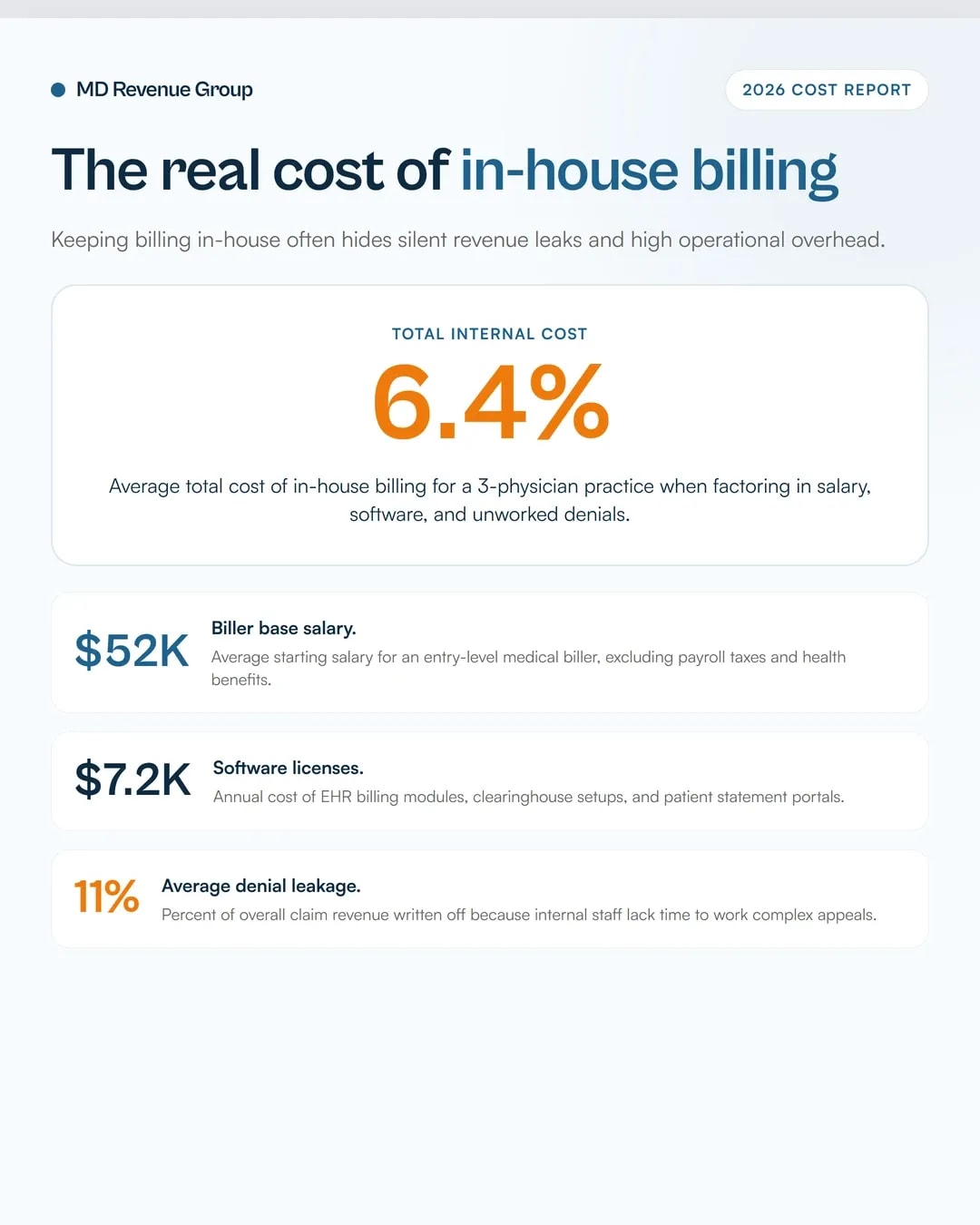
Let us look at a real-world scenario. A 3-physician family practice in Newark, NJ collected $2,400,000 annually. They employed one full-time biller at a salary of $52,000. When they factored in payroll taxes, health benefits, and retirement contributions, the biller's total compensation reached $68,000. New Jersey practices face added pressure here because the state has one of the highest administrative costs per physician in the country, partly due to its dense network of commercial payers, each with distinct billing rules [6].
The practice also paid $600 monthly for their billing software license, which cost $7,200 annually. Clearinghouse fees and patient statement postage added another $3,000. Office space, computers, and phone lines cost roughly $4,000 annually.
This brought their direct in-house billing cost to $82,200 annually, which is about 3.4% of their total collections. This seems cheaper than outsourcing, but it ignores their unpaid claims.
The practice had an average initial denial rate of 11%, and their biller was too busy to appeal them. They wrote off $72,000 in collectible claims annually. That write-off rate aligns with industry data showing that 50% to 65% of denied claims are never reworked [4]. Practice overhead now consumes roughly 60% of revenue nationally, and when experienced billing staff leave, they take institutional knowledge of payer quirks with them [7]. This creates a staffing trap: the practice cannot afford to hire a second biller, but the single biller cannot keep up with both submissions and appeals.
When you add these unrecovered denials to their direct costs, their total billing expense reached $154,200, or 6.4% of their collections. That number falls squarely within the 7% to 13.7% range that industry benchmarks report for in-house operations [1]. The "cheap" in-house approach was costing them more than outsourcing would have.
By outsourcing to a dedicated provider, they reduced their overhead and recovered those unpaid claims. A professional team uses advanced software to audit payments and appeal denials. For small NJ practices with 2 to 10 providers, outsourcing RCM can save between $50,000 and $100,000 annually by eliminating fixed salary, benefits, and training costs. If you suspect your current team is missing claims, you can request a free audit to find the leaks.
Questions to ask before signing a billing contract
Before you commit to a billing partner, you must interview them thoroughly. You need to know how they handle your claims, who does the work, and how they protect your revenue.
First, ask if they perform certified coding. Some billing companies only enter demographic data and submit the codes your doctors select. A partner that provides certified coding helps prevent compliance errors before they reach the payer. This reduces your audit risk and ensures your claims represent the exact services provided. About 77% of all claim denials stem from administrative causes like eligibility errors, missing authorizations, and coding mistakes [3]. Certified coders catch many of these before submission.
Second, ask where their billing team is located. Many cheap billing companies outsource their operations to overseas call centers. This can lead to communication gaps and slower response times when dealing with local payers. For NJ practices specifically, having a team that understands the state's dense payer network and Medicaid managed care rules matters more than in states with simpler payer landscapes.
Third, ask how they handle denials. Ensure they appeal every denied claim rather than writing off low-dollar balances. A quality partner will provide regular reports showing their appeal success rates and outstanding AR days. The best-in-class benchmark for 2026 is AR days below 25 and a net collection rate above 96%. If a vendor cannot share their actual performance against these numbers, that is a red flag.
Fourth, ask about their technology stack. After the 2024 Change Healthcare cyberattack forced providers across the country to revert to manual processes, system resilience became a top priority [8]. Ask if the vendor relies on a single clearinghouse or has redundancy built in. Ask if they use automated claim scrubbing and real-time eligibility verification. Practices that adopted AI-driven tools for pre-submission error checking have seen 10% to 20% improvements in clean claim rates [9].
You can learn more about our team's credentials and our approach to revenue cycle management. We believe in complete transparency and provide detailed reports every month.
If you are ready to evaluate your practice's billing performance, contact us. We will help you analyze your current costs and compare them to our outsourced solutions.
You can visit our contact page to speak with our RCM team. We will answer your questions and help you determine the most cost-effective path.
Managing your revenue cycle is a critical business task. If your billing is holding your practice back, it is time to make a change. Let our team protect your collections and help you grow.
References
- RCM Industry Benchmarking Data. "In-House vs. Outsourced Medical Billing Cost Analysis, 2025-2026." Multiple sources including Global Payments and Gitnux. Accessed July 2026.
- Qualigenix. "National Denial Rate Trends, 2025-2026." Accessed July 2026.
- MedXpert Services / Immedicare Solutions. "Cost-to-Rework Denied Claims and Preventable Denial Rate Analysis." Accessed July 2026.
- Zedtreeo / Datarovers. "Denial Write-Off Rate Analysis: The Revenue Impact of Unworked Claims." Accessed July 2026.
- CAQH. "2025 CAQH Index: Measuring Progress in Administrative Simplification." Accessed July 2026.
- EZMD Solutions. "NJ Medical Practice Administrative Cost Benchmarks." Accessed July 2026.
- Medical Group Management Association (MGMA). "MGMA DataDive Practice Financial Overview, 2026." Accessed July 2026.
- American Hospital Association (AHA). "Impact of the 2024 Change Healthcare Cyberattack on Provider Operations." Accessed July 2026.
- MD Revenue Group / Medical Economics. "AI-Driven Claim Scrubbing and Clean Claim Rate Improvements." Accessed July 2026.
See your revenue leaks in dollars.
Get a forensic 90-day cash flow audit of your practice. 100% confidential, 48-hour delivery, zero obligation.