
The 2026 HCPCS 'M Code' Mystery: 78 New Codes (M1426–M1503) You Aren't Using Yet
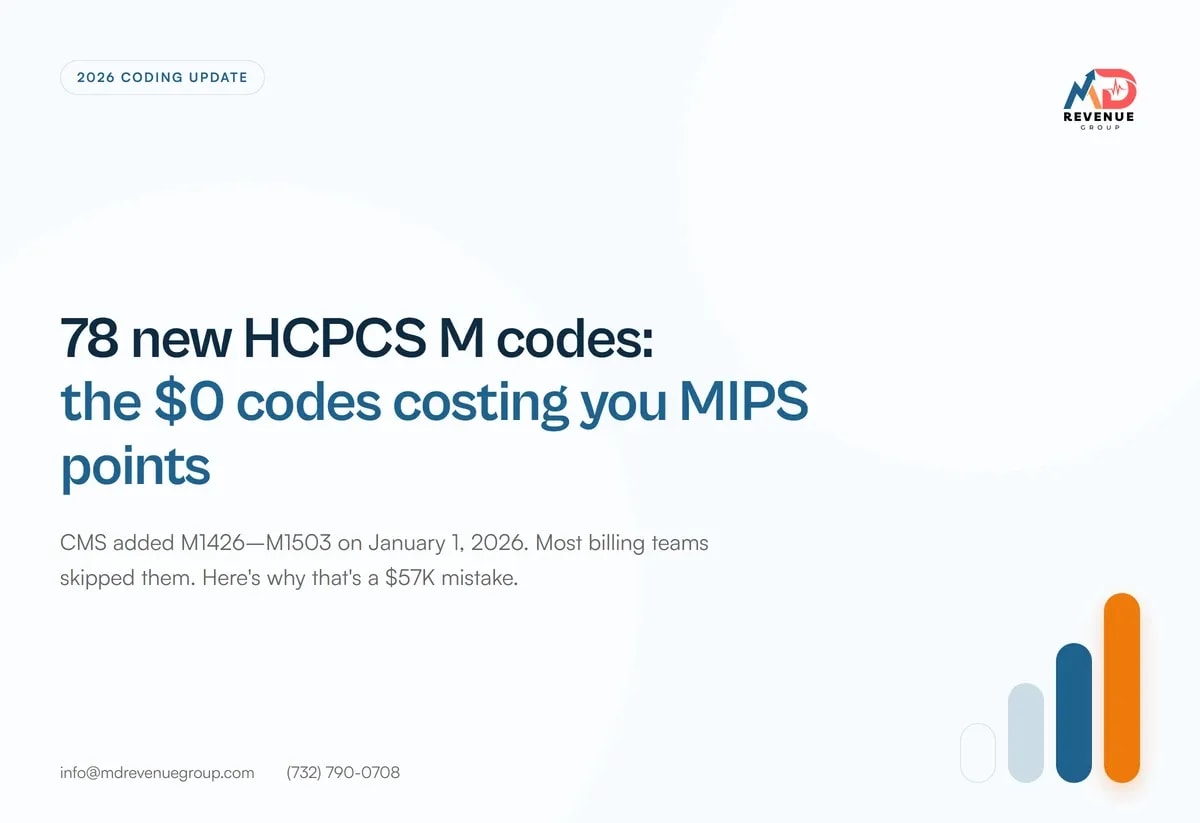
78 new 2026 HCPCS M codes (M1426–M1503) went live January 1. Most billing teams skipped them. Here's what they do, why they matter for MIPS, and how to use them.
The 2026 HCPCS 'M Code' mystery: 78 new codes (M1426–M1503) you aren't using yet
CMS added 78 new 2026 HCPCS M codes in the M1426 through M1503 range, effective January 1, 2026. These codes track telehealth encounters, document clinical rationale for quality measures, identify patient populations for MIPS reporting, and designate specialty pathways under MIPS Value Pathways (MVPs). Most billing teams ignore them because they carry $0 reimbursement. That's a mistake. Missing these codes means lost MIPS credit, inaccurate quality measure reporting, and potential payment adjustments that hit your practice 2 years later. The 2026 MIPS performance threshold sits at 82 points, and every missed reporting code chips away at that score. This guide breaks down what each code category does, which ones apply to your specialty, and the exact steps to get them into your charge master before your next quarterly update.
Key takeaways
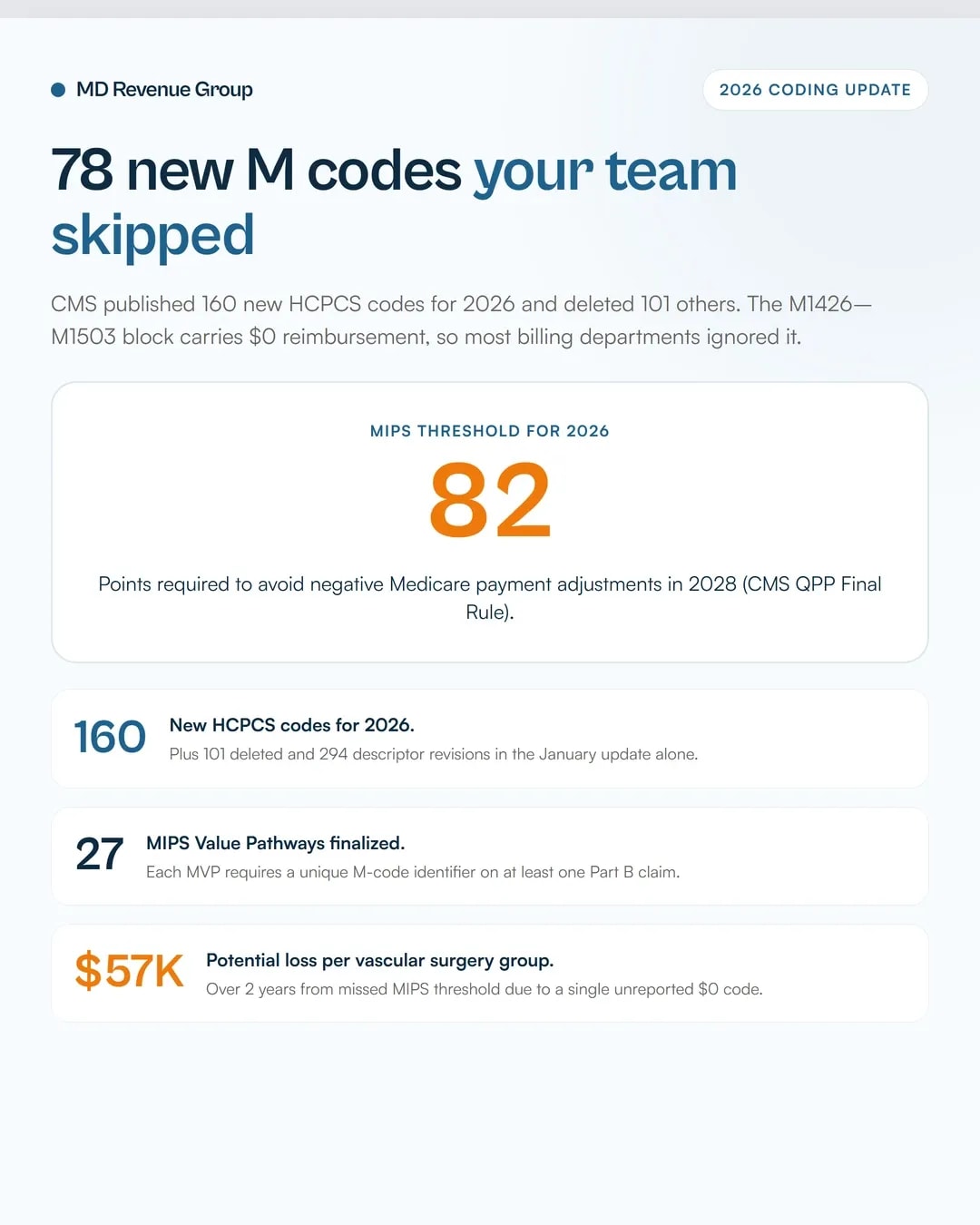
- CMS added 78 new HCPCS M codes (M1426–M1503) effective January 1, 2026, as part of a 160-code update that also deleted 101 codes.
- These codes are informational tracking codes for quality reporting, not procedure codes for billing services.
- Missing them doesn't trigger an immediate denial. It erodes your MIPS score, which adjusts Medicare payments 2 years downstream.
- The 2026 MIPS performance threshold is 82 points; inaccurate reporting from missing M codes can drop your score below that line.
- CMS releases HCPCS updates quarterly (January, April, July, October) with no grace period for discontinued codes.
What are HCPCS M codes and why did CMS add 78 new ones?
HCPCS Level II codes use alphabetic prefixes to organize services into categories. The "M" prefix covers "Other Medical Services," a catch-all designation that CMS uses for administrative tracking, documentation indicators, and quality measure support codes.
The January 2026 annual update was significant: 160 new codes added, 101 deleted, 294 long descriptor revisions, and 65 payment changes across the entire HCPCS Level II system (CMS HCPCS Quarterly Update, January 2026). The M1426–M1503 block represents the largest single batch of M-category additions in recent years.
Why the expansion? Three reasons.
First, CMS finalized 27 MIPS Value Pathways (MVPs) for the 2026 performance year. Each pathway needs a unique identifier code that clinicians append to claims. Many of the new M codes serve that function.
Second, telehealth became a permanent fixture. CMS needed dedicated tracking codes to differentiate in-person encounters from virtual ones within quality measure denominators. Codes like M1426, M1431, and M1436 fill that gap.
Third, quality measure specifications keep getting more granular. CMS wants to track clinical rationale at a level that CPT and standard HCPCS codes can't capture. When a physician documents why they ordered a bone scan for a prostate cancer patient, M1427 records that rationale in the claims data.
These codes carry $0 reimbursement and show as "noncovered" on fee schedules. That's by design. They aren't meant to pay you. They're meant to report what you did and why you did it, and CMS uses that data to score your quality performance.
The 4 categories of new M codes you need to know
The 78 codes sort into 4 functional groups. Knowing which group matters for your practice saves you from loading all 78 into a charge master you won't use.
Category 1: Telehealth encounter tracking
These codes flag that a specific patient encounter happened via telehealth rather than in person. They don't replace the POS code (02 or 10) or the telehealth modifier (95 or 93) on your professional claim. They exist within quality measure logic to identify which encounters qualify for telehealth-specific measure adjustments.
Code | Description |
|---|---|
M1426 | Encounter conducted via telehealth |
M1431 | Encounter conducted via telehealth |
M1436 | Encounter conducted via telehealth |
Why are there 3 codes that say the same thing? Each maps to a different quality measure specification. M1426 applies to one set of CQMs, M1431 to another, and M1436 to a third. Your registry or EHR should auto-select the correct one based on the measure being reported. If you're reporting manually, check your specific quality measure specs on the QPP website before picking one.
Category 2: Clinical documentation indicators
These codes capture the clinical reasoning behind a specific decision. They tell CMS why a physician ordered a particular test, what the finding was, or whether specific clinical criteria were met.
Code | Description |
|---|---|
M1427 | Medical reason documented for performing a bone scan (prostate cancer pain, salvage therapy, or other medical reasons) |
M1429 | Retinal exam finding with evidence of retinopathy (left, right, or both eyes), severity documented |
M1430 | Retinal exam finding without evidence of retinopathy in both eyes, severity documented |
M1427 matters for urology and oncology practices reporting prostate cancer screening measures. If you're ordering bone scans for prostate patients, this code documents the clinical justification within your quality data. Without it, the measure logic may flag the scan as an unexplained utilization outlier.
M1429 and M1430 are critical for any practice reporting on the Diabetes: Eye Exam measure (MIPS Quality Measure #117). These codes capture whether retinopathy was present and at what severity. They work alongside CPT II codes like 3072F but provide the granularity CMS needs for updated measure specifications. Practices handling behavioral health and primary care integration with diabetic patient panels should confirm these codes are mapped in their EHR.
Category 3: Patient population identifiers
These codes identify patients who meet specific demographic or clinical criteria that affect how quality measures calculate denominators and exclusions.
Code | Description |
|---|---|
M1428 | Patient with bilateral absence of eyes any time during history through measurement period |
M1441 | Encounter corresponds to initial diagnosis of sleep apnea or first contact with diagnosed patient |
M1446 | Patient who died any time prior to end of measure assessment period |
M1451 | Patient with active diagnosis of pervasive developmental disorder |
M1428 and M1446 are measure exclusion codes. A patient who has bilateral eye absence gets excluded from eye exam quality measures. A patient who died gets excluded from measures requiring end-of-period follow-up. These exclusions protect your measure performance rate from being dragged down by patients who can't complete the required care pathway.
M1441 matters for sleep medicine and pulmonology practices. It identifies the initial encounter with a sleep apnea patient, which triggers specific follow-up measure timelines.
Category 4: MVP specialty identifiers
MIPS Value Pathways require a unique identifier code on at least one claim per reporting period. Without it, your quality measures default to Traditional MIPS attribution, which may produce a lower score.
Code | MVP pathway |
|---|---|
M1503 | Vascular Surgery |
M1503 is the identifier for the Vascular Surgery MVP, newly finalized for 2026. Clinicians and groups reporting through this pathway must append M1503 as a line item on at least one Part B claim. The charge amount is nominal (0.01). CMS has finalized 27 total MVPs for 2026, each with its own M-code identifier (CMS Quality Payment Program, 2026).
If you're a vascular surgeon or nonphysician practitioner working in vascular surgery, skipping this code means your MIPS quality data gets routed to the wrong scoring bucket. Your measures still get reported, but under Traditional MIPS rules instead of the MVP framework that was designed to favor your specialty's specific outcomes.
Which M codes apply to your specialty?
You don't need all 78. Here's where to focus:
Your specialty | Codes to prioritize |
|---|---|
Primary care / internal medicine | M1426, M1429, M1430 (diabetes eye exam tracking), M1446 (deceased exclusion) |
Urology / oncology | M1427 (bone scan rationale), M1426 (telehealth tracking) |
Ophthalmology / optometry | M1429, M1430 (retinopathy findings), M1428 (bilateral eye absence exclusion) |
Vascular surgery | M1503 (MVP identifier), M1426 (telehealth) |
Sleep medicine / pulmonology | M1441 (sleep apnea initial encounter) |
Behavioral health | M1451 (developmental disorder identifier), M1431 (telehealth) |
Any specialty using telehealth | M1426, M1431, or M1436 (check measure specs for correct code) |
Cross-reference this list with the specific quality measures you're reporting for 2026 MIPS. The QPP Resource Library has the full measure specifications with exact HCPCS code requirements. If your practice handles credentialing across multiple specialties, you'll want specialty-specific code mappings for each provider.
How M codes connect to MIPS Value Pathways
The MVP framework is CMS's push to simplify MIPS reporting by grouping quality measures, improvement activities, and cost measures around a clinical specialty. Instead of picking from the full MIPS menu, you report through a curated pathway that matches your actual practice.
Here's how the M-code connection works:
- You choose an MVP for your specialty (e.g., M1503 for Vascular Surgery).
- You append the MVP identifier code to at least one Part B claim during the performance year.
- CMS routes your quality data through the MVP scoring framework instead of Traditional MIPS.
- You report 4 quality measures (including at least 1 outcome or high-priority measure).
- Small practices (15 or fewer clinicians) may qualify for simplified reporting requirements.
The 2026 MIPS performance threshold is 82 points (CMS Quality Payment Program Final Rule). Fall below that and your Medicare payments get adjusted downward starting in 2028. The MVP framework generally produces better scores for specialists because the measures align with their clinical workflow. But only if you actually submit the M-code identifier.
Proprietary impact estimate: A vascular surgery group with 4 providers billing $3.2 million annually through Medicare stands to lose approximately $57,600 in payment adjustments over 2 years if they miss the 82-point threshold by failing to submit M1503. That's the math on a $0 code that takes 30 seconds to add.
The cost of ignoring $0 codes
Here's the trap. Because M codes don't generate direct revenue, they get deprioritized. Billing teams focus on CPT codes that pay. Quality teams focus on G-codes and CPT II codes they already know. The M codes sit in a gap between the two departments.
The consequences show up later:
- Inaccurate quality measure denominators. Without telehealth tracking codes, CMS may include encounters that should have been measured differently, skewing your performance rates.
- Missed exclusions. Without M1428 or M1446, deceased patients and clinically ineligible patients stay in your denominators, pulling your quality scores down.
- Wrong MIPS attribution. Without MVP identifiers, your quality data routes through Traditional MIPS. That means your vascular surgery outcomes get scored against a general physician benchmark instead of a specialty-specific one.
- Downstream payment cuts. MIPS adjustments are cumulative. A practice scoring 70 points (12 below threshold) faces a negative adjustment of approximately 3% to 5% on all Part B claims for that payment year. On 30,000 to $50,000 lost.
Run a revenue integrity check against your current MIPS reporting to identify which M codes you should have been submitting since January.
How to add these codes to your charge master
CMS provides no grace period for code updates. Claims submitted with deleted codes after the termination date get denied. And codes you should be using but aren't sit as silent gaps in your quality reporting.
Here's the implementation checklist:
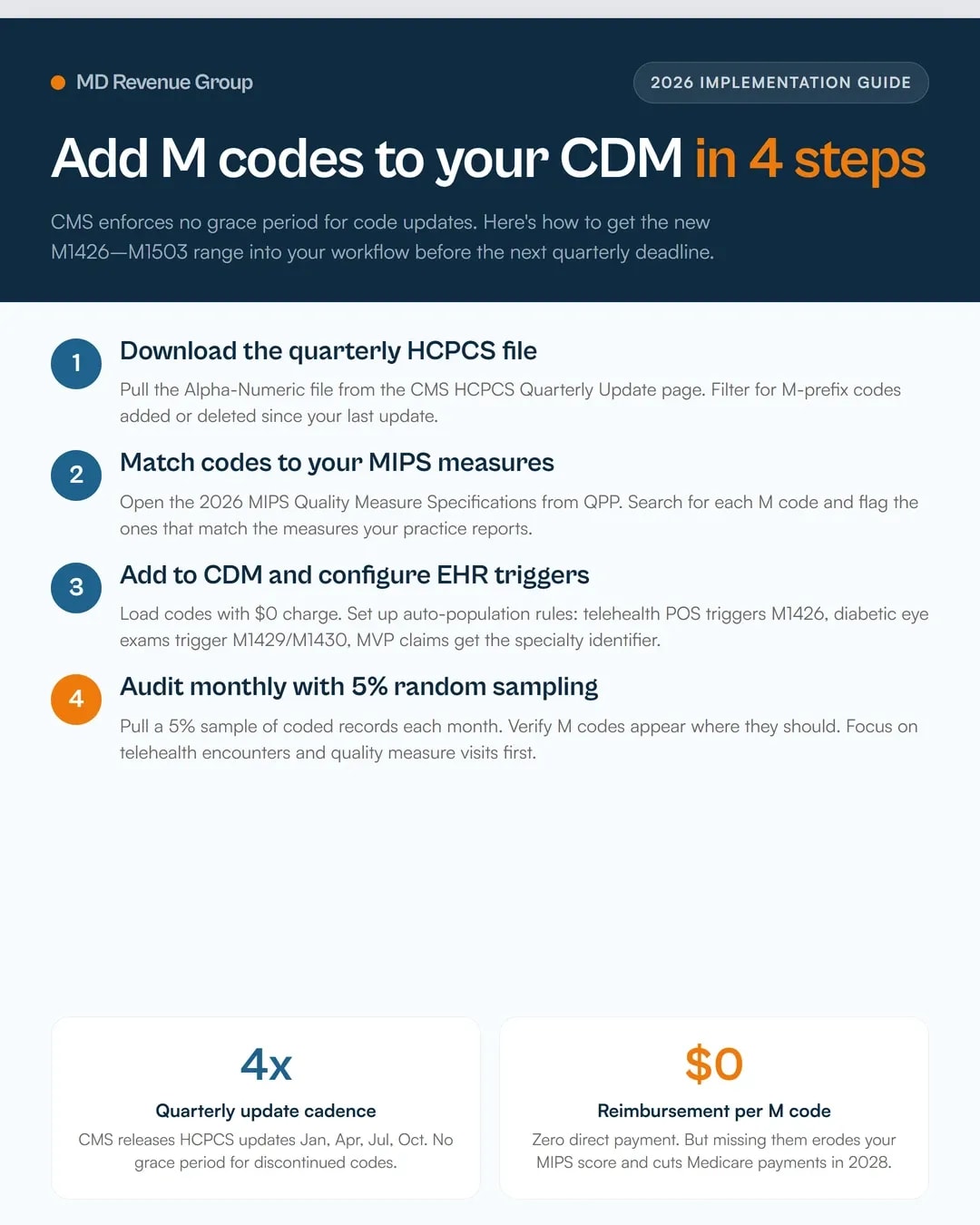
Step 1: Download the current HCPCS quarterly file. Go to the CMS HCPCS Quarterly Update page. Download the Alpha-Numeric file for the current quarter. Filter for M-prefix codes.
Step 2: Cross-reference with your MIPS measures. Open the 2026 MIPS Quality Measure Specifications from the QPP Resource Library. Search for each M code to identify which measures reference it. Flag the ones that match your reported measures.
Step 3: Update your charge master. Add the relevant M codes to your CDM with a $0 charge amount. Map them to the appropriate order catalogs and clinical documentation templates in your EHR. Confirm that the code descriptions match the CMS long descriptors exactly.
Step 4: Configure auto-population triggers. Work with your EHR vendor to set up rules that auto-append the correct M code based on encounter type. For example: if POS = 02 (telehealth) and the encounter is linked to MIPS measure #117, the system should auto-attach M1426.
Step 5: Set up quarterly review cadence. Block 2 hours on your calendar for April 1, July 1, and October 1. That's when CMS releases quarterly updates. Assign a specific person (not "the team") to own the download, review, and implementation. Run a billing audit after each quarterly update to verify the new codes are flowing correctly.
Step 6: Run monthly spot checks. Pull a 5% random sample of coded records. Verify that M codes appear on claims where they should. Focus on telehealth encounters and quality measure-eligible visits. If your sample shows gaps, your EHR rules need adjustment.
Code-by-code reference table
Code | Category | Description | Key specialty |
|---|---|---|---|
M1426 | Telehealth tracking | Encounter conducted via telehealth | All specialties |
M1427 | Documentation indicator | Medical reason for bone scan (prostate cancer) | Urology, oncology |
M1428 | Population identifier | Bilateral absence of eyes | Ophthalmology |
M1429 | Documentation indicator | Retinal exam WITH retinopathy, severity documented | Primary care, ophthalmology |
M1430 | Documentation indicator | Retinal exam WITHOUT retinopathy, severity documented | Primary care, ophthalmology |
M1431 | Telehealth tracking | Encounter conducted via telehealth | All specialties |
M1436 | Telehealth tracking | Encounter conducted via telehealth | All specialties |
M1441 | Population identifier | Initial sleep apnea diagnosis or first contact | Sleep medicine, pulmonology |
M1446 | Population identifier | Patient deceased before end of assessment period | All specialties |
M1451 | Population identifier | Active pervasive developmental disorder diagnosis | Behavioral health, pediatrics |
M1503 | MVP identifier | Vascular Surgery MIPS Value Pathway | Vascular surgery |
For the complete list of all 78 codes and their full CMS long descriptors, download the official HCPCS Level II Alpha-Numeric file from cms.gov or consult your Medicare Administrative Contractor's (MAC) Local Coverage Determinations.
FAQ
Do M codes affect reimbursement?
No. M codes in the M1426–M1503 range carry $0 reimbursement. They appear as "noncovered" or "informational only" on Medicare fee schedules. Their function is quality reporting and administrative tracking, not payment. The financial impact comes indirectly through MIPS scoring, which adjusts your Medicare payments 2 years later.
Can I bill M codes as line items on a standard claim?
Yes, but with a nominal charge (0.01). MVP identifier codes like M1503 must appear as a line item on at least one Part B claim during the performance period. Telehealth and documentation M codes are typically submitted alongside the professional service codes on the same claim.
What happens if I used a deleted HCPCS code after January 1?
CMS enforces no grace period. Claims submitted with a discontinued code for dates of service after the termination date will be denied. Check the quarterly update files to confirm which codes were deleted and verify your charge master doesn't still have them active.
How do I know which M code to use for telehealth reporting?
M1426, M1431, and M1436 all describe "encounter conducted via telehealth" but each maps to different quality measure specifications. Check the specific measure you're reporting in the 2026 MIPS Quality Measure Specifications on qpp.cms.gov. The measure denominator criteria will specify which M code to use.
Are M codes required for all MIPS reporting?
Only if the specific quality measures you've chosen reference them. Not all measures use M codes. Review your selected measures' specifications to determine which M codes are part of the denominator, numerator, or exclusion logic.