
Outsourcing Medical Billing in 2026: A Data-Driven Vendor Scorecard
A 9-score vendor scorecard for outsourcing medical billing, built on CAQH, MGMA, and BLS data on cost, denial rates, and vendor risk.
Most practices decide whether to outsource medical billing by comparing two numbers: what a vendor charges and what a biller costs. Both numbers are real, and both numbers are the wrong ones. The vendor that quotes 5% and collects 80% costs you more than the vendor that quotes 7% and collects 95%. A fully loaded in-house biller runs 111,000 per year and produces first-pass claim acceptance rates of 70% to 80%. Specialty-focused vendors produce 95% to 98% acceptance on the same claim volume. That gap, multiplied across every claim your practice submits, is the entire financial argument for outsourcing. The percentage on the contract is a rounding error next to it.
This guide gives you 9 scores to put on any vendor. Each one has a number attached, a source, and a threshold that tells you whether to keep looking.
Key takeaways
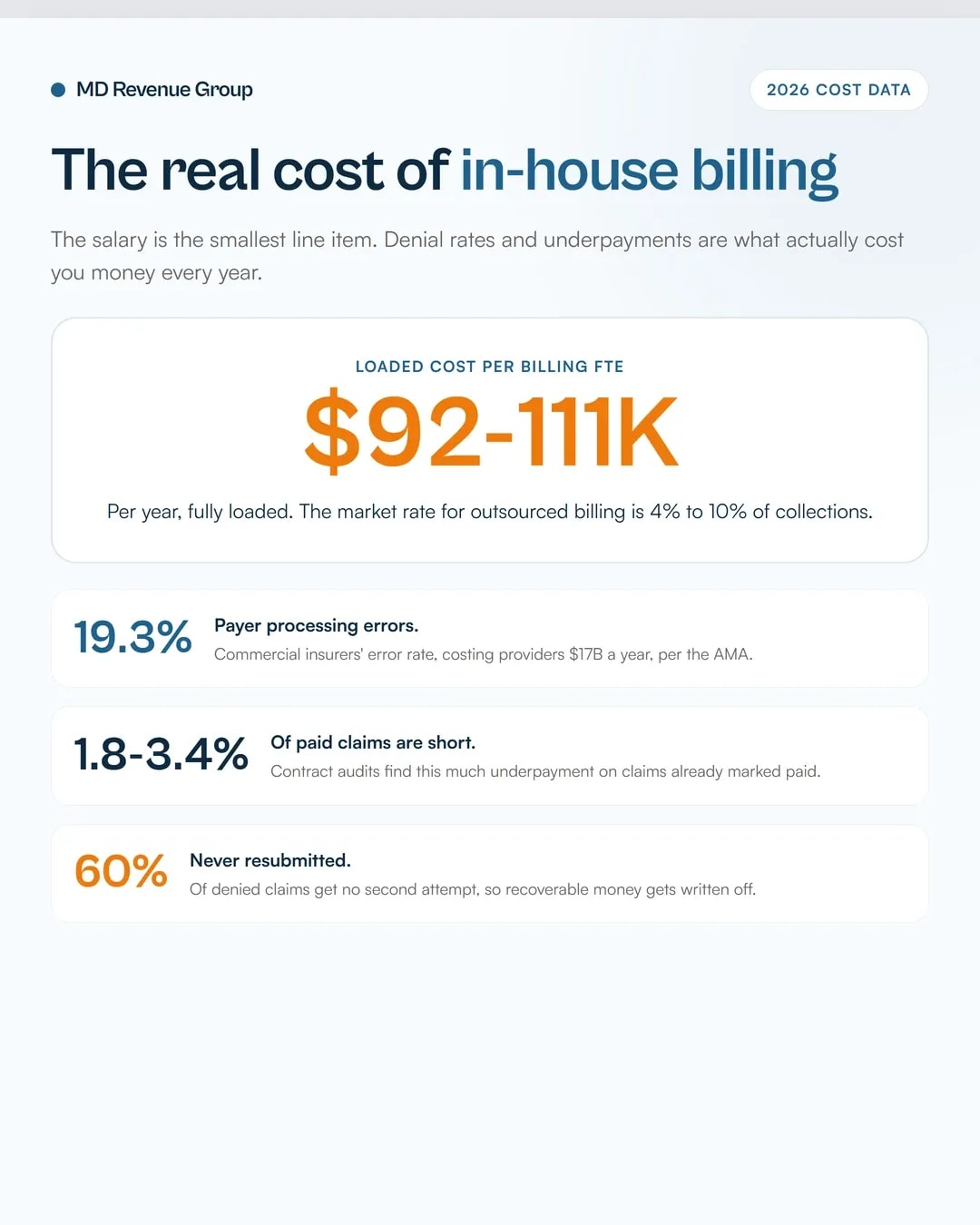
- 111,000 per year is the true loaded cost of one in-house billing FTE, against a market rate of 4% to 10% of collections
- 19.3% claims-processing error rate at commercial insurers costs providers $17 billion a year, per the AMA
- 1.8% to 3.4% of paid claims contain an unrecovered underpayment, money you earned and never collected
- 60% of denied claims are never resubmitted, and working one costs 181
- 192.7 million people were hit in the Change Healthcare breach, the largest in US history, and your vendor holds the same PHI
What the fee percentage actually tells you
A percentage of collections is an honest pricing model. The vendor gets paid more when you get paid more. Roughly 80% of outsourced billing arrangements use it, and for a practice collecting 6,000 a month.
The problem is that the same model hides everything that matters.
Here's the arithmetic that should drive your decision. Assume a practice submits 1,500 claims a month. In-house teams average 12% to 18% denial rates; specialty-focused outsourced firms run 2% to 8%. At a 15% in-house denial rate, you are reworking 225 claims a month. At 100 per claim in staff time, that is 22,500 a month in rework labor, before any revenue is written off.
Now add the underpayment problem, because a vendor that only works denials will leave it on the table. The American Billing Association found that 1.8% to 3.4% of paid claims contain an underpayment. A 142 contracted rate and paid at 24 short, and it arrives with no denial code attached, so it looks like a clean payment on the remittance. The AMA puts the commercial insurers' claims-processing error rate at 19.3%, an inefficiency the association estimates costs providers $17 billion annually. Contracts that reference annual rate escalators are where this hides: a 3% increase lands, nobody updates the fee schedule, and you absorb the difference across every claim in the year.
Recovery rates run 70% to 85% when the appeal cites exact contract language and the rate exhibit. That is the single highest-yield piece of work a vendor can do for you, and plenty of base-fee quotes exclude it.
Market pricing for outsourced billing runs 4% to 10% of net collections, with most competitive quotes for small and mid-sized practices landing between 5% and 8%. MGMA benchmarks billing and RCM cost at roughly 5% of collections. If a vendor quotes well below that band, the money has to come from somewhere. Find out where before you sign. Our medical billing audit service exists to answer that question with numbers from your own remittances rather than a vendor's sales deck.
Score 1: clean claim rate and what it costs you
Ask for the vendor's clean claim rate, defined as percentage of claims paid on first submission with no edit or rework. Then ask for their client's median, not their best reference.
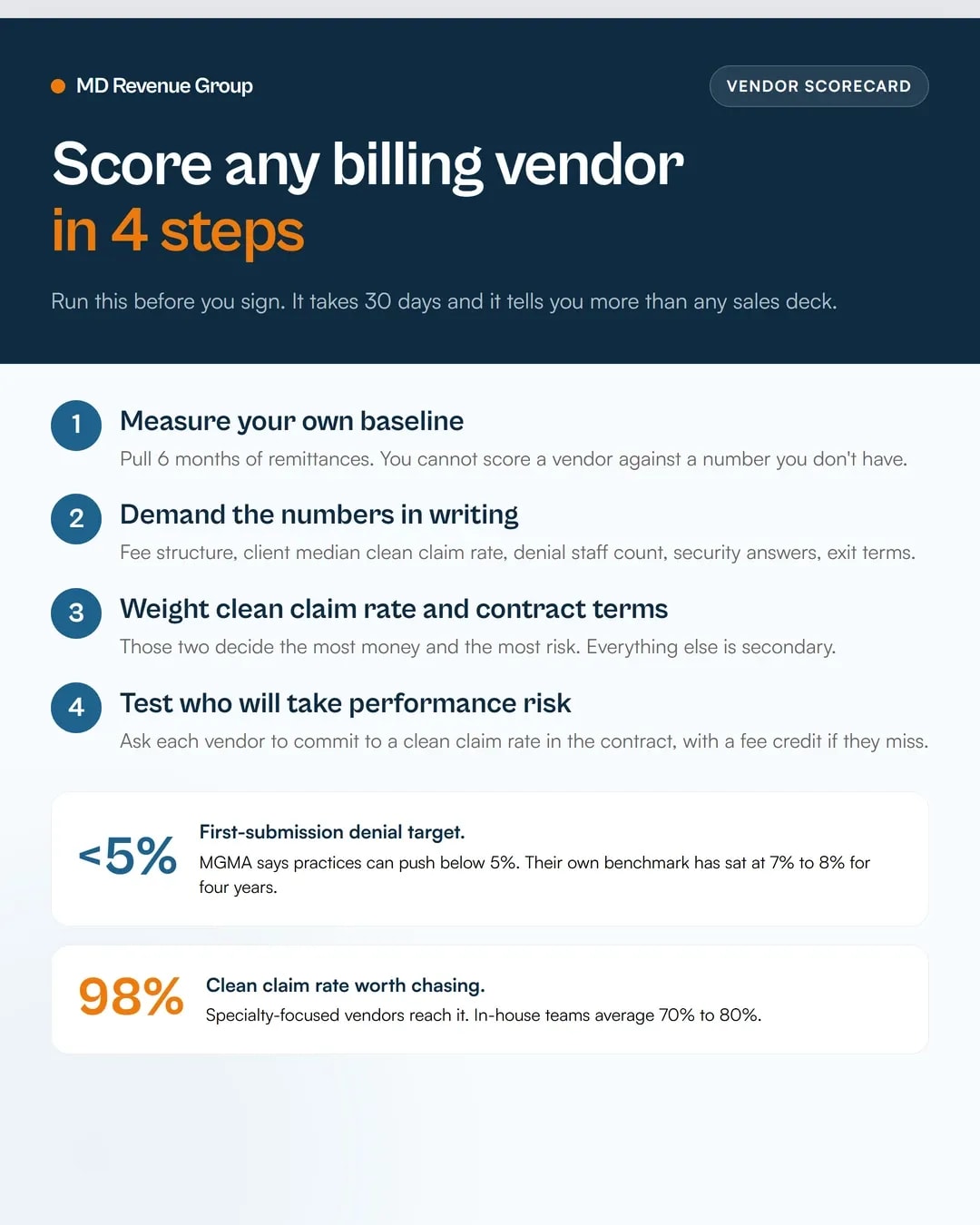
The industry threshold is clean. MGMA's 2025 Financials and Operations report suggests practices can push first-submission denials below 5% with targeted process fixes. Their own multiyear benchmark has held at 7% to 8%. Anything a vendor claims above 98% clean claim rate deserves a reference call. The average in-house team sits at 70% to 80%.
What you are really measuring is the cost of the gap. At 1,500 claims a month, the difference between 75% and 96% clean claim rate is roughly 315 claims a month that pay without a human touching them twice.
Score it: 95% or above is strong. 90% to 95% is acceptable with a corrective plan. Below 90% means you are paying a percentage fee for rework labor.
Score 2: denial management capacity
Denials are where the money hides, and 48% of medical group leaders name denials and appeals as their single largest source of revenue leakage, according to MGMA. A January 2026 MGMA Stat poll put front-end issues at 23% by comparison.
Costs vary by denial type, and a vendor that quotes one flat rework rate probably treats a 25 eligibility correction:
Denial type | Typical rework cost | Primary cost driver |
|---|---|---|
Eligibility or demographics | 45 | Quick fix if caught early |
Missing authorization | 80 | Retroactive auth, physician time |
Coding or documentation error | 100 | Coding review, clarification |
Medical necessity | 181+ | Peer-to-peer, full clinical packet |
The national average administrative cost per denied claim was $57.23 in 2023, up from $43.84 in 2022. And 60% of denied claims are never resubmitted at all, which turns a recoverable balance into a permanent write-off. 41% of providers report denial rates of 10% or higher.
Ask the vendor how many full-time denial staff they have, and ask for their overturn rate on medical necessity appeals specifically. A generic "we handle denials" means nothing.
Score it: named denial staff, a reported overturn rate above 60%, and a written process for each of the four denial types in that table. If they can't name the staff, keep looking.
Score 3: contract and fee structure
Percentage of collections is the right base. Everything around it matters more.
Per-claim pricing between 8 looks cheap and misaligns incentives, because the vendor earns the same whether the claim pays 5,000. A 4% fee on gross charges will almost always cost more than a 6% fee on net collections, and in a group with heavy contractual adjustments, the gap is real.
Then read these four clauses. They decide how the relationship ends, and a physician who reviews only the fee schedule has read the least risky page in the contract.
Renewal. A full automatic one-year renewal unless you give 90 days notice before the term ends is standard and easy to miss. Calendar the notice window the day you sign.
Liquidated damages. Watch for a clause computing 70% of the average monthly fee multiplied by every month remaining in the term, including a renewal term you missed the window to cancel. Ask for it to be capped or removed.
Data release. If data returns only after payment and a signed general release, you cannot transition, work your own A/R, or defend an audit while a fee dispute runs.
Exclusivity. Narrow exclusivity limited to the tasks you assigned leaves room to bring in an auditor. Broad exclusivity blocks you from hiring anyone else to audit the vendor you're paying.
Fee escalation of 3% to 5% a year is normal market practice. Uncapped escalation with no notice requirement is not. Put any increase cap in writing.
Score it: month-to-month after the first term, termination for cause with reasonable notice, immediate data return, assignment requiring your written consent, and a capped annual increase. Anything less and you are negotiating from a weak position at renewal.
Score 4: data security and breach exposure
Your billing vendor holds the PHI for every patient you see. The largest healthcare data breach in US history is a cautionary tale about what happens when that chain breaks.
The Change Healthcare ransomware attack exposed 192.7 million individuals, nearly two-thirds of the US population, making it the largest healthcare breach ever recorded. The attackers entered through a Citrix remote access portal that lacked multi-factor authentication, and stayed undetected for 9 days before the ransomware was deployed. UnitedHealth Group paid a $22 million ransom. The provider track of the consolidated litigation alleges roughly $2.5 billion in remediation costs and that providers will never see payment for claims they could not submit during the shutdown.
Change processes approximately 15 billion healthcare transactions a year, more than half of all medical claims in the country.
Ask the vendor three questions. Do they have multi-factor authentication on remote access, including third-party portals? What's their breach notification timeline in the contract, and does it beat the 60-day HIPAA Breach Notification Rule? What's their subcontractor list, and who's liable when a subcontractor has an incident?
The legal basis for sharing PHI with a billing vendor is treatment, payment, and health care operations under 45 CFR 164.506. Your practice is entitled to a business associate agreement, and you should read it rather than file it.
Score it: MFA on all remote access, a notification window shorter than 60 days, a current BAA, and a named subcontractor list with liability terms. The Change Healthcare facts are the reason this is a score and not a footnote.
Score 5: credentialing and enrollment scope
Enrollment failures are quiet, expensive, and entirely preventable. A provider billing under the wrong taxonomy, or a lapsed revalidation, generates denials that repeat every cycle until someone catches it.
Medicare DMEPOS suppliers revalidate on a 3-year cycle, and missing a revalidation date can trigger a billing-privilege deactivation that holds reimbursement until it's resolved. Revalidation is a recurring control with a real calendar attached, not a one-time task at onboarding. Our provider credentialing services team handles that calendar for practices that don't have a full-time owner for it.
Ask the vendor: do you handle Medicare revalidation scheduling and PECOS submission? Do you monitor CAQH profile accuracy and payer directory listings? Who reconciles the roster when a provider leaves or a new one joins? What's your process for group reassignment and effective date changes across payers?
Score it: named ownership for revalidation, CAQH, and payer directories, plus a documented effective-date change process. A vendor that only handles initial enrollment will leave you exposed at every anniversary.
Score 6: automation you can audit
CAQH's 2025 Index, built from more than 600 organizations representing 63% of insured lives, found that US healthcare avoided an estimated $258 billion in administrative costs in 2024 through electronic transactions and improved data exchange. Medical administrative spend fell 9%, and a $21 billion savings opportunity remains through full automation.
The same Index reports that more than 50% of health plans and 25% of provider organizations now use AI tools in administrative workflows.
Here is the vendor question that actually tests whether automation is real: can we see the audit trail? Which transactions are automated, which fall back to manual queues, and who reviews the exceptions? A vendor claiming AI denial prevention with no way to inspect the model's decisions on your claims is running a black box over your revenue.
Score it: documented automation rates by transaction type, named human review for exceptions, and access to the audit log. The CAQH figures tell you the ceiling exists. Whether your vendor is near it is a separate conversation.
Score 7: staffing depth and turnover risk
Billing staff are hard to hire and harder to keep. Turnover in revenue cycle roles runs 11% to 40% annually, against a national average of roughly 20% across all occupations. MGMA's DataDive Practice Operations report found 40% turnover in front office support staff and 33.3% in business operations support staff in 2022. Replacing a support employee is estimated to cost 30,000.
Nearly 90% of hospital CFOs reported labor shortages in their billing departments, with about half of open positions staying unfilled for long stretches. The share of billing and coding staff working fully remote rose from about 30% before 2020 to 65.7% by 2024, according to AAPC survey data.
A one-person in-house team is a single point of failure. When that person takes a vacation, resigns, or gets sick, claims queue, denials age, and knowledge walks out the door. Institutional knowledge matters more here than in most roles, because a biller who knows a payer's edit patterns can catch a denial before it happens.
Ask for the tenure of the specific team assigned to your account, and what coverage exists during absences. Our revenue cycle management model handles bench depth as a standard, which is the practical answer to this score.
Score it: dedicated named staff, documented backup coverage, and account-team tenure you can verify. A vendor promising your account is covered by "the team" has told you nothing.
Score 8: reporting you can verify
Ask for a sample report before you sign, and check whether it reconciles to your bank deposits.
The report should include clean claim rate, denial rate by reason, days in A/R, net collection rate, and aged A/R by bucket. Put the benchmarks in the contract as an exhibit so there's an objective reference point when a quarter goes sideways.
MGMA's July 2026 poll found 43% of leaders reporting days in A/R roughly flat year over year, 32% reporting an increase, and 22% reporting a decrease. In a year where a third of practices are moving backward on cash flow, reporting is how you find out which direction you're heading. It also found that practices collected 72% of copayments at time of service but only about 27% of other patient-due balances, which is a collections problem hiding in plain sight.
Score it: a sample report you can reconcile, benchmarked metrics written into the contract, and monthly delivery with a named owner. A vendor that reports quarterly can't help you fix a 30-day problem.
Score 9: transition and exit terms
Ask what happens if you leave. A vendor that resists this question is telling you something.
Most RCM contracts allow exit for convenience on 30 to 90 days notice, and 90 days is the common standard. A structured transition runs 60 to 90 days from notice to full cutover, and the details decide whether you lose claims or not.
The operational sequence matters. Set the A/R cutoff date at the start of a billing cycle. Request a full data export in a usable format rather than a summary PDF. Start clearinghouse and EFT/ERA re-enrollment well before cutover, because payments and remittances route to the old vendor's clearinghouse ID until you change it, and payer-side updates run on their own timeline. Run a parallel test claim batch. Document in writing who owns denials and appeals on pre-cutoff claims. Reconcile A/R 30 days after cutover.
Score it: data return on termination regardless of fee dispute, a defined transition assistance obligation, parallel-run access, and no extraction fees. Vendors who charge to help you leave are planning to keep you.
How to run the scorecard in 30 days
Week 1: pull six months of your own remittance data. Calculate your clean claim rate, your denial rate by reason, and how many claims went past 120 days. You cannot score a vendor against a number you don't have.
Week 2: audit your top 20 procedure codes by payer. Those codes typically represent about 80% of your volume, and contract audits consistently find underpayments concentrated in high-volume, high-dollar codes. If you find variance, you have a specific dispute to raise with any vendor you talk to.
Week 3: request the scorecard answers in writing from at least 3 vendors. Ask for the fee structure, the client median clean claim rate, the denial staff count, the security answers, and the exit terms. Written answers separate vendors from salespeople.
Week 4: score each vendor on the 9 points. Weight clean claim rate and contract terms highest, because those two decide the most money and the most risk.
A useful tiebreaker when two vendors price identically: ask each to commit to a clean claim rate in the contract with a fee credit if they miss it. Vendor willingness to take performance risk tells you more than any reference call.
When in-house still makes sense
In-house billing works well in a few specific situations, and pretending otherwise helps nobody.
A practice collecting $5 million or more a year, with a payer mix complex enough to need dedicated contract management, can spread the cost of a mature team across enough volume. System-owned groups with centralized billing functions operate this way for good reason.
You also need it when nobody can do the job. A biller who knows your payers, your state rules, and your contracts is worth more than a percentage saved, particularly in markets with specific prompt-pay statutes and filing deadlines. Medical billing in New Jersey and medical billing in California carry different timely filing rules and different appeal windows, and that kind of local knowledge takes time to build.
For everyone else, the math is settled. One loaded biller at 111,000 produces 70% to 80% clean claim rate. A specialty vendor at 5% to 8% produces 95% to 98%. The question was never whether outsourcing saves money. It's whether you can find a vendor whose 9 scores actually hold up.
Ready to see where your practice stands?
Send us six months of remittances and we'll score your current revenue cycle against the same 9 points, then tell you which ones are costing you the most. Request a free revenue audit.