
Cardiology Billing Services: Prior Authorization and Documentation Controls for High-Value Diagnostics
Cardiology billing services turn on prior auth routing and medical necessity documentation. Learn payer rules, denial causes, and 2026 fee schedule changes.
Cardiology billing services run on two things: getting authorization before the test happens, and building documentation that survives medical necessity review after it does. Miss either one and a high-dollar claim comes back denied. Medical necessity is the largest denial category in cardiology, and prior authorization failures follow close behind.
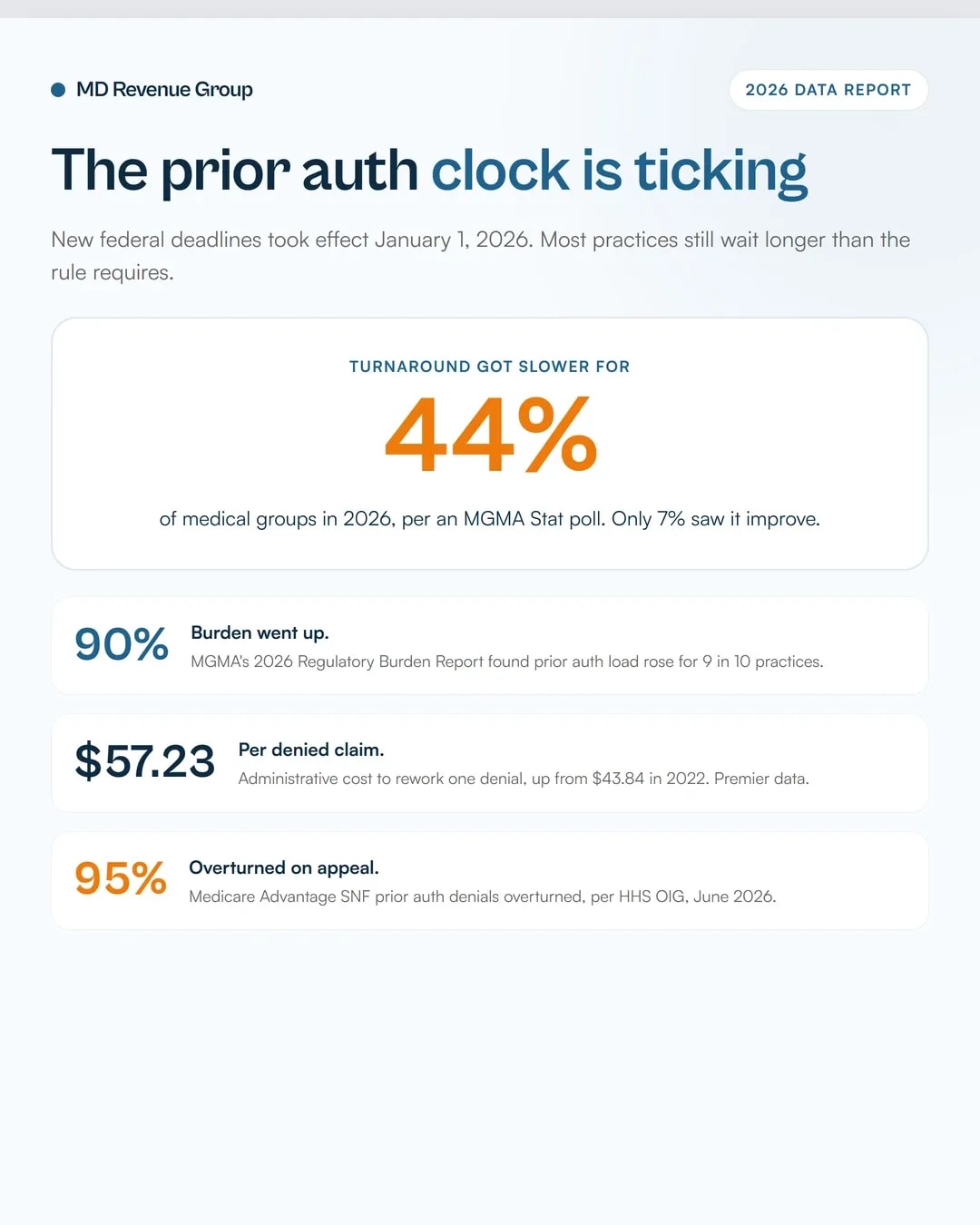
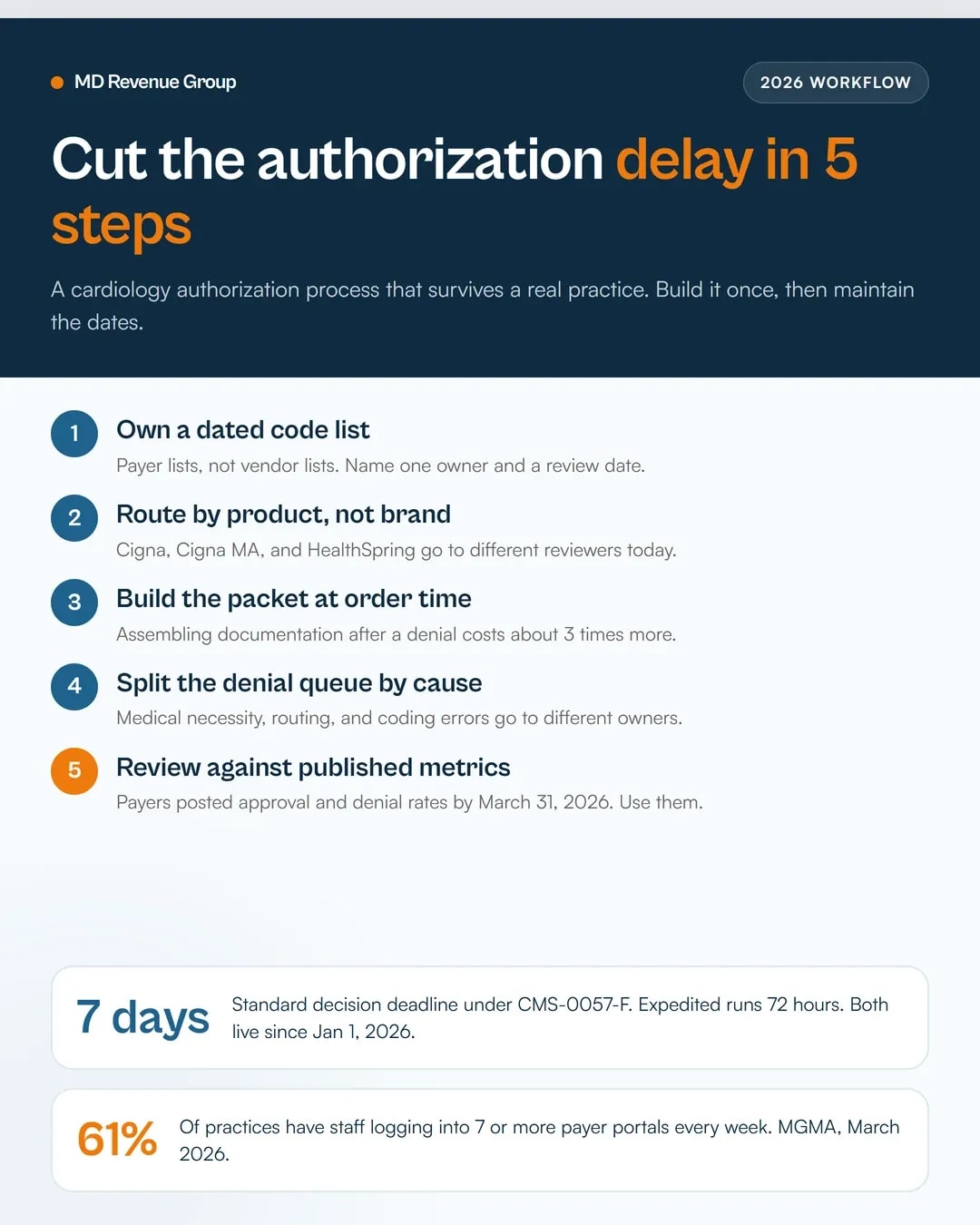
The rules changed in January 2026, and they changed in your favor on paper. Under CMS's Interoperability and Prior Authorization final rule (CMS-0057-F), Medicare Advantage, Medicaid, and CHIP payers must decide standard requests within 7 calendar days and expedited requests within 72 hours. Every denial now has to carry a specific reason, and payers had to publish their prior authorization metrics by March 31, 2026.
So why does it still feel slower? Because the clock only runs once a complete request lands. The delay lives upstream, in the hours your staff spend figuring out where to send it. 44% of medical group leaders said payer prior authorization turnaround got slower in 2026, according to a September 1, 2026 MGMA Stat poll of 178 respondents. Only 7% reported it got faster.
Key takeaways
- Standard prior authorization decisions are due in 7 calendar days, expedited in 72 hours, under CMS-0057-F. Federal exchange QHPs are exempt and keep a 15-day standard.
- Payer denial reasons are now required. Vague denials are a compliance gap you can escalate.
- UnitedHealthcare requires authorization for only 2% of its medical services and approves around 92% of requests in under 24 hours on average. Most delays are yours to fix.
- Medicare's 2026 conversion factor rose to $33.5675 for qualifying alternative payment model participants and $33.4009 for everyone else, gains of 3.77% and 3.26%.
- A -2.5% efficiency adjustment landed on nearly all non-time-based codes in 2026, partially offsetting the conversion factor increase.
- Administrative cost per denied claim climbed from 57.23 in 2023, per Premier.
- Federal appeals data shows Medicare Advantage plans overturn denials at very high rates once appealed, which is why unappealed denials are the expensive ones.
What cardiology billing services actually cover
Cardiology sits in a strange spot. The procedures are expensive, so payers scrutinize them. The documentation requirements are layered, because the same diagnosis can support three different justifications depending on which test you're ordering.
A cardiology billing team typically handles five functions:
- Authorization routing, confirming which entity actually reviews the code for a given member and plan
- Medical necessity documentation, assembling the clinical packet that supports the order
- Coding and modifier accuracy, including professional and technical component splits
- Denial work and appeals, rebuilding the packet when the first one wasn't enough
- Payer policy tracking, since coverage criteria change at least annually
Most practices have some version of this in-house. The question is whether it's a defined workflow or a person guessing. If your front desk is calling a payer to ask whether authorization is required, you've already lost a day.
Which cardiac diagnostics need prior authorization
Authorization requirements are set by plan, product, and state. There's no national list, and treating a vendor blog list as authoritative is how practices get denials.
Here's the general pattern across major commercial payers and Medicare Advantage plans:
Service | Typical CPT range | Prior authorization pattern |
|---|---|---|
Diagnostic cardiac catheterization | 93454 to 93461 | Required by most commercial payers and MA plans |
Structural heart intervention (TAVR) | 33361 to 33369 | Required by nearly all commercial payers and most MA plans |
Transcatheter mitral valve repair | 33418, 33419 | Standard requirement, severe mitral regurgitation evidence expected |
Nuclear myocardial perfusion imaging | 78451, 78452 | Commonly required |
Stress echocardiography | 93350, 93351 | Commonly required |
Pharmacologic or dobutamine stress testing | 93016, 93018 | Commonly required |
Routine exercise treadmill testing | 93015 to 93018 | Usually not required by major commercial payers |
Two things to notice. Routine treadmill testing is the one service in that table that most payers let through, and pharmacologic stress testing is the one that trips people up because the CPT range overlaps with exercise testing.
Verify requirements against the member's actual plan before scheduling. Requirements differ by product and by state, and they change. A pre-service eligibility and authorization check is part of our medical billing audit process for exactly this reason.
Why routing errors kill more requests than clinical gaps
Here's the failure mode that costs practices the most. Cigna delegates diagnostic cardiac imaging and vascular intervention to EviCore by Evernorth. Send a Cigna prior auth request to Cigna directly and you've started a clock you can't see.
The routing map changed again in 2026:
- Cigna Healthcare delegated roughly 600 CPT codes to EviCore starting March 7, 2026
- Cigna maintains separate cardiology code lists effective 03/07/2026
- HealthSpring, the Medicare Advantage business HCSC acquired from Cigna, pulled cardiology prior authorization away from EviCore effective July 1, 2026. Existing authorizations stayed valid through their end dates.
A practice that built its routing logic in 2024 and never updated it is now sending requests to a vendor that no longer handles that service. The request doesn't get denied. It disappears.
This is the argument for treating authorization tracking as a controlled process rather than institutional memory. If your team's routing knowledge lives in one person's head and that person takes a vacation, you have a denial backlog.
Our prior authorization workflow guide lays out the 10-step structure we use to run this. It was built for behavioral health, but the mechanics are identical.
What a medical necessity denial actually says
When a payer denies a stress echo for medical necessity, they aren't saying the test was unnecessary. They're saying your documentation didn't hit the specific criterion in their medical policy. Those are very different problems.
The denial reason requirement under CMS-0057-F is what makes this workable. Before January 1, 2026, a denial could arrive as a generic code. Now the payer has to name the clinical criterion the request failed.
For stress testing with electrocardiogram, for example, Anthem's policy CG-MED-57 was last reviewed May 14, 2026 and republished July 1, 2026. UnitedHealthcare maintains a Cardiovascular and Radiology Imaging Guidelines document at version 4.0.2026. Carelon's Imaging of the Heart guidelines were updated May 1, 2026. Each one names specific indications.
Match your appeal to the named criterion, not to your clinical opinion. The appeal packet needs diagnosis, symptoms described specifically rather than as "cardiac symptoms," risk factors, and what changed clinically since the last study. If a repeat study falls inside a frequency window, that status change is the whole argument.
A useful detail: when a Medicare Advantage denial names a specific clinical criterion, that criterion tells you exactly which document was missing. Our denial management breakdown covers how to work denials systematically rather than one at a time.
What the 2026 Medicare fee schedule did to cardiology
The CY 2026 Physician Fee Schedule final rule, published November 5, 2025, moved the conversion factor in both directions depending on your participation status:
Participant status | 2026 conversion factor | Change |
|---|---|---|
Qualifying alternative payment model participants | $33.5675 | +3.77% |
Non-qualifying participants | $33.4009 | +3.26% |
Both increases include the 2.5% boost passed through H.R. 1. The two-factor split is required by statute, and 528,827 clinicians qualified for the higher rate based on 2024 participation.
Now the part that stings. CMS finalized a -2.5% efficiency adjustment on the intra-service times and work relative value units of nearly all non-time-based codes, using a 5-year lookback to the Medicare Economic Index. Codes new for 2026 are exempt, and CMS has signaled it will apply the adjustment every 3 years with no floor on how far a service can be devalued.
Practice expense moved too. CMS rejected the AMA's Physician Practice Information Survey for 2026 rate setting and reduced indirect practice expense payments for services furnished in a facility. The American Society of Nuclear Cardiology's analysis puts the effect on cardiology at roughly 5% higher office-based payments and 7% lower facility-based payments. Nuclear SPECT and PET are exempt from the new methodology itself.
MIPS also lost four measures from the cardiology quality measure set, with 190 total measures finalized for the 2026 performance period.
Medicare fee-for-service doesn't require prior authorization for most cardiology diagnostics. But the LCDs still govern coverage, and they are MAC-specific. L38396 covers cardiology non-emergent outpatient stress testing, and L34324 covers cardiovascular stress testing including stress echocardiography. These are contractor policies, not national policy. What one MAC covers, another may not.
If you bill across states, this matters more than the conversion factor does. Our state-by-state coverage guide shows how MAC jurisdiction differences change what a given test requires.
Payers are cutting authorization requirements
Here's something that changes how you should think about 2026. Payers are removing prior authorization at a real pace, and cardiology is in the crosshairs of that change.
UnitedHealthcare announced on May 5, 2026 that it would eliminate authorization requirements for 30% of healthcare services that previously required insurer approval, explicitly naming echocardiograms among the diagnostic tests losing their requirement by the end of 2026.
The context matters. UnitedHealthcare says prior authorization now applies to only 2% of its medical services. Of the authorizations submitted, roughly 92% are approved, in under 24 hours on average.
Blue Cross plans are moving too, expecting approximately 11% fewer prior authorizations in 2026, about 6.5 million fewer for patients, including a 15% reduction in Medicare Advantage.
Here's the trap. If a practice keeps its prior authorization process static while payers remove requirements, staff keep working queues that no longer need to exist. Meanwhile the codes that still require authorization get buried under the ones that don't.
Re-tier your authorization tracking. Know exactly which of your codes still need it, because that list is shrinking faster than most practices realize.
When the payer is wrong and you can prove it
Here's the part that changes how you should staff your denial queue. A meaningful share of payer denials should never have been issued. Federal oversight data makes that hard to argue with.
The Department of Health and Human Services Office of Inspector General published two reports on June 11, 2026 examining Medicare Advantage organizations' use of prior authorization for post-acute care. The findings:
- 19 Medicare Advantage organizations denied roughly 12% of all skilled nursing facility admission requests, with denial rates by plan ranging from 0.4% to 23%
- When patients or treating physicians appealed, those organizations overturned approximately 95% of SNF prior authorization denials
- Long-term acute care appeal denials were overturned 36% of the time
- Inpatient rehabilitation facility denials were overturned 43% of the time, with some plans overturning as much as 86%
OIG's own conclusion is the line that matters: the extremely high overturn rate indicates some enrollees were initially denied medically necessary care, and it raises concerns about denials that were never appealed.
A 95% overturn rate means the appeals process is where the money is. If your staff writes off denied Medicare Advantage claims without appealing, you are handing over revenue that the plan has already agreed you were entitled to.
Be precise about what this data does and doesn't cover. These reports analyze post-acute care admissions, not cardiac diagnostics. The lesson transfers to cardiology because the mechanism is the same: a payer's initial medical review is a screening step, and a high volume of initial denials don't survive appeal. It would be wrong to quote 95% as a cardiology overturn rate.
What it does justify is a hard rule: every deniable Medicare Advantage denial gets worked before it gets written off. An unworked denial is a decision to lose money, and a 43% to 86% overturn rate on comparable service categories means that decision is usually the wrong one.
The process matters too. Track the appeal by payer and by denial reason. Practices that carry a formal denial analytics dashboard find the same payer-specific patterns repeat monthly, which turns appeal work into targeted resubmission instead of full rebuilds.
What to track before January 2027
On January 1, 2027, impacted payers must implement and maintain FHIR-based Prior Authorization APIs. CMS granted enforcement discretion on the all-FHIR requirement, but the API build-out deadline stands.
Until now, most prior authorization moves through portals, faxes, and phone calls. An API changes that to structured electronic exchange.
You can't control whether your EHR vendor is ready. You can control whether you know which requests are going through which channel. Track these fields per request:
- Payer and plan, with product type
- Submission date and decision date
- Standard or expedited
- Number of requests for additional information
- Status checks made
- Peer-to-peer reviews
- Denial reason as written
- Appeal outcome and final resolution date
MGMA makes the same point: the location of the delay determines what you fix. A practice waiting 7 days for a payer decision has a different problem from one whose staff burned 4 hours getting a complete request submitted.
The January 2027 API requirement is worth reading about in more detail before you build anything. Our CMS-0057-F readiness guide covers what providers control and what stays payer-side.
How to build a workflow that holds up
A cardiology authorization workflow that survives contact with a real practice has 5 parts.
1. A current code list, owned by one person. Not a vendor list. The payer list, dated, with a review date. Our specialty billing services start here.
2. Routing rules per payer, not per payer brand. Cigna Healthcare, Cigna Medicare Advantage, and HealthSpring route differently today. They did not in 2024.
3. A documentation packet assembled at order time, not at denial time. History, risk factors, imaging reports, and the specific payer criterion you're satisfying. Building this after a denial costs 3 times more.
4. A denial queue that routes by cause. Medical necessity goes to clinical review. Routing errors go to the process owner. Coding errors go to the coder. Mixing them is why denial backlogs stall.
5. Monthly review against payer-published metrics. They had to publish by March 31, 2026. Use them.
Cardiology denial volume is expensive to leave unworked. Administrative cost per denied claim rose from 57.23 in 2023, per Premier, and Premier's own analysis found roughly 70% of denied claims were ultimately overturned and paid once worked. We audit cardiology RCM for practices across New Jersey and New York among other states. Request a free audit and we'll show you exactly which authorizations, denials, and documentation gaps are costing you money.
Reviewed by Ruben Moreno, CPC, CPMA. Coding and coverage details reflect CMS guidance current as of September 2026. Payer authorization requirements change at least annually and vary by product and state. Verify against the member's specific plan before scheduling.