
The Ultimate Guide to Outsourcing Medical Billing (2026)
Learn how to evaluate, hire, and manage outsource medical billing services. Discover the red flags, pricing models, and frameworks to stop revenue leakage.
You are likely bleeding cash because your in-house billing team cannot keep up with payer changes. If you are reading this, you are tired of excuses about staffing shortages, clearinghouse errors, and denied claims. This guide is built specifically for practice owners and administrators who need to stop the financial bleeding and find a vendor they can actually trust.
Most billing guides are written by marketing interns who have never filed a claim. They give you generic pros and cons. You already know the pros and cons. What you need is an exact framework to evaluate vendors, spot red flags, and understand the real cost of outsourcing. The 2026 regulatory changes have made billing too complex for a generalized front desk staff.
This guide is different because it focuses on the unsaid truths of the billing industry. It gives you the exact logic to decide when to keep billing in-house and when to outsource. It breaks down the technical pricing models. It shows you how to protect your practice during a transition.
Key Takeaways
- You should never sign a contract that charges extra for denial management.
- Offshore teams often struggle with complex specialty coding and appeals.
- The average transition takes 60 to 90 days.
- A true revenue cycle management partner functions as an extension of your practice, not just a data entry farm.
Fast Decision-Making: When to Outsource
You have three options to handle your billing. Pick the one that matches your current operational bandwidth and revenue goals.
35 days in AR is the benchmark. Anything over 50 is uncollected revenue.
We conduct a forensic 90-day cash flow audit to identify unworked claims, fee schedule underpayments, and clearinghouse leaks.
Audit My Cash Flow Leaks →If you run a brand new solo practice with a low patient volume, keep it in-house for now. Use an integrated EHR and practice management system. Learn the basics of your specialty's codes. You need to understand the mechanics of your cash flow before you hand it off to someone else. Measure your clean claim rate closely.
If you manage an established clinic facing sudden staff turnover, outsource immediately. Do not try to hire a temporary biller. The learning curve is too steep. A dedicated vendor can step in, stabilize your cash flow, and prevent a massive backlog of unworked claims. This approach prevents a temporary staffing issue from becoming a permanent financial disaster.
If you operate a high-volume multi-specialty group, outsource to a specialized medical billing services team. Your internal team should focus entirely on patient experience and upfront collections. Let the experts handle the back-end payer battles. You cannot afford the infrastructure required to train and maintain an elite internal billing department.
The Practical Buyer Checklist for Billing Vendors
If you want to find a vendor that actually improves your revenue, use this checklist to avoid terrible contracts.
Look for specialty-specific experience. A vendor that excels at primary care might fail miserably at orthopedic surgery. Demand case studies or references from practices that match your exact specialty and size. If they cannot provide them, walk away.
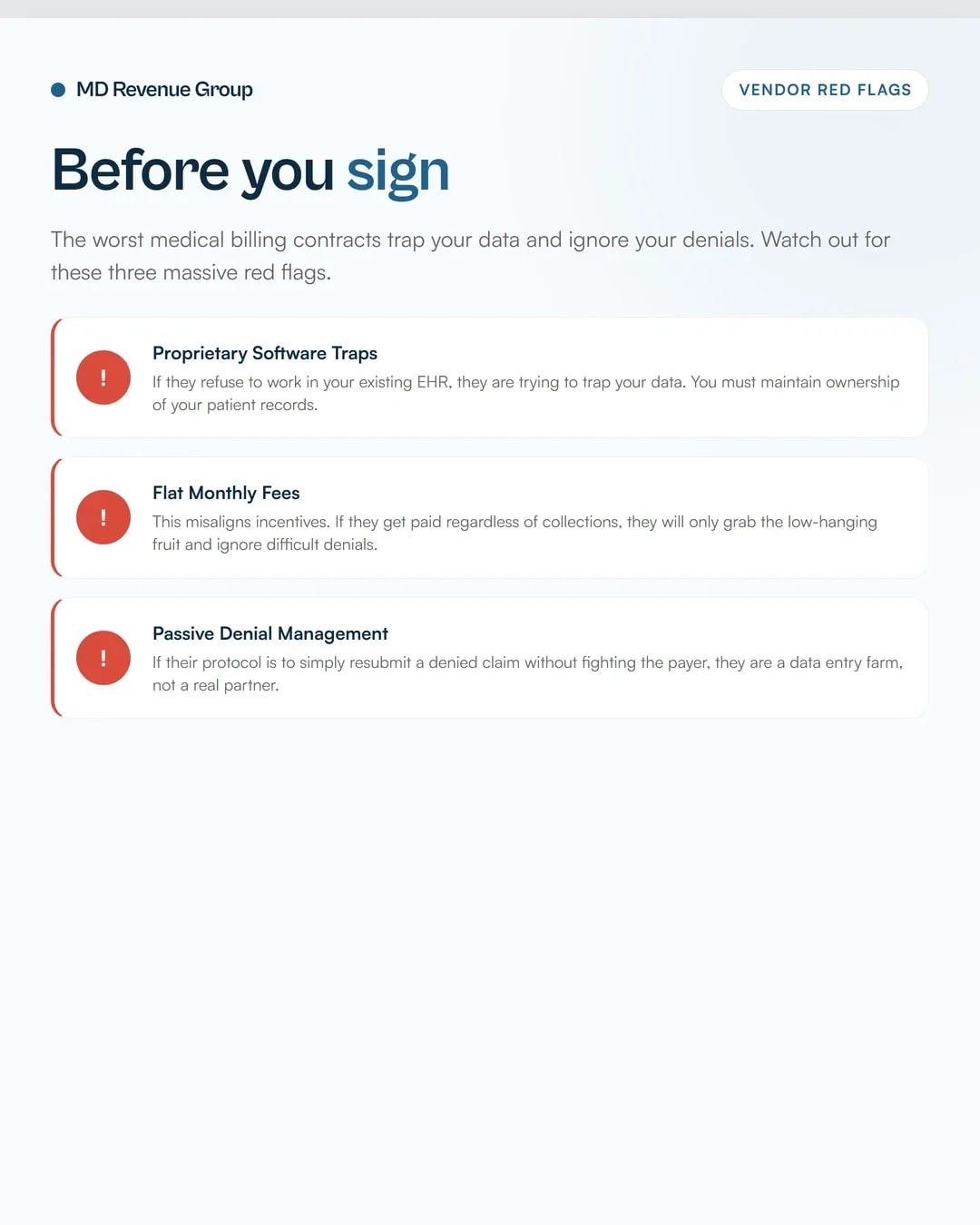
Watch out for vendors who refuse to work in your EHR. Many cheap billing companies force you to use their proprietary, outdated software. This traps your data. You want a partner who works directly within your existing system. You must maintain ownership of your patient records.
Check their denial management protocol. Ask them exactly what happens when a complex claim is denied. If their answer is to simply resubmit the claim without changing anything, do not hire them. They must have a dedicated appeals team that calls the payers and fights for your money.
Ask about their reporting cadence. You need a monthly financial review meeting, not just an automated PDF sent to your inbox. You need a human being to explain why your accounts receivable over 90 days is growing. You can request a free audit from our team to see what a real financial review looks like.
Strongest vs. Best: Choosing Your RCM Model
The strongest model is comprehensive revenue cycle management. The vendor handles everything from patient eligibility verification to final collection agency handoffs. They act as your entire financial department. It guarantees consistency and maximizes revenue. It is also the most expensive option and requires giving up significant control.
The best model is targeted outsourcing. You keep the front-end tasks like scheduling and copay collection in-house. You outsource the complex back-end tasks like claim submission, payment posting, and denial management. This takes the heavy lifting off your staff. It solves 95% of your revenue leakage while maintaining a personal touch with your patients at the front desk.
You must choose the best approach over the strongest approach if you value patient relationships. Total outsourcing can sometimes feel cold and corporate to your patients. Keep the patient-facing financial conversations in your office. Outsource the payer-facing battles.
A Selection Framework Based on Practice Size
You need to group your vendor selection strategy based on the specific complexity of your practice.
For the solo provider seeking stability, look for a boutique billing firm. You need a dedicated account manager who knows your practice by name. Do not hire a massive national corporation. You will be treated like a rounding error on their balance sheet.
For the mid-sized group looking for scale, focus on technology integration. You need a vendor that uses AI to scrub claims before submission. They must have a powerful analytics platform. The goal is to identify trends in payer denials across your multiple providers.
For the enterprise clinic aiming for maximum yield, you need a strategic partner. You need a vendor that offers coding audits, compliance training, and fee schedule analysis. They should actively advise you on how to negotiate better payer contracts.
Simplified Technical Data: Pricing Models Explained
The pricing models for billing services are notoriously confusing. Let me simplify what actually matters and what you can ignore.
You can ignore vendors who offer a flat monthly fee. This model misaligns incentives. If they get paid the same amount regardless of how much they collect, they will not fight the difficult denials. They will only grab the low-hanging fruit.
What matters is the percentage of net collections. This is the industry standard. The vendor takes a percentage of the money that actually hits your bank account. If you do not get paid, they do not get paid. This perfectly aligns their success with yours. Expect to pay between 4% and 8% depending on your specialty and volume.
What also matters are the hidden setup fees. Some vendors charge thousands of dollars just to connect to your EHR. Demand that these fees be waived or amortized over the first year. A confident vendor will waive the setup fee because they know they will make it back through increased collections.
Smart vs. Average Buying Behavior
Average practices wait for a financial crisis to look for a billing vendor. They panic when their primary biller quits or private equity consolidation disrupts their operations. They search Google, click the first ad, and sign a contract without reading it. Two months later, their revenue completely stops because the new vendor bungled the clearinghouse enrollment. They lose thousands of dollars due to rushed decisions.
Smart practices evaluate vendors when their cash flow is stable. They interview three different companies. They ask hard questions about clearinghouse setups and offshore staff. They demand a 90-day out clause in the contract. They understand that switching billing companies is a major surgical procedure for their business.
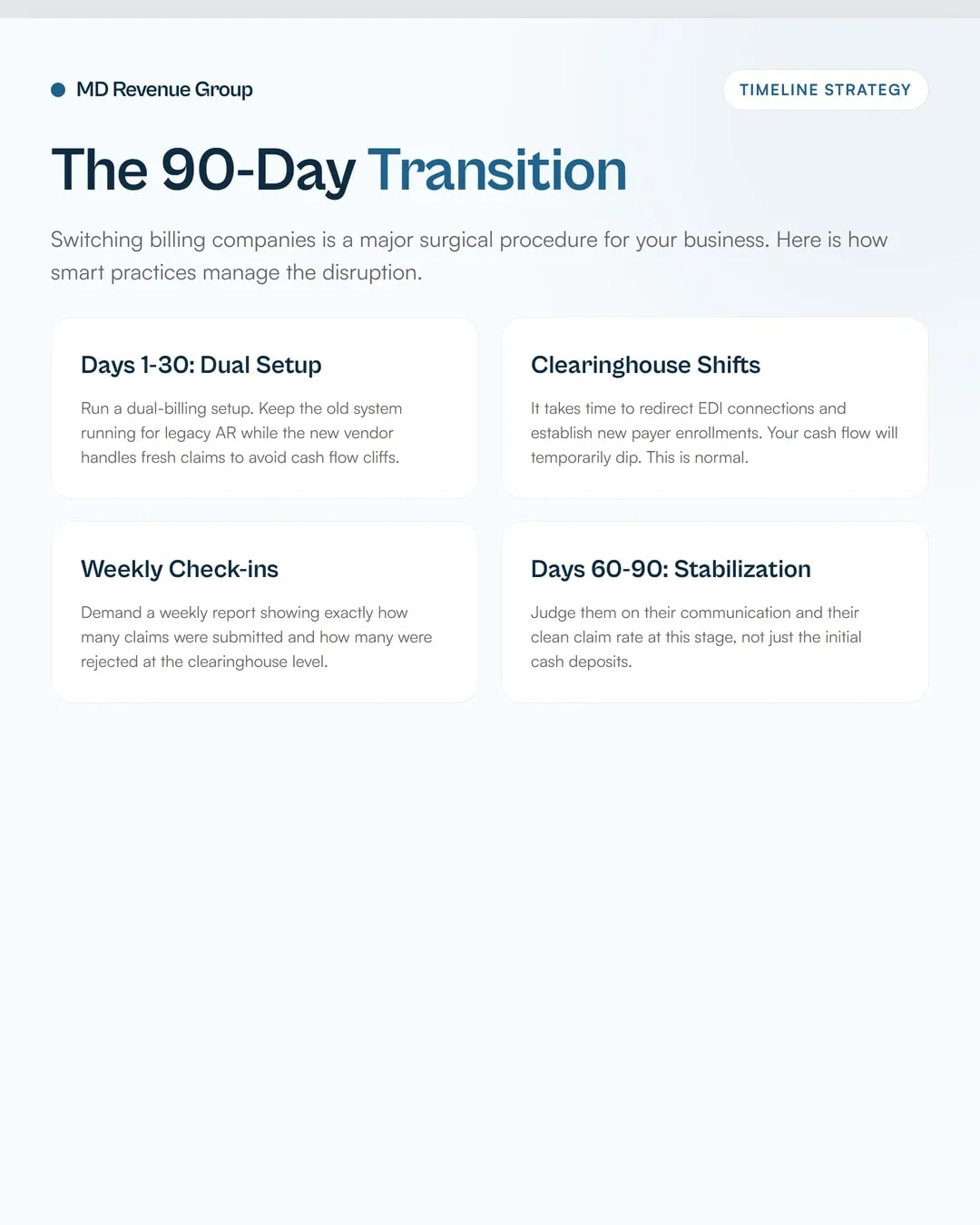
Once the smart practice selects a vendor, they plan a structured transition. They run a dual-billing setup for 30 days. They keep the old system running for legacy AR while the new vendor handles fresh claims. They build trust through verified performance.
Top Recommendations for Your Practice
For the independent surgical center, you must prioritize coding expertise. Surgical billing is entirely dependent on modifiers and complex operative reports. Do not hire a generalist firm. Hire a vendor with certified surgical coders on staff.
For the high-volume primary care clinic, prioritize speed and automation. You need a vendor that can process hundreds of claims a day without human intervention. Your margins are too thin to pay for manual data entry.
For the practice struggling with massive backlogs, consider a targeted clean-up project first. Hire a vendor to tackle your aging AR before committing to a long-term contract. Use our contact page to discuss a short-term AR recovery project. See how they perform on the hard stuff before handing over your entire revenue cycle.
The Hidden Risks of Offshore Billing
Many cheap billing companies outsource their labor to offshore teams. This is not inherently bad, but it introduces massive risks if managed poorly. Offshore teams excel at simple, repetitive data entry. They struggle with complex, detailed appeals.
You must ask your potential vendor exactly where the work is being done. If the team is offshore, ask how they handle payer phone calls. Many US-based insurance companies will hang up on offshore representatives. This means your difficult denials will simply sit untouched.
You must also verify their HIPAA compliance protocols. Offshore data security standards are different. Ensure the vendor assumes full liability for any data breaches. Do not let a cheap billing rate cost you a massive federal fine.
Managing the Transition Period
The first 60 days with a new billing vendor will be painful. Your cash flow will dip. This is normal. It takes time to redirect the clearinghouse connections and establish new payer enrollments.
You must set clear expectations with your staff and your new vendor. Establish a weekly check-in call during the transition. Demand a weekly report showing exactly how many claims were submitted and how many were rejected at the clearinghouse level.
Do not panic and fire the vendor after 30 days. It takes at least 90 days for the new revenue cycle to stabilize. Judge them on their communication and their clean claim rate, not just the initial cash deposits.
Outsourcing Medical Billing FAQs
How much does outsourcing medical billing cost? The industry standard is 4% to 8% of net collections. Be wary of anyone charging significantly less, as they likely offshore the work or ignore complex denials.
Will I lose control of my practice if I outsource? No. A good vendor works within your EHR and provides total transparency through dashboards. You retain full control of your patient data.
How long does it take to switch billing companies? A safe, structured transition takes 60 to 90 days. This allows time for clearinghouse enrollments and Electronic Data Interchange (EDI) setups.
What happens to my old uncollected claims (Legacy AR)? You can either keep your old staff to work the legacy AR or pay the new vendor a higher percentage to clean it up. The latter is usually the better option.
Do I still need a front desk staff? Yes. You still need staff to verify eligibility, collect copays, and answer patient questions. Outsourcing only replaces the back-office claim submission and denial management.
Why do some vendors charge a flat monthly fee? It guarantees their income regardless of performance. Avoid this model. Always choose a percentage-based model to align incentives.
What is the biggest red flag when hiring a billing company? Refusal to work in your existing EHR. If they force you to migrate to their proprietary software, they are trying to trap your data to prevent you from leaving.
Can I cancel my contract if the vendor performs poorly? Always demand a 90-day out clause without penalty. If they refuse to offer this, do not sign the contract.
See your revenue leaks in dollars.
Get a forensic 90-day cash flow audit of your practice. 100% confidential, 48-hour delivery, zero obligation.