
Medical Billing Audits in 2026: A Documentation-First Scope for Telehealth, Medicaid, and Part C
Build a documentation-first audit scope for 2026. Learn how medical billing auditing companies audit virtual care, Medicaid, and Medicare Advantage RADV risks.
Medical billing auditing companies evaluate claim documentation, code assignment, and compliance risks before or after payment posting. In 2026, external auditors focus heavily on automated payer edits, virtual check-in timing rules, and Medicare Advantage Risk Adjustment Data Validation (RADV) audits. Practices that conduct quarterly internal reviews identify billing errors before payers initiate clawbacks or administrative holds.
Key Takeaways
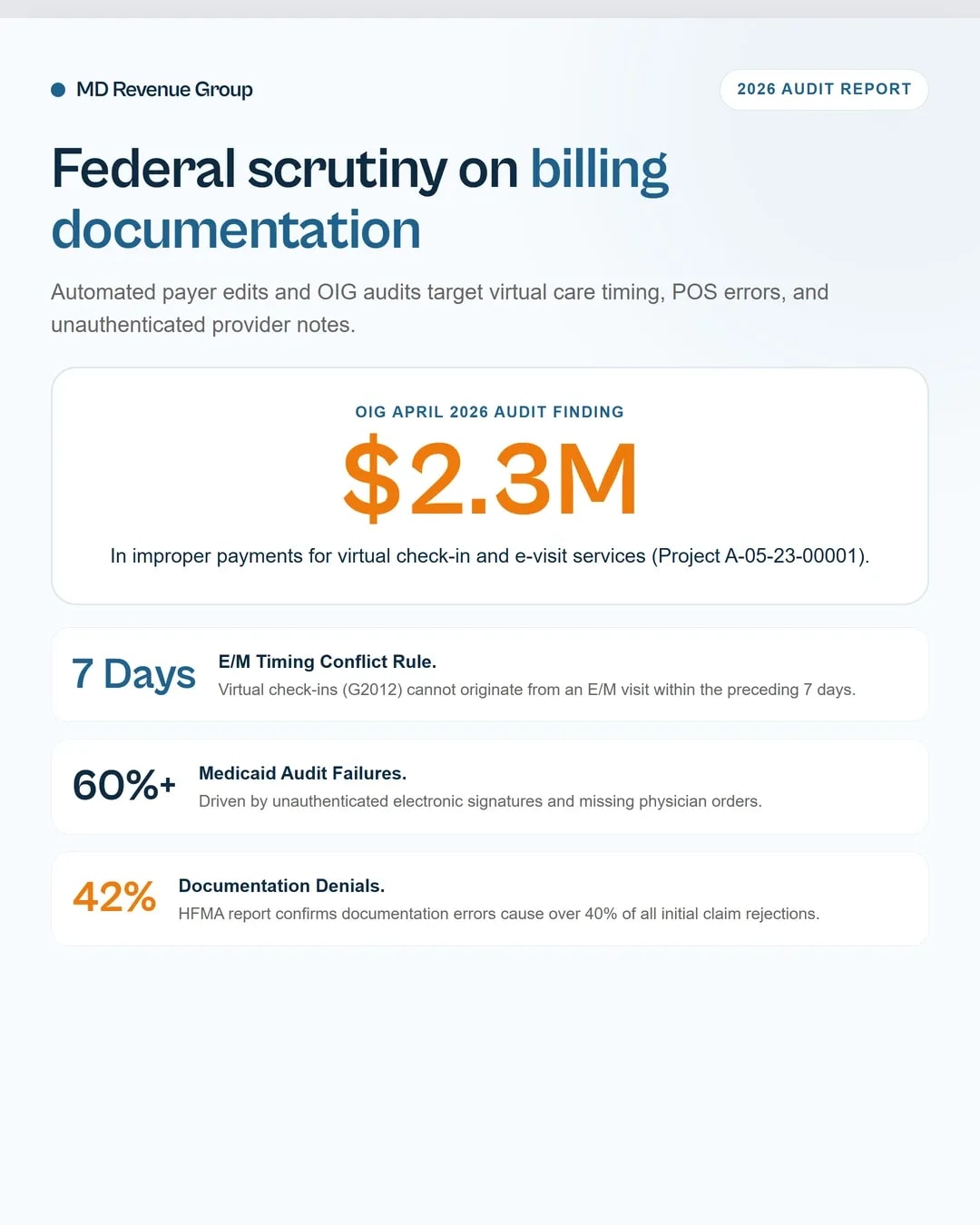
- The HHS Office of Inspector General identified $2.3 million in potential improper payments for virtual check-in and e-visit services in an April 2026 audit report (Project A-05-23-00001).
- Payer algorithms flag virtual check-in claims billed within 7 days after or 24 hours prior to an evaluation and management service sharing the same diagnosis code.
- Mismatched place of service codes (POS 02 for telehealth outside the home versus POS 10 for telehealth inside the home) trigger automatic payment reversals across commercial plans.
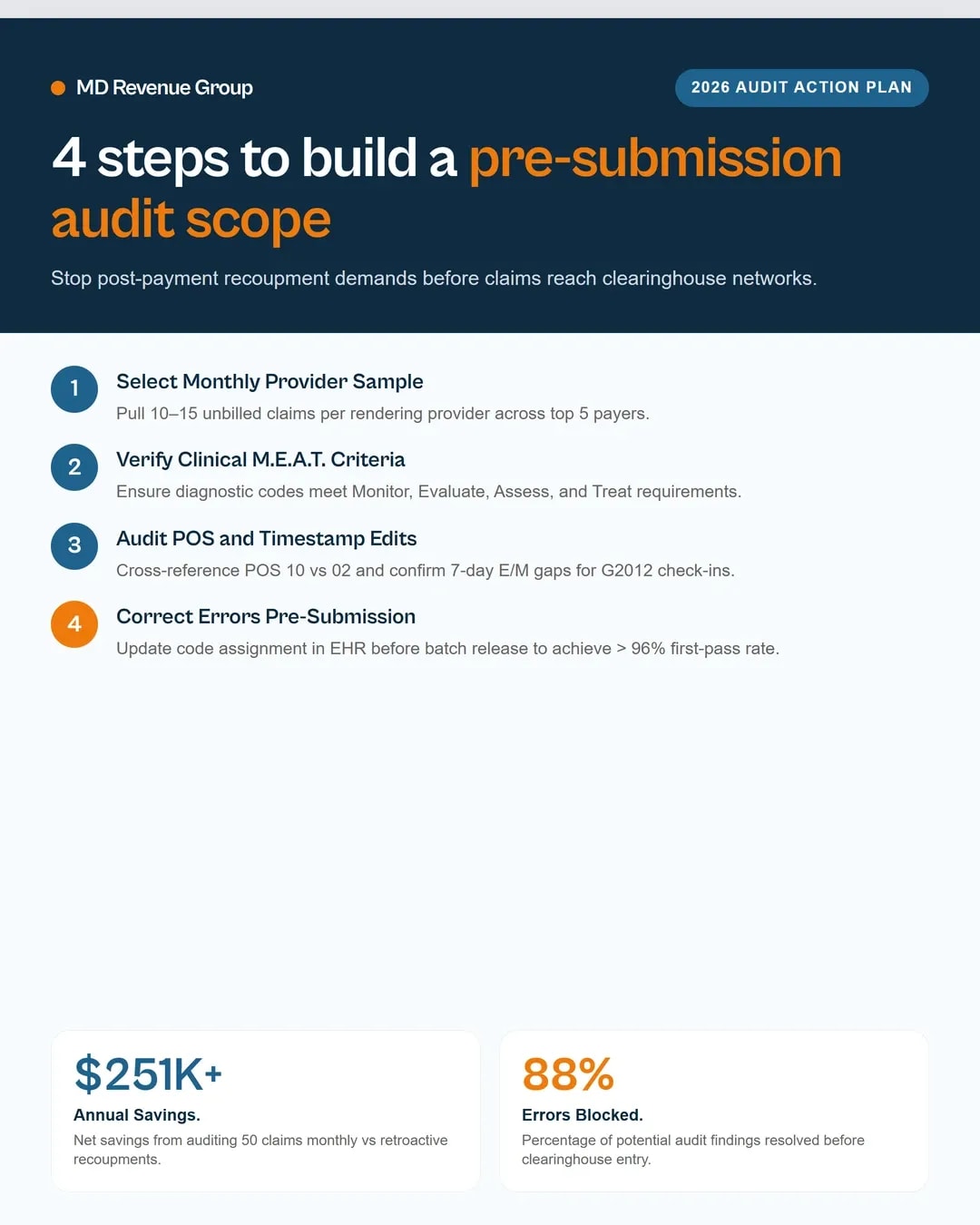
- Prospective pre-submission audits on a 50-claim monthly sample catch error patterns before claims enter clearinghouses, reducing denial rates below 4%.
Why medical billing audits are shifting to pre-submission controls
Commercial payers and Medicare Administrative Contractors (MACs) use automated claims processing rules to inspect every submitted line item. Retrospective audits that analyze paid claims from 12 months ago miss real-time claim edit changes.
When your practice relies on post-payment reviews, you discover coding mistakes only after payers issue recoupment demands. Contracting with experienced medical billing auditing companies allows your compliance team to audit claims prior to clearinghouse transmission.
The Healthcare Financial Management Association (HFMA) reported that final claim denials cost US healthcare organizations $48 billion in 2025, with documentation errors accounting for 42% of total rejections. Payers now deploy machine-learning tools that cross-reference provider notes against historical billing patterns.
If your billers submit claims without verified clinical notes, automated edits deny those services instantly. A structured audit scope fixes recurring root causes across your entire revenue cycle management workflow.
Post-Payment Audit (Retrospective)   ──►  Recoupment Demand Issued  ──►  Revenue Loss & Interest
Pre-Submission Audit (Prospective)   ──►  Claim Edit Corrected       ──►  Clean First-Pass Payment
Prospective audits target high-volume procedures and new modifier usages before claims leave your electronic health record system. By establishing internal error thresholds, medical practices catch unbundled service lines, invalid ICD-10 combinations, and missing provider credentials before submission.
Internal compliance teams recommend sampling 10 to 15 claims per rendering provider monthly. This focused sample size provides statistical confidence without overwhelming billing staff.
Scoping telehealth billing audits: OIG timing rules and place of service
Telehealth auditing requires verification of exact interaction timestamps, technology consent, and physical locations. In April 2026, the Department of Health and Human Services Office of Inspector General published audit findings (Project A-05-23-00001) showing $2.3 million in improper Medicare payments for virtual check-ins (HCPCS G2012) and e-visits (CPT 99421-99423).
The OIG found that providers frequently billed virtual check-ins within 7 days after an in-person evaluation and management (E/M) encounter. Medicare rules explicitly prohibit billing G2012 if the encounter originates from an E/M service provided within the previous 7 days or leads to an E/M service within the next 24 hours (or earliest available appointment).
[Day 1: In-Person E/M (99213)]  ───(Must wait > 7 Days)───►  [Virtual Check-In (G2012) Allowed]
               │
               └───(If billed within 7 Days)───► [OIG Audit Flag: Non-Covered / Recoupment]
Audit teams must also inspect Place of Service (POS) indicators on claims. POS 02 applies when the patient receives telehealth services in a location other than their home, such as a rural clinic. POS 10 applies when the patient is located in their home during the encounter.
Submitting POS 02 for a home-based visit results in non-facility payment rate adjustments and triggers audit flags for multi-state billing. Group practices operating medical billing services in New Jersey must verify state-specific telehealth consent mandates during every quarterly review.
A real-world example occurred at a mid-sized specialty practice in 2025. Internal auditors discovered that 310 virtual check-in claims billed over six months lacked documented time duration and technical consent. The practice voluntarily corrected its billing logs, preventing a $43,000 post-payment recoupment demand from regional MAC auditors.
Audit scopes must also evaluate audio-only modifier usage. Append modifier FQ when audio-only communication technology is used for mental health services. For non-behavioral audio-only visits, modifier 93 must be present. Missing these modifiers leads to automated claim rejection by commercial clearinghouses.
Medicaid and Medicare Advantage Part C RADV documentation risks
Medicare Advantage plans conduct rigorous Risk Adjustment Data Validation (RADV) audits to verify hierarchical condition category (HCC) coding accuracy. The Centers for Medicare & Medicaid Services (CMS) audits medical records to confirm that documented diagnoses meet the M.E.A.T. criteria (Monitor, Evaluate, Assess, Treat).
If a physician lists chronic conditions in the diagnostic summary without documenting active evaluation or treatment during the visit, RADV auditors invalidate the code. This results in extrapolation penalties applied across the provider's entire Medicare Advantage patient cohort.
For Medicaid populations, state audit agencies inspect non-emergency medical transportation, behavioral health authorizations, and modifier compliance. Practices managing Texas medical billing operations face strict audit requirements for Medicaid prior authorization attachments and physician signatures.
Reviewing published CMS improper payment findings shows that unauthenticated electronic signatures and missing physician orders represent over 60% of all Medicaid documentation audit failures.
M.E.A.T. Requirement   Clinical Note Documentation Standard
──────────────────────────────────────────────────────────────────────────────────────────
Monitor                Document lab values, vital signs, or symptom progression tracking.
Evaluate               Note diagnostic test results, diagnostic responses, or clinical progress.
Assess                 Record physician clinical impression, stability status, or severity.
Treat                  Outline prescription updates, therapy orders, or surgical plans.
When auditing Medicaid managed care plans, reviewers must confirm that rendering providers maintain active enrollment in state provider registries. If an ordering physician's NPI is not fully registered in the state Medicaid portal, the payer reverses the entire facility and professional claim line.
State-specific audit enforcement: NJ, NY, and Texas compliance triggers
State regulatory agencies enforce unique billing audit standards alongside federal CMS guidelines. Multi-state group practices must customize audit checklists to address regional compliance triggers.
In New Jersey, the Office of the State Comptroller (OSC) conducts targeted audits on Medicaid fee-for-service and managed care claims. New Jersey auditors require explicit proof of patient consent for telehealth encounters and strict adherence to itemized billing regulations. Practices utilizing New York medical billing protocols must account for NY Office of the Medicaid Inspector General (OMIG) self-disclosure requirements, which mandate reporting coding errors within 60 days of identification.
State Jurisdiction   Primary Audit Agency                  Key Audit Risk Area
──────────────────────────────────────────────────────────────────────────────────────────
New Jersey           Office of the State Comptroller (OSC) Telehealth consent & itemized billing
New York             Office of Medicaid Inspector General  60-day mandatory self-disclosure
Texas                Health & Human Services OIG           Medicaid prior auth & NPI registry
Texas Medicaid enforcement focuses heavily on provider revalidation deadlines and prior authorization attachment verification. If a Texas group practice fails to confirm provider credentialing dates every 3 years, Medicaid contractors place reimbursement holds on all pending claim batches.
Proprietary calculation: The true cost of retroactive claim recoupments vs. prospective auditing
Retroactive claim clawbacks cost significantly more than the face value of the returned reimbursement. When a payer demands a recoupment, your practice incurs administrative labor costs, legal consulting expenses, and interest charges.
Consider a 6-physician practice submitting 2,400 claims monthly with an average claim value of $180. The math demonstrates the financial impact of post-payment audits versus pre-submission reviews:
PROPRIETARY REVENUE INTEGRITY CALCULATION:
Scenario A: Retrospective Recoupment (No Pre-Submission Audit)
Monthly Claim Volume: 2,400 claimsAnnual Billed Revenue: 28,800 claims × $180 = $5,184,000Retrospective Audit Error Rate (Payer Audit): 4.5%Recoupment Amount: $5,184,000 × 0.045 = $233,280Administrative Re-adjudication Labor: 1,296 staff hours × $32/hr = $41,472Statutory Payer Interest (6% per annum): $13,996Total Annual Retrospective Loss: $288,748
Scenario B: Prospective Pre-Submission Audit (50-Claim Monthly Sample)
Monthly Internal Audit Investment: 12 hours × $65/hr = $780/month ($9,360/year)Error Prevention Rate: 88% of potential audit errors caught pre-submissionRemaining Recoupment Exposure: $233,280 × 0.12 = $27,993Administrative Re-adjudication Labor saved: $36,495Total Annual Prospective Cost: $9,360 + $27,993 = $37,353
NET ANNUAL SAVINGS WITH PROSPECTIVE AUDITING:
$288,748 (Scenario A) - $37,353 (Scenario B) = $251,395
By auditing 50 random claims each month before submission, the practice saves $251,395 annually in avoided recoupments and administrative rework.
Decision matrix: Prospective vs. retrospective audit scope selection
Choosing between prospective (pre-submission) and retrospective (post-payment) audit models depends on your practice size, historical denial rates, and compliance history. Use this matrix to determine the correct audit framework:
Operational Metric | Prospective Audit Scope | Retrospective Audit Scope | Hybrid Audit Scope |
|---|---|---|---|
Primary Objective | Prevent claim denials before submission | Identify historical coding trends and systemic leakage | Combine pre-claim edits with annual compliance reviews |
Sample Size | 10–20 claims per provider per month | 50–100 claims per provider annually | 15 claims monthly + 30 claims annually |
Best For | New providers, high-risk coding changes, new telehealth codes | Established practices with clean claim rates > 96% | Multi-specialty groups with high payer turnover |
Turnaround Time | 24–48 hours before billing batch release | 30–60 days post-payment | Monthly reporting cycles |
Financial Impact | Immediate cash flow protection | Identifies underbilling and missed revenue opportunities | Complete coverage of cash flow and compliance |
Literal documentation examples for virtual care notes
Generic statements like "patient examined via video" fail audit scrutiny. Auditors require detailed documentation showing duration, modality, platform security, and clinical content.
Non-Compliant Telehealth Note Example:
"Spoke with patient via video call regarding persistent knee pain. Advised to continue exercise and ice. Follow up in two weeks."
Why it fails: Missing start and end times, missing technical consent, missing location of patient, missing confirmation of secure HIPAA-compliant platform, and no mention of specific E/M elements.
Compliant Telehealth Note Example:
"Service performed via interactive audio-video technology (HIPAA-compliant Zoom Healthcare portal). Patient located at personal residence (POS 10) in Trenton, NJ. Provider located at clinic office (Trenton, NJ). Patient gave verbal consent for telehealth treatment. Total visit time: 22 minutes (16 minutes spent in direct medical decision making). Patient reports left knee pain (M25.562) rated 5/10 over the past 4 days. Evaluated Range of Motion via visual observation; mild swelling noted anteriorly. Prescribed Naproxen 500mg twice daily; instructed on home quadriceps strengthening exercises. Follow-up scheduled in 14 days."
This compliant note supports CPT 99213 with POS 10 and satisfies all regional auditor criteria for time-based coding. Automated edits flagging virtual check-in claim edits pass this note without human intervention.
Checklist: What to ask medical billing auditing companies before signing
Before hiring an external auditing partner, evaluate their technical capabilities, credentialing standards, and audit scope.
- Are your auditors certified by AAPC or AHIMA? Ensure all audit staff hold CPC, CPMA, or CCS credentials.
- Do you offer prospective pre-submission auditing? Verify if claims can be reviewed within 24 hours to prevent clearinghouse delays.
- How do you handle specialty-specific billing rules? Confirm experience in your specific medical specialty and regional MAC Local Coverage Determinations.
- What reporting deliverables do you provide? Request sample executive summaries, provider error rate scorecards, and corrective action plans.
- How do you audit AI payer algorithms? Ask how the firm tracks downcoding patterns driven by commercial payer claim edits.
Author Byline
Written by the MDRG Revenue Integrity Team. Reviewed by Ruben Moreno, Certified Healthcare Compliance Specialist, with over 14 years of experience managing physician billing audits, OIG compliance plans, and payer dispute workflows.
Ready to protect your practice revenue?
Struggling with billing errors or audit notices? MD Revenue Group audits clinical documentation, identifies hidden code errors, and blocks payer recoupments. Request a free revenue cycle audit today to evaluate your billing integrity.