
Behavioral-Health Patient Collections and Good-Faith Estimates: A Compliance-Safe Workflow
A compliance-safe workflow for behavioral health patient balances, good faith estimates, disputes, and payment plans that hold up." author:
Behavioral-health patient collections start earlier than most practices think. The moment a patient asks "roughly what will this cost?" you've been asked for a good faith estimate, whether you called it that or not. Federal rule requires a written estimate within 3 business days of that question, and failing it opens a dispute process you can't opt out of.
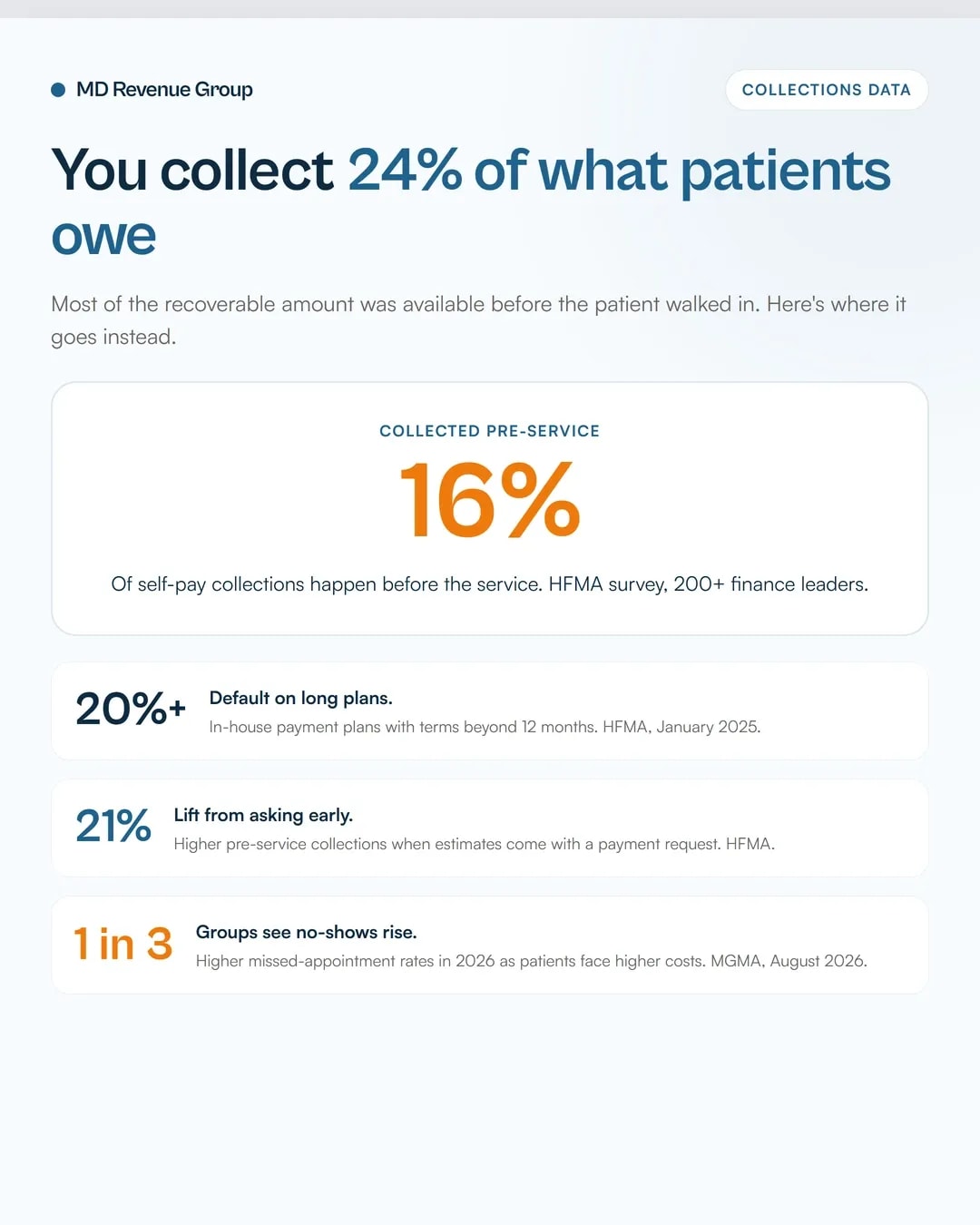
Two numbers frame the whole problem. Providers collect just 24% of patient out-of-pocket billings, per an HFMA survey of 200-plus healthcare finance leaders. And only 16% of self-pay collections happen before the service, per the same survey. Most of the money you're chasing after the visit was available before it.
The federal requirement is narrower than most practices assume. Good faith estimates under 45 CFR 149.610 apply to uninsured and self-pay patients only. An insured patient who declines to submit a claim counts as self-pay. An insured patient using their coverage does not, and the advanced explanation of benefits that would cover them is still not in effect.
That leaves you with a specific obligation and a specific set of numbers. Here's how the workflow actually works.
If you want the short version of the whole revenue cycle instead, our behavioral health billing service page covers where collections sit relative to coding, credentialing, and authorization.
Key takeaways
- Any conversation about price counts as a request for a good faith estimate. 45 CFR 149.610(b)(1)(iv) says so explicitly.
- The deadline is 3 business days from the request, or 1 business day if the patient scheduled at least 3 business days out.
- The $400 threshold is measured per provider or facility, not across the whole visit. One $450 overage qualifies even if the total bill came in under.
- A dispute must be filed within 120 calendar days of the first bill, and collection efforts must stop while it's pending.
- For services that weren't on the estimate, a provider who can't show unforeseen necessity owes $0 for that line.
- The good faith estimate is part of the medical record. You must be able to produce any estimate from the last 6 years.
- The advanced explanation of benefits for insured patients has no effective date yet. Don't build a workflow around it.
- The CFPB's medical debt credit reporting rule was vacated nationwide on July 11, 2025. There is no federal prohibition on medical debt reporting right now.
Who actually needs a good faith estimate
Federal law covers two groups, and only these two:
- Uninsured patients, someone with no coverage under a group health plan, individual or group insurance, a federal health care program, or a federal employees health benefits plan
- Self-pay patients, someone who has coverage but declines to have the claim submitted to it
That second group catches practices off guard. A patient with excellent coverage who says "I'd rather not use my insurance for this" is a self-pay patient. You owe them an estimate. A patient who uses their insurance is not, and you owe them nothing under this rule yet.
Emergency services are excluded. So are walk-ins and anything unscheduled. The rule is built around planned care.
Determining which bucket a patient falls in is your first step, and 45 CFR 149.610(b)(1) spells out how: ask about enrollment, ask whether they want a claim submitted, and inform all uninsured or self-pay patients that estimates are available on request, in writing on your website, in the office, and verbally at scheduling.
That last part trips people up. The availability notice has to be prominent and searchable on your website, displayed in the office where scheduling happens, and provided orally at scheduling. All three.
The deadlines that catch practices off guard
Here's the timeline most practices get wrong, straight from the regulation:
When | Estimate due |
|---|---|
Patient schedules at least 10 business days out | 3 business days after scheduling |
Patient schedules at least 3 business days out | 1 business day after scheduling |
Patient requests an estimate | 3 business days after the request |
Scope changes before the service | 1 business day before the service |
The co-provider clock runs alongside it. When you schedule, you have 1 business day to contact every co-provider who will furnish items or services alongside the primary service, and they have 1 business day to respond. If you're a therapist referring a patient for lab work, you're the convening provider for the initial request.
Then there's the substitution rule. If a co-provider changes less than 1 business day before the service, the replacement provider inherits the original estimate. You can't reset the number by swapping in a different clinician.
What the estimate has to contain
The content requirements in 45 CFR 149.610(c)(1) are longer than most templates. The list includes:
- Patient name and date of birth
- The primary item or service in plain language, with the scheduled date if applicable
- An itemized list grouped by each provider or facility, including co-providers
- Applicable diagnosis codes, expected service codes, and expected charges for each line
- Name, National Provider Identifier, and Tax Identification Number of every provider or facility, plus the state and location where services will happen
- A list of items that require separate scheduling, with a disclaimer directly above it
- A disclaimer that additional recommended services may not be reflected
- A disclaimer that actual charges may differ
- A disclaimer explaining the right to dispute, where to find the information, and that using the dispute process doesn't affect the quality of care
- A disclaimer that the estimate is not a contract
The patient name and date of birth requirement catches templates that start with a service description. The NPI and TIN requirement is why you can't just estimate for "the clinic."
If you use a state process, it has to meet or exceed the federal standard. Under 45 CFR 149.610(f)(2), a state process that falls short means you're out of compliance with the federal rule. HHS determines which states qualify under 45 CFR 149.620(h) and publishes that determination, and states have to apply to be listed.
New York runs one through its Department of Financial Services. If you bill there, confirm where the patient has to file, because the state process replaces the federal one for covered items. We covered the New York specifics in our New York billing guide.
Practices that bill behavioral health in more than one state should treat this as two separate compliance reviews rather than one. Which brings up the service mix itself. A practice carrying both therapy and addiction treatment billing has a second consent and disclosure layer that changes what can even appear on a statement.
What happens when the bill comes in higher
The patient-provider dispute resolution process is patient-initiated, federal, and outside your control. The sequence under 45 CFR 149.620 runs like this:
- Patient files an initiation notice with HHS within 120 calendar days of the initial bill
- Patient pays a $25 administrative fee to the dispute entity
- HHS assigns a selected dispute resolution entity
- The entity gives the patient 21 calendar days to cure an incomplete submission
- You have 10 business days to submit the estimate, the bill, and documentation on unforeseen necessity
- The entity rules within 30 business days
Two things stop the moment a dispute is filed. Collection efforts must halt, including if the account already went to collections, and late fees stop accruing. Retaliation against a patient for filing is prohibited.
If the parties settle instead, you must notify the entity within 3 business days and reduce the patient's settlement by at least half the administrative fee, which works out to $12.50.
The $400 rule most practices misunderstand
"Substantially in excess" is defined precisely. Under 45 CFR 149.620(a)(2), it means billed charges are at least $400 more than the total expected charges listed for that provider or facility.
Per provider. Not per visit. A patient who sees a therapist and a lab on the same day can have a combined bill well under 400 over its own portion.
What the entity decides depends on whether the item was on the estimate:
Situation | Determination |
|---|---|
On the estimate, billed at or under expected charge | Billed charge |
On the estimate, billed higher, no credible info on unforeseen necessity | The expected charge |
On the estimate, billed higher, credible info provided | Lesser of billed charge or median in-network payment for a similar service in the area |
Not on the estimate, no credible info | $0 |
Not on the estimate, credible info provided | Lesser of billed charge or median in-network payment in the area |
That fourth row is the one that changes behavior. An unplanned service with no documentation of unforeseen necessity is worth $0 to you. Documentation is the entire defense.
One more protection: if the independent database amount comes out below the expected charge on the estimate, the amount to be paid is the expected charge, not the lower figure.
Your two safe harbors
45 CFR 149.610(f) gives you two ways out of a good faith estimate mistake, and most practices have never read them.
The good faith and due diligence safe harbor. You don't fail to comply if you acted in good faith, used reasonable due diligence, made an error or omission anyway, and corrected it as soon as practicable. The regulation says it directly. This is why process matters more than perfection.
The reliance safe harbor. If compliance requires information from another entity, like a co-provider, and you relied on it in good faith, you don't fail to comply. Unless you knew or should have known the information was wrong. If you learn it was wrong, correct it as soon as practicable.
Both harbors share a condition: if the services were already furnished before you fixed the error, the patient may still be able to dispute. The safe harbor protects you from a compliance finding, not from the dispute itself.
Recurring treatment and the 12-month estimate
This one is built for behavioral health specifically. Weekly therapy is a recurring primary item or service, and 45 CFR 149.610(b)(1)(x) lets you issue a single estimate covering up to 12 months.
The estimate has to state the expected scope clearly: timeframes, frequency, and total number of recurring services. If you expect the course to run past 12 months, or if scope changes, you issue a new one and tell the patient what changed between the old estimate and the new one.
For an IOP or PHP program running a defined session count, this is where it pays to be precise about the number. "Weekly group therapy, 36 sessions" is defensible. "Weekly group therapy as clinically indicated" gives a patient room to argue, and gives you a dispute you can't win. Our guide to group therapy, IOP, and PHP billing covers how those settings differ on the claim side, which affects what belongs on the estimate.
Building the collections workflow
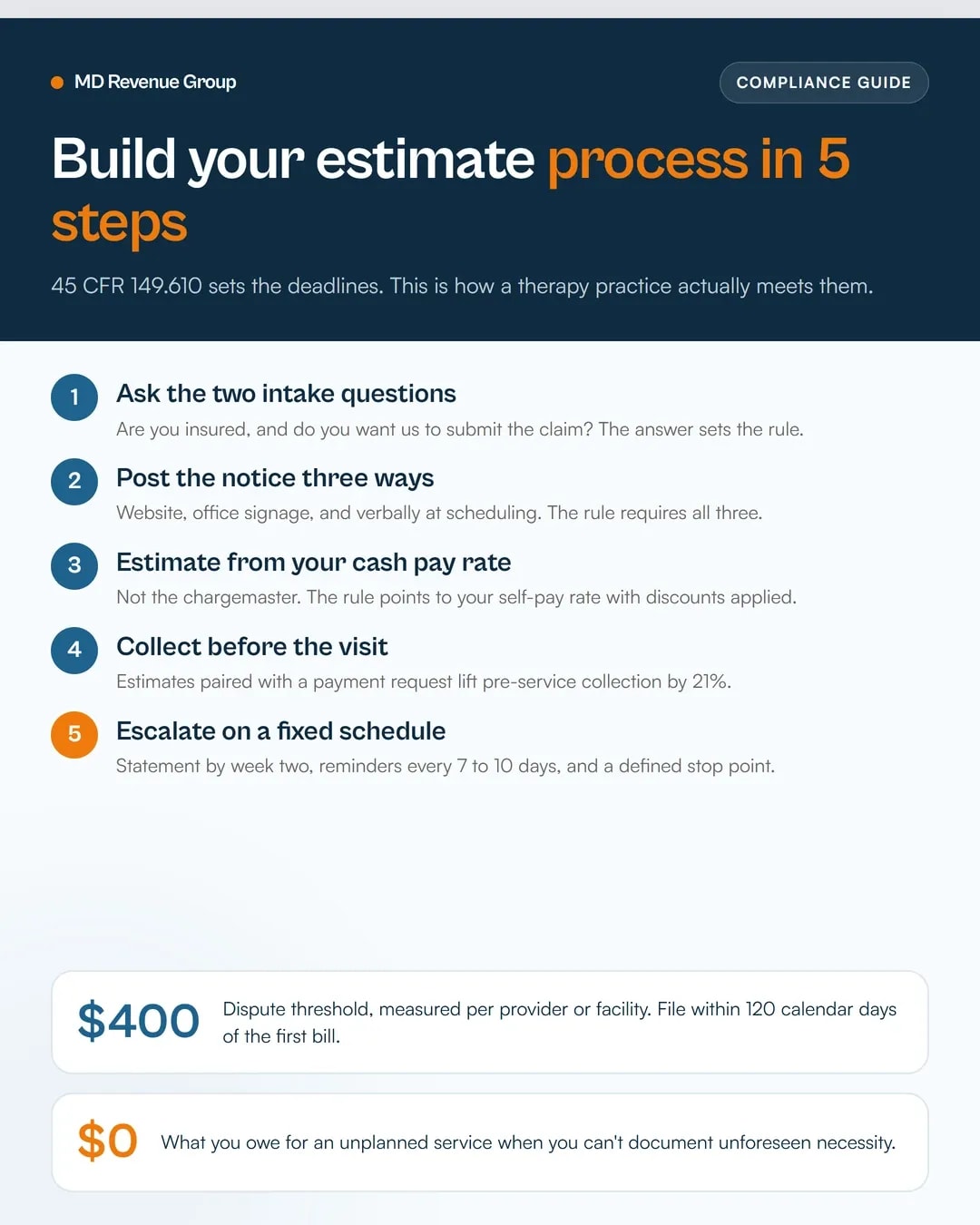
Now the part that actually moves money. A compliant behavioral health collections process has 5 stages.
1. Determine uninsured or self-pay status at intake. Two questions: are you enrolled, and do you want us to submit the claim. Capture the answer in the record. This determination drives everything downstream.
2. Provide the availability notice three ways. Website, office, and verbally at scheduling. Most practices do the website and skip the other two, which leaves a clear compliance gap.
3. Build the estimate from a current source, not memory. The regulation defines expected charge as the cash pay rate or rate established for uninsured or self-pay individuals, reflecting any discounts. If your front desk estimates from the chargemaster while your published self-pay rate is lower, your estimate is wrong by construction.
4. Collect pre-service. Only 16% of collections happen here, per HFMA. Practices that encourage or require pre-service payment see a 21% lift in pre-service collections and 20% higher overall collection rates, according to that same survey. Only 1 in 4 hospitals run presumptive eligibility checks before service, which is a free way to catch patients who qualify for assistance.
5. Escalate on a schedule, with a stop. Send the first statement within 1 to 2 weeks of balance creation. Remind every 7 to 10 days. Stop at the point where sending to collections costs you more than writing off.
On payment plans, the HFMA numbers are sobering. In-house plans with terms longer than 12 months default above 20%, and the average hospital or health system carries outstanding payment plan balances twice as high as its annual payment plan collections. 62% of providers don't work with third-party financing partners at all.
A written patient financial policy that names the escalation timeline, the contact attempts, and the stop point protects staff from having to improvise. It also protects the patient from inconsistent treatment. New Jersey already legislates a piece of this, and we covered the itemized billing statement requirement separately.
Timing matters because of the no-show data. About 1 in 3 medical groups saw higher no-show rates in 2026 as patients faced higher costs, per an August 2026 MGMA Stat poll. Behavioral health runs 15% to 25% no-show against 8% to 15% for cardiology. Every empty slot is a balance you never create and never collect.
What changes in the next 18 months
Two things are coming. Neither requires you to act yet.
The advanced explanation of benefits. The No Surprises Act requires payers to send insured patients an AEOB before care, built from a good faith estimate the provider gives the plan. Agencies issued a Request for Information on September 16, 2022 (87 FR 56905) and have been working through data standards since. As of now there is no effective date.
Practices under pressure to build AEOB data feeds are building against a spec that doesn't exist. Hold.
State-level debt protections are moving faster than federal ones. Roughly 15 states now limit medical debt credit reporting, and 9 of those statutes took effect in 2025 or 2026. Oregon's Senate Bill 605, for example, took effect January 1, 2026 and limits both furnishing medical debt to credit bureaus and bureaus reporting it. The Commonwealth Fund's August 2026 analysis notes that 19 states collect no data at all on hospital financial assistance or collections actions.
The federal picture went the other direction, and practitioners often get the timeline wrong. The CFPB's Regulation V rule was finalized in January 2025 and set to take effect March 17, 2025. It would have removed medical debt from credit reports entirely, covering an estimated $49 billion across 15 million Americans. Then a federal court in the Eastern District of Texas vacated the rule in its entirety on July 11, 2025, holding it exceeded the CFPB's statutory authority under the Fair Credit Reporting Act. That vacatur is nationwide.
So there is no federal prohibition on medical debt credit reporting today. The CFPB is working on a replacement proposal, and that proposal is subject to the same preemption question the court raised.
Check your state's law before assuming anything. That matters for you in two ways. The vacatur opinion also raised preemption of state bans, which is unsettled. And the FDCPA and Regulation F always applied to third-party collectors rather than provider billing offices, so your own collection practices sit under state law and your financial policy regardless of what happens federally. Which is exactly why New Jersey and New York need more care than the federal baseline.
Your good faith estimate duty is live now, and the AEOB wait doesn't touch it. Build the estimate workflow, hold the data feed work until the rule exists, and have your state-specific collections review done before someone does it for you.
One last thing that touches every section above. Behavioral health records carry consent and disclosure obligations on top of the estimate rules, and a careless collections workflow can run into them. If your team handles substance use disorder records alongside ordinary psychotherapy notes, our 42 CFR Part 2 consent rules guide covers the boundaries.
Behavioral health practices collect 24% of what patients owe, per HFMA, and most of the recoverable amount is decided before the patient arrives. We review patient balance workflows, financial policies, and estimate processes for practices across New Jersey and New York. Book a revenue cycle consultation and we'll tell you which of the five stages above is leaking money for you.
Reviewed by Ruben Moreno, CPC, CPMA. Requirements described reflect 45 CFR 149.610 and 149.620 as current in September 2026. State collections and debt-reporting rules vary and change. Confirm state-specific obligations with counsel before relying on this workflow.