How a 5-Physician NJ Group Recovered $150K: A NJ Revenue Integrity Case Study
In this NJ revenue integrity case study, discover how a 5-physician group recovered $150K in unpaid claims and billing leakage.
--- title: slug: date: 2026-07-13 category: NJ Local Authority target_keyword: NJ revenue integrity case study meta_title: meta_description: author: Ruben Hassid reviewed_by: Arslan status: draft ---
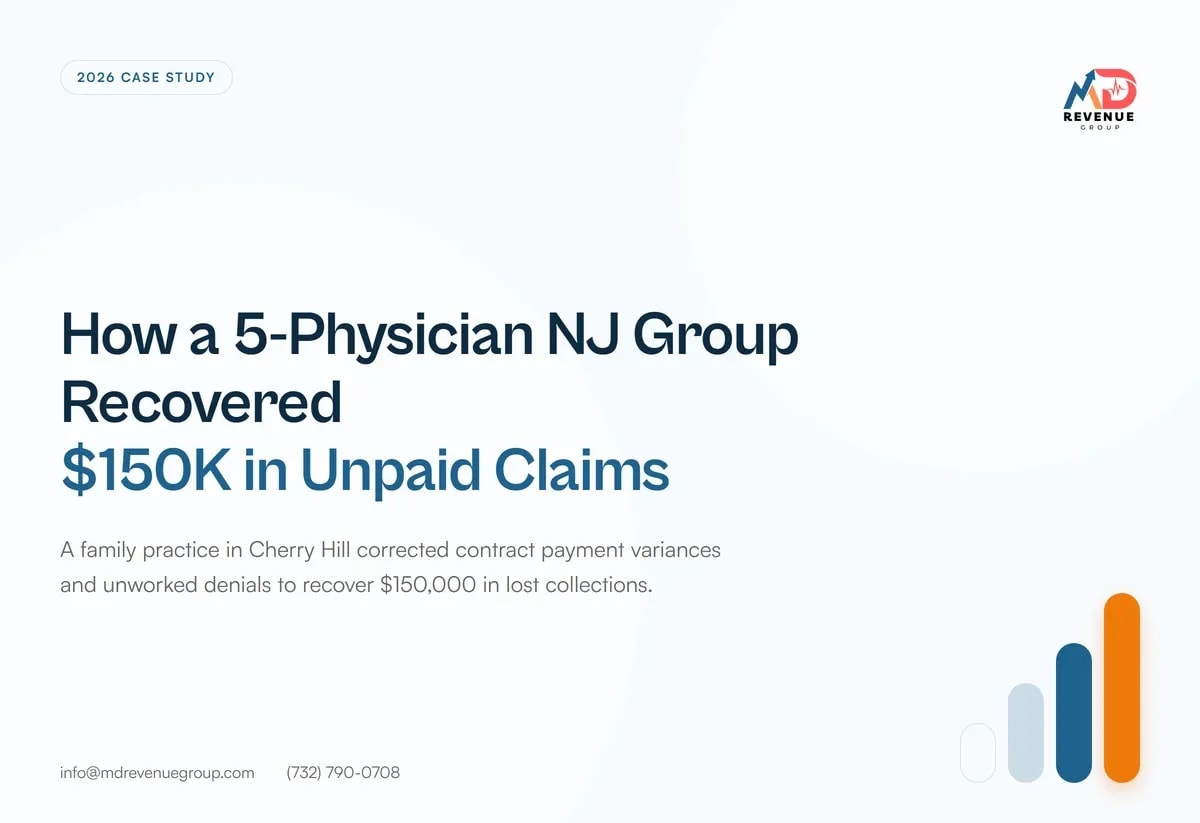
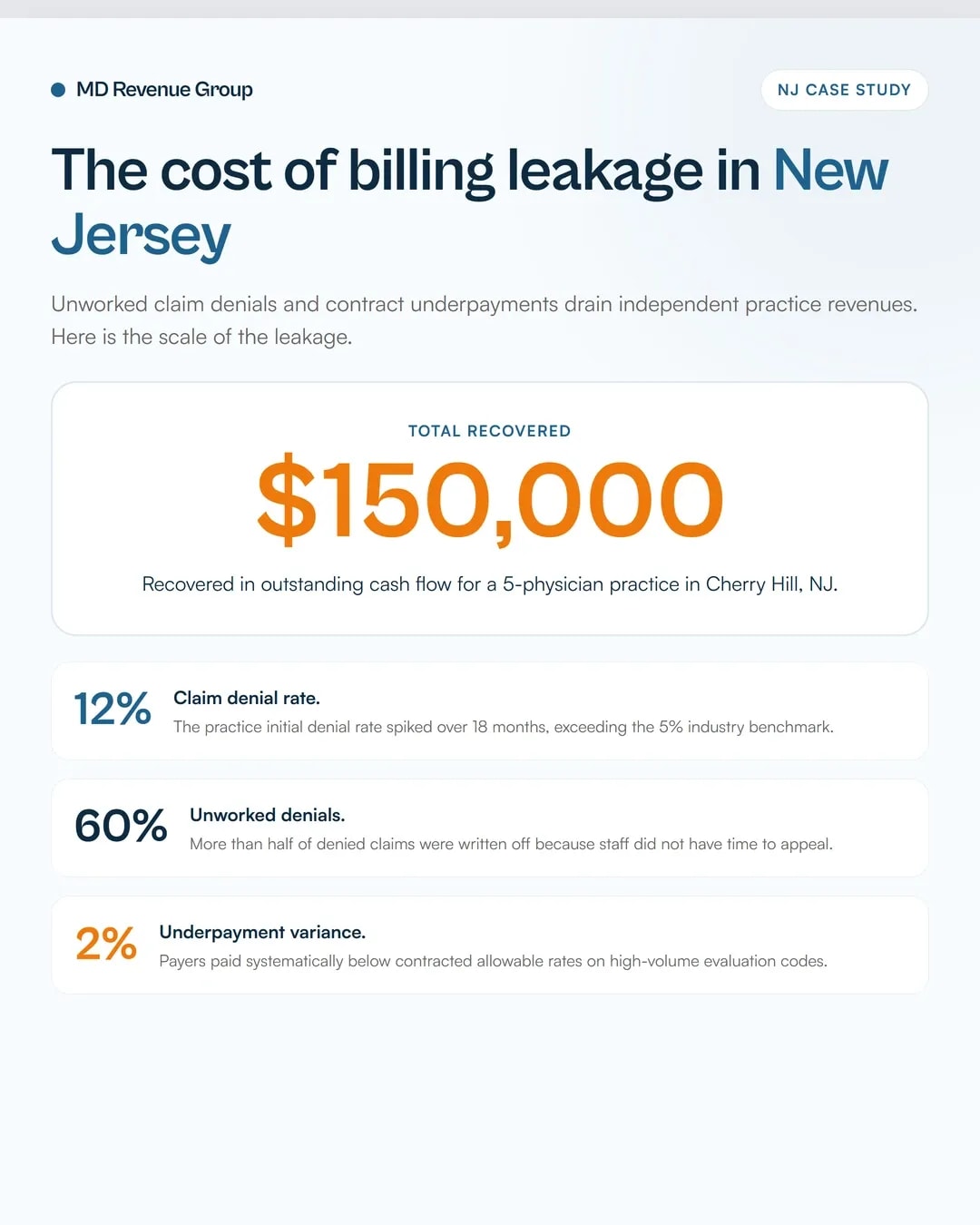
This NJ revenue integrity case study shows how a 5-physician group in Cherry Hill, NJ recovered $150,000 in unpaid claims and contract underpayments. The group saw their initial claim denial rate spike to 12% in early 2026, with over 60% of those denials going completely unworked due to billing staff shortages. By deploying advanced revenue integrity tools, the practice identified system-wide payer underpayments that deviated from their contracted fee schedules by 2% on average. Within 6 months, the group resolved their billing errors, recovered $150,000, and established a consistent workflow. According to 2026 MGMA data, 84% of medical groups are now reporting year-over-year operating cost increases averaging 11%, while only 47% report revenue gains. That margin squeeze makes every dollar of payer underpayment a direct hit to survival. If your practice doesn't collect what you contracted for, this analysis shows exactly how to plug the leaks.
Key takeaways
- The primary source of leakage was undetected payer underpayments that deviated from the practice's contracted fee schedules.
- Over 60% of initial claim denials went unworked because the practice did not have enough billing staff to handle the appeal volume.
- Automated contract compliance tools identified systemic payment variances on high-volume E/M codes.
- Correcting modifier errors and resubmitting underpaid claims recovered $150,000 in cash flow.
- Regular billing audits prevent payers from systematically underpaying for services.
Why this NJ medical practice had a $150K revenue leak
The Cherry Hill family practice had 5 active physicians and a busy patient schedule. They collected $4,000,000 in annual net patient revenue, but their cash flow began to slip. The practice manager noticed that collections were falling even though patient volume remained steady.
35 days in AR is the benchmark. Anything over 50 is uncollected revenue.
We conduct a forensic 90-day cash flow audit to identify unworked claims, fee schedule underpayments, and clearinghouse leaks.
Audit My Cash Flow Leaks →New Jersey practices face a unique pressure point in 2026. The state has one of the highest administrative costs per physician in the country, driven by a dense network of commercial payers and a large Medicaid managed care population. Each payer enforces distinct billing rules, modifier requirements, and prior authorization protocols. This complexity increases the likelihood of errors and underpayments, especially for small groups without dedicated compliance staff.
Their in-house billing team consisted of 2 full-time employees. They spent most of their time entering charges, verifying insurance eligibility, and submitting initial claims. They had no time to review closed claims or monitor payer compliance. This is a common pattern. Practice overhead now consumes roughly 60% of revenue nationally, and staffing is the single largest driver. When experienced billing staff leave, they take institutional knowledge of payer quirks and contract terms with them.
The initial claim denial rate crept up from 6% to 12% over 18 months. The Healthcare Financial Management Association (HFMA) benchmarks state that high-performing practices keep their denial rates below 5%. National denial rates have climbed to between 11.8% and 15% as of 2025-2026, partly because commercial payers are deploying AI-driven adjudication engines that flag and deny claims faster than ever. The Cherry Hill group was losing ground quickly.
Because the billing staff was busy with daily tasks, they ignored complex denials. Industry data shows that between 50% and 65% of denied claims are never reworked and become permanent revenue losses. Each reworked denial costs a practice between $25 and $118 in staff time, phone calls, and resubmission labor, according to multiple RCM benchmarking studies. The Cherry Hill group fit this reality. They wrote off low-dollar denials and left money on the table.
They also suffered from a silent cash leak. Payers paid their claims, but they did not pay the contracted rates. The billing system marked these claims as paid with a zero balance. Nobody noticed that the payments were 2% to 3% below the agreed fee schedule. Industry estimates suggest that 3% to 7% of net patient revenue is lost annually to payer underpayments. For a practice collecting $4 million, that translates to $120,000 to $280,000 per year in uncollected revenue that never shows up on a denial report.
This combination of unworked denials and fee schedule variances created a massive deficit. Over a 12-month period, the practice lost $150,000 in collectible revenue. They needed a structured approach to find and fix the problem.
How our revenue integrity audit spotted the billing errors
The practice contacted us to perform a complete revenue cycle review. We started by gathering their payer contracts and comparing them to their historical payment files. This process is part of a detailed medical billing audit that checks every transaction.
We loaded their top 5 commercial payer contracts into our contract compliance database. This database stores the exact contracted rates for every CPT code and modifier combination. We then analyzed their paid claims from the previous 12 months. Revenue integrity software works by digitizing payer contracts (including fee schedules, carve-outs, and payment rules) and automatically auditing incoming remittance advice (ERA) files. When a variance is detected, the system flags the claim for a recovery specialist to review and appeal.
The analysis revealed that a major regional payer was underpaying code 99214 by $8 per visit. The contracted rate was $128, but the payer only paid $120. The billing system accepted the payment and adjusted off the remaining $8 as a contractual write-off. This is a textbook example of what HFMA calls "Policy Drift," where payer policy changes outpace a practice's ability to update workflows. The result is systematic underpayments that get misattributed to normal contractual adjustments rather than flagged as errors.
The practice billed code 99214 over 8,000 times a year. This single contract variance caused a $64,000 loss annually. Because the claims did not trigger a denial, the billing staff never investigated the variance. This is the core distinction between denial management and revenue integrity. Denials create alerts and AR entries. Underpayments on paid claims create nothing. The account closes with a zero balance, and the money disappears.
We also reviewed their denied claims. The practice had a high volume of denials for code 99213 billed with modifier 25. Payers denied these claims as bundled services. The billing staff did not appeal these denials because they did not know how to document the separate E/M service. With over 400 CPT code changes annually and constant CMS policy adjustments, keeping up with documentation requirements is a full-time job on its own.
We used a specialized revenue integrity tool to run these validation tests. The software flagged every claim where the paid amount did not match the expected allowable amount. It also grouped denials by root cause so we could identify patterns. This root-cause clustering is what separates a one-time recovery from a permanent fix. When you can see that a specific CPT code is systematically underpaid by a specific payer, you can resolve the issue at the contract level rather than chasing individual claims.
The audit proved that the practice was not suffering from a patient volume problem. They were suffering from a payment accuracy problem. Payers were not following their own contracts, and the practice had no way to verify the payments.
Recovering the lost revenue step by step
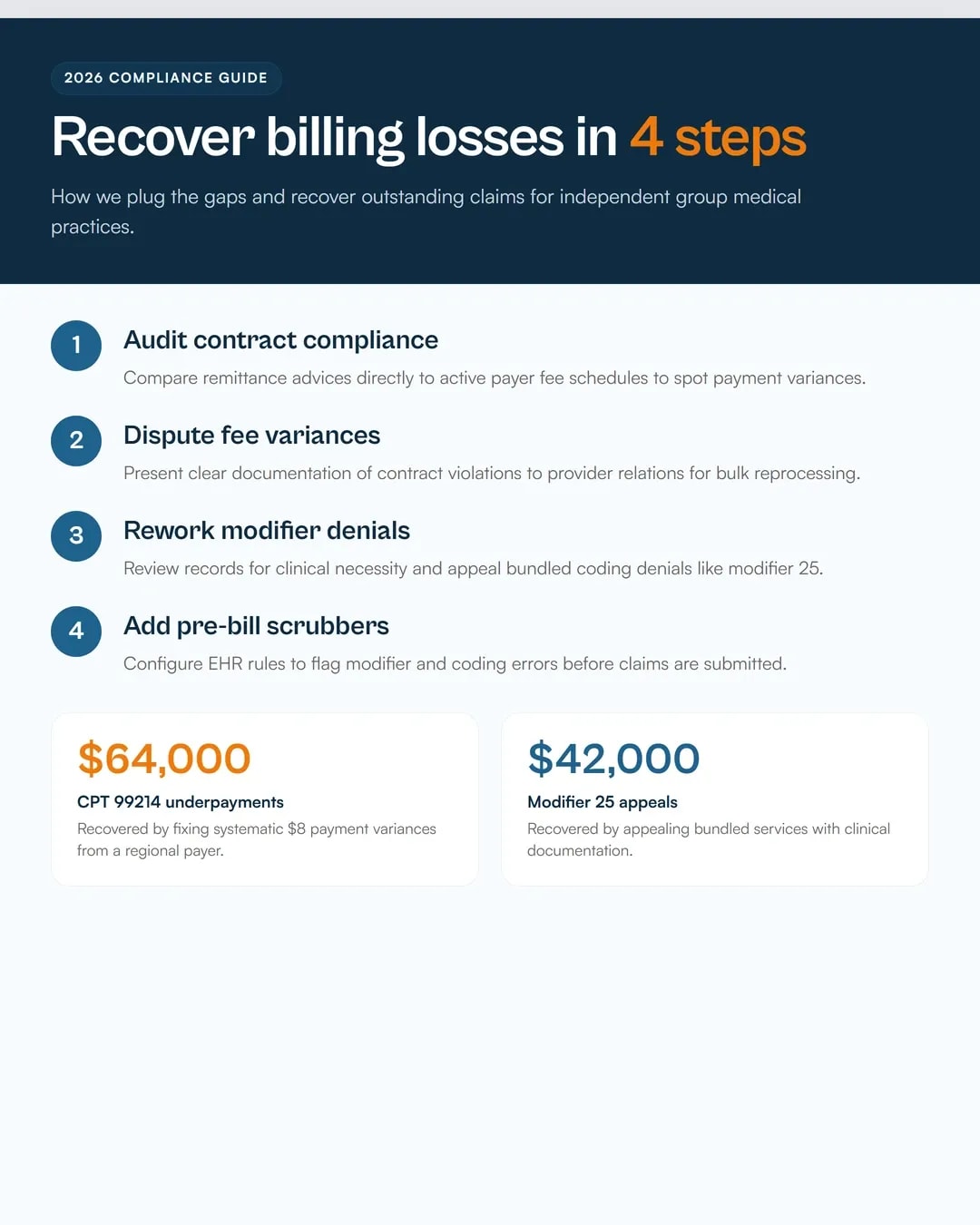
We built a recovery plan focused on the highest-value opportunities first. The first step was to address the $8 contract variance on code 99214. We gathered the payment files and the active payer contract.
We contacted the payer's provider relations representative and presented the payment discrepancies. We showed proof that the payer was violating the active contract. The payer acknowledged the system error and agreed to reprocess the affected claims.
This single dispute recovered $64,000 in retroactive payments. The payer issued a bulk check to the practice within 45 days. We then adjusted the practice's billing system to flag future payments that fell below the contracted rate.
Next, we tackled the modifier 25 denials. We pulled the medical records for 500 denied claims and reviewed the clinical documentation. The records showed that the physicians had documented separate, distinct services during the office visits.
We drafted standard appeal letters containing the necessary clinical evidence. We submitted these appeals to the payers and tracked them through completion. This effort recovered $42,000 in previously written-off revenue.
We then implemented a pre-bill scrubbing routine to prevent future modifier denials. The billing software now flags any claim where modifier 25 is used without supporting documentation. This ensures that the billing staff checks the record before submitting the claim.
Finally, we reviewed their outstanding accounts receivable (AR). The practice's average AR days had reached 48 days. We helped their billing team focus on claims older than 60 days. This cleanup recovered another $44,000 in unpaid claims.
The total recovery reached $150,000. The practice saw a direct cash injection that stabilized their operations. The billing team now had the tools to maintain these improvements over time.
What your medical practice should check today
If you manage a practice in New Jersey, you must monitor your payer payments closely. You cannot assume that payers pay the correct rate. Payer systems make mistakes, and those mistakes usually benefit the payer. NJ physicians should be aware of the broader payer accountability landscape: in November 2025, Horizon BCBS of NJ agreed to pay $100 million to settle a False Claims Act lawsuit over failure to comply with "lesser of" payment provisions on state employee health plans. Separately, the national BCBS antitrust settlement totaled $2.8 billion over price-fixing allegations. These cases confirm that payer payment practices warrant scrutiny at every level.
First, check your top 10 most billed CPT codes. Compare the paid amounts in your remittance advices to your signed contract documents. Look for even small discrepancies like $2 or $3. Over thousands of claims, these tiny amounts add up to significant losses. The 2025 CAQH Index found that $21 billion in industry savings remains available just by transitioning from manual to electronic administrative workflows. Contract auditing is one of the highest-ROI areas to automate.
Second, monitor your initial denial rate monthly. If your denial rate is above 5%, your front-desk or coding workflows need adjustment. The best-in-class benchmark for 2026 is a denial rate below 4% and a clean claim rate above 97%. You should track your denials by category to find the root cause. Common categories include eligibility, prior authorization, and coding. About 77% of all denials stem from administrative causes that are entirely preventable.
Third, look at your write-off reports. Ensure that your billing staff does not write off denials without a manager's approval. Many billers write off claims as non-collectible because they do not have time to write appeals. This habit hides the true cost of poor billing. Industry data shows that 20% to 25% of underpaid or denied claims remain permanently unrecovered.
Fourth, track your days in accounts receivable (AR). The best-in-class benchmark for 2026 is below 25 days. If your practice is above 40 days, that is a direct indicator of collection process failure. The Cherry Hill group was at 48 days before the audit.
You must also understand your medical billing service cost options. If your in-house team is overwhelmed, you are likely losing more money in denials than you save on salaries. A professional team often pays for itself by catching billing errors.
You can review our complete list of medical billing services to see how external experts manage contract compliance. Outsource billing teams use dedicated software to audit every claim. This level of scrutiny is difficult for a busy in-house team to match.
Regular audits are the only way to maintain revenue accuracy. If you do not check your payments, you are giving payers interest-free loans. Take control of your contract compliance before the losses mount.
Outsourcing your revenue integrity audit
Managing revenue cycle management (RCM) requires specialized skills and tools. Most independent practices do not have the resources to build contract compliance databases. They must rely on manual reviews that miss subtle leakage. Organizations that deploy dedicated revenue integrity technology report recovering 75% to 100% of identified underpayments. One published case showed a health system recovering $45 million over six years through systematic contract auditing. The ROI on contract lifecycle management implementations ranges from 200% to 350% within three years.
When you outsource your billing to a dedicated partner, you gain access to their technology stack. The partner audits every payment against your contracts automatically. They flag underpayments immediately and file appeals on your behalf. For small NJ practices, outsourcing RCM can save between $50,000 and $100,000 annually by eliminating the fixed costs of salary, benefits, software training, and turnover-related disruptions.
This approach transforms your billing from a reactive task to a managed process. You no longer worry about staff turnover or missing appeal deadlines. The billing partner manages the entire workflow while you focus on patient care. The Change Healthcare cyberattack in 2024, which forced providers across the country to revert to manual processes, highlighted how fragile internal billing operations can be. Practices that relied on a single system lost weeks of revenue processing. Diversified, partner-based operations recovered faster.
You should investigate revenue cycle management solutions that include contract audit features. A complete partner does more than submit claims. They protect your contract rates and recover every dollar you deserve.
If you are concerned about your current collection rate, schedule a review. We provide a comprehensive assessment to find hidden leakage in your billing files. We will show you exactly where you are losing money.
You can schedule a complimentary consultation with our revenue experts today. We will review your recent payments and help you build a plan to recover your contracted revenue. Do not let payers keep your hard-earned collections.
References
- Medical Group Management Association (MGMA). "MGMA DataDive Practice Financial Overview, 2026." Accessed July 2026.
- EZMD Solutions. "NJ Medical Practice Administrative Cost Benchmarks." Accessed July 2026.
- Zedtreeo / Datarovers. "Denial Write-Off and Rework Rate Analysis, 2025-2026." Accessed July 2026.
- Qualigenix / MedXpert Services. "National Denial Rate Trends and Cost-to-Rework Benchmarks, 2026." Accessed July 2026.
- AnnexMed / Aspirion. "Payer Underpayment Recovery and Revenue Leakage Statistics." Accessed July 2026.
- Healthcare Financial Management Association (HFMA). "Policy Drift and Preventive Denial Strategies." Accessed July 2026.
- New Jersey Office of the Attorney General. "$100 Million Settlement with Horizon Blue Cross Blue Shield, November 2025." Accessed July 2026.
- Blue Cross Blue Shield Association. "National BCBS Provider Antitrust Settlement, $2.8 Billion." Accessed July 2026.
- CAQH. "2025 CAQH Index: Measuring Progress in Administrative Simplification." Accessed July 2026.
- Gitnux / Global Payments. "Revenue Integrity ROI and Contract Lifecycle Management Benchmarks." Accessed July 2026.
- American Hospital Association (AHA). "Impact of the 2024 Change Healthcare Cyberattack on Provider Operations." Accessed July 2026.
See your revenue leaks in dollars.
Get a forensic 90-day cash flow audit of your practice. 100% confidential, 48-hour delivery, zero obligation.