Pennsylvania's HB 2722 Would Force Dental Insurers to Honor Benefit Quotes: What It Means for Your Practice
Pennsylvania HB 2722 makes dental benefit quotes binding, with $10K fines for violations. What dental and medical practices need to know about this 2026 bill.
Pennsylvania's HB 2722 would force dental insurers to honor benefit quotes: what it means for your practice
Pennsylvania just filed a bill that could reshape how dental insurance benefit verification works across the state. House Bill 2722, introduced on July 30, 2026, would make dental benefit quotes legally binding, meaning insurers can't tell your office a patient has 400 when the claim hits. The bill carries fines up to $10,000 for non-compliance, and if an insurer doesn't pay within 30 business days, they owe your full office fee instead of the contracted rate. The bill was referred to the House Committee on Insurance on July 31, 2026, and would take effect 1 year after passage.
This matters beyond Pennsylvania. Fourteen states enacted 21 new dental insurance reform laws in 2026 alone (ADA, July 2026). Wrong benefit quotes cost dental practices an estimated 60,000 per year in lost revenue. HB 2722 is the first state bill to make those quotes binding.
Key takeaways
- HB 2722 makes benefit quotes binding. Any dollar amount an insurer provides (verbal, electronic, or written) becomes the amount they owe, with 3 narrow exceptions: fraud, material misrepresentation, or loss of eligibility after the quote.
- Penalties are steep. Fines up to $10,000, and if payment doesn't arrive within 30 business days, the insurer pays your full office fee rather than the contracted rate.
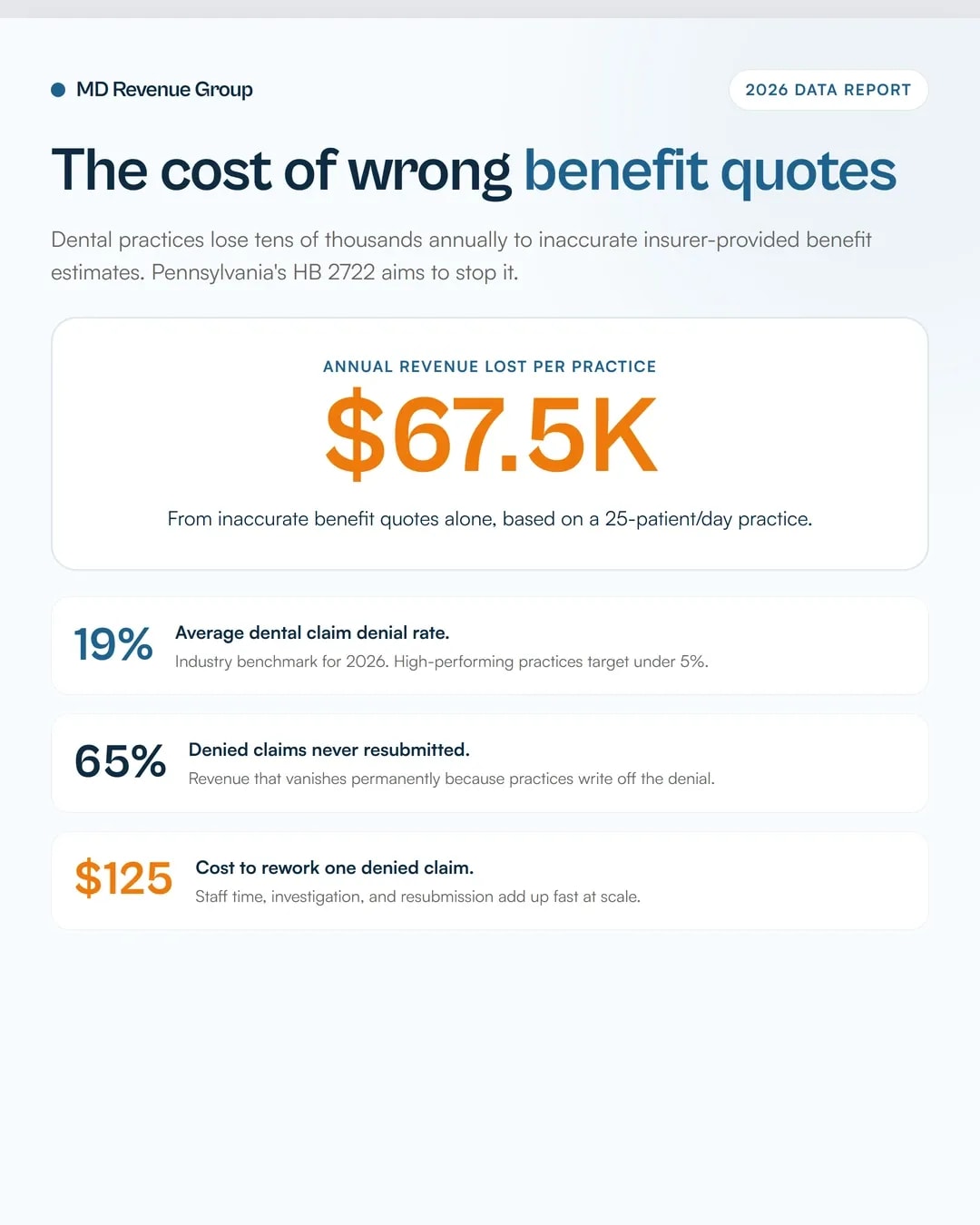
- Wrong quotes cost the average practice $67,500/year. That's our estimate based on a 25-patient/day practice where 15% of insurer-provided benefit quotes turn out to be inaccurate.
- 14 states passed 21 dental insurance reform laws in 2026. Pennsylvania joins a national trend toward insurer accountability covering dental loss ratios, network leasing, and virtual credit card restrictions.
- The ERISA loophole remains open. Self-funded dental plans (covering nearly half of Americans with dental benefits) could still claim exemption from state laws like HB 2722 until the federal IDA Act (H.R. 7931) passes.
What HB 2722 actually requires
The bill targets 4 specific areas. Here's the provision-by-provision breakdown:
Provision | What it requires | Why it matters |
|---|---|---|
Binding quotes | Any benefit information provided by an insurer (verbal, electronic, or written) is legally binding for claim adjudication and patient benefit determination | Ends the "estimate only" defense insurers use when quotes don't match payments |
Secure provider portals | Insurers must maintain a portal updated every 24 hours with at least 3 years of claims history: procedures billed, payments made, denials, and remaining benefits | No more calling a 1-800 number and waiting 45 minutes for a benefits rep |
Record retention | Insurers must keep recordings or transcripts of benefit verification calls for 3 years and provide copies on request | Creates an evidence trail when quotes don't match claim payments |
Enforcement penalties | PA Insurance Department can impose $10,000 fines. If payment isn't made within 30 business days of a compliant claim, insurer pays your full office fee (not contracted rate). Providers can sue for fee recovery and legal costs. | Gives the bill real teeth, unlike advisory-only guidelines |
Three situations where the binding quote doesn't apply:
- Fraud by the provider or patient
- Material misrepresentation of treatment or eligibility
- Loss of eligibility after the quote was provided
That's it. If the insurer gave your office a number and none of those 3 exceptions apply, they owe that number.
How much wrong benefit quotes cost your practice
Most practices know inaccurate benefit quotes hurt revenue. Few know the actual dollar amount. Here's a calculation based on real industry benchmarks.
The math for a mid-size dental practice:
Variable | Value | Source |
|---|---|---|
Patients per day | 25 | Assumption |
Percentage with insurance | 60% | Assumption |
Insured patients per day | 15 | Calculated |
Inaccurate quote rate | 15% | Industry benchmark (2026) |
Wrong quotes per day | 2.25 | Calculated |
Average procedure value | $400 | Assumption |
Daily revenue at risk | $900 | Calculated |
Working days per year | 250 | Assumption |
Annual revenue exposed | $225,000 | Calculated |
Percentage resulting in write-offs | 30% | Assumption |
Annual loss from wrong quotes | $67,500 | Calculated |
That 117 to $125 to rework a single denied dental claim. When 65% of denied claims never get resubmitted at all, that revenue vanishes permanently.
Practices are already bleeding from broader billing inefficiencies. Dental practices lose an estimated 10% to 15% of gross annual production to administrative billing errors (Sirius Solutions Global, 2026). For an 80,000 to $120,000 in unrealized revenue. Wrong benefit quotes are one of the largest single contributors to that total.
HB 2722 attacks the problem at the root. If the insurer's quote is binding, the practice gets paid what the insurer said they'd pay. The revenue integrity math changes overnight.
Why dental benefit verification fails today
The 19% average dental claim denial rate (2026 industry benchmarks) doesn't happen because practices are careless. It happens because the verification system is broken at the insurer level.
Root cause 1: manual processes with built-in error rates. Most dental offices still verify benefits by phone or through insurer portals that update on multi-day lag cycles. Industry data shows that manual verification consumes 20+ hours per week in the average dental office. That's half a full-time employee dedicated to calling insurers and keying in coverage details that change constantly.
Root cause 2: "eligibility check" vs. "deep benefits check." There's a gap between confirming that a patient has active coverage and confirming what that coverage actually pays for a specific procedure. Many front-desk teams run a quick eligibility check (yes, coverage is active) but skip the deep dive into annual maximums, frequency limits, waiting periods, and downgrade clauses. That's where the surprises land.
Root cause 3: insurer portal data that's wrong or stale. Even when practices use portal-based verification, the data isn't always current. Some portals update on 48-to-72-hour cycles, meaning a patient who exhausted their annual maximum on Monday still shows available benefits on Wednesday. HB 2722 would fix this by requiring updates every 24 hours.
Root cause 4: no paper trail on verbal quotes. Your front-desk coordinator calls an insurer, gets a verbal quote for a crown at 700. The insurer says, "that was an estimate, not a guarantee." There's no recording, no transcript, no evidence. HB 2722's record retention mandate addresses this directly.
The result: 78% to 80% of dental practices reported increased claim denials or payer scrutiny over the past 12 months (Group Dentistry Now, 2026). And 71% of dental revenue cycle professionals say real-time insurance verification is their single biggest daily operational challenge. The problem isn't that practices aren't trying. The system penalizes them for trusting the information insurers provide.
If your practice handles medical billing denial management, you'll recognize the same payer playbook: give a favorable estimate, then pay less when the claim arrives.
The ERISA gap: why self-funded plans dodge state rules
HB 2722 applies to dental insurers operating in Pennsylvania. But there's a significant carve-out that legislators haven't addressed: ERISA preemption.
The Employee Retirement Income Security Act of 1974 (ERISA) governs private-sector employee benefit plans, including dental coverage offered through employers. Under ERISA, federal law overrides state insurance regulations for self-funded plans.
This matters because nearly half of Americans with dental benefits are enrolled in self-funded plans. When a large employer self-funds its dental coverage and hires a third-party administrator (TPA) to process claims, that TPA can argue it falls under ERISA rather than state law.
The practical impact: even if HB 2722 passes, a dental practice in Pittsburgh could have binding-quote protections for one patient (on a fully insured plan) and zero protection for the next patient (on a self-funded employer plan), both administered by the same insurance company.
The IDA Act (H.R. 7931) is the federal fix. Introduced in March 2026 by Representatives Jeff Van Drew (R-NJ) and Herb Conaway (D-NJ), the Improving Dental Administration Act would modify Section 514(b) of ERISA to create an explicit exception. If passed, state dental insurance reform laws would apply to self-funded plans and their administrators, closing the loophole 18 months after enactment. The ADA and state dental associations across the country are backing it.
Until the IDA Act passes, practices need to know which patients are on fully insured vs. self-funded plans before relying on HB 2722's protections. That distinction starts at credentialing and enrollment: knowing your payer contracts and which plan types each insurer administers in your market.
What 14 states are doing about dental insurance reform in 2026
Pennsylvania's HB 2722 is part of a national wave. As of July 2026, 14 states had enacted 21 new dental insurance reform laws this year, building on 30+ laws passed across 18 states in 2025 (ADA, 2026).
The major reform areas:
Reform type | What it does | States with active legislation |
|---|---|---|
Dental loss ratios (DLR) | Requires insurers to report what percentage of premium dollars go to actual patient care, with rebate requirements if ratios fall below thresholds | Mississippi, Massachusetts, and others |
Virtual credit card opt-in | Prohibits insurers from forcing dentists to accept VCC payments (which carry transaction fees) without express consent | Multiple states in 2025-2026 |
Network leasing restrictions | Requires insurer permission before including a dentist in a "leased network" they didn't agree to join | Colorado, Wisconsin |
Assignment of benefits | Mandates insurers pay dentists directly when the patient requests it, regardless of network status | Several states enacted in 2025-2026 |
Binding benefit quotes | Makes insurer-provided benefit information legally enforceable | Pennsylvania (HB 2722, pending) |
Why this matters for medical practices too: the payer tactics dental practices fight (inaccurate benefit estimates, slow payments, retroactive denials) are the same tactics medical practices deal with daily. Insurers who get held accountable on the dental side will face pressure to clean up their practices across all lines of business. If your practice tracks how to reduce claim denials, these state-level reforms are worth watching.
The broader federal context also matters. CMS-0057-F, effective January 2026, established stricter timelines for prior authorization decisions: 7 days for standard requests, 72 hours for expedited. That federal rule covers Medicare Advantage and Medicaid managed care, and it signals the direction regulators are heading. For practices that also deal with prior authorization workflows, HB 2722 and CMS-0057-F are converging signals: payer accountability is becoming law, not just an industry talking point.
What your practice should do right now
HB 2722 is in the House Committee on Insurance. It hasn't passed yet. But the practices that prepare now will be the ones that benefit first if (and when) it does.
Decision table: what to do now vs. after passage
Action | Do it now (before passage) | Do it after passage |
|---|---|---|
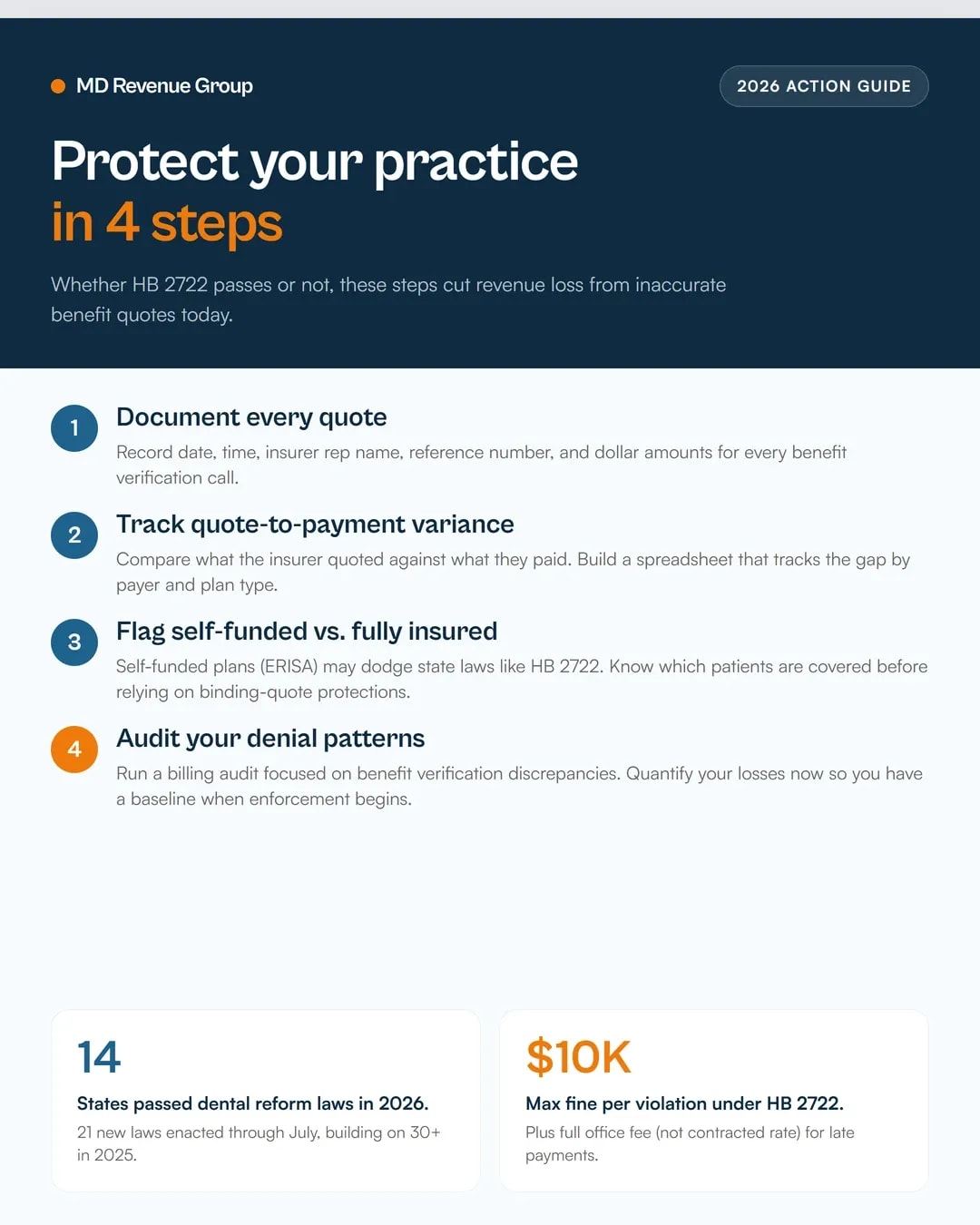
Document every benefit quote with date, time, insurer rep name, and reference number | ✓ Yes, this protects you regardless of HB 2722 | ✓ Required for enforcement |
Record or transcribe verification calls (check your state's consent laws first) | ✓ Yes, builds your evidence library | ✓ Insurers will be required to retain recordings |
Flag self-funded vs. fully insured plans for each payer in your system | ✓ Yes, determines which patients HB 2722 covers | ✓ Necessary for selective enforcement |
Track quote-to-payment variance in a spreadsheet or your PM system | ✓ Yes, quantifies your losses for internal use | ✓ Creates the data trail to file complaints with PA Insurance Department |
Audit your payer contracts for "estimate only" language on benefit quotes | ✓ Yes, know your current contractual position | ✓ HB 2722 would override these clauses for covered plans |
Build verification SOPs with timestamp requirements for your front-desk team | ✓ Yes, reduces errors now and creates compliance readiness | ✓ Standard operating procedure under the new law |
The practices that build these habits now will have 6 to 12 months of documentation when the bill takes effect. That data becomes the basis for enforcement complaints, contract renegotiations, and internal revenue analysis.
One more item: run a medical billing audit on your current denial patterns. If a meaningful percentage of your denials trace back to benefit verification discrepancies, you have a measurable dollar figure to track before and after HB 2722's enforcement date.
FAQ
Are dental benefit quotes currently binding?
No. In most states, dental benefit quotes are explicitly labeled as "estimates" and carry disclaimers stating they do not guarantee payment. Pennsylvania HB 2722 would change this by making any dollar amount communicated by an insurer binding for claim adjudication, with exceptions only for fraud, misrepresentation, or loss of eligibility.
What happens when dental insurance denies a claim after a pre-authorization?
It depends on the state and the plan type. Pre-authorizations are generally not guarantees of payment under current law. However, under HB 2722, any benefit statement (including pre-authorization amounts) would be binding. If a practice received a pre-authorization for 800, the insurer would owe the difference plus potential penalties.
Which states have dental insurance transparency laws?
As of July 2026, 14 states enacted 21 new dental insurance reform laws in 2026 alone. Key states include Massachusetts and Mississippi (dental loss ratio requirements), Colorado and Wisconsin (network leasing restrictions), and Pennsylvania (pending binding benefit quotes under HB 2722). Over 30 similar laws passed in 18 states in 2025.
Does ERISA preempt state dental insurance laws?
Yes, for self-funded plans. ERISA's preemption clause (Section 514) allows self-funded dental plans to bypass state insurance regulations. The IDA Act (H.R. 7931), introduced in Congress in March 2026, would modify ERISA to explicitly allow state dental reform laws to apply to self-funded plans, closing this loophole 18 months after enactment. Until then, HB 2722's protections would only cover fully insured dental plans.
How can dental practices protect themselves before HB 2722 passes?
Start documenting every benefit quote with timestamps, insurer rep names, and reference numbers. Track the variance between quoted amounts and actual payments in a spreadsheet. Flag which patients are on self-funded vs. fully insured plans. And run a revenue cycle audit to quantify how much you're losing to benefit verification discrepancies right now.
Your practice doesn't have to wait for HB 2722 to stop losing revenue to inaccurate benefit quotes. A structured revenue cycle management process with documented verification protocols, payer variance tracking, and denial pattern analysis closes the gap today. Request a free audit and we'll show you exactly where your benefit verification process is leaking money.