
Medical Billing Denial Management: How to Recover Every Dollar
Medical billing denial management in 2026 means beating AI-driven payers at their own game. Learn root causes, recovery workflows, and benchmarks to fix your denial rate.
Medical Billing Denial Management: How to Recover Every Dollar
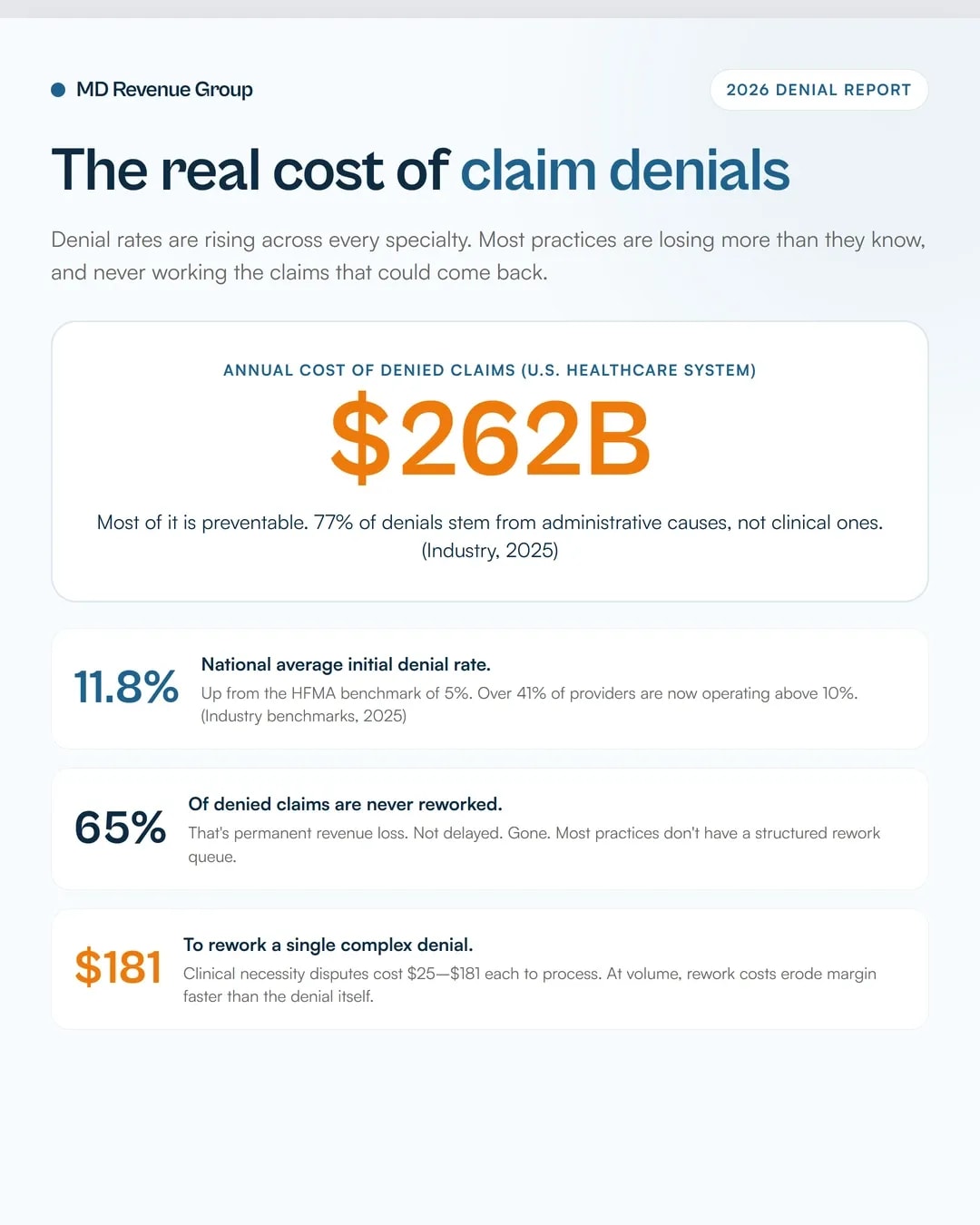
Medical billing denial management is the difference between a practice that collects what it earns and one that silently bleeds revenue into payer systems that are designed to make recovery feel optional. The national average initial denial rate hit 11.8% in 2025, with more than 41% of providers reporting denial rates above 10% (industry benchmarks, 2025). Against an HFMA standard of 5%, those numbers tell you most practices are losing real money on every claim cycle.
The problem compounds fast. 60% to 65% of denied claims are never reworked, resulting in permanent revenue loss. That's not a billing department capacity issue. It's a structural problem with how most practices have built their denial workflow. This guide gives you the full picture: root causes, detection, appeal strategy, and the benchmarks that tell you whether your current process is working.
Key takeaways
- $262 billion in claims are denied annually in the U.S. healthcare system, most from administrative errors, not clinical necessity.
- 77% of denials stem from administrative causes (eligibility, demographics, missing authorizations), all of which are preventable.
- It costs between $25 and $181 to rework a single denied claim. At scale, that cost erases margin fast.
- Top-performing practices achieve denial rates below 5% by combining automated pre-bill scrubbing with structured feedback loops between coders and clinical staff.
- Appeals with complete documentation win at 40% to 70%+, but most practices never file them.
Why denial rates are climbing in 2026
The short answer: payers are using AI and their billing teams aren't.
Payers now run claims through automated adjudication engines that flag issues in seconds: modifier mismatches, diagnosis-procedure inconsistencies, prior authorization discrepancies at the modifier level, eligibility gaps. What used to slip through manual review now gets denied automatically at submission. The AI arms race in healthcare billing is well underway, and right now the payers have the bigger system (HFMA, 2025).
CMS interoperability rules introduced stricter prior authorization API requirements in 2026, which means payer systems can now match your submitted claim against authorization data at a granular level (exact site of service, specific modifier, authorized units). A claim that matches in 9 of 10 fields gets denied on the 10th. Your biller then has to work backwards to figure out which field triggered it.
Revenue cycle teams are spending 50 to 75 hours per week just managing the denial lifecycle, according to a 2025 industry survey. That's before counting the cost per rework: $25 on the low end for a quick eligibility fix, $181 on the high end for a complex clinical necessity dispute. The math on unmanaged denials is brutal.
For a full audit of where your denial exposure sits, a medical billing audit is the right starting point.
The 5 root causes behind most denials
77% of denials come from administrative reasons, not clinical ones. Most practices focus energy on clinical necessity appeals, where recovery is hardest and timelines are longest. The faster path to improving denial rates is fixing the front-end administrative failures.
1. Eligibility verification gaps. The most common denial trigger: the patient's coverage lapsed, changed, or was applied to the wrong plan. Eligibility checks at scheduling don't cut it. Coverage changes between scheduling and the date of service more often than most billing teams realize. Check eligibility at check-in, every time.
2. Prior authorization not obtained or mismatched. PA requirements change with payer contract cycles. A procedure that didn't need auth last year might require it now. And payers are increasingly matching the authorized CPT code against what was actually billed. A minor deviation (e.g., authorizing 27447 bilateral but billing one side) generates an automatic denial.
3. Coding errors and modifier misuse. Missing modifiers, incorrect modifier placement, unbundling violations, and diagnosis-procedure mismatches are systematic denial generators. A single coder who misunderstands a modifier rule will produce the same denial pattern across hundreds of claims.
4. Timely filing failures. Payer filing windows range from 90 days to 24 months. Most are 12 months, but Medicare Advantage plans and some commercial payers run shorter windows. Claims that miss the filing deadline are denied with no right of appeal. This is entirely preventable: it's a process failure, not a clinical one.
5. Incomplete or missing documentation. Clinical necessity denials typically trace back to documentation that doesn't establish medical necessity clearly. The payer's AI system scans the submitted claim data; if the diagnosis doesn't connect logically to the procedure in the payer's logic tree, the claim gets flagged before a human sees it.
The forensic RCM audit on our blog explains how to trace denials back to their actual root cause, not just the surface-level denial code.
Benchmarking your denial rate
Your denial rate is the percentage of submitted claims that are denied on first pass. Here's where your practice should stand:
Denial rate | What it means |
|---|---|
Below 3% | Best-in-class. You have systematic prevention and a tight pre-bill scrubbing workflow. |
3–5% | HFMA benchmark standard. Solid, but there's room to tighten pre-bill checks. |
5–10% | Above benchmark. Administrative root causes are likely the primary driver. |
Above 10% | Revenue at risk. A structured denial management audit and workflow rebuild are needed. |
41% of U.S. providers operate above 10%. If your practice is in that group, the revenue impact compounds each billing cycle until the workflow changes.
For the industry benchmark context on clean claim rates (the inverse metric), the clean claim rate benchmark article has the numbers you need to compare against.
For average AR days by specialty, those benchmarks connect directly to your denial rate. High denial rates push AR days up consistently.
Building a denial management workflow that actually works
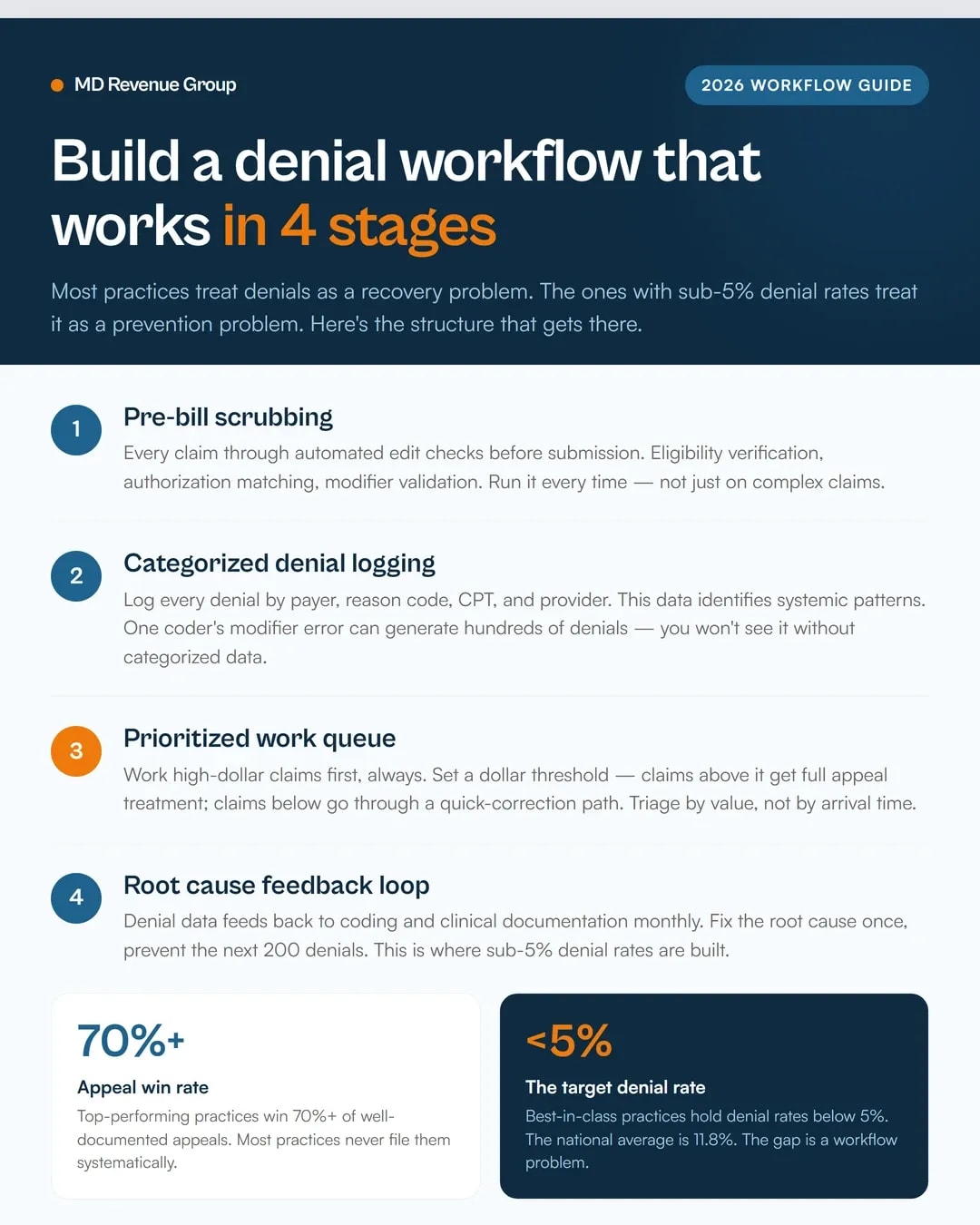
The mistake most practices make is treating denial management as a recovery function. By the time a claim is denied, the revenue is already delayed, the rework cost is already incurred, and the billing team is already behind. A genuine denial management workflow prevents most denials before they happen and recovers the rest within a defined, prioritized system.
Stage 1: Pre-bill scrubbing. Every claim goes through automated edit checks before submission. At minimum: eligibility verification, authorization matching, modifier validation, and diagnosis-procedure relationship checks. Most modern practice management systems have built-in scrubbers. The question is whether your team actually uses the workflow or bypasses it under volume pressure.
Stage 2: Denial logging and categorization. When a denial arrives, it goes into a categorized log immediately, not a queue that gets worked based on whoever has bandwidth. Categories should include: payer, denial reason code, CPT code, provider, and original submission date. This data is how you identify systemic patterns rather than chasing individual claims.
Stage 3: Prioritized work queue. High-dollar claims get worked first, always. A $4,200 surgical claim denied for a modifier mismatch is worth 4 hours of a biller's time. A $68 office visit denied for a missing referral may not be. Build a dollar-threshold filter into your queue management: claims below a certain dollar value go through a quick-correction pathway; claims above the threshold get full appeal treatment.
Stage 4: Root cause feedback loop. This is where most practices fall short. When a coder's modifier error generates 60 denials, the fix isn't to appeal all 60. Correct the coder and prevent the next 200. Your denial data needs to feed back to your coding team and your clinical documentation workflow on a defined schedule. Monthly at minimum.
Your full revenue cycle management process should be structured around this loop. Denial management is downstream of RCM. Fix the upstream failures and the denial volume drops.
The prevention checklist
Run through this for your practice. Each item is a systematic denial source if it's missing.
At scheduling:
At check-in:
At charge capture:
At pre-bill scrubbing:
For guidance on how to reduce claim denials at the workflow level, that walkthrough goes deeper into each stage.
How to prioritize what to appeal
You can't appeal everything, and you shouldn't try to. The economics of denial management require triage.
Tier 1: Appeal immediately. High-dollar claims denied for fixable administrative reasons (missing modifier, wrong NPI, timely filing still within window). These have a high probability of fast reversal and the dollar value justifies the time.
Tier 2: Appeal with documentation. Clinical necessity denials where the medical record clearly supports the service. These take more time to prepare but win at 40–70%+ for well-documented encounters.
Tier 3: Correct and resubmit. Coding errors where the correct code changes the claim. These aren't appeals. They're corrected claims. Batch them by coder and fix the root cause at the same time.
Tier 4: Write off. Claims below your dollar threshold where rework cost exceeds potential recovery, or where the filing window has passed. Document the write-off reason for your denial rate tracking, then use it to fix the process that caused the miss.
One real-world example: a 3-physician family medicine practice in New Jersey was writing off 18% of denied claims as uncollectible. After categorizing denials by root cause, they found that 61% of written-off claims were in Tier 3 (correct-and-resubmit cases where the coder had been applying the wrong modifier to a specific telehealth CPT for 4 months). One coding fix stopped the bleeding. One batched resubmission recovered $34,000 in claims that had been written off.
That's what a structured denial management workflow actually looks like in practice.
Specialty-specific denial patterns to know
Some specialties carry higher base denial rates because of code complexity, prior auth volume, or payer-specific rules. If your specialty is on this list, your denial management workflow needs to account for these specific triggers.
Cardiology: Cardiology billing generates a high proportion of prior auth denials because interventional procedures require authorization that must match the specific CPT code billed. Device implant claims are particularly vulnerable to bundling edits. See our cardiology medical billing guide for the full breakdown of cardiology-specific denial patterns.
Behavioral health: Behavioral health practices face session limit denials, medical necessity denials for longer-term treatment, and credentialing-related denials when treating patients under plans where the provider isn't yet paneled. The behavioral health billing page walks through the most common denial scenarios in this specialty.
Multi-specialty groups: The denial pattern in multi-specialty settings often involves cross-specialty billing rules: a procedure billed by a surgeon may be denied when performed on the same day as an E/M by a primary care provider in the same group, depending on modifier usage. Groups need payer-specific modifier rules documented at the provider level.
For practices outside New Jersey, our medical billing services page lists the states where MDRG provides specialty billing support.
When outsourcing denial management makes sense
A billing team of 2 or 3 people managing 40+ providers cannot run a systematic denial management workflow. They're triaging inbound work. Appeals fall behind, root causes stay unfixed, and the denial rate creeps up quarter by quarter.
The signal that outsourcing makes sense is when your denial rework backlog consistently exceeds 30 days, or when your denial rate has been above 8% for 2 consecutive quarters with no downward movement.
What outsourced denial management should include: categorized denial tracking, a defined appeal timeline (not just "we'll get to it"), root cause reporting back to your coding team, and clear KPIs (denial rate, first-pass resolution rate, and appeal win rate) reported to you monthly.
A generic answer isn't useful here. Your specialty, payer mix, and volume all determine what a realistic denial rate target looks like and how quickly you can get there.
Schedule a free revenue audit and we'll pull your denial rate by payer, identify the top 3 root causes, and show you what the revenue recovery looks like with a structured process in place.