
The RCM Staffing 'Death Spiral': Why 63% of Providers Have Gaps and How AI Can (Actually) Help
63% of health systems have unfilled RCM roles. Learn why the RCM staffing shortage AI solutions gap keeps widening and the 5-step fix that works.
The RCM Staffing 'Death Spiral': Why 63% of Providers Have Gaps and How AI Can (Actually) Help
The RCM staffing shortage is real, and AI solutions alone won't fix it. Two out of 3 health systems reported unfilled revenue cycle positions in 2026. Coder vacancy rates at hospitals sit between 25% and 40%. And the remaining staff? They're burning out, driving turnover rates as high as 40% in some billing departments. Here's the pattern: a biller quits. The workload shifts to whoever is left. Denials pile up. AR days climb. Another biller quits. That's the death spiral. AI can break the cycle, but only if you deploy it on the right tasks. This guide covers where the staffing gaps actually hurt your revenue, which AI tools deliver measurable ROI today, and the 5-step model that combines automation with human judgment to stop the bleeding.
Key takeaways
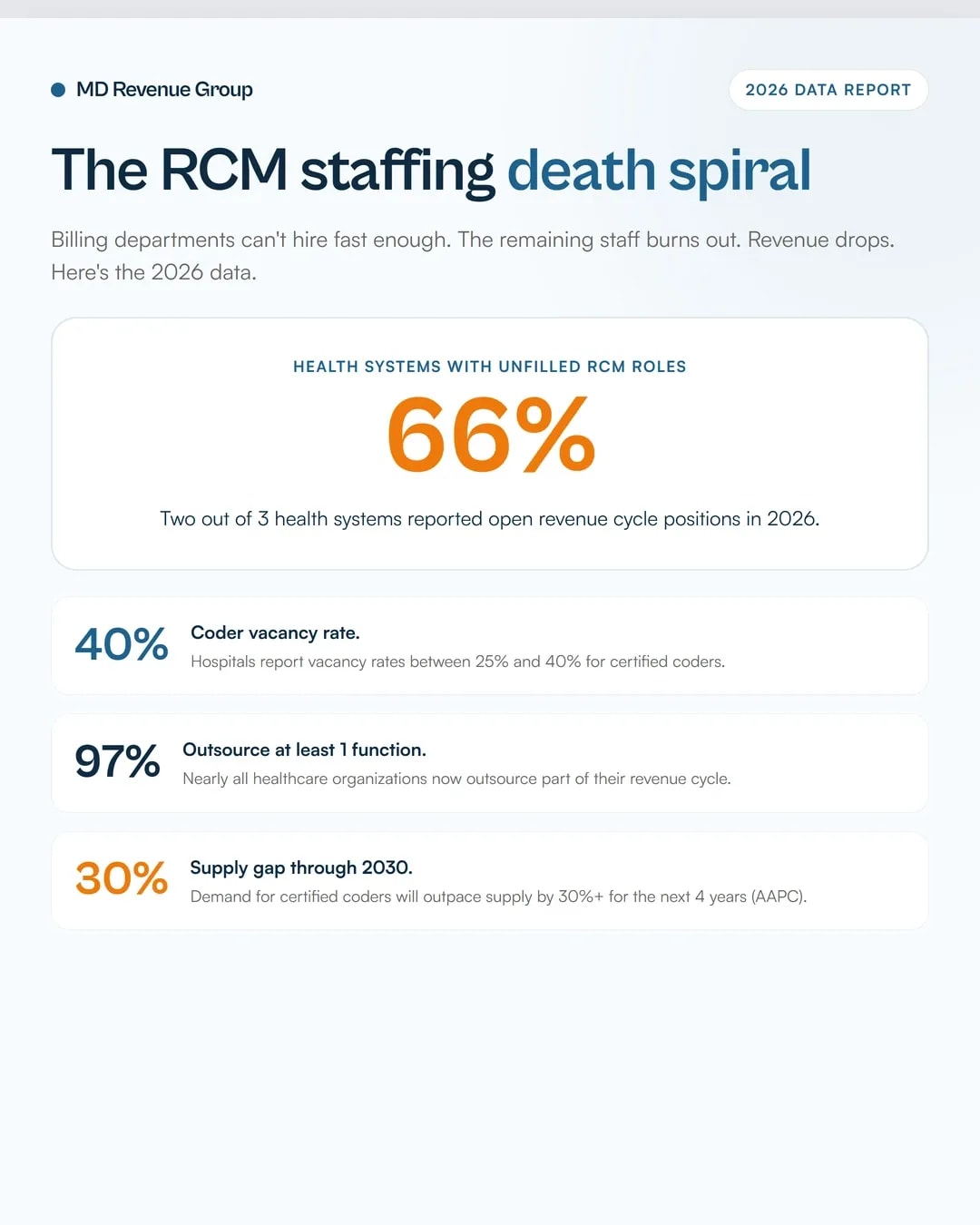
- 66% of health systems have unfilled revenue cycle positions in 2026, and 97% now outsource at least 1 RCM function to a third party.
- Medical coder vacancy rates range from 25% to 40% at hospitals, and new hires take 3 to 6 months to reach full productivity.
- RCM department turnover reaches 40% in some organizations, significantly higher than the 22.7% average across all healthcare roles.
- AI delivers the fastest ROI on eligibility verification, claim scrubbing, and denial prediction, but complex appeals, payer negotiations, and compliance audits still require experienced humans.
- 70% of hospitals and health systems plan to expand their RCM outsourcing partnerships in the near term.
How bad is the RCM staffing shortage in 2026?
The numbers tell a clear story. AAPC projects that demand for credentialed medical coders will outpace supply by more than 30% through 2030. That gap isn't closing. It's widening. A May 2026 MGMA Stat poll found that nearly 30% of medical groups experienced higher turnover compared to the prior year, with billing and RCM roles consistently cited as the departments under the most strain. Here's where it sits across the industry:
35 days in AR is the benchmark. Anything over 50 is uncollected revenue.
We conduct a forensic 90-day cash flow audit to identify unworked claims, fee schedule underpayments, and clearinghouse leaks.
Audit My Cash Flow Leaks →Metric | 2026 data |
|---|---|
Health systems with unfilled RCM positions | 66% |
Hospital coder vacancy rates | 25%–40% |
Healthcare organizations outsourcing ≥1 RCM function | 97% |
Organizations planning to expand outsourcing | 70% |
Turnover across all healthcare roles | 22.7% |
For a deeper look at how medical billing service costs compare between in-house and outsourced teams, that breakdown gets even more relevant when you factor in vacancy costs. The staffing crisis isn't a post-pandemic blip. The pipeline of certified coders and billing professionals can't keep up with the volume of work, and the work keeps getting more complex. ICD-11 transition planning, value-based care coding, telehealth billing rules, and the CMS Interoperability Rule (CMS-0057-F) all add layers of specialization that generic hires can't handle on day one.
Why the shortage keeps getting worse
Three forces compound the problem:
Experienced coders are retiring faster than new ones graduate
AAPC and AHIMA training programs produce certified professionals, but the pipeline is too small. And experienced coders (the ones who know your top payers' quirks, your denial patterns, your documentation gaps) can't be replaced by a freshly certified graduate. The institutional knowledge walks out the door with every departure. It takes 3 to 6 months for a new coder to reach full productivity. That's 3 to 6 months of slower claim processing, higher error rates, and delayed revenue.
Regulatory complexity makes the work harder
The CMS 2026 mandates added new reporting and compliance requirements. Prior authorization volume keeps climbing. Payer rules fragment further. Every new regulation adds tasks without adding staff. MGMA reports that over 90% of practices have had to hire or reassign staff specifically to manage PA requests. That's staff pulled away from claims, follow-ups, and collections to do PA paperwork. For practices already running lean, the staffing math breaks. A forensic RCM audit often reveals that the revenue leakage isn't coming from one big failure. It's coming from dozens of small tasks that nobody had time to complete because the team was understaffed.
Burnout drives a self-reinforcing loop
Approximately 70% of healthcare leaders cite retention and burnout as their top workforce challenges for 2026. When someone leaves a 4-person billing team, the remaining 3 absorb that workload. Denial rework piles up. Phone hold times for payer calls get longer. The pressure builds until another person leaves. Then you're at 2. RCM teams face what industry analysts call "intense demand swings," meaning patient volume spikes hit billing departments in waves, and you can't easily flex a 3-person team the way you can a 30-person call center.
What happens to revenue when positions stay empty
Empty chairs in the billing department have a direct, measurable financial impact: Denials increase. Without enough staff to verify eligibility before the visit, check prior auth status, and scrub claims before submission, errors slip through. Initial claim denial rates hovered near 12% in 2025 across the industry. Understaffed teams consistently run above that benchmark. AR days climb. MGMA benchmarks 35 AR days as the target. When you're short-staffed, follow-up calls to payers get delayed, denied claims sit in work queues, and the cash that's owed to you takes weeks longer to arrive. Your clean claim rate drops in proportion to how thinly your staff is stretched. Collection rates fall. Patient balance follow-up is usually the first thing that gets deprioritized when the team is overwhelmed. Unpaid patient balances grow. Write-offs increase. Overtime and temp costs spike. The remaining staff work longer hours. You hire temporary billers from agencies at 2 to 3 times the hourly rate. And temps, who don't know your payers or your workflows, make more mistakes, generating more rework. For small practices, the impact is amplified. A solo biller getting sick for a week can stall your entire revenue cycle. The denial management process breaks down first when staffing gets thin. Denials require investigation, documentation review, and appeal letter writing. That's high-skill, time-consuming work. It's the first thing to fall off the priority list when your team is drowning in claim submissions.
Where AI actually works in the revenue cycle
AI isn't a staffing replacement. It's a workload multiplier for the staff you still have. Here's where it delivers today (not in theory, but in production deployments across mid-size practices and health systems): Eligibility verification. Automated eligibility checks before the patient walks in the door catch coverage gaps and prevent claims that would have been denied. This is the fastest payback in the revenue cycle. Most tools handle this in real time. Claim scrubbing and coding assistance. AI-assisted coding tools flag likely errors (missing modifiers, incorrect diagnosis-procedure pairings, unbundling issues) before the claim goes out. They don't replace the coder. They catch what the coder might miss at 4:30 PM on a Friday. Denial prediction. Preemptive denial management is the 2026 shift. Instead of reacting to denials after they land, AI analyzes historical patterns and flags high-risk claims before submission. This lets your team fix the documentation now instead of appealing later. Prior authorization routing. AI tools can match PA requests to payer-specific criteria and flag documentation gaps before submission. (Though as we've covered in our analysis of prior authorization automation failure, the tool is only as good as the clinical documentation feeding it.) For a full breakdown of how AI works in medical billing today, that guide covers the current state without the vendor hype.
Where AI falls short (and why you still need humans)
AI can't do these things. Not yet. Maybe not for a long time. Complex appeals. When a payer denies a $40,000 surgical claim, the appeal requires a human who understands the clinical context, the payer's history on similar denials, and the specific regulatory language that supports the claim. AI can draft the letter. A human needs to finalize and submit it. Payer relationship management. Getting a payer rep on the phone, escalating a pattern of denials, negotiating contract terms. These are human conversations that require judgment, persistence, and sometimes creative problem-solving. Compliance audits. OIG scrutiny, False Claims Act exposure, AI-driven upcoding risks. These require experienced professionals who can evaluate whether your coding patterns are defensible, not just profitable. The revenue integrity tool helps identify risk areas, but a human has to interpret and act on the findings. Patient financial conversations. Explaining a $3,000 balance, setting up payment plans, handling disputes. These conversations require empathy and negotiation skills that AI can't replicate without damaging patient trust. The practices getting burned by AI in 2026 are the ones that automated without governance. They let the AI code, submit, and follow up without human review, and now they're facing compliance questions they can't answer.
The 5-step hybrid model that works
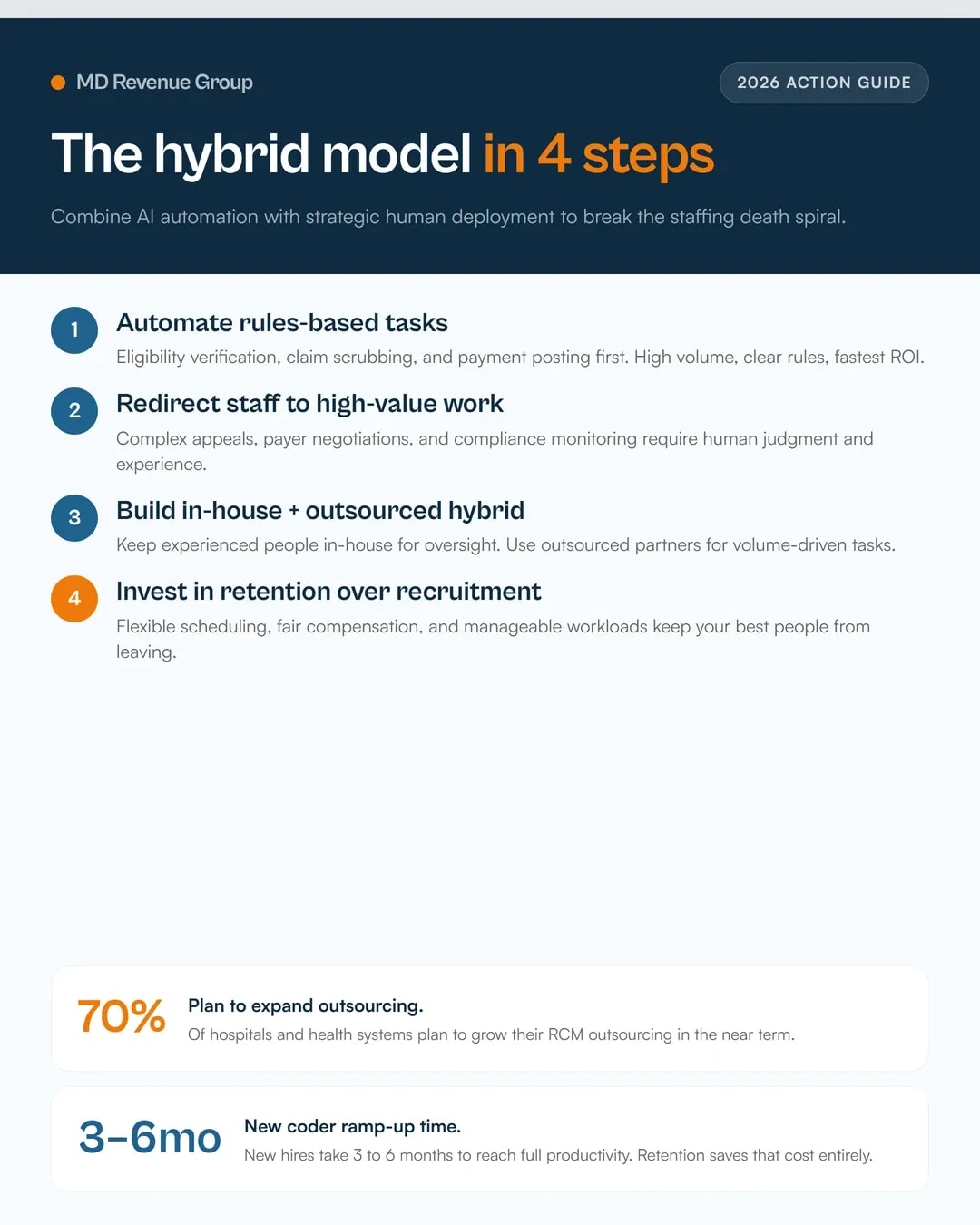
The practices that are solving the RCM staffing shortage are combining AI automation with strategic human deployment. Here's the model:
Step 1: Automate the rules-based, high-volume tasks first
Start with eligibility verification, basic claim scrubbing, and payment posting. These are tasks with clear rules, high volume, and low variability. They're where AI performs best, and where your staff time is most wasted. Outsourced medical billing services often bundle these automation tools with trained staff, giving you both layers in one engagement.
Step 2: Redirect your experienced staff to high-value work
Once AI handles the routine, your certified coders and billing specialists should focus on: complex claim adjudication, denial appeals, payer negotiations, and compliance monitoring. That's the work that requires institutional knowledge and judgment, the stuff AI can't touch.
Step 3: Build a hybrid staffing model
Combine in-house staff with outsourced specialists. Keep your most experienced people in-house for complex cases and oversight. Use virtual medical assistance for high-volume, process-driven tasks like claim follow-up, eligibility calls, and data entry. This gives you flexibility to scale up during volume spikes without burning out your core team. Some practices find that virtual assistance services can cover the gap faster than hiring, especially when the labor market for certified billers is this tight.
Step 4: Measure what matters
Track these metrics monthly:
- Days in AR by payer
- First-pass claim approval rate
- Denial rate by category (eligibility, coding, PA, medical necessity)
- Cost to collect
- Staff productivity (claims processed per FTE per day) If AI tools are working, your days in AR should drop and your first-pass approval rate should climb within 60 to 90 days. For help identifying where your revenue is leaking, reducing claim denials starts with knowing which denial categories eat the most time and money.
Step 5: Invest in retention, not just recruitment
Hiring is expensive and slow. Keeping people is cheaper. The practices that are winning the retention game offer:
- Flexible scheduling (4-day workweeks show up consistently in MGMA retention data)
- Professional development pathways (certification support, conference attendance)
- Fair compensation benchmarked to market rates
- Reasonable workloads (which steps 1 through 3 above make possible) You can't retain people in a department where every day feels like an emergency. Fix the workload first, and retention follows.
What to do right now if you're short-staffed
If you're reading this because your billing department has open positions and your AR is climbing, here's the priority order: This week: Audit your denial backlog. How many denied claims are sitting unworked? What's the total dollar value? That number is your starting point. This month: Automate eligibility verification and basic claim scrubbing. These two tasks give you the fastest staff-time recovery. This quarter: Evaluate outsourcing for your highest-volume, most process-driven RCM functions. Get pricing. Compare it to your cost of internal vacancies (including overtime, errors, and lost revenue). The RCM staffing shortage isn't going away by 2027. AAPC projects the coder supply gap will persist through 2030. The practices that survive aren't the ones that wait for the labor market to improve. They're the ones that restructure how work gets done. If your revenue cycle is understaffed and losing money, request a free audit and we'll identify where the biggest gaps are.
Sources cited: AMA 2025 Prior Authorization Physician Survey, MGMA 2026 Stat Poll (workforce turnover), AAPC coder shortage projections, HFMA workforce architecture reports, 2025 CAQH Index, healthcare staffing industry benchmarks.
See your revenue leaks in dollars.
Get a forensic 90-day cash flow audit of your practice. 100% confidential, 48-hour delivery, zero obligation.