
The Change Healthcare 'Timely Filing' Trap: Why Practices are Still Losing Millions in 2026
The CMS waivers expired, and payers are denying 2024 claims. Here is the exact appeal framework to overturn Change Healthcare timely filing denials.
When the Change Healthcare cyberattack hit in early 2024, it wiped out revenue cycles across the country. Fast forward to 2026, and practices are still paying the price. Payers are systematically issuing CO-29 timely filing denials for claims that were delayed during the outage. The emergency waivers have expired, and payers are banking on the fact that you do not have the administrative bandwidth to fight them.
The cyberattack on Change Healthcare caused disruptions costing over $1 billion to the U.S. healthcare system (American Hospital Association, 2026). At the height of the crisis, 80% of physician practices lost revenue from unpaid claims (American Medical Association, 2024). But the lingering effect is the administrative trap of 2026. Practices are finally clearing the backlog of delayed claims only to get hit with automatic timely filing rejections.
This guide breaks down exactly what these denials cost your practice, the current 2026 regulatory status of payer waivers, and the step-by-step appeal strategy you need to force payers to honor these claims.
Key Takeaways
- The Waivers are Gone: Most payer-specific timely filing waivers implemented in 2024 have expired. You are now operating under standard "good cause" exception rules.
- Batching is Mandatory: Do not appeal these claims individually. Group them by payer and date of service to prove systemic delay.
- Documentation is Everything: Your appeal will fail without specific transmission failure logs from the exact dates of the outage.
- Cost of Appealing: A manual appeal costs about $18 to $25 in pure administrative time. You must weigh the claim value against the cost to fight it.
What the Change Healthcare Timely Filing Denials Actually Cost You
A 5-physician orthopedic group in Ohio had $400,000 tied up for four months during the 2024 outage. In 2026, $120,000 of those claims are finally being processed, and immediately slapped with CO-29 timely filing denials because the state's emergency waiver expired.
Stop writing off 4.8% of your billing to preventable payer edits.
We review 50 of your recent denied claims against commercial & Medicare payer rules to show exactly which write-offs are legally recoverable.
Find My Recoverable Dollars →That $120,000 is not just delayed revenue. It is revenue that now requires intense administrative labor to recover. Our comprehensive revenue cycle management analysis consistently proves that delayed recovery destroys margin. When you factor in inflation, staffing costs, and opportunity cost, a dollar collected in 2026 from a 2024 service is worth significantly less than its face value.
Payers are acutely aware of this math. They know that if they place a high enough administrative barrier in front of an old claim, most practices will simply give up. They use the CO-29 denial code as a filter. Only the practices with the most persistent and well-documented billing operations will push through and get paid.
The Downstream Effect on Patient Relationships
There is another hidden cost to these delayed claims. When a claim is finally processed and adjudicated two years late, the patient responsibility portion is also delayed. Patients who visited your clinic in early 2024 are suddenly receiving statements in 2026 for balances they assumed were settled.
This causes immediate friction at the front desk. Patients are confused, angry, and distrustful of your billing practices. Many will refuse to pay, leaving your practice to either write off the patient balance or send them to collections, which further damages your reputation. Resolving the clearinghouse log issues correctly the first time prevents these delayed patient statements from causing irreparable harm to your patient relationships.
The Proprietary Calculation: The Hidden Cost of a Timely Filing Appeal
Let us look at the math of fighting a timely filing denial.
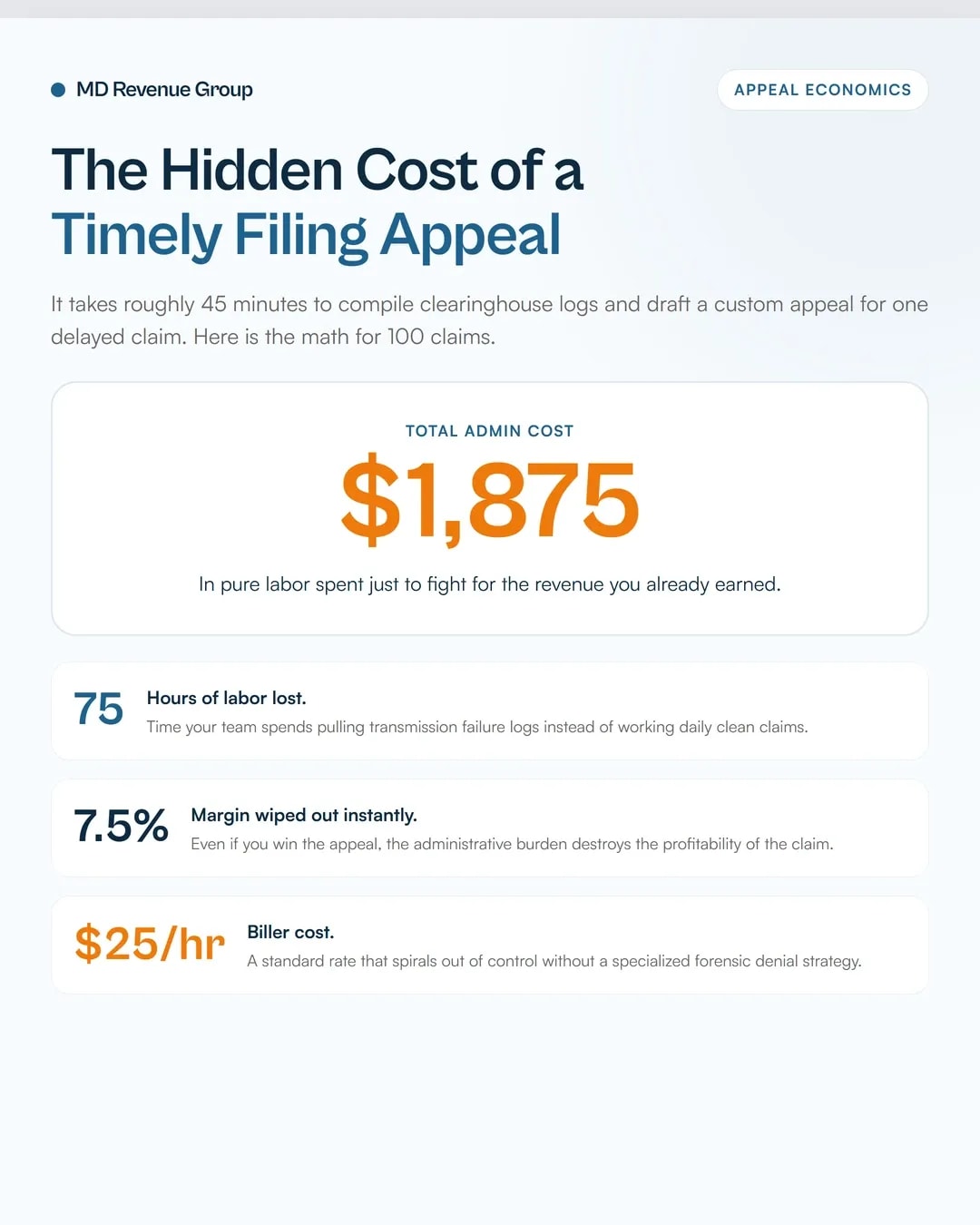
Assume you have 100 denied claims valued at $250 each. That is $25,000 in stranded revenue. An average medical biller costs $25 per hour. A manual CO-29 appeal requires a biller to locate the original clearinghouse failure log, draft a custom appeal letter citing the cyberattack, and submit the package. This takes roughly 45 minutes per claim.
- 45 minutes × 100 claims = 75 hours of labor.
- 75 hours × $25/hour = $1,875 in pure administrative cost.
You are spending nearly 7.5% of the total claim value just for the opportunity to fight for the money you are already owed. And that is before you even know if the payer will approve the appeal. This is why standard denial workflows fail when applied to systemic events like the Change Healthcare outage. Your in-house team needs specialized medical billing services to handle this volume without bleeding profitability.
If the claim value is lower, the math gets even worse. A $75 claim that takes 45 minutes to appeal will cost you $18.75 in labor, meaning you are spending 25% of the revenue just to collect it. At a certain point, the cost of collection exceeds the value of the claim itself.
The 2026 Regulatory Status of CMS and Payer Waivers
During the immediate fallout of the cyberattack, CMS strongly encouraged Medicare Advantage organizations and state Medicaid agencies to relax timely filing requirements. Many did. But in 2026, the landscape has hardened.
Almost 94% of hospitals suffered a direct financial impact during the event (AHA, 2024), prompting those early flexibilities. Today, those blanket waivers are largely gone. You can no longer just stamp a claim with a note about the outage and expect it to clear.
When dealing with government payers, you must now request a formal reopening or file a standard appeal demonstrating "good cause." For commercial payers, you are at the mercy of their specific, often opaque, internal policies for retroactive claim submission. Having the correct provider data enrolled via accurate credentialing services is also critical. Credentialing mismatches combined with timely filing flags often result in unappealable rejections.
How State Specific Codes Like Delay Reason 15 Work Now
Some states, like Texas, utilized specific codes like "Delay Reason 15" for natural disasters and unforeseen circumstances. In 2024, appending this code to a claim was often enough to bypass the automated timely filing edits.
In 2026, applying these codes retroactively requires precise documentation. Payers have updated their claims adjudication software to flag older dates of service that use emergency codes. If you use Delay Reason 15 now, the claim will likely be suspended and routed for manual review. During that review, the examiner will look for the exact transmission failure log that proves the claim was caught in the Change Healthcare outage window. If that log is missing, the claim is permanently denied.
How to Appeal Change Healthcare Timely Filing Denials (Step-by-Step)
If you are fighting a stack of CO-29 denials related to the outage, a generic appeal letter will not work. Payers will auto-deny it. You need an airtight, documentation-heavy approach.
1. Batch Your Claims by Payer
Never appeal these claims one by one. Group related claims into batches. This highlights the systemic nature of the issue. Create a HIPAA-compliant consolidated spreadsheet that includes the patient name, date of service, claim ID, and original submission attempt date. Submitting a batch of 50 claims with one master letter is infinitely more effective than submitting 50 individual letters.
2. Isolate the Transmission Logs
You must provide irrefutable proof that the delay was a direct result of the cyberattack. You need the clearinghouse acknowledgment reports or failure logs showing the exact date your transmission failed. If you do not have the failed log, the payer will assume you simply forgot to file. If you are struggling with disparate data sources, using a dedicated revenue integrity tool can automate the extraction of these historical transmission receipts.
3. Draft a Targeted "Good Cause" Letter
Your appeal letter must explicitly connect the transmission failure to the cyberattack. State clearly that the delay was beyond your control. Do not write a five-page narrative. Keep it strictly factual.
The exact structure of your letter:
- State the purpose of the appeal (overturning CO-29 due to the Change Healthcare cyberattack).
- Reference the attached consolidated spreadsheet of claims.
- Reference the attached transmission failure logs.
- Cite the payer's specific "good cause" or emergency exception policy if available.
When to Appeal vs. Write Off
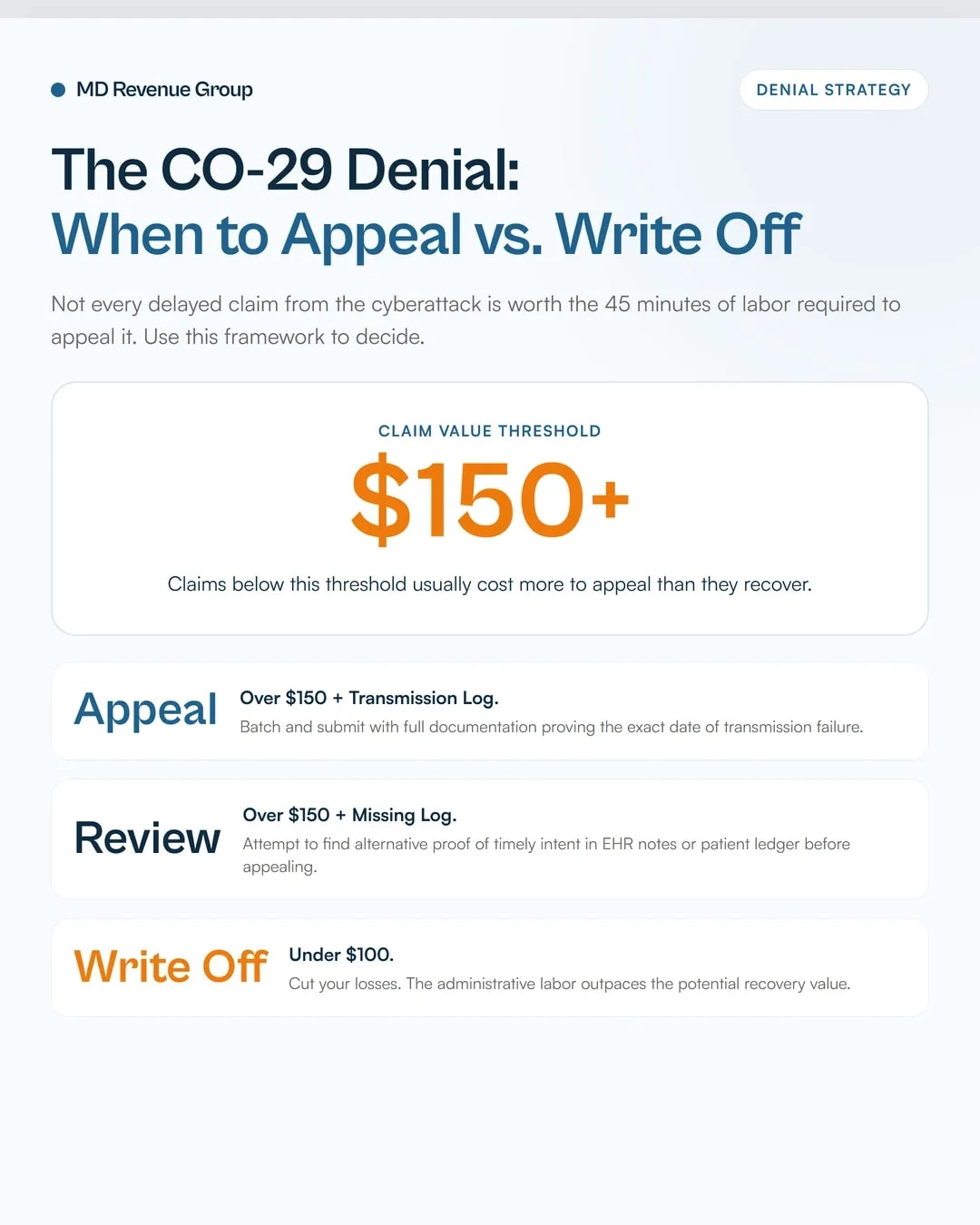
Not every claim is worth the 45 minutes of labor required to appeal it. Use this framework to decide:
Claim Value | Transmission Log Available? | Payer Has Known Exception? | Action |
|---|---|---|---|
Over $150 | Yes | Yes | Appeal. Batch and submit with full documentation. |
Over $150 | No | Yes | Review. Attempt to find alternative proof of timely intent before appealing. |
Under $100 | Yes | No | Write off. The administrative cost outpaces the recovery value. |
The Clearinghouse Architecture Problem
One of the main reasons practices struggle to appeal these claims in 2026 is the sheer difficulty of retrieving historical clearinghouse data. When the Change Healthcare network was severed, many practices hastily switched to alternative clearinghouses to resume cash flow.
This created a fragmented data environment. The failure logs from early 2024 are housed in one system, while the 2026 remittance advice and denial codes are housed in another. Billers are forced to manually cross-reference data between legacy archives and their current active system. This data fragmentation is exactly what payers rely on. They know that compiling a complete narrative for a single claim across two different clearinghouse platforms is incredibly tedious. You must establish a reliable data bridge to your archived logs before you begin appealing.
Why Your In-House Team is Losing to These Payer Tactics
Payers count on attrition. They issue the CO-29 denial knowing that most practices do not have the staff bandwidth to pull the transmission logs, build the spreadsheets, and format the appeals for hundreds of claims. Your billers are already overwhelmed with daily clean claim submission for your specific medical billing specialties.
When you task your internal team with a forensic project like recovering 2024 cyberattack denials, their daily metric performance drops. Your clean claim rate falls. Your AR days increase. It is a staffing death spiral that ends with massive write-offs. You are essentially trading future revenue for past revenue, and losing money in the exchange.
Specialized RCM teams use automation to bridge the gap between legacy clearinghouse logs and current denial inventories. They can generate batch appeals at scale without disrupting the daily flow of clean claims.
Stop Bleeding Revenue to Technicalities
The Change Healthcare cyberattack was not your fault, but the financial fallout is entirely your problem. If you are sitting on a backlog of timely filing denials, every day that passes makes them harder to recover. You need a dedicated, forensic approach that does not cannibalize your daily billing operations.
If your AR is bloated with CO-29 denials from the 2024 outage, something is broken. We will show you exactly where. Request a free medical billing audit today.
Recover your denied claims in dollars.
Send us 50 of your recent denied claims. Our certified AAPC/AHIMA billing team will identify every recoverable dollar within 48 hours.