
Private Equity's 'Structural Erosion': How RCM Consolidation Is Quietly Killing Physician Autonomy
The private equity RCM consolidation 2026 trend is quietly stripping control from independent physicians. Here is how to keep your autonomy.
You are probably noticing that your billing partner feels different lately. The response times are slower. The account managers keep turning over. The private equity RCM consolidation 2026 wave is not just a headline. It is the reason your cash flow is suddenly unpredictable. This guide is for independent practice owners who refuse to sell out but need to protect their revenue.
The truth is uncomfortable. Wall Street is buying up medical billing companies at a record pace. They consolidate operations, offshore the labor, and standardize the software. You get trapped in a generic template that ignores your specialty's unique coding rules. You need a fast decision framework to determine if your RCM partner is working for you or their shareholders.
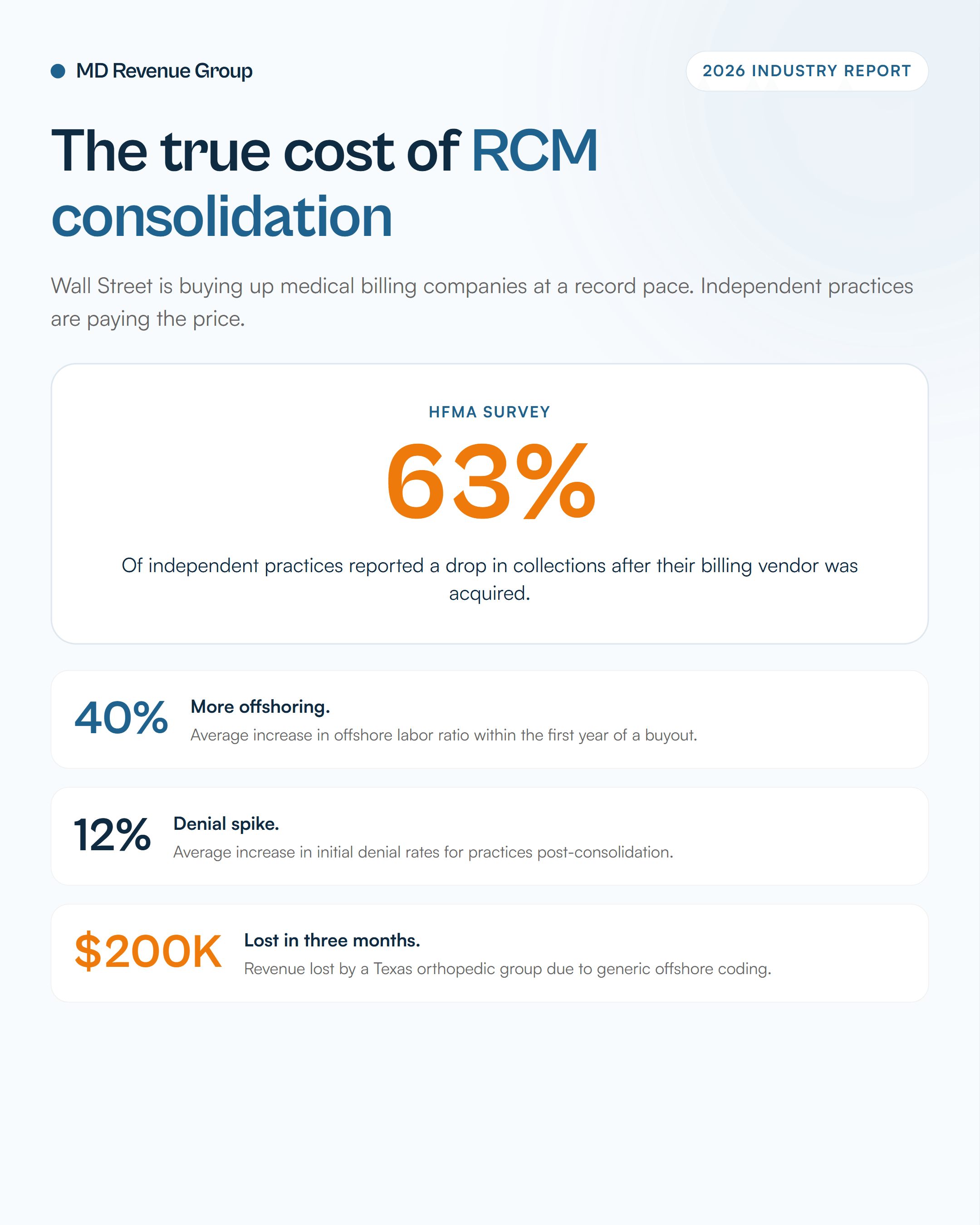
This is not a theoretical problem. A 2026 HFMA survey shows 63% of independent practices reported a drop in collections after their billing vendor was acquired. This guide will show you how to spot the red flags, evaluate your options, and defend your practice's financial independence.
Key Takeaways
- Private equity RCM consolidation prioritizes standardized workflows over specialty-specific coding accuracy.
- A 2026 MGMA report states acquired billing firms increase their offshore labor ratio by an average of 40% within the first year.
- Practices experience an average 12% increase in initial denial rates post-consolidation.
- You must review your vendor's service level agreements immediately to retain control.
Fast Decision-Making: Stay or Leave
If your billing company just got acquired, you have a narrow window to act. You need to make a fast decision on whether to stay or migrate.
35 days in AR is the benchmark. Anything over 50 is uncollected revenue.
We conduct a forensic 90-day cash flow audit to identify unworked claims, fee schedule underpayments, and clearinghouse leaks.
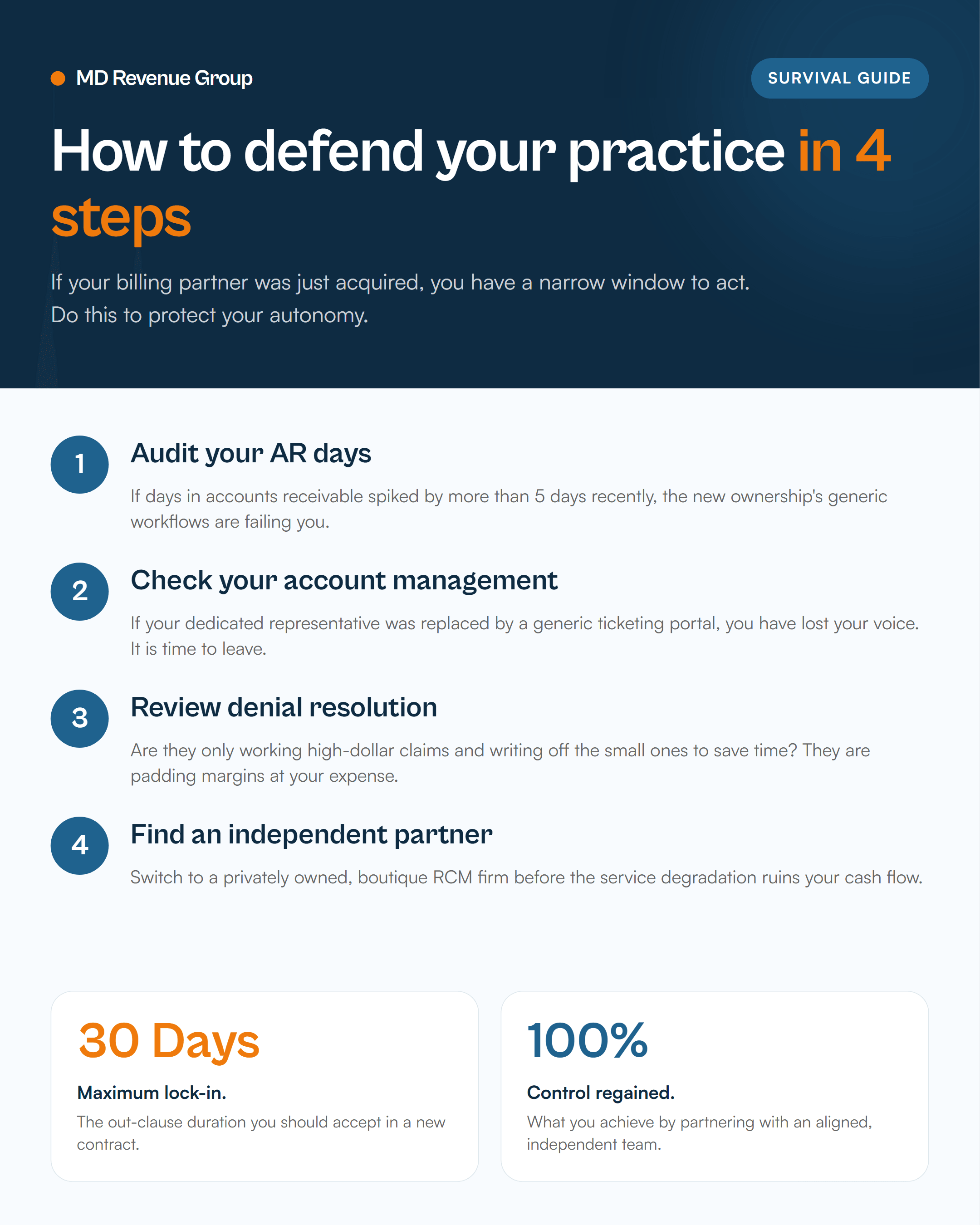
Audit My Cash Flow Leaks →Look at your AR days. If your days in accounts receivable spiked by more than five days in the last quarter, leave. The new ownership has disrupted the claims workflow. They fired the senior coders and replaced them with offshore data entry clerks.
Look at your account manager. If your dedicated rep was replaced by a generic ticketing system, leave. You need a partner who understands your specific medical billing services requirements. You cannot run a specialty practice through an anonymous help desk.
Look at your denial resolution rate. If the vendor is only working the high-dollar claims and writing off the small ones to save time, leave. They are padding their margins at your expense. Every small claim written off is pure profit for their bottom line and a pure loss for yours.
The Smart vs. Average Reaction to Consolidation
Average practices wait. They assume the transition bumps will smooth out. They ignore the declining collections because switching vendors feels like too much work. They wake up a year later with a massive backlog of unworked denials. They realize too late that their billing vendor treats them like a number on a spreadsheet.
Smart practices read the writing on the wall. They understand that private equity buys billing companies to cut costs, not to improve service. They proactively seek out an independent revenue cycle management partner before the service degradation hits their bottom line. They demand transparency and audit their billing partner's performance without fail.
Here is a real example. A thriving Texas orthopedic group saw their billing vendor acquired by a massive roll-up firm. Within three months, their complex surgical modifiers were being coded incorrectly by a new offshore team. Their denial rate doubled. They lost $200,000 in three months before finally pulling the plug and moving to a specialized, independent billing team. They stopped the bleeding, but they will never recover that initial loss.
Simplified Technical Data: The Offshore Arbitrage
The private equity model relies on a very specific technical shift. Let me simplify it. They buy a U.S.-based billing company with a strong reputation. They keep the brand name. They replace the senior stateside coders with cheaper offshore labor.
They use software to force your complex specialty billing into a generic, algorithmic workflow. If a claim requires manual intervention or a detailed appeal letter, it gets dropped to the bottom of the queue. The system automatically tags it for a write-off after 60 days.
This arbitrage looks great on their quarterly earnings report. It looks terrible on your bank statement. You are paying premium rates for automated, lowest-common-denominator processing. You need to check the fine print on pricing to ensure you are paying for actual expertise. You should demand a clause that requires stateside denial management.
Strongest vs. Best: Reclaiming Your RCM
The strongest move is to pull everything in-house. You hire a dedicated team of certified coders, buy the best software, and manage it yourself. This gives you total control. It also costs a fortune and requires you to become a full-time HR manager. You have to worry about employee turnover, software licenses, and clearinghouse fees.
The best move is to partner with a privately owned, boutique RCM firm. You get the scale and technology of an outsourced team, but the alignment of an in-house partner. They fight for every dollar because they are not trying to hit a private equity mandate. They care about your collection rate because their reputation depends on it.
This is how you maintain your independence. You control the clinical side. They protect the financial side. You can read about our team and see exactly why we built our infrastructure to avoid this trap. We remain fiercely independent so you can too.
The Practical Buyer Checklist for Independent RCM
If you are looking to escape a consolidated vendor, use this checklist to vet your next partner.
Ask who owns them. If they are backed by private equity, walk away. You are just replacing one problem with another. You need an owner-operated firm.
Ask where the work is done. If they offshore the complex denial management, walk away. You need stateside experts handling the appeals. Data entry can be offshored. Clinical appeals cannot.
Ask about their technology stack. They should integrate seamlessly with your existing EHR, not force you to change systems to fit their model. If they demand you use their proprietary EHR, they are trying to lock you in.
Check their contract terms. You want a 30-day out clause. If they require a multi-year lock-in, they are not confident in their service. Look for performance-based fees, a dedicated account manager, and a short-term out clause that gives you power over the relationship.
Top Recommendations to Protect Autonomy
For the small practice, demand transparency. Request a weekly report on your denial resolution rate. If the numbers slip, trigger your exit clause immediately. Do not accept vague excuses about system migrations.
For the mid-sized group, start auditing your current vendor. You need to know exactly how much revenue is bleeding out through unworked claims. You should pull a detailed AR aging report and look closely at the balances over 90 days.
For the large independent clinic, it is time to make a clean break. Do not let a corporate roll-up dictate your financial future. You should request a free audit to see exactly what your current vendor is missing. We will analyze your clearinghouse data and identify exactly where the private equity firm is dropping the ball.
A 2026 AMA study revealed that physician autonomy is directly linked to financial stability. If you let a private equity firm control your cash flow, you have already lost your independence. Take it back.
How Private Equity Values Your Billing Company
You need to understand how the firm buying your vendor makes money. They use a metric called EBITDA. They acquire the billing company for a multiple of that EBITDA. Their only goal is to increase that multiple before they sell the company to a larger firm three years later.
They increase EBITDA by slashing operating costs. Your dedicated account manager is a cost. Your senior, certified medical coder is a cost. Your customized monthly reporting meeting is a cost. They eliminate these costs to boost the valuation.
They do not value your individual practice's cash flow. They value the aggregate revenue of the roll-up. If they lose your business, they will simply acquire another billing company to replace your revenue. You are completely expendable in this model.
The Hidden Costs of Algorithm-Driven Coding
Consolidated firms love to brag about their proprietary artificial intelligence. They claim their algorithms will speed up your billing process. This is a half-truth.
The algorithms are designed to push clean claims through quickly. They are completely incapable of handling complex, specialty-specific coding scenarios. When a surgeon performs a multi-level spinal fusion, the algorithm fails. It requires a human to review the operative note and append the correct modifiers.
The consolidated firm fired the humans who know how to read that operative note. The algorithm drops the complex claim into a generic denial queue. The offshore team blindly submits standard appeal templates that get rejected instantly. You end up writing off high-value surgical procedures because the algorithm could not handle the nuance.
Private Equity RCM FAQs
Why is private equity RCM consolidation 2026 happening now? Wall Street sees healthcare revenue cycle as a highly fragmented, high-margin industry ripe for roll-ups and cost-cutting through automation and offshoring.
How does an acquisition affect my current billing contract? Your contract typically transfers to the new owner automatically. However, the service levels almost always degrade as they consolidate operations.
What is the first sign that my billing company was bought out? Your dedicated account manager disappears and is replaced by a centralized support email or a generic ticketing portal.
Is offshore billing always bad? No. But it is disastrous when private equity uses it to replace senior, specialty-specific coders with entry-level data entry staff to boost margins.
How do I safely transition away from a consolidated vendor? You need an overlap period. Do not terminate the old vendor until the new partner has fully integrated with your EHR and tested the clearinghouse connections.
Can a boutique billing firm really handle my volume? Yes. Modern software allows specialized, privately-owned firms to scale efficiently without losing the personal touch. You can contact us to see how we handle high-volume practices.
What should I look for in a new RCM contract? Look for performance-based fees, a dedicated account manager, and a short-term out clause that gives you power over the vendor.
Wait, what if they buy my next billing company too? This is a real risk. You must ask the owners directly about their long-term plans. Partner with firms led by founders who are actively involved in the daily operations, not executives preparing for a buyout.
Take back control of your practice. Audit your current vendor and see the truth for yourself.
See your revenue leaks in dollars.
Get a forensic 90-day cash flow audit of your practice. 100% confidential, 48-hour delivery, zero obligation.