
Is Outsourcing Medical Billing Worth It for Small Practices?
Is outsourcing medical billing worth it for small practices? Compare fully loaded in-house costs vs 5-7% vendor fees with real MGMA data.
Is Outsourcing Medical Billing Worth It for Small Practices?
Is outsourcing medical billing worth it for a small or independent medical practice? For most practices generating between 3 million in annual net collections, outsourcing is worth it because internal billing costs typically consume 10% to 14% of revenue when factoring in salaries, mandatory benefits, software licensing, clearinghouse fees, and staff turnover. In contrast, an outsourced revenue cycle management partner charges 4% to 9% of net collections while improving clean claim rates from an industry average of 88% up to 98%.
Key Takeaways
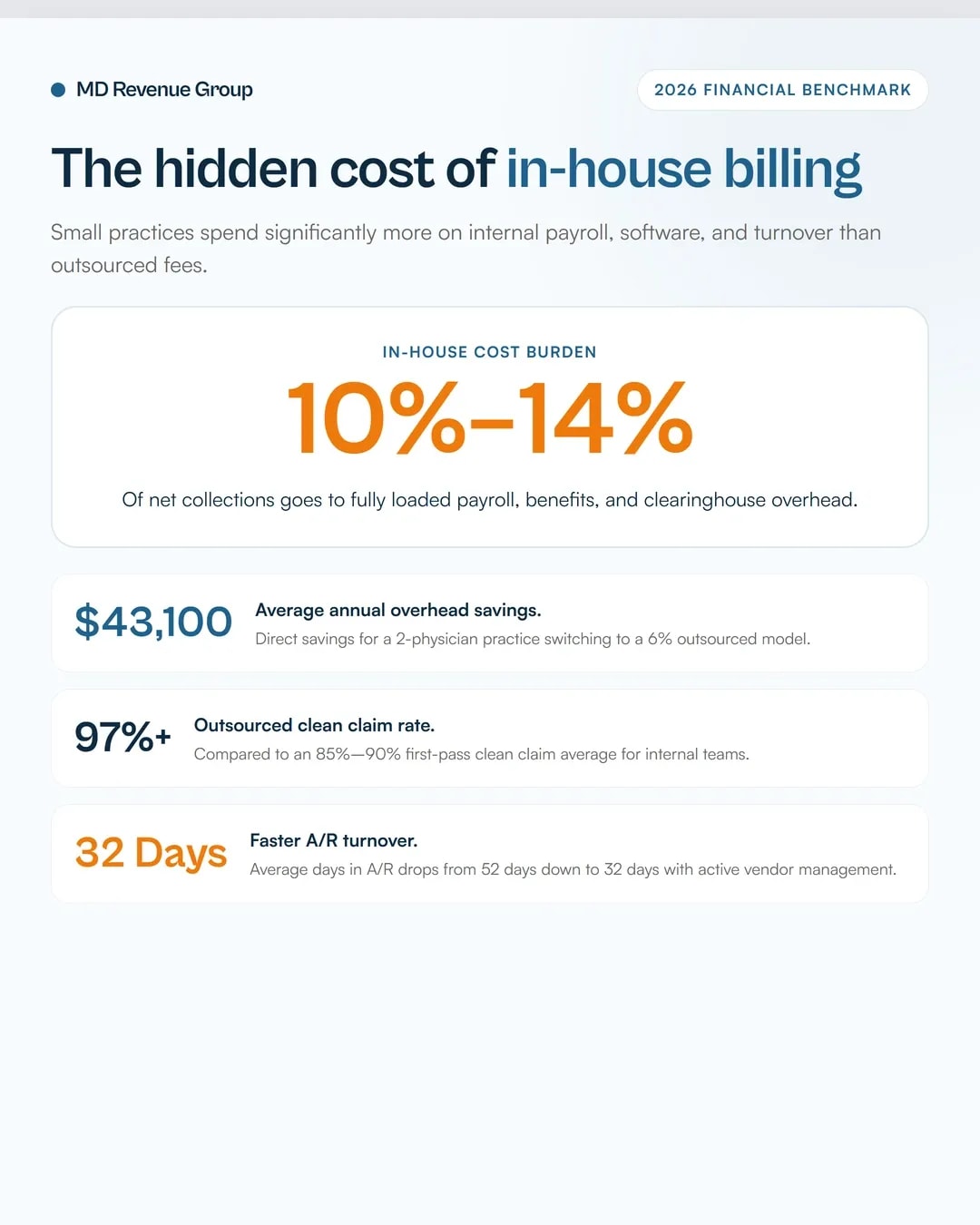
- Total Overhead Reduction: In-house billing costs 10% to 14% of net collections in fully loaded expenses, while outsourcing averages 4% to 9%.
- Clean Claim Performance: Medical Group Management Association (MGMA) data shows internal small practice clean claim rates hover around 85% to 90%, compared to 97%+ for dedicated billing firms.
- Turnover Risk Mitigation: Billing staff turnover averages 25% to 40% annually. Each resignation stalls claims processing for 30 to 60 days, risking 50,000 in aged A/R.
- Faster Cash Flow: Professional RCM partners lower average days in A/R from 52 days down to under 32 days.
The True Cost of In-House Medical Billing
Many practice managers evaluate internal billing by looking only at base employee wages. That calculation overlooks the hidden costs of managing a billing department in-house.
A full-time certified medical biller commands a base salary between 62,000 per year depending on your region. Payroll taxes, health insurance, 401(k) matching, and paid time off add another 20% to 30% to that base figure. That pushes your actual labor cost to 80,000 annually per biller.
Base Salary:             $55,000
Benefits & Taxes (25%): +$13,750
Software & Clearinghouse:+$7,200
Office Hardware & Space: +$3,600
--------------------------------
Fully Loaded Annual Cost: $79,550 per biller
Beyond payroll, your practice pays direct operational overhead. Practice management software seats cost 600 per biller each month. Clearinghouse subscription fees, electronic claim submission charges, statement printing, and mandatory annual coding updates add thousands more.
When your primary biller takes vacation, calls in sick, or quits, claim submission halts completely. According to Healthcare Financial Management Association (HFMA) benchmarks, an unworked billing backlog of just two weeks increases your practice's days in A/R by 14 days and permanently increases claim denial risk.
If you want to review your current pricing structure against market standards, inspect our detailed breakdown of medical billing service cost to calculate your practice baseline.
Outsourced Medical Billing Costs vs. In-House Financial Model
To determine whether outsourcing makes financial sense, look at a side-by-side comparison for a 2-physician practice collecting $1,200,000 annually.
Expense Category | In-House Billing Model | Outsourced RCM Partner (6%) |
|---|---|---|
Primary Biller Salary & Benefits | $74,000 | $0 |
Part-Time Billing Assistant | $28,000 | $0 |
Billing Software & Clearinghouse | $8,400 | $0 |
Continuing Education & Code Sets | $1,500 | $0 |
Statement Postage & Printing | $3,200 | Included in service fee |
Vendor Percentage Fee (6%) | $0 | $72,000 |
Total Annual Billing Cost | $115,100 | $72,000 |
Cost as % of Net Collections | 9.59% | 6.00% |
Annual Direct Savings | N/A | $43,100 |
In this real-world financial model, switching to an outsourced partner saves $43,100 per year in direct overhead alone.
Beyond overhead savings, an outsourced firm collects more of what you bill. MGMA survey data indicates that independent practices using external RCM services increase overall net collections by 3% to 7% due to diligent denial follow-up and faster appeal processing. On 60,000 to your bottom line.
If you are weighing these two approaches, explore our dedicated comparison on outsource vs in-house medical billing for a breakdown of internal team management versus specialized services.
5 Key Financial & Operational Benefits of Outsourcing
1. Shift Fixed Costs to Variable Expenses
In-house billing is a fixed overhead cost. Whether your practice sees 400 patients in a busy month or 200 patients during vacation season, your payroll, software fees, and equipment bills remain identical.
Outsourcing ties your billing expense directly to your cash receipts. If collections drop during a slow month, your billing expense drops proportionally. This variable structure protects your practice cash flow during low-volume periods.
2. High Clean Claim Submission Rates
Payer rules change constantly. CMS introduced over 300 CPT code revisions and modifier shifts for the 2026 fee schedule alone. In-house billers struggling to manage front-desk duties rarely have time to track payer-specific billing rules.
Specialized billing agencies employ full-time certified coders who handle claim scrubbing software daily. They achieve clean claim rates of 97% or higher on first-pass submission. Fewer rejections mean faster reimbursement cycles.
3. Immediate Reduction in Claim Denials
The American Medical Association (AMA) reports that 15% of all medical claims submitted in the United States are initially denied by commercial and government payers. In small practices, up to 80% of those denied claims are never resubmitted or appealed due to lack of staff time.
Outsourced firms maintain dedicated denial recovery teams whose sole job is appealing rejected claims and recovering money. You can learn how professional teams handle appeal workflows by reading our guide on medical billing denial management.
4. Elimination of Staffing Vulnerabilities
When your internal biller leaves, your practice faces a major operational crisis. Recruiting, vetting, and training a qualified medical biller takes 45 to 60 days. During that gap, unsubmitted claims pile up, timely filing deadlines pass, and patient accounts age.
An outsourced partner provides built-in team redundancy. Multiple billers familiar with your specialty handle your account. Your claim submission workflow operates continuously without interruption.
5. Access to Advanced RCM Technology
Modern revenue cycle management relies on sophisticated claim scrubbers, automated eligibility verification tools, and comprehensive business intelligence platforms. Purchasing these tools independently costs a small practice thousands of dollars per month.
Outsourced partners absorb technology investments into their infrastructure. You gain enterprise-level reporting, real-time analytics, and automated insurance verification without paying capital expenses. Practices seeking comprehensive support can discover our complete revenue cycle management solutions.
When In-House Billing Makes More Sense
Outsourcing is not the universal answer for every medical facility. In-house billing remains effective under specific operational conditions:
- Large Enterprise Volume: Health systems or multi-specialty groups generating 30,000+ claims per month can build economies of scale that lower internal costs below 5% of net collections.
- Highly Custom Clinical Workflows: Practices running unique concierge or cash-based care models with minimal third-party payer billing often do not need external agency management.
- Stable, Long-Tenured Internal Staff: If your practice has had the same certified biller for 10 years with clean claim rates above 96% and A/R days under 30 days, keeping billing in-house avoids operational disruption.
For small practices operating outside these parameters, self-managed billing usually creates unnecessary overhead and higher financial risk.
How to Choose the Right Medical Billing Partner
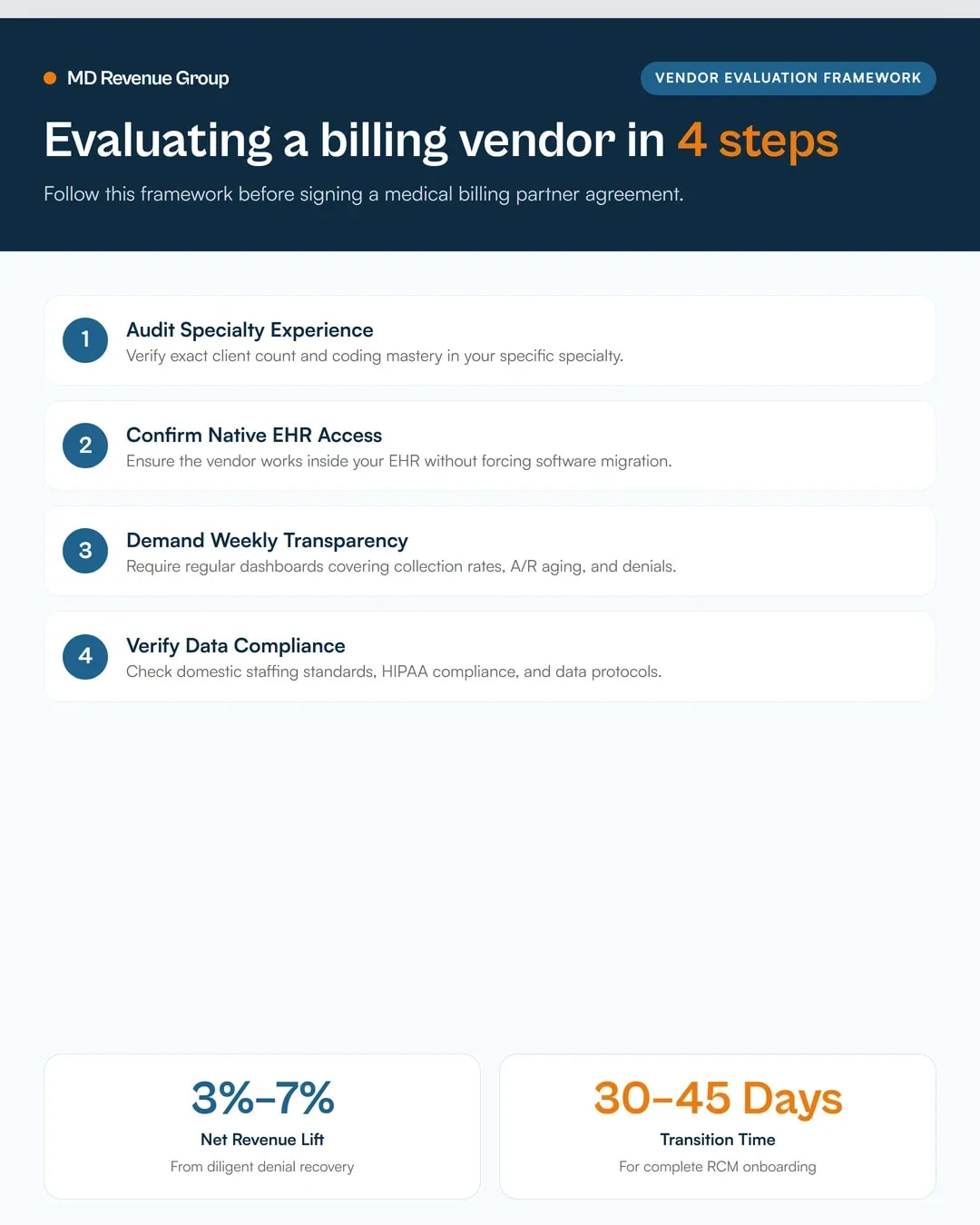
If you decide to outsource, selecting the right partner determines your success. Avoid vendors who offer bare-minimum data entry and evaluate partners using these four criteria:
- Specialty-Specific Expertise: Ask the vendor how many practices in your exact specialty they represent. Coding requirements for orthopedic surgery differ dramatically from behavioral health or cardiology billing.
- EHR & System Integration: Ensure the billing company works directly inside your current EHR platform rather than forcing you to switch software.
- Transparent Weekly Reporting: Demand full visibility into your financial performance. Your partner should provide transparent reports on monthly net collection rates, days in A/R, denial reasons, and aged accounts over 90 days.
- Domestic Compliance Standards: Verify where your billing and patient data will be handled. Practice managers concerned with compliance and communication should evaluate our 100% US-based billing services to safeguard patient data security.
Before signing a vendor agreement, review key evaluation criteria in our guide on questions to ask medical billing company to protect your practice revenue.
State-specific billing mandates also influence billing performance. Practices operating in the Mid-Atlantic region can consult our specialized breakdown on medical revenue recovery for group practices in New Jersey for regional compliance guidance.
In addition, medical practices evaluating small business support can check our guide on medical billing for small practices to analyze workflow setups for 1 to 5 provider teams.
Frequently Asked Questions
Will outsourcing medical billing cause my practice to lose control over patient accounts?
No. Reputable RCM partners work directly within your existing EHR and practice management system. You retain complete ownership of your patient data and financial records while receiving regular, transparent collection reporting.
How much do medical billing companies charge for small practices?
Most commercial billing vendors charge between 4% and 8% of monthly net collections for small to mid-sized practices. Fees vary based on monthly claim volume, medical specialty, and patient population mix.
How long does it take to transition to an outsourced billing service?
A smooth transition typically takes 30 to 45 days. This timeline allows for clearinghouse enrollment, credentialing verification, EHR integration, and team onboarding without interrupting daily cash flow.
Can an outsourced billing company help lower our claim rejection rates immediately?
Yes. Professional RCM firms utilize dedicated claim scrubbing software and certified coders who verify eligibility, demographic data, and coding rules prior to submission. This process reduces claim rejections from the typical 12% internal average down to under 3% within the first 60 days.
Is Your Practice Overhead Running Too High?
If your internal billing costs exceed 8% of collections or your days in A/R sit above 40 days, your practice is spending too much money to collect what you earn. We audit RCM workflows, identify hidden overhead leaks, and show you exactly how much money you can recover.