
Why Is My Medical Practice Leaving Money on the Table?
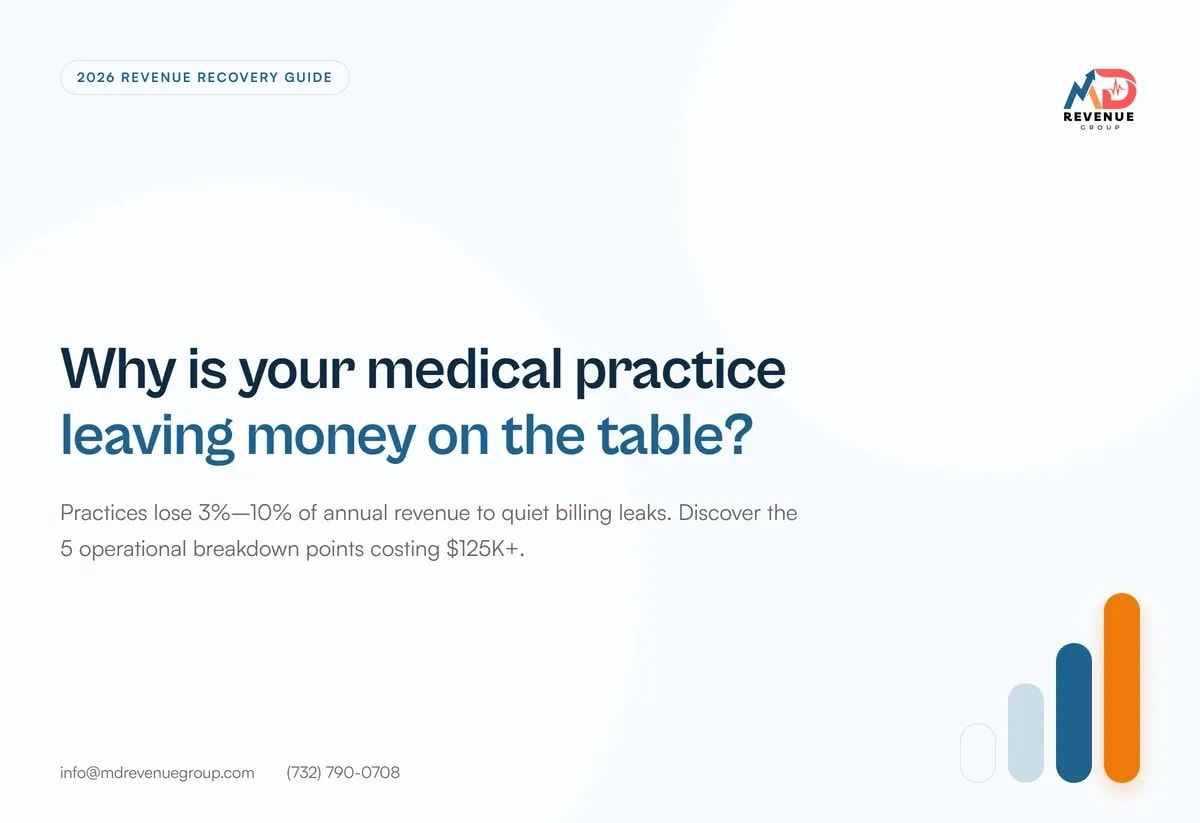
Why is your medical practice leaving money on the table? Fix the 5 quiet revenue leaks costing 3-10% of net collections with MGMA data.
Why Is My Medical Practice Leaving Money on the Table?
Why is your medical practice leaving money on the table every single month? Medical practices lose 3% to 10% of their annual net collections to quiet revenue cycle leaks, which costs a standard two-physician group between 250,000 per year. These losses rarely stem from a single catastrophic mistake. Instead, revenue slips away through unworked claim denials, front-desk eligibility errors, payer underpayments, unbilled procedures, and aging accounts receivable that internal teams lack the bandwidth to audit.
Key Takeaways
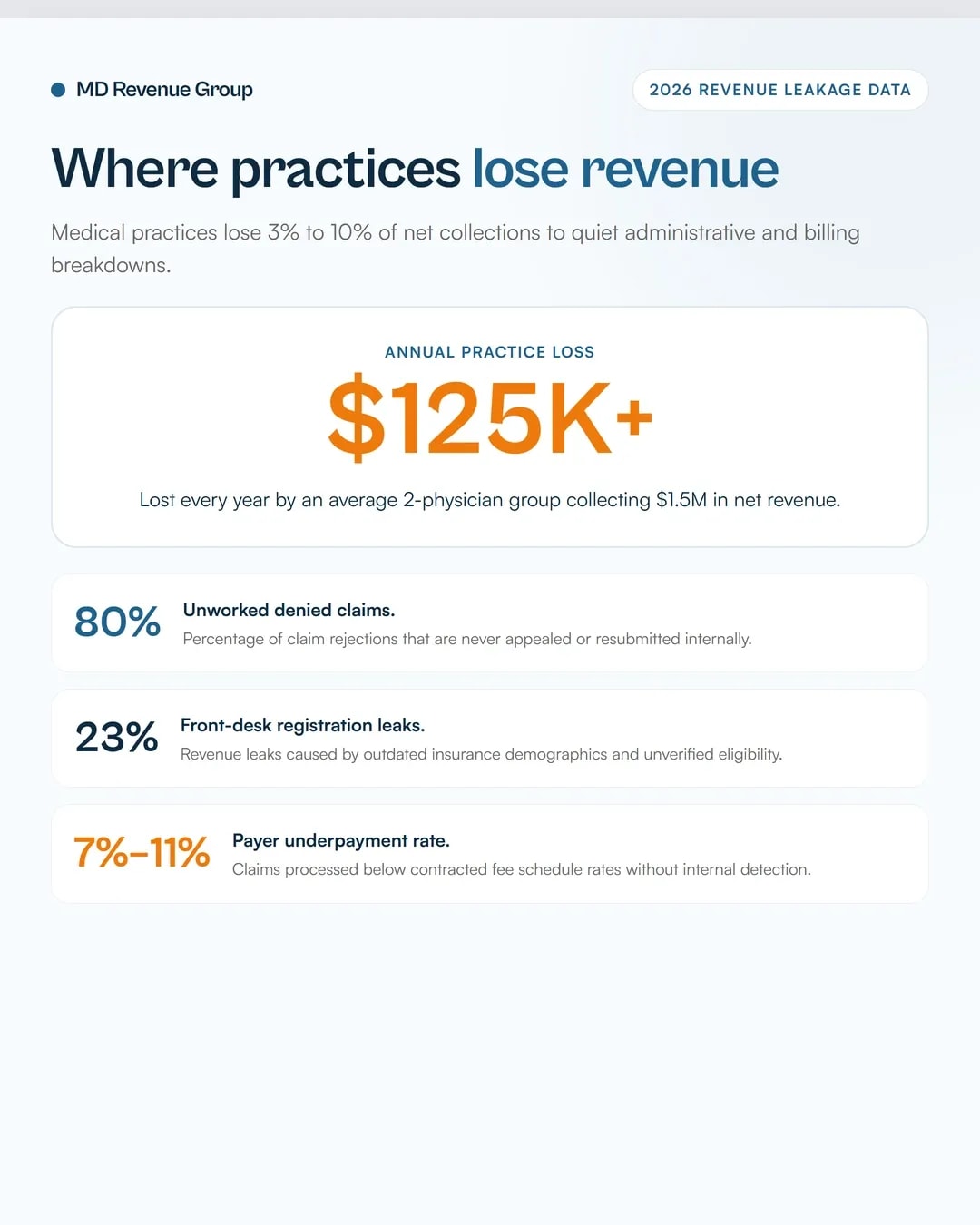
- The 250K Revenue Gap: Medical Group Management Association (MGMA) benchmarks show average practices lose 3% to 10% of net collections to systemic billing inefficiencies.
- The 80% Denial Abandonment Rule: Industry audit data shows 80% of denied claims are never appealed or resubmitted by busy in-house teams.
- Front-End Vulnerability: 23% of revenue leaks originate at patient check-in due to outdated insurance demographics and unverified eligibility.
- Payer Underpayments: Payers underpay contracted fee schedule rates on 7% to 11% of processed claims, which goes unnoticed when claims are marked as paid.
- Timely Filing Expirations: Commercial payers enforce 90 to 180 day timely filing limits. Claims sitting unworked past these windows become uncollectible write-offs.
The 5 Hidden Drivers of Practice Revenue Leakage
When physician owners notice stagnant revenue despite steady patient volume, they often assume patient visit counts are down. In reality, clinical work was performed, but revenue leaked out during the billing cycle.
Total Clinical Revenue Generated:   $1,500,000
----------------------------------------------
Front-End Eligibility Leaks (23%):   -$34,500
Unworked Claim Denials (80% rule):   -$45,000
Coding Errors & Downcoding (13%):    -$19,500
Payer Underpayments (7% rate):       -$15,000
Unbilled Charge Capture Leaks (1%):  -$15,000
----------------------------------------------
Actual Net Revenue Collected:       $1,371,000
Total Annual Revenue Leakage:        $129,000 (8.6%)
Revenue cycle leaks happen because traditional practice management billing systems track submitted claims rather than uncollected revenue. Five operational breakdowns cause this leakage:
- Unworked Claim Denials: The American Hospital Association reports claim denials rose 25% year over year. In-house billers focused on daily claim entry rarely have time to appeal complex rejections.
- Eligibility Failures: Patient coverage changes, expired pre-authorizations, and misspelled subscriber IDs generate instant rejections.
- Coding Undercoding: Physicians bill lower Evaluation and Management (E/M) levels out of audit anxiety, leaving 65 per visit unbilled.
- Contractual Underpayments: Payers process claims below agreed fee schedules, hoping billing departments won't audit line items.
- Unbilled Services: Procedures documented in chart notes are never transferred to billing claim forms.
Practices seeking a thorough review of their financial health can request a professional medical billing audit to expose hidden collection bottlenecks.
Front-Desk Registration Errors: The 23% Chain Reaction
Revenue integrity starts at patient check-in. MGMA research reveals that 23% of all claim denials originate from administrative mistakes committed before the patient meets the physician.
When front-desk staff skip real-time eligibility verification, your practice submits claims with invalid policy numbers, inactive group coverage, or wrong secondary payer order. Commercial payers reject these claims 30 to 40 days later.
Patient Check-in → Demographic Typo → Claim Submitted → 35-Day Payer Rejection → Manual Rework → Timely Filing Limit Passed ($0 Collected)In addition, failing to collect patient co-pays, deductibles, and past-due balances at the point of service reduces your eventual collection rate. Once a patient leaves the office, collection probability drops by 15% each week. Sending post-visit billing statements costs $5.50 per statement in postage, printing, and administrative labor.
When front desk workflows fail to capture accurate primary insurance cards, claims route to incorrect clearinghouses. This mistake delays initial submission by weeks and exposes claims to timely filing rejections.
Coding Errors and Payer Downcoding Algorithms
Coding inaccuracies account for 13% of total practice revenue loss and trigger nearly 40% of all formal claim denials. Payers now utilize automated algorithms to flag claims for downcoding.
Commercial insurers systematically review level 4 and level 5 E/M visits (CPT 99214 and 99215). If documentation lacks specific clinical complexity details, payer algorithms automatically recalculate reimbursement to level 3 (CPT 99213). This single change cuts your reimbursement by $42 per encounter.
CPT 99214 (Level 4 Established):  $132 Payer Allowable
CPT 99213 (Algorithm Downcode):   -$90 Payer Allowable
------------------------------------------------------
Net Lost Revenue Per Visit:       $42 Uncollected
Omission of modifier 25 when performing minor procedures during an office visit causes immediate rejection. Billers who fail to link secondary ICD-10 codes to support medical necessity forfeit legitimate revenue.
Many physicians undercode out of fear of payer audits. They select CPT 99213 for complex chronic care visits that meet all medical decision-making criteria for CPT 99214. Over 500 patient visits a year, undercoding costs your practice $21,000 in unearned revenue.
To combat algorithmic claim adjustments, read our analysis on automatic downcoding payer algorithm to protect your practice coding integrity.
Payer Fee Schedule Underpayments and Unbilled Charges
The quietest form of revenue leakage occurs when insurance companies underpay contracted rates. Healthcare Financial Management Association (HFMA) studies show payers underpay 7% to 11% of claims processed.
Because practice management software marks these claims as "paid," internal billers close the accounts without checking the Remittance Advice (ERA) against your signed payer fee schedule. A 60,000 from your bank account.
Contracted Fee Schedule Rate: $185
Payer ERA Remittance Paid:   $162
Unnoticed Shortage:           $23 per claim
Annual Impact (3,000 claims): $69,000 lost
Unbilled services create another major drain. Physicians frequently perform diagnostic tests, minor surgical procedures, or care management services that never get checked off on encounter forms. If charge capture procedures are not reconciled daily against EHR encounter logs, 1% of your clinical work goes unbilled.
Practices needing to evaluate charge capture performance can utilize our revenue integrity tool to calculate uncollected service charges.
If you suspect your software is missing collections, review our strategy guide on forensic RCM audit revenue leakage to trace hidden financial gaps.
How Timely Filing Deadlines Burn Uncollected Revenue
Commercial and government payers enforce strict timely filing windows. Medicare requires claims to be submitted within 365 calendar days of the service date, but commercial payers like UnitedHealthcare, Aetna, and Horizon BCBS often enforce 90-day or 180-day deadlines.
When a claim is denied for a front-desk demographic error 45 days after service, your billing staff has a narrow window to correct and resubmit it. If the biller sits on the rejection for another 60 days while managing daily phone calls, the resubmission passes the timely filing threshold.
Payer Name           Timely Filing Window    Appeal Window
----------------------------------------------------------
Medicare Part B      365 Days                120 Days
UnitedHealthcare     90–180 Days             180 Days
Aetna Commercial     90 Days                 180 Days
Horizon BCBS NJ      180 Days                90 Days
Once a claim passes its timely filing deadline, the payer issues a final denial that cannot be billed to the patient. Your practice is forced to write off 100% of the charges as contractual loss.
How to Audit and Plug Practice Revenue Leaks
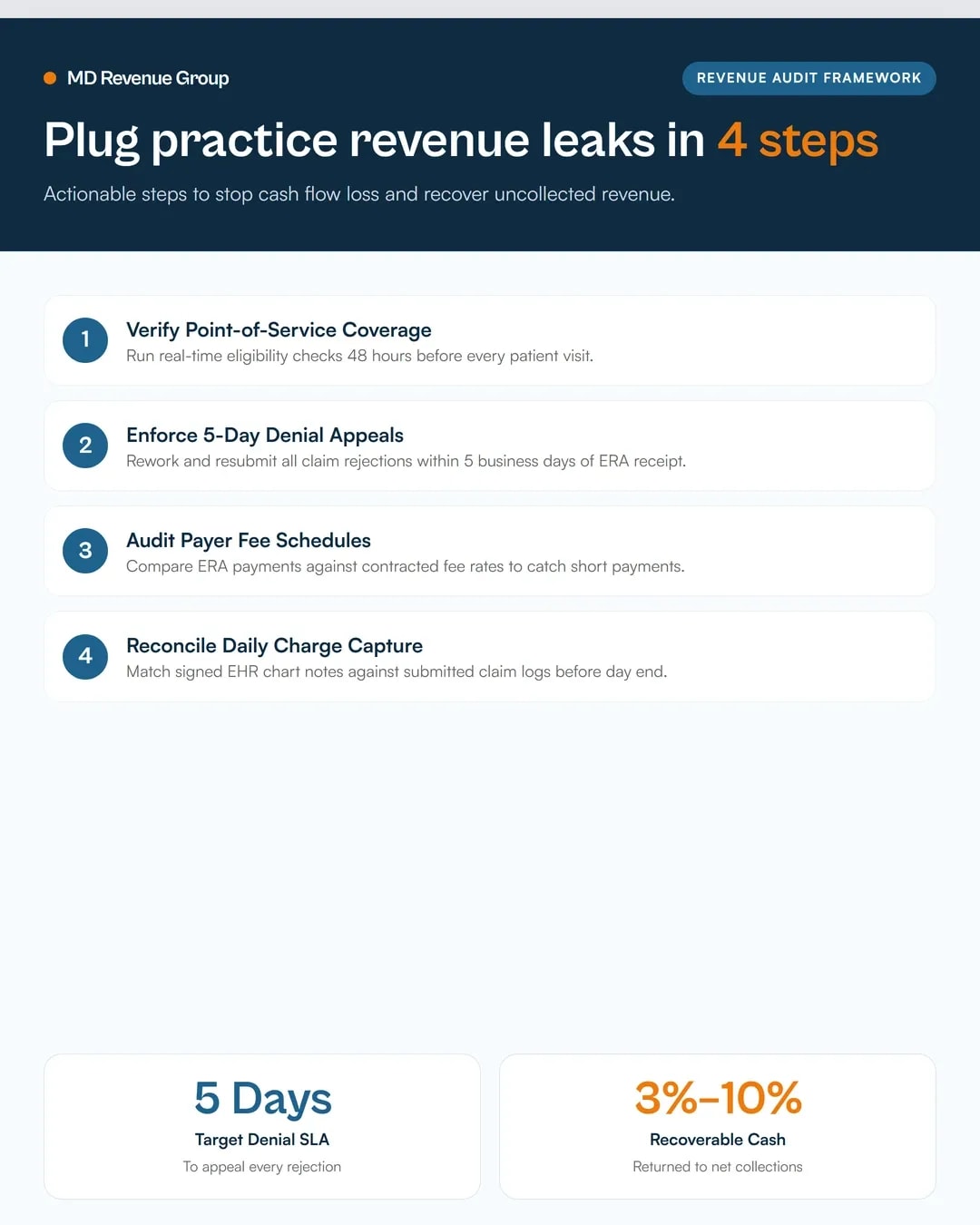
Plugging revenue leaks requires transitioning from reactive billing to structured revenue cycle management. Implement these four operational steps to secure your cash flow:
1. Enforce Point-of-Service Verification
Mandate automated real-time insurance eligibility checks 48 hours prior to patient appointments. Train front-desk personnel to collect co-pays and deductibles before patients enter the exam room.
2. Track the 80% Denial Recovery Rule
Never allow denied claims to sit in aged accounts receivable. Establish a rule that every claim rejection must be reviewed, corrected, and resubmitted within 5 business days of ERA receipt.
3. Conduct Monthly Payer Fee Schedule Audits
Compare ERA payments against contracted payer rates for your top 10 CPT codes. If a payer underpays, submit an immediate fee schedule variance appeal.
4. Implement Charge Capture Reconciliation
Run end-of-day reports comparing completed EHR clinical notes against submitted billing claims. Every signed chart note must match a billed claim line.
State legislative changes also affect revenue collection. Healthcare providers operating in New Jersey should review regulatory updates like the louisa carman medical debt relief act nj providers to ensure compliance with patient collection laws.
In addition, regional medical groups can inspect our guide on medical revenue recovery for group practices in New Jersey to improve local collection workflows.
Frequently Asked Questions
What is a normal claim denial rate for a medical practice?
Industry benchmarks suggest a healthy claim denial rate should stay below 5%. However, many independent practices experience average denial rates between 10% and 15% due to staffing constraints and evolving payer rules.
How do I know if my practice is experiencing payer underpayments?
You can identify underpayments by comparing your Remittance Advice (ERA) payments line-by-line against your signed payer fee schedule agreements. If payments fall below contractual rates, your practice is experiencing underpayments.
What is charge capture reconciliation?
Charge capture reconciliation is the daily process of cross-referencing completed patient appointment schedules and EHR encounter notes against submitted billing claims to ensure every provided service gets billed.
Why do busy medical practices fail to appeal denied claims?
Most in-house billing staff are consumed with daily claim creation and phone calls. Appealing a single denied claim takes 20 to 30 minutes of administrative work, causing teams to prioritize new claims over appealing old rejections.
How often should a medical practice perform a billing audit?
Medical practices should perform an internal billing and coding audit at least twice a year. An external independent RCM audit should be conducted annually to benchmark collection performance against specialty standards.
Is Your Practice Leaving Revenue Behind?
Unworked claim denials, downcoding algorithms, and fee schedule shortages drain thousands of dollars from independent practices every month. We perform forensic RCM audits to find your exact revenue leaks and recover your uncollected income.