
MFT and MHC Medicare Billing: A Credentialing Checklist for Therapy Practices
Master medical billing for mental health services with our 2026 MFT & MHC Medicare enrollment checklist, 75% fee schedule math, and PECOS guide.
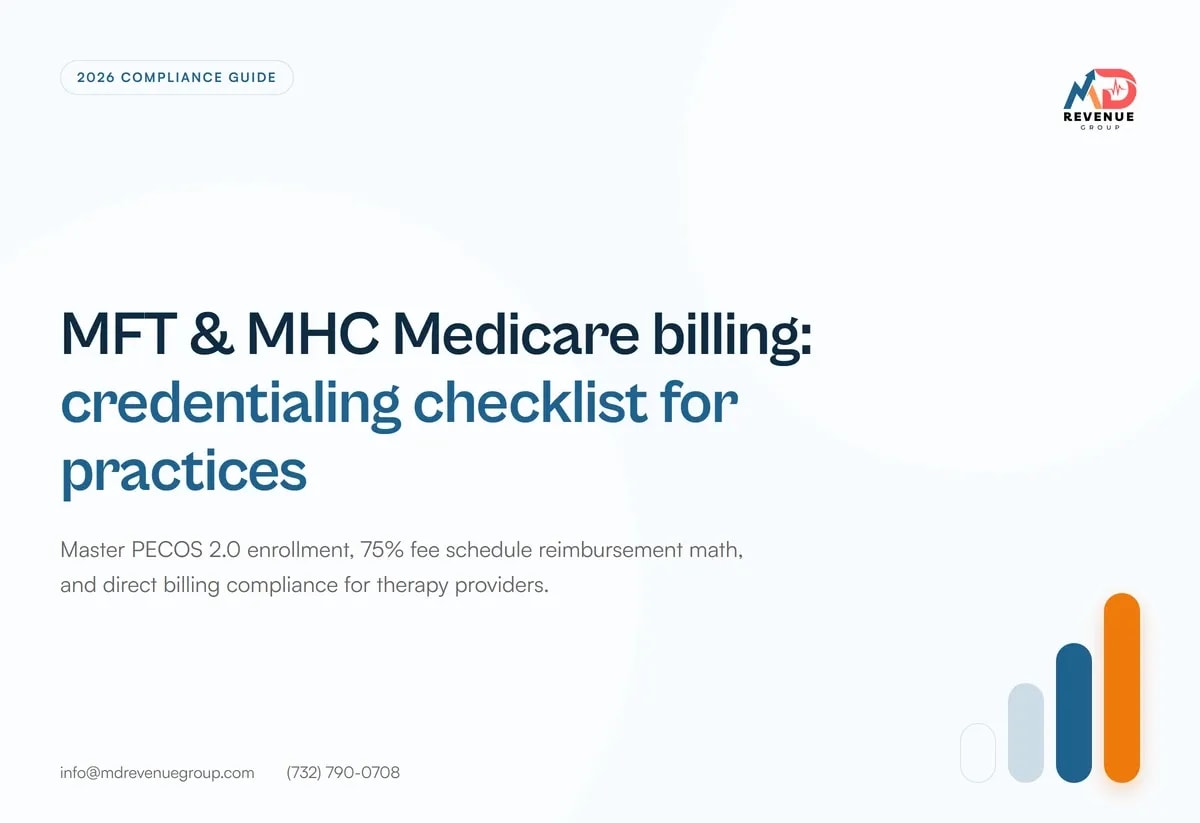
Establishing efficient medical billing for mental health services requires group practices to properly enroll Licensed Marriage and Family Therapists (LMFTs) and Licensed Mental Health Counselors (LMHCs) into Medicare PECOS 2.0. Under Section 4113 of the Consolidated Appropriations Act and 2026 CMS Physician Fee Schedule guidelines, MFTs and MHCs receive reimbursement at 75% of the Clinical Psychologist rate (yielding approximately $125.25 for 60-minute therapy code CPT 90837). CMS rules strictly prohibit "incident to" billing for MFTs and MHCs; each clinician must maintain individual Medicare enrollment and reassign benefits using Form CMS-855I. Medical practices utilizing specialized behavioral health billing procedures reduce average credentialing delays from 180 days down to under 60 days. This comprehensive operational checklist covers PECOS registration, 75% reimbursement math, NPI taxonomy selection, and denial prevention strategies.
Key Takeaways
- No Incident To Billing: MFTs and MHCs cannot bill Medicare under a physician's NPI. Every therapist must individually enroll via PECOS 2.0 and reassign billing rights to the practice.
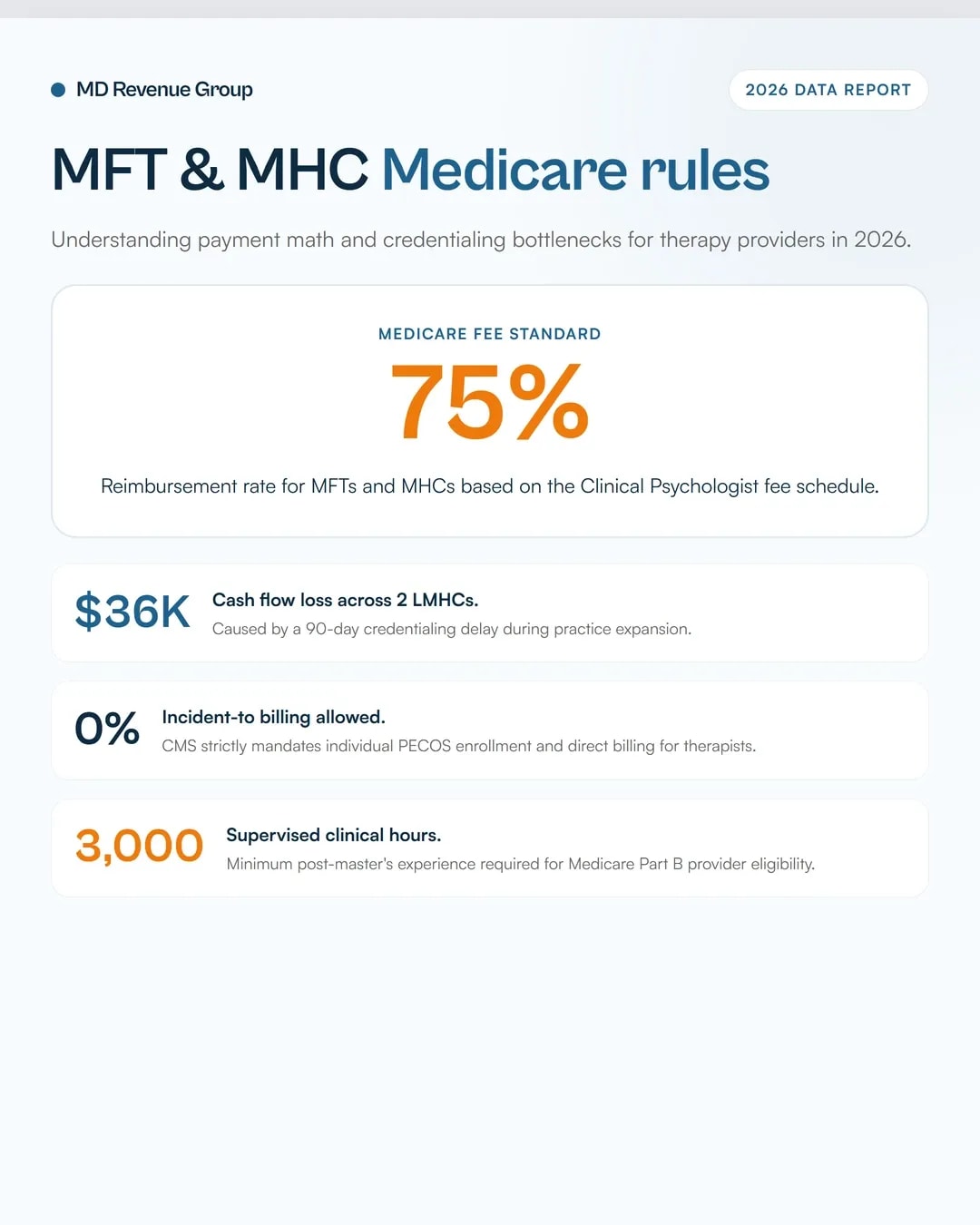
- 75% Payment Standard: MFTs and MHCs are reimbursed at exactly 75% of the Medicare Physician Fee Schedule rate established for Clinical Psychologists.
- Supervised Clinical Hours: Enrollment requires a master's or doctoral degree plus at least 2 years or 3,000 post-graduate hours of clinical supervised experience.
- Credentialing Financial Delay: Standard commercial credentialing takes 90 to 180 days, while Medicare PECOS processing averages 60 to 90 days. Unenrolled clinicians cause $7,000 to $12,000 in monthly lost revenue per provider.
Medicare Expansion Rules for MFTs and MHCs
The inclusion of Marriage and Family Therapists and Mental Health Counselors as independent Medicare Part B providers represents a major shift in mental health reimbursement. Previously, therapy practices had to rely on complex supervisory structures or private pay arrangements for Medicare beneficiaries.
To qualify for independent Medicare billing privileges in 2026, clinicians must satisfy three primary statutory criteria set by CMS:
- Degree Requirements: Possess a master's or doctoral degree that qualifies for licensure as an MFT or MHC under state law.
- Clinical Experience: Complete a minimum of 2 years or 3,000 hours of post-master's degree clinically supervised experience in an appropriate clinical setting.
- Active State Licensure: Hold a current, unrestricted state license or certification as an LMFT, LMHC, LPC (Licensed Professional Counselor), or LCPC (Licensed Clinical Professional Counselor).
Failing to verify these qualifications prior to submitting Form CMS-855I results in application rejection by Medicare Administrative Contractors (MACs). Practice management teams managing complex revenue operations benefit from reviewing our comprehensive revenue cycle management frameworks.
| MFT & MHC MEDICARE QUALIFICATION | |
|---|---|
| Master's/Doctoral Degree --> 3,000 Supervised Hours --> Active State License Medicare Enrollment Approved <-- Submit CMS-855I via PECOS 2.0 <-- |
Understanding the 75% Medicare Reimbursement Formula
CMS sets Medicare Physician Fee Schedule allowable rates for MFTs and MHCs at exactly 75% of the fee schedule amount authorized for Clinical Psychologists. Clinical Social Workers (LCSWs) receive 80% of the Clinical Psychologist rate, creating a multi-tiered reimbursement structure within group therapy practices.
CPT Code | Service Description | Clinical Psychologist 2026 National Rate | MFT / MHC 2026 National Rate (75%) | LCSW 2026 National Rate (80%) |
|---|---|---|---|---|
90791 | Diagnostic Evaluation | $182.40 | $136.80 | $145.92 |
90832 | Individual Psychotherapy (30 min) | $78.50 | $58.88 | $62.80 |
90834 | Individual Psychotherapy (45 min) | $113.97 | $85.48 | $91.18 |
90837 | Individual Psychotherapy (60 min) | $167.00 | $125.25 | $133.60 |
90847 | Family Psychotherapy w/ Patient | $122.10 | $91.58 | $97.68 |
When modeling group practice financial performance, billing teams must adjust fee schedules based on provider taxonomy. Submitting claims for an LMHC at 100% of the physician fee schedule results in automatic clearinghouse repricing or contractual adjustment write-offs.
Strict Prohibition of Incident To Billing for Therapists
A frequent billing error among group practices is attempting to submit claims for newly hired MFTs or MHCs under a supervising psychiatrist's or psychologist's NPI using "incident to" billing rules.
CMS billing regulations explicitly state that services rendered by MFTs and MHCs are covered under their own benefit category. Therefore, "incident to" billing is strictly prohibited for these provider types.
INCORRECT INCIDENT-TO CLAIM SUBMISSION (Triggers Audit Recoupment):
Rendering Provider: Jane Doe, LMHC (Unenrolled)
Billing NPI: Dr. Smith, MD (Psychiatrist)
Claim Result: False Claims Act Violation / Medicare Post-Payment Recoupment
CORRECT DIRECT MEDICARE SUBMISSION:
Rendering Provider NPI: Jane Doe, LMHC (Type 1 Individual NPI enrolled in PECOS)
Billing NPI: Practice Group NPI (Type 2 Group NPI with CMS-855I Reassignment)
Claim Result: Clean Claim Paid at 75% Allowable Fee Schedule
Practices that submit claims under a supervising provider's NPI while an MFT's PECOS application is pending risk total claim recoupment and civil monetary penalties during MAC audits. For a deeper breakdown of general behavioral health coding compliance, review our detailed guide on mental health billing.
The 8-Step PECOS 2.0 Credentialing Checklist
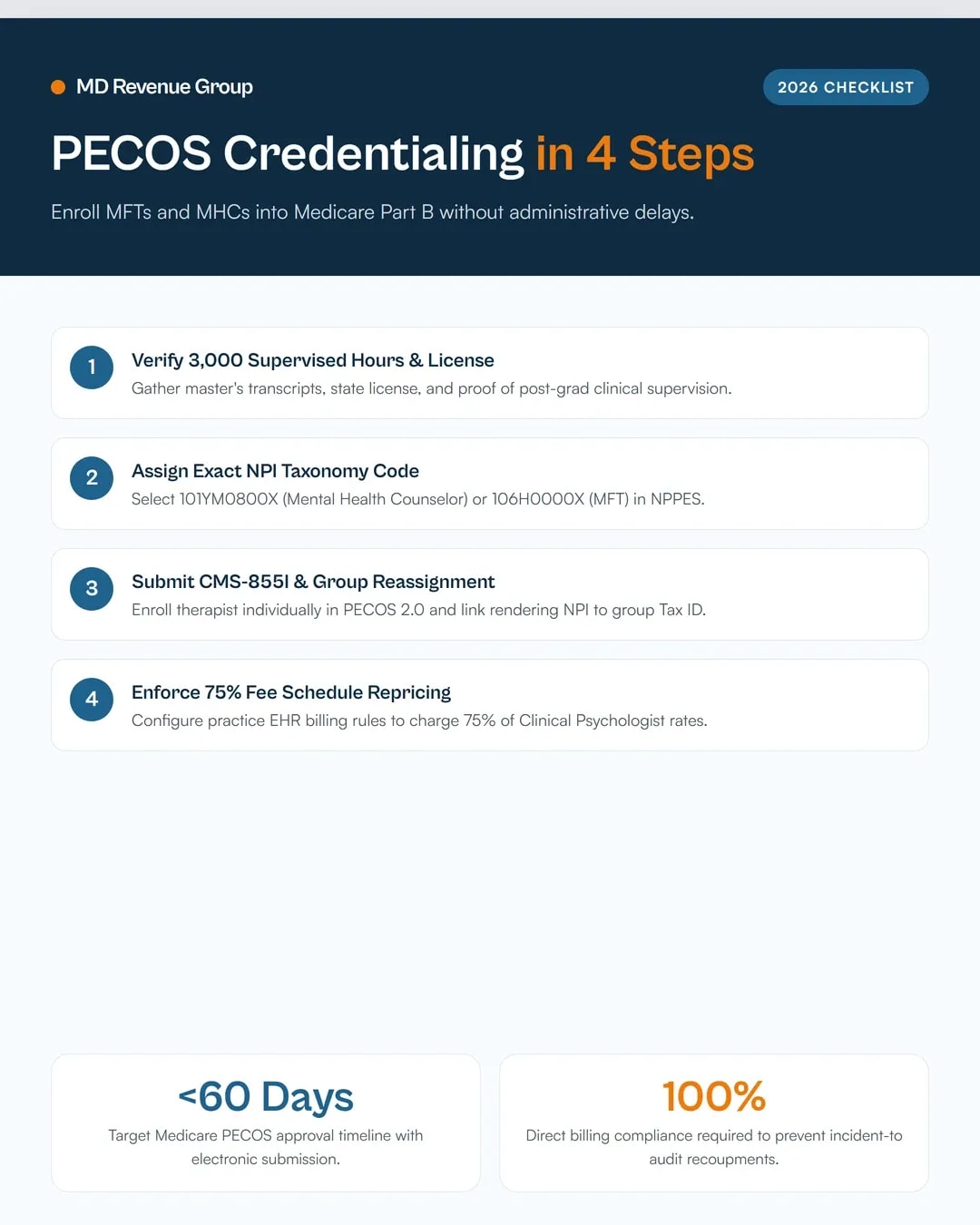
To ensure smooth Medicare enrollment without administrative rejection, follow this step-by-step checklist for every new MFT or MHC joining your therapy practice:
Step | Action Item | Responsible Party | Documentation Required | Verification Target |
|---|---|---|---|---|
1 | Obtain Type 1 NPI | Clinician | NPPES Registration | Confirm Taxonomy (101YM0800X or 106H0000X) |
2 | Create CMS I&A Account | Practice Manager | Social Security Name Check | Establish Authorized Official Rights |
3 | Gather Degree & License | Clinician | Master's Transcripts, State License | Verify 3,000 Supervised Hours |
4 | Complete CMS-855I | Practice Administrator | PECOS 2.0 Portal Entry | Select Individual Provider Option |
5 | Reassign Group Benefits | Practice Administrator | Group Type 2 NPI | Link Rendering NPI to Group Tax ID |
6 | Submit EFT Form CMS-588 | Billing Department | Voided Practice Check | Banking Verification |
7 | Track MAC Progress | Billing Specialist | PECOS Self-Service Portal | Resolve Development Letters <30 Days |
8 | Update CAQH/DataSpring | Credentialing Manager | CAQH Online Profile | Attest Profile & Re-Attest Every 120 Days |
Our specialized credentialing services team handles all eight steps electronically to shorten payer approval timelines for growing practices.
Proprietary Calculation: The $36,000 Cash Flow Gap for Expanding Practices
When a group therapy practice hires two new LMHCs to meet growing patient demand, delays in Medicare and commercial payer credentialing create severe financial strain. Below is an operational financial model demonstrating the impact of a 90-day enrollment backlog in 2026.
Practice Parameters
- New Clinicians: 2 Full-Time LMHCs
- Target Patient Volume per Clinician: 25 individual sessions per week (50 total sessions/week)
- Expected Payer Mix: 30% Medicare, 50% Commercial, 20% Self-Pay
- Average Blended Reimbursement (CPT 90837 at 75% rate): $120 per session
- Total Insured Session Volume (80% of 50 sessions): 40 insured sessions per week
- Expected Weekly Insured Revenue: 40 * 4,800 per week ($19,200 per month)
90-Day (12-Week) Financial Impact Math
Gross Insured Revenue Capacity (12 Weeks): 12 weeks * $4,800/week = $57,600
Retroactive Medicare Collection (50% approved back to PECOS filing date): $57,600 * 0.50 = $28,800
Uncollectible Revenue from Out-of-Network Denial Rules & Expired Timely Filing: $28,800
Staff Administrative Re-Work Costs (Appeals, Reprocessing, Patient Statements): $2,400
Carrying Cost of Clinician Compensation During Un-Credentialed Period: $4,800 margin impact
Total Net Cash Flow Loss across 2 LMHCs: $36,000
A 90-day credentialing delay results in a direct cash flow leak of $36,000 for a two-therapist expansion. Initiating PECOS applications 120 days prior to clinician start dates preserves revenue streams. To evaluate broader operational losses, consult our analysis on physician credentialing revenue bottlenecks.
State-Specific Credentialing and Multi-State Payer Enrollment
Credentialing requirements for mental health providers vary across state jurisdictions and regional commercial health plans. Practices expanding across state lines must adapt their enrollment tracking systems.
- California: Commercial plans such as Blue Shield of CA and Kaiser require separate panel applications even after Medicare PECOS approval. Review state-specific billing considerations at medical billing in California.
- Florida: Florida Medicaid managed care networks enforce strict credentialing verification organization (CVO) checks for LMFTs. Practices can access specialized regional workflows via medical billing in Florida.
- Texas: Texas practices must navigate Texas Department of Insurance (TDI) rules governing network adequacy and prompt pay. Explore regional guidelines at medical billing in Texas.
Managing Telehealth and In-Person Medicare Encounter Rules
Teletherapy billing for MFTs and MHCs under Medicare Part B requires strict compliance with location modifiers and audio-video technology standards. CMS mandates that teletherapy visits originate from HIPAA-compliant interactive audio and video systems.
1. Place of Service Code Selection
Medicare billing rules distinguish between teletherapy delivered to a patient at home versus a clinical setting. Use POS 10 when the patient receives teletherapy in their home environment. Use POS 02 when the beneficiary is located at an outpatient clinic or originating facility.
2. Required Telehealth Modifiers
When submitting electronic 837P claims for teletherapy, append Modifier 95 to indicate synchronous telemedicine rendered via real-time audio and video. If the patient lacks broadband capability and requires audio-only teletherapy, append Modifier FQ to verify that audio-only treatment was medically necessary.
3. Documentation of Encounter Modality
Clinical notes must state the exact medium used for the session. A compliant EHR note must explicitly confirm: "Session conducted via HIPAA-compliant real-time audio-video connection. Patient verified identity and confirmed location at home."
Clinical Documentation Standards for Medicare Post-Payment Audits
Medicare Administrative Contractors audit therapy documentation to verify that services meet medical necessity standards. Encounter notes for CPT 90834 and 90837 must contain specific structural elements.
Required Audit Documentation Elements
- Start and Stop Times: Exact session start time and stop time (e.g., 10:05 AM to 10:58 AM). Stating "50 minute session" without specific timestamps results in claim recoupment.
- Individualized Treatment Plan: A documented diagnosis, functional impairments, treatment goals, and estimated timeline for improvement.
- Progress Tracking: Clear clinical description of interventions used (such as Cognitive Behavioral Therapy techniques) and patient response during the session.
Literal Documentation Example for EHR Therapy Notes
PATIENT ENCOUNTER NOTE (CPT 90837)
Date of Service: 08/16/2026
Start Time: 09:00 AM | Stop Time: 09:55 AM | Total Duration: 55 Minutes
Provider: Sarah Jenkins, LMHC (NPI: 1982736450)
DIAGNOSIS: Major Depressive Disorder, Recurrent, Moderate (ICD-10 F33.1)
INTERVENTIONS: Conducted 55-minute individual psychotherapy utilizing Cognitive Behavioral Therapy (CBT). Focused on restructuring cognitive distortions regarding workplace performance. Reviewed weekly mood log (PHQ-9 score reduced from 14 to 11).
PLAN: Continue weekly CBT sessions. Patient to complete thought record exercise before next appointment.
Maintaining exact EHR documentation standards protects your practice against post-payment Medicare clawbacks. Practices seeking comprehensive audit protection can schedule a professional review through our medical billing audit team.
Frequently Asked Questions
Can Marriage and Family Therapists bill Medicare directly in 2026?
Yes. Effective January 1, 2024, and continuing under 2026 CMS guidelines, LMFTs and LMHCs are authorized independent Medicare Part B providers. They must enroll via PECOS 2.0 and reassign benefits to their practice.
What is the Medicare reimbursement rate for MFTs and MHCs?
MFTs and MHCs are reimbursed at 75% of the Medicare Physician Fee Schedule allowable rate established for Clinical Psychologists. For CPT 90837 (60-minute therapy), the 2026 national average rate is approximately $125.25.
Is "incident to" billing allowed for LMFTs or LMHCs under Medicare?
No. CMS explicitly prohibits "incident to" billing for MFTs and MHCs. These clinicians must bill under their own individual NPI and maintain active PECOS enrollment.
What taxonomy code should an LMHC use when applying for an NPI?
Mental Health Counselors should use taxonomy code 101YM0800X (Mental Health Counselor) or 106H0000X (Marriage & Family Therapist). Ensuring exact taxonomy alignment across NPPES, PECOS, and CAQH prevents claim rejections.
Optimize Your Practice Credentialing
If your group practice faces credentialing backlogs, clearinghouse denials, or uncertainty around MFT/MHC Medicare billing rules, MD Revenue Group can help. We manage end-to-end provider enrollment, PECOS maintenance, and behavioral health claim workflows to maximize practice collections.
Request a free revenue audit with our certified behavioral health billing experts today.