
The 'Offshoring' Quality Gap: Why 2026 Is the Year of RCM 'Reshoring' for High-Complexity Claims
Learn how the RCM offshoring vs reshoring quality gap affects high-complexity claims, and why providers are reshoring billing for surgical modifiers.
Outsourcing medical billing to save money is common. However, the RCM offshoring vs reshoring quality gap is growing in 2026. For high-complexity claims, relying on cheap offshore labor often results in costly denials, delayed payments, and compliance issues.
Many medical groups are reshoring their billing operations to protect their revenue. We will explore why complex claims require domestic expertise, look at the math behind the quality gap, and outline a hybrid billing model that works.
Key Takeaways
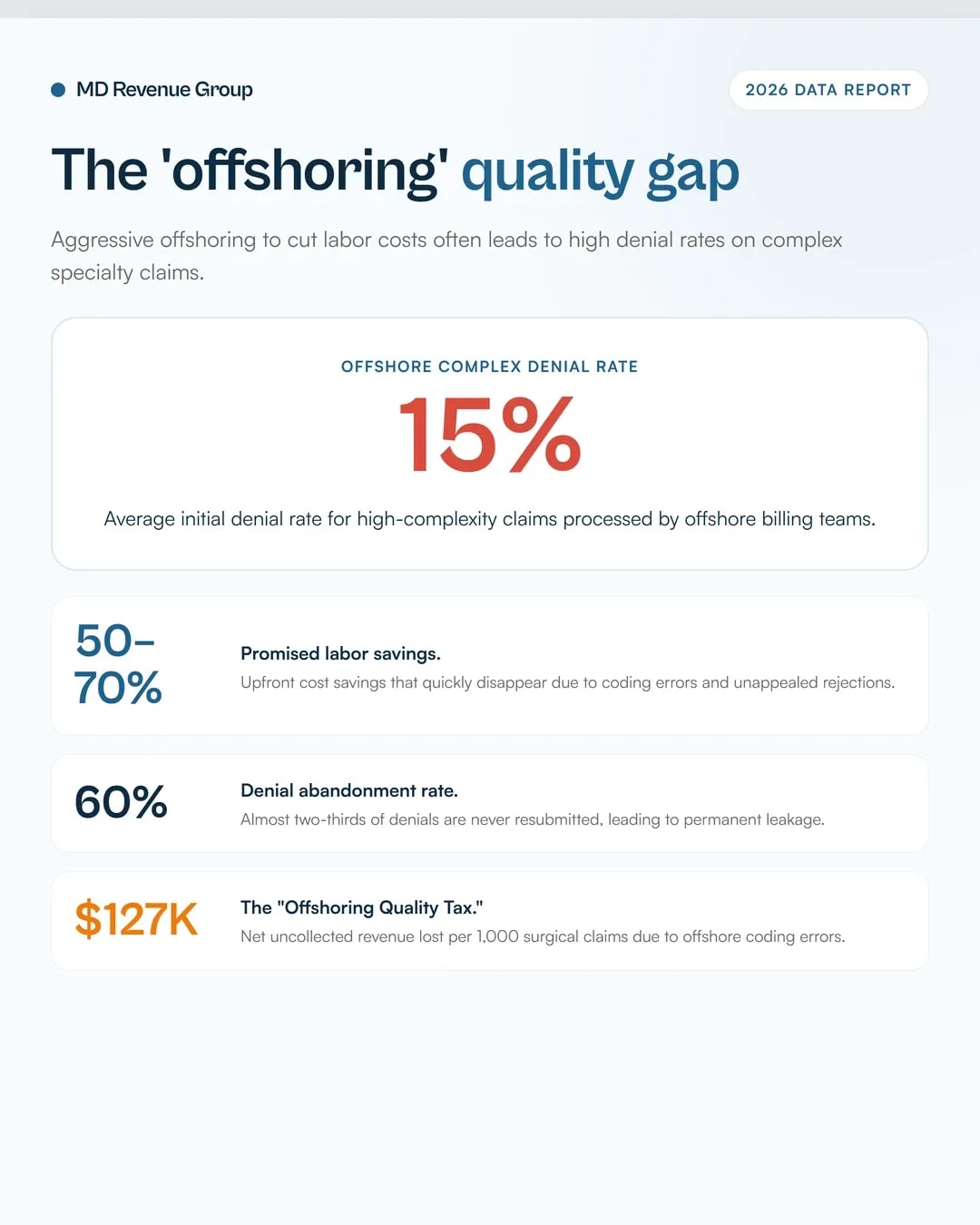
- Upfront Savings Illusion: Offshore vendors promise 50% to 70% labor savings.
- Denial Rate Disparity: High-complexity claims processed offshore face a 15% denial rate, compared to 4% onshore.
- The Offshoring Quality Tax: A practice loses $125,000 per 1,000 surgical claims due to offshore coding errors.
- Hybrid Solution: Smart practices use offshore staff for entry-level data tasks, keeping complex coding onshore.
What drives the offshoring quality gap in complex claims?
Many RCM vendors promise cheap billing services. They hire offshore teams in regions where labor costs are low. This approach works for simple data entry. It fails when claims require clinical judgment.
The primary issues are communication and training. Complex billing requires constant back-and-forth between billers, payers, and clinical staff.
Time Zone Friction
Offshore teams operate in distant time zones. If a payer denies a claim for missing documentation, a domestic biller calls the insurance representative during local business hours. They resolve the issue immediately.
An offshore worker cannot do this easily. They send emails or log into portals after hours. This delay adds days to your accounts receivable.
When your biller sleeps while the insurance company works, billing issues drag on. A question that takes 5 minutes on the phone takes 5 days over email.
Payer phone systems are complex. If your team is located offshore, navigating these lines is challenging. Calls get dropped. Connections are poor. Payers refuse to release information to offshore agents who cannot verify security questions quickly. This friction slows down denial resolution and extends your AR days.
Language and Contextual Nuance
Insurance representatives use complex language to justify denials. Appealing these decisions requires fluent communication. It requires an understanding of U.S. healthcare policy.
Without this context, offshore staff struggle. They tend to accept denials or resubmit claims without correcting the root errors.
We often see offshore teams resubmit the exact same claim. They hope for a different result. This repetition alerts payer audit algorithms, leading to stricter reviews.
They do not understand local coverage determinations. These rules vary by state and payer. A code accepted in New Jersey might be denied in New York. Onshore coders monitor these updates daily to keep billing clean.
Many clinics try to bridge these gaps by hiring US-based virtual assistants to handle communication. This keeps the customer-facing roles onshore while lowering overhead.
High-complexity coding: why offshoring fails on surgical and specialty modifiers
Simple coding involves matching a diagnosis to a procedure. High-complexity coding is different. It involves surgical modifiers, drug units, and multiple overlapping procedures.
If a biller does not understand these nuances, they submit unclean claims. This triggers immediate audits.
Consider orthopedic surgery. A surgeon performs a knee revision. They use multiple implants. They document hours of work.
Applying the correct modifier is essential. The biller must know when to use modifier 59, modifier 51, or modifier 80.
If the billing team lacks specialized training, they omit modifiers. The payer rejects the secondary procedures.
For instance, modifier 25 allows payment for an evaluation and management visit on the same day as a procedure. Offshore teams often apply modifier 25 to every visit. This pattern triggers audits.
Payers track modifier 25 utilization. If your usage exceeds the specialty average, you face an audit.
Surgical global periods add another layer of complexity. Modifiers 58, 78, and 79 determine if a post-operative procedure is related to the original surgery. Modifier 58 represents a planned staged procedure. Modifier 78 indicates an unplanned return to the operating room. Modifier 79 is for an unrelated procedure during the global period.
If your team applies modifier 78 when they should use 58, your payment drops by 30%. Payers reduce the surgical care portion of the reimbursement. Offshore coders often mix up these codes because they do not read the full operative report. They read the summary sheet and guess.
Practices must maintain accurate records to prevent these losses. Utilizing a modern revenue cycle management platform helps flag missing modifiers before submission.
Let's look at a real scenario. A vascular surgery group in New York used an offshore billing service. The vendor charged 3% of collections.
The group's billing data showed a high denial rate. The offshore coders consistently used modifier 51 instead of modifier 59 on complex endovascular procedures.
This error caused the payer to bundle the procedures. The practice received 50% less reimbursement on secondary lines.
The clinic lost 420,000.
The vendor's low fee did not cover this loss. The practice reshored their billing to a specialized team. Within 90 days, the denial rate dropped from 16% to 3.5%.
Practices facing similar challenges benefit from specialized oncology medical billing resources to navigate drug unit calculations. The same applies to surgical specialties where orthopedic coding and modifiers dictate payment.
The offshoring quality tax: a worked cost-benefit comparison
Let's analyze the math. Offshore billing services look cheap on paper. The hourly rates are low. The percentage fees are attractive.
We call the hidden cost of errors the "offshoring quality tax." When you add the cost of denied claims and lost revenue, offshoring is often more expensive than reshoring.
Consider a surgical practice processing 1,000 high-complexity claims annually. The average reimbursement is $2,000 per claim.
We will compare the financial performance of an offshore billing model against a reshored onshore model.
Cost Element | Offshore Billing Model | Reshored Onshore Model |
|---|---|---|
Billing Service Cost | 3,000 total) | 10,000 total) |
Initial Denial Rate | 15% (150 denials) | 4% (40 denials) |
Denial Rework Cost | 3,750 total) | 1,000 total) |
Denial Abandonment Rate | 60% (90 claims abandoned) | 60% (24 claims abandoned) |
Lost Revenue (Abandoned) | 90 claims x 180,000 | 24 claims x 48,000 |
Total Model Cost | $186,750 | $59,000 |
The offshore service saved 180,000 in uncollected revenue.
The net loss under the offshore model was $127,750 per 1,000 claims.
Offshore Upfront Savings:   -$7,000
Offshore Revenue Leakage:   +$180,000
Net Cost of Offshore Model:  $186,750
Net Cost of Onshore Model:   $59,000
The data shows that reshoring saves money. You invest more in the billing service, but you collect the cash you are owed.
If you struggle with high error rates, you can find strategies for reducing claim denials in our technical guides.
There are also indirect costs to consider. When you offshore, you spend hours managing the vendor. You must hire internal staff to re-check their work.
If you need 1 full-time manager just to audit your offshore vendor, you add $60,000 in local salary waste. Reshoring eliminates this duplicate labor.
You also face audit risks. If an offshore coder consistently misapplies codes, the Office of Inspector General (OIG) can issue penalties. A compliance audit costs a practice upwards of $50,000 in legal fees.
Designing a hybrid RCM model: what to offshore vs. what to reshore
You do not need to reshore your entire operation. A hybrid model combines the efficiency of offshore labor with the accuracy of onshore experts.
We divide RCM tasks into two categories.
Routine Administrative Tasks (Offshore) ──> Eligibility, Charge Entry, Claim Status
Complex Clinical Tasks (Onshore)        ──> Specialty Coding, Modifiers, Appeals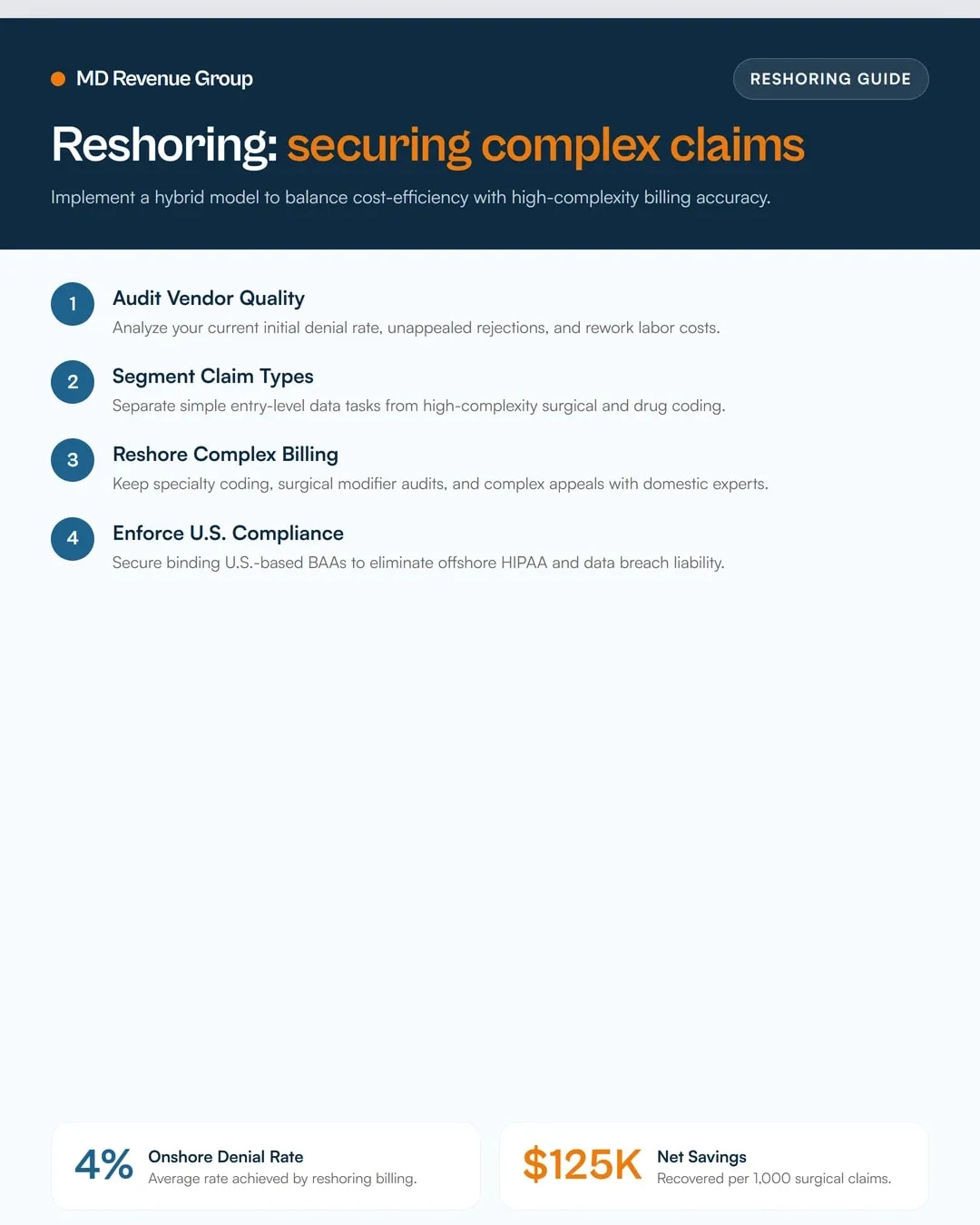
Offshore Tasks
Assign simple, rules-based tasks to your offshore team. This includes entering demographic details from registration sheets.
It includes checking eligibility through automated portals. It also includes tracking claim status. These tasks require time, but they do not require deep clinical knowledge.
Onshore Tasks
Keep complex, judgment-based tasks onshore. This includes specialty coding and modifier application.
It includes reviewing physician documentation for compliance. Onshore experts should also manage appeals for high-value claims.
This division of labor protects your cash flow. It ensures that your most expensive procedures are billed correctly.
To make this model work, you need a clear communication loop. The offshore team should flag complex claims for onshore review. They should not try to guess the code.
If a coder is unsure about a modifier, they place the claim in an onshore hold queue. A domestic certified coder reviews it before submission. You must implement a billing workflow engine that routes claims automatically based on procedure value and complexity.
Compliance and HIPAA liability under onshore vs. offshore models
Compliance is another risk factor. U.S. healthcare providers must comply with HIPAA regulations. They must protect patient data.
If a data breach occurs offshore, enforcing penalties is difficult. The offshore vendor operates outside U.S. legal jurisdiction.
The provider remains liable. You face the fines, the audit costs, and the reputational damage.
The Department of Health and Human Services enforces strict rules. Fines for HIPAA violations reach up to $50,000 per compromised record. If an offshore subcontractor leaks patient data, U.S. regulators penalize your practice.
Onshore billing companies operate under U.S. laws. They sign Business Associate Agreements (BAAs) that carry legal weight. They undergo regular security audits.
For practices in strict regulatory environments, utilizing localized New York medical billing support ensures compliance with both federal and state mandates.
Reshoring your billing operations reduces compliance anxiety. It protects your patient data and secures your practice against audits.
Are you losing revenue to offshore coding errors? We provide 100% US-based, high-complexity billing services that protect your cash flow. Talk to our team.