
Medical Billing Auditing Companies: A Practical Scope for Price Transparency, IDR, and Payment Integrity
Medical billing auditing companies in 2026: what IDR batching, hospital price transparency MRFs, and improper payments change about your audit scope.
Medical Billing Auditing Companies: A Practical Scope for Price Transparency, IDR, and Payment Integrity
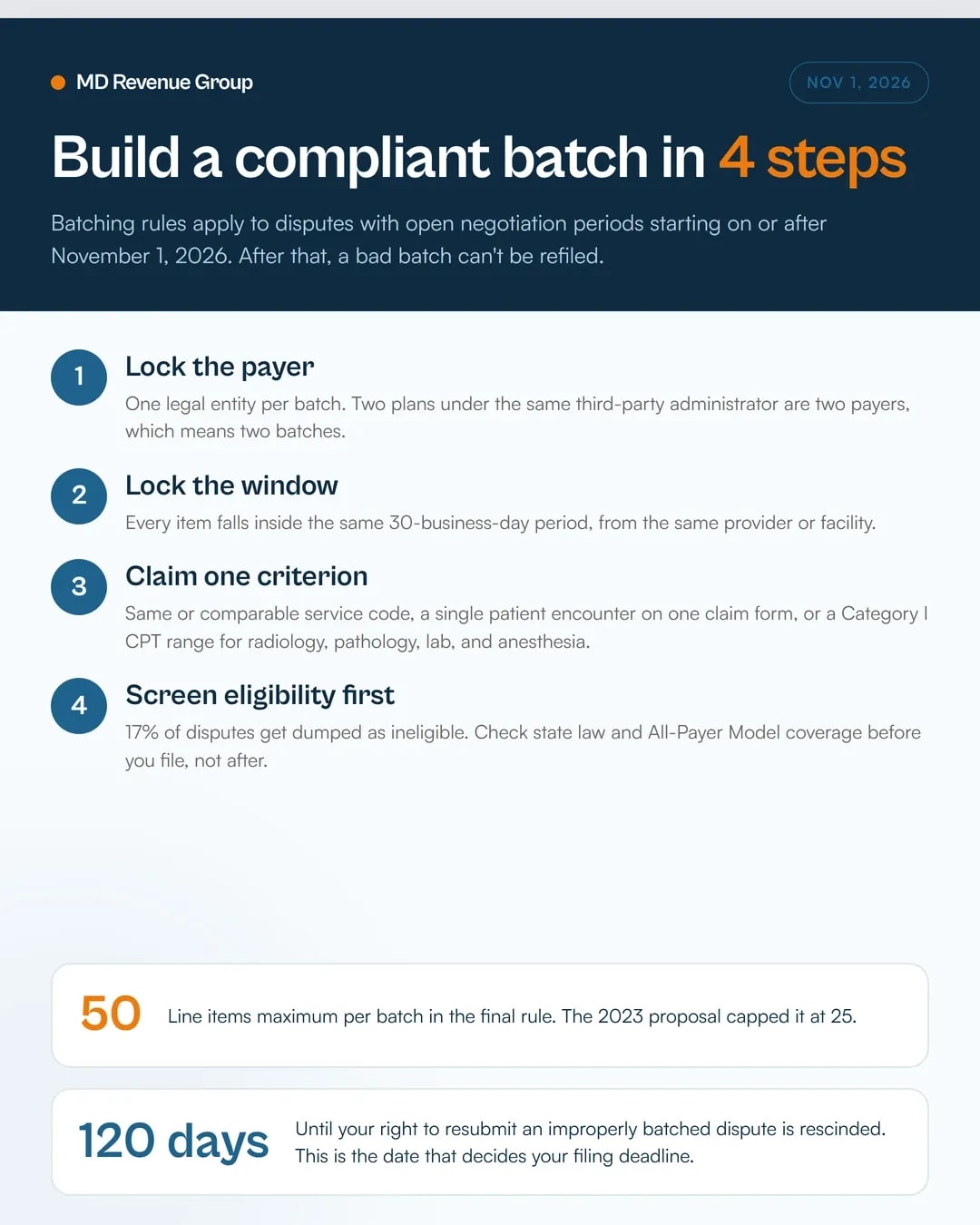
The Federal IDR Operations final rule took effect August 3, 2026, and its batching provisions apply to any dispute with an open negotiation period beginning on or after November 1, 2026. Starting that date, a dispute you batch wrong can never be refiled.
That is what changed the job description for medical billing auditing companies. The audit used to test coding accuracy and documentation support. Now it has to test whether your dispute batches are legally constructible, whether your remittance data can support the eligibility review the new rule requires, and whether your charge master survives the new machine-readable file rules CMS began enforcing on April 1, 2026.
Key takeaways
- The IDR batching rules apply to disputes with open negotiation periods starting November 1, 2026. Improperly batched disputes lose the right to resubmit 120 days after the registry window closes.
- The batch cap is 50 qualified IDR line items, double the 25 proposed in 2023.
- Three batching paths now exist: same or comparable service code, single patient encounter on one claim form, and Category I CPT range for anesthesia, radiology, pathology, and lab.
- Providers won 86.4% of disputed line items in 2025. Total No Surprises Act IDR cost reached $22.4B.
- Hospitals must now encode median, 10th, and 90th percentile allowed amounts plus a named senior official in the machine-readable file, enforced since April 1, 2026.
- CMS found $37.39B in Medicaid improper payments for FY 2025, and 77.17% of it was insufficient documentation.
What changed on August 3, 2026
The Departments of Labor, HHS, and Treasury, with OPM, published the Federal Independent Dispute Resolution Operations final rule on June 4, 2026. It is effective August 3, 2026, with staggered applicability dates extending into 2026 and beyond.
Here are the dates that govern your audit calendar.
Requirement | Applicability |
|---|---|
Effective date of the final rule | August 3, 2026 |
Fee changes | Disputes initiated on or after June 11, 2026 |
QPA disclosure with initial payment or denial notice | Disclosures provided on or after August 3, 2026 |
Batching definitions and limits | Open negotiation periods beginning on or after November 1, 2026 |
Open negotiation notice, response, and IDR initiation notices | 90 days after effective date, or November 1, 2026 |
CARC and RARC remittance codes | Items and services furnished after January 1, 2027 |
DOL guidance establishing CARC and RARC codes | Due by December 4, 2026 |
Rescission of resubmission for improperly batched disputes | 120 days after the registry registration period ends |
Full portal functionality | Not expected until August 2028 |
Two rows in that table create the deadline. November 1, 2026 is when the new batching rules start applying. The 120-day rescission is when your ability to correct a bad batch disappears.
We wrote up the operational side of the batching change in No Surprises Act IDR batching workflow, and the specialty-level version in IDR batching by specialty.
Why IDR became its own audit discipline
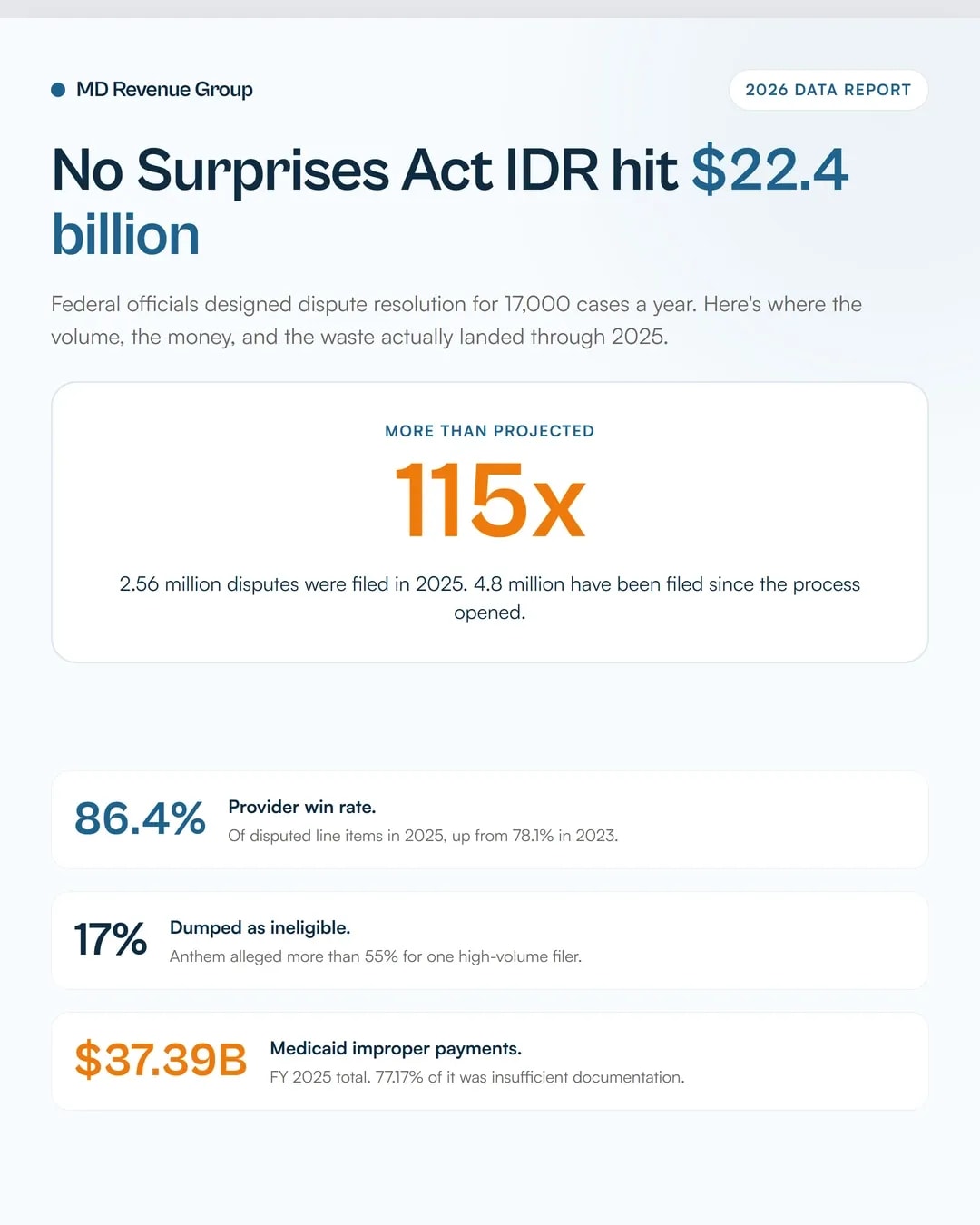
Federal IDR volume broke every projection Congress made. Officials estimated about 17,000 disputes a year when they designed the process. Providers and facilities filed 2.56 million disputes in 2025, which Georgetown's Center on Health Insurance Reforms calculates as 115 times that estimate.
The money followed the volume.
Metric | Figure |
|---|---|
Total IDR disputes through end of 2025 | 4.8 million |
Disputes initiated in 2025 | 2.6 million, up 77% year over year |
Disputes filed in first half of 2026 | ~1.75 million, up 50% |
IDR fees in first half of 2025 alone | $844 million |
Total NSA IDR cost through 2025 | $22.4 billion |
Payments above in-network rates | $15.6 billion |
Administrative costs | $4.2 billion |
IDR entity fees and costs | $2.7 billion |
Outcomes are just as lopsided. Providers prevailed on 86.4% of disputed line items in 2025, up from 78.1% in 2023. The median award was 3.9 times the qualifying payment amount, the mean was 7.6 times, and the award exceeded the QPA in 91.6% of line items. The 90th percentile award went from 7.8 times QPA in Q1 2023 to 17.7 times QPA in Q4 2025.
This creates a specific audit exposure. Four organizations filed roughly half of all provider-initiated disputes determined in 2025, and the top 10 filed about 66%. Anthem sued HaloMD in California in 2025, alleging more than 55% of its dispute submissions were ineligible for IDR. Anthem separately asserted that nearly 60% of more than 27,000 disputes filed against it since 2024 were ineligible.
Ineligible batches get dismissed. The award never lands. For most practices that is a write-off nobody tracked.
The three new batching criteria
The 2023 proposed rule would have limited batches to items sharing the same service code. The final rule replaced that with three distinct paths.
Criterion 1: Same or comparable service code. Items billed under the same service code, or a comparable code in a different coding system, such as CPT versus HCPCS.
Criterion 2: Single patient encounter. Items and services furnished to one patient during one patient encounter, on one or more consecutive dates of service, billed on the same claim form. The Departments noted this is meaningful for air ambulance, where a single transport can now carry mileage and base rates together.
Criterion 3: Same Category I CPT range, restricted specialties. For anesthesiology, radiology, pathology, and laboratory only, items furnished under service codes belonging to the same Category I CPT code range.
Three conditions still apply to every batch.
Condition | Requirement |
|---|---|
Provider | Same provider or facility for all items in the batch |
Payer | Same insurer paid all the claims in the batch |
Timing | All items furnished within the same 30-business-day window |
One carve-out matters for emergency departments. The Departments declined to allow batching of multiple emergency medicine E/M codes, 99281 through 99285, across different patients. Their reasoning: the variability across those codes means they don't relate to treatment of a similar condition.
Our radiology billing services page covers how criterion 3 maps onto imaging charge review, and emergency medicine billing covers the 99281 to 99285 restriction.
The 120-day trap and how to build a batch that holds
Once resubmission rights are rescinded, a rejected batch is gone. Build it once, correctly.
This is our worked model, not a published benchmark.
Assumptions: independent imaging group, 1,200 out-of-network MRI line items in a quarter, spread across 3 payers and 4 weeks, $900 median qualifying payment amount per line item. We use Radiology Partners' Q2 2025 median award of 594% of QPA as the radiology benchmark.
Step | Calculation | Result |
|---|---|---|
Payer-week buckets | 3 payers × 4 weeks | 12 |
Line items per bucket | 1,200 ÷ 12 | 100 |
Batches needed per bucket | 100 ÷ 50 cap | 2 |
Total batches | 12 × 2 | 24 |
Value of one batch at QPA | 50 × $900 | $45,000 |
Value of one batch at 594% award | $45,000 × 5.94 | $267,300 |
Total award exposure | 24 × $267,300 | $6,415,200 |
Batches lost at the 17% ineligible rate | 24 × 0.17 | ~4 |
Forefeit if eligibility isn't pre-validated | 4 × $267,300 | ~$1,069,200 |
The eligibility line is the one to act on. A 17% ineligible rate costs about $1.07M on this volume. Georgetown's data attributes the improvement from earlier ineligible rates to better eligibility review at the IDR entity level, which means the pre-work moved to the filer side.
Also worth knowing: 22% of IDR determinations in the first half of 2025 were default decisions, meaning only one party submitted an offer and paid fees. Track your open negotiation response clock. Under the new rule you have 15 business days to respond after receiving a complete open negotiation notice.
Here's the pre-flight check before you file:
- Confirm every item shares one provider or facility.
- Confirm every claim was paid by the same legal entity, checking that a third-party administrator under one plan is not a separate payer.
- Confirm the 30-business-day window.
- Confirm the batch qualifies under exactly one of the three criteria, and document which one.
- Run an eligibility screen against the specific state law and All-Payer Model list before filing.
- Attach the QPA disclosure the payer sent. The rule now requires providers to show they had it.
What the April 2026 price transparency rules change
CMS finalized new Hospital Price Transparency requirements in the CY 2026 OPPS/ASC final rule, CMS-1834-FC, published November 21, 2025. Enforcement of the revisions began April 1, 2026.
The changes are specific enough to audit line by line.
Requirement | What the hospital must encode |
|---|---|
Allowed amounts | Median allowed amount replaces the estimated allowed amount |
Percentile data | 10th and 90th percentile allowed amounts |
Volume | Count of allowed amounts used in each calculation |
Lookback window | No less than 12 months and no longer than 15 months before posting |
Attestation | Statement that data is true, accurate, and complete as of the file date |
Accountability | Name of the hospital CEO, president, or designated senior official |
Identifiers | Type 2 NPIs for taxonomy codes starting 28 or 27 |
CMS defines the core failures narrowly: failing to post a machine-readable file at all, or failing to post shoppable services in a consumer-friendly format.
Compliance is still incomplete nationally. Patient Rights Advocate's eighth report, published September 2026, found 49.4% of 2,000 hospitals fully compliant. That is real progress from 21.1% in their November 2024 report, and a long way from done.
The audit implication runs in both directions. A hospital with a stale charge master produces low payments and inflated patient balances. A hospital overstating prices in its MRF creates exposure on the reference-based-pricing side. We covered the enforcement mechanics in hospital price transparency enforcement in 2026.
What CMS FY 2025 improper payments tell you to audit
CMS published the FY 2025 improper payments fact sheet on January 15, 2026. The numbers tell you where documentation audit effort pays.
Program | FY 2025 rate | FY 2025 amount | FY 2024 rate | Dominant cause |
|---|---|---|---|---|
Medicare FFS | 6.55% | $28.83B | 7.66% | Ninth straight year under the 10% threshold |
Medicare Part C | 6.09% | $23.67B | 5.61% | Diagnosis data not substantiated by the MA organization |
Medicare Part D | 4.00% | $4.23B | 3.70% | Documentation gaps |
Medicaid | 6.12% | $37.39B | 5.09% | 77.17% insufficient documentation |
CHIP | 7.05% | $1.37B | 6.11% | 56.07% insufficient documentation |
FFE APTC (BY2023) | 0.89% | $657.46M | 1.01% | 47.08% manual data entry errors |
Read the Medicaid line twice. 77.17% of Medicaid improper payments were insufficient documentation, and CMS states plainly that this is generally not indicative of fraud or abuse. CMS's own framing: improper payment measurement is not a measure of fraud, and improper payments include overpayments, underpayments, and payments made without enough information to determine whether they were proper.
Part C moved the wrong direction, from 5.61% to 6.09%, driven by MA organizations failing to substantiate beneficiary diagnosis data.
Two practical consequences. First, if you bill Medicaid, documentation support is the highest-yield audit category available to you. Second, the 60-day overpayment rule bites you as a finding, not just as a payer action: return identified overpayments by the later of 60 days after identification or the applicable cost report due date.
We broke down the root-cause categories in CMS FY 2025 improper payments and billing audits, and the broader scope in medical billing audits in 2026.
Questions to ask before you hire an auditing company
Most vendors selling IDR work in 2026 are reselling batching services. That's a valid business. It is not an audit.
- Do you validate eligibility before filing? If the answer is no, ask what their ineligible rate is. Anything above 17% is costing you money.
- Which batching criterion do you use, and can you show the logic per batch?
- Do you work the payment integrity side, or only IDR filings? A practice with no IDR volume still has overpayment exposure under the 60-day rule.
- Will you deliver a charge master and remittance reconciliation, or only a findings memo? A findings memo changes nothing on its own.
- Do you cover price transparency MRF review? That requires parsing machine-readable files and comparing them against your remittance.
- What is your fee structure, flat or contingent? Contingent fees on recovered revenue are normal. Contingent fees on IDR filings reward filing more, which is the wrong incentive.
Ask question 2 in writing. "We batch properly" is not an answer. "We use criterion 3 within Category I ranges for radiology, and criterion 1 for the rest" is.
Our medical billing audit service covers the documentation and payment integrity side, and medical revenue recovery is where we work the post-audit recovery. We also publish a forensic RCM audit walkthrough if you want to see the methodology before talking to anyone.
Frequently asked questions
When do the new IDR batching rules start applying? To disputes with open negotiation periods beginning on or after November 1, 2026. The final rule is effective August 3, 2026, so the batching provisions apply 90 days later.
What is the maximum number of line items in one IDR batch? 50 qualified IDR items and services. The Departments proposed 25 in 2023 and adopted 50 in the final rule.
Can I still refile a dispute that was batched incorrectly? Not after the rescission takes effect, which occurs 120 days after the registry registration period ends. Get the batch right on the first submission.
Are emergency medicine E/M codes batchable? 99281 through 99285 cannot be batched across different patients. The Departments declined because the variability across those codes does not meet the statutory requirement that batched items relate to treatment of a similar condition.
Do I need a private right of action to enforce an IDR award? Generally no. The Supreme Court declined to hear the Guardian Flight appeal in January 2026, and the Eleventh Circuit reached the same conclusion in November 2025. One Connecticut district court found an implied right in May 2025. File complaints with CMS; providers had filed nearly 1,600 complaints about late IDR payments through September 2024.
How much does an IDR dispute cost to file? Fees totaled $844 million in the first half of 2025 alone. Total No Surprises Act IDR cost reached $22.4 billion through the end of 2025.
Which state arbitration systems give providers a better win rate? It varies sharply. New Jersey providers won about 66% and Washington about 60%, while New York was about 81%. Virginia providers won only 45% in the state system from May 2024 to May 2025, against 85% in the federal system. Our New York medical billing page and New Jersey page cover state-level mechanics.
If your current audit scope stops at coding accuracy, you are not testing the two rules that carry the most money this year.