
Behavioral-Health Telehealth and E-Visit Claim Edits: How to Prevent Duplicate-Service Denials
Psychiatry medical billing services have to watch two claim edits right now: virtual check-in timing and e-visit unbundling. The OIG found $2.26M in improper payments. Here is how to bill clean.
The HHS Office of Inspector General published an April 2026 audit that should be on every behavioral-health biller's desk. CMS paid providers $2.26 million in potentially improper payments for virtual check-in and e-visit services, flagged across 183,524 claim units. The root cause in almost every case was the same: timing and bundling edits that most practices never wired into their billing workflow.
For psychiatry medical billing services, this matters more than most specialties. Behavioral-health telehealth kept its special status under the Consolidated Appropriations Act of 2026 (H.R. 7148, signed February 3, 2026), with flexibilities extended through December 31, 2027. That extension keeps audio-only visits, group-practice billing, and home-based care fully billable. It also keeps the duplicate-service exposure very real.
This article breaks down the exact rules, the two edit families that hurt practices, and the verification workflow that keeps these claims clean.
Key takeaways
- $2.26 million in potentially improper virtual care payments is what OIG flagged in its April 2026 report (A-05-23-00001).
- The 7-day rule: a virtual check-in (G2012, now CPT 98016) and an e-visit (CPT 99421 to 99423) cannot be billed if they fall within 7 days before or 24 hours after an E/M visit with the same diagnosis code.
- E-visits must be bundled as 7-day cumulative time blocks. Billing the same portal conversation as separate daily claims is the second OIG finding.
- Behavioral-health telehealth flexibilities run through December 31, 2027 (H.R. 7148). Audio-only is covered for non-behavioral services through that same date.
- Same-day psychiatric E/M plus psychotherapy has its own edit logic. Modifier and time-separation rules apply separately from the OIG telehealth findings.
What OIG actually found in the April 2026 audit
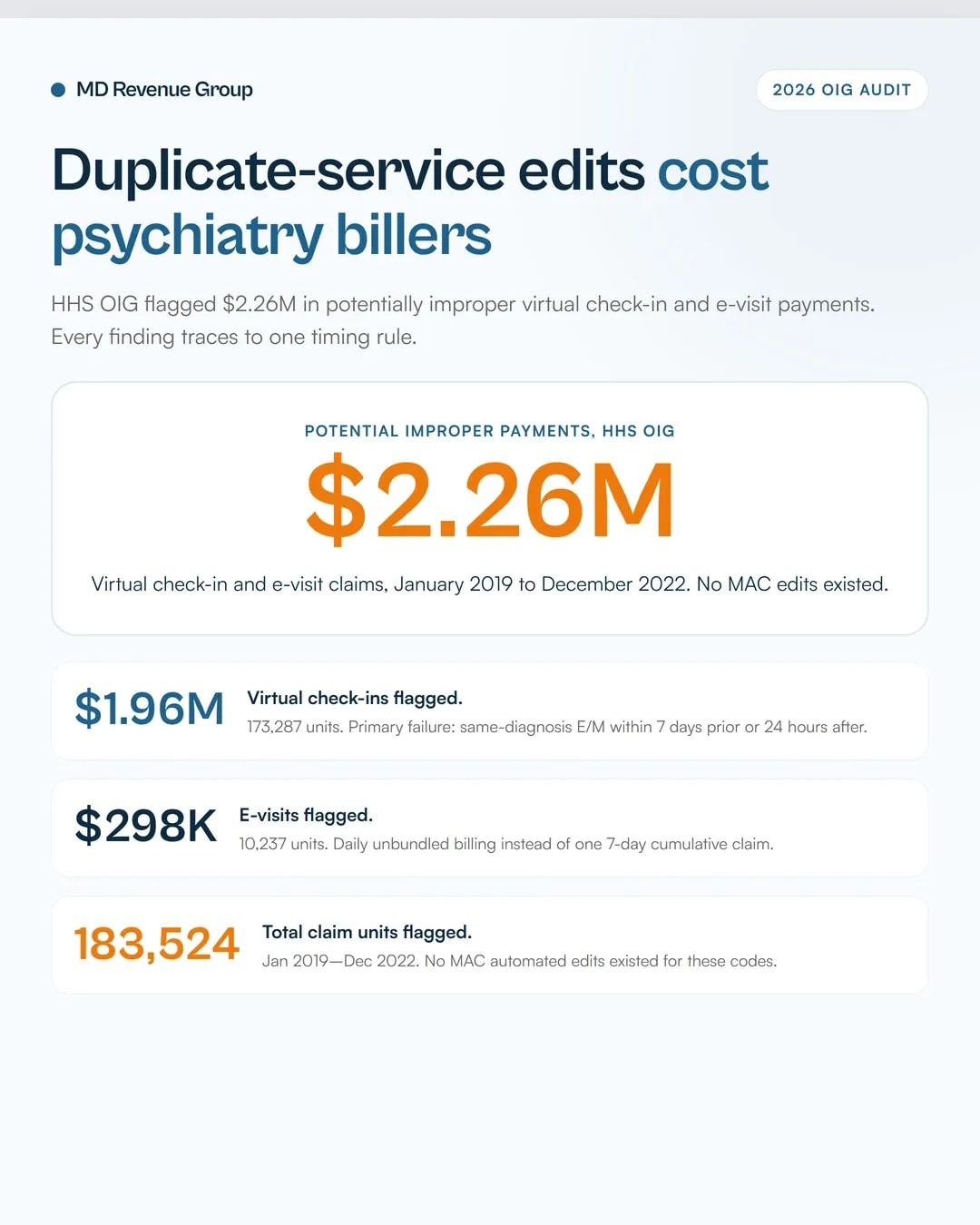
The audit reviewed claims from January 2019 through December 2022. OIG concluded that CMS and its Medicare Administrative Contractors had no system edits to catch the two failure modes that drove the losses. The breakdown from the HHS OIG report A-05-23-00001:
Finding | Amount | Claim units flagged | Primary failure |
|---|---|---|---|
Virtual check-ins (G2010/G2012) | $1,964,125 | 173,287 | E/M with same diagnosis within 7 days prior or 24 hours after |
E-visits (CPT 99421-99423) | $298,200 | 10,237 | Daily unbundled billing instead of 7-day cumulative |
Total | $2,262,325 | 183,524 | No MAC automated edits |
OIG's three recommendations to CMS: build system edits for communication-technology-based services (estimated up to $2.3 million in savings during the audit period), tighten HCPCS code descriptions in the Physician Fee Schedule, and educate providers on proper virtual and e-visit billing. CMS agreed in its April 2026 response to Dr. Mehmet Oz.
The exposure pattern is clear. Providers are billing short-visit codes around longer E/M visits, and billing the same portal episode multiple times. The denials are deterministic, not subjective: a payer can flag them with a simple date and diagnosis-code match. Our broader virtual check-in and e-visit audit guide covers the general edit logic; this article is the behavioral-health adaptation.
The two code families behind the duplicate problem
Virtual check-ins: G2010, G2012, and the 2025 CPT 98016 change
A virtual check-in is a brief communication with an established patient about an existing condition. The codes:
Code | Description | Time |
|---|---|---|
HCPCS G2012 | Brief communication technology-based service, established patient, not originating from related E/M in prior 7 days or leading to E/M within next 24 hours | 5 to 10 minutes |
HCPCS G2010 | Remote evaluation of recorded video or images submitted by patient, with follow-up within 24 business hours | Not specified |
CPT 98016 | Brief technology check-in, replaced G2012 in CY 2025 for Medicare professional claims | Varies |
Medicare does not recognize the old CPT 98000 to 98015 telehealth E/M codes that commercial payers added in 2025. CMS assigned 16 of the 17 new codes an invalid status. Only 98016 is active in the Medicare fee schedule. So a claim billed to Medicare with any 98000-series code except 98016 will deny or pay nothing.
E-visits: CPT 99421 to 99423
E-visits are patient-initiated digital E/M through a portal or secure messaging for an established patient, with a cumulative time window of 7 days:
Code | Cumulative time over 7 days |
|---|---|
CPT 99421 | 5 to 10 minutes |
CPT 99422 | 11 to 20 minutes |
CPT 99423 | 21 or more minutes |
The critical rule: one code per patient per 7-day episode. You cannot bill four separate 99421 claims for four portal messages in the same week about the same issue. The OIG audit's second finding was exactly this unbundling pattern.
For psych and other non-facility clinicians, the parallel codes are HCPCS G2061 to G2063, and therapy services have their own digital E/M rules. Behavioral health providers should confirm which set their EHRs are mapping to.
The timing rules that trigger the denials
The rules are unforgiving and date-driven. Memorize this table and put it in your billing checklist.
Rule | Applies to | What it blocks |
|---|---|---|
No E/M with the same diagnosis code within 7 days before the check-in/e-visit | G2010/G2012/98016, 99421-99423 | Virtual check-in or e-visit claim |
No E/M with the same diagnosis code within 24 hours after the check-in/e-visit | G2010/G2012/98016, 99421-99423 | Virtual check-in or e-visit claim |
One 7-day cumulative window per episode | 99421-99423 | Any claim overlapping the same 7-day block |
Consent required | All three | Patient must verbally consent to virtual service |
No billing without the portal message falling within the window | 99421-99423 | Any e-visit without documented patient-initiated message |
The trap for psychiatry practices is the 24-hour rule. A patient messages about anxiety on Monday, your therapist reviews and replies Monday, then the patient has a full E/M Tuesday for the same diagnosis. The Monday e-visit at 99421 is now unbillable because the E/M followed within 24 hours with the same diagnosis code. The fix is workflow: review portal messages as a triage queue, and only bill e-visit codes when no E/M for the same diagnosis code lands within 24 hours on either side. The same triage pattern protects same-day psychiatric E/M plus psychotherapy claims, which have their own modifier and time-separation logic documented in our psychiatry E/M plus psychotherapy guide.
Why behavioral-health telehealth changes the math
The Consolidated Appropriations Act of 2026 made three structural changes that every behavioral-health biller needs to track:
Provision | Status after Feb 3, 2026 |
|---|---|
In-person visit requirement for Medicare behavioral/mental telehealth (within 6 months of initial, annually after) | Not required through December 31, 2027 |
Audio-only telehealth for non-behavioral/mental services | Extended through December 31, 2027 |
MFT/MHC services as distant-site providers | Permanent |
Group practice billing for behavioral telehealth | Extended through December 31, 2027 |
FQHCs/RHCs as distant-site telehealth providers for behavioral/mental services | Permanent |
These changes hit audio-only billing especially hard. Our teletherapy audio-only billing checklist covers the payer-by-payer verification and consent requirements that still apply even with the flexibility extension. Commercial payers have their own telehealth edit logic, and a practice billing across multiple states should check each state's rules separately; we maintain state-specific telehealth guidance as well.
The telehealth volume is why this matters. Mental health accounts for the majority of telehealth claims: roughly 58% to 70% of all telehealth visits depending on the dataset, and about 52% of mental health patients had a telehealth claim in the first quarter of 2026 (Epic Research via AJMC). If you are a behavioral-health practice, telehealth is not a side service. It is a quarter to a half of your revenue.
The audit exposure concentrates there too. Behavioral-health practices bill the same short virtual check-in and e-visit codes around long psychotherapy sessions, and the same diagnosis-code clustering problems apply. An anxiety patient who messages about a crisis and then has a full psychotherapy session 6 hours later will fail the 24-hour test. Bill the session. Write off the e-visit. Do not fight the edit.
Claim-build controls that stop the edits cold
These are the concrete settings and habits that prevent the denials.
Lock the portal messaging workflow. Route all patient portal messages into a triage queue, not directly to a biller. Each message gets one owner. If it becomes an E/M, suppress the e-visit bill. If it stays an e-visit, track the 7-day window before coding.
Use the diagnosis-code adjacency check. Before coding a 99421 or 98016, pull the patient's last 14 days of E/M claims. If the same ICD-10 appears, stop. The edit is same-diagnosis, same-patient, and same-rough-window.
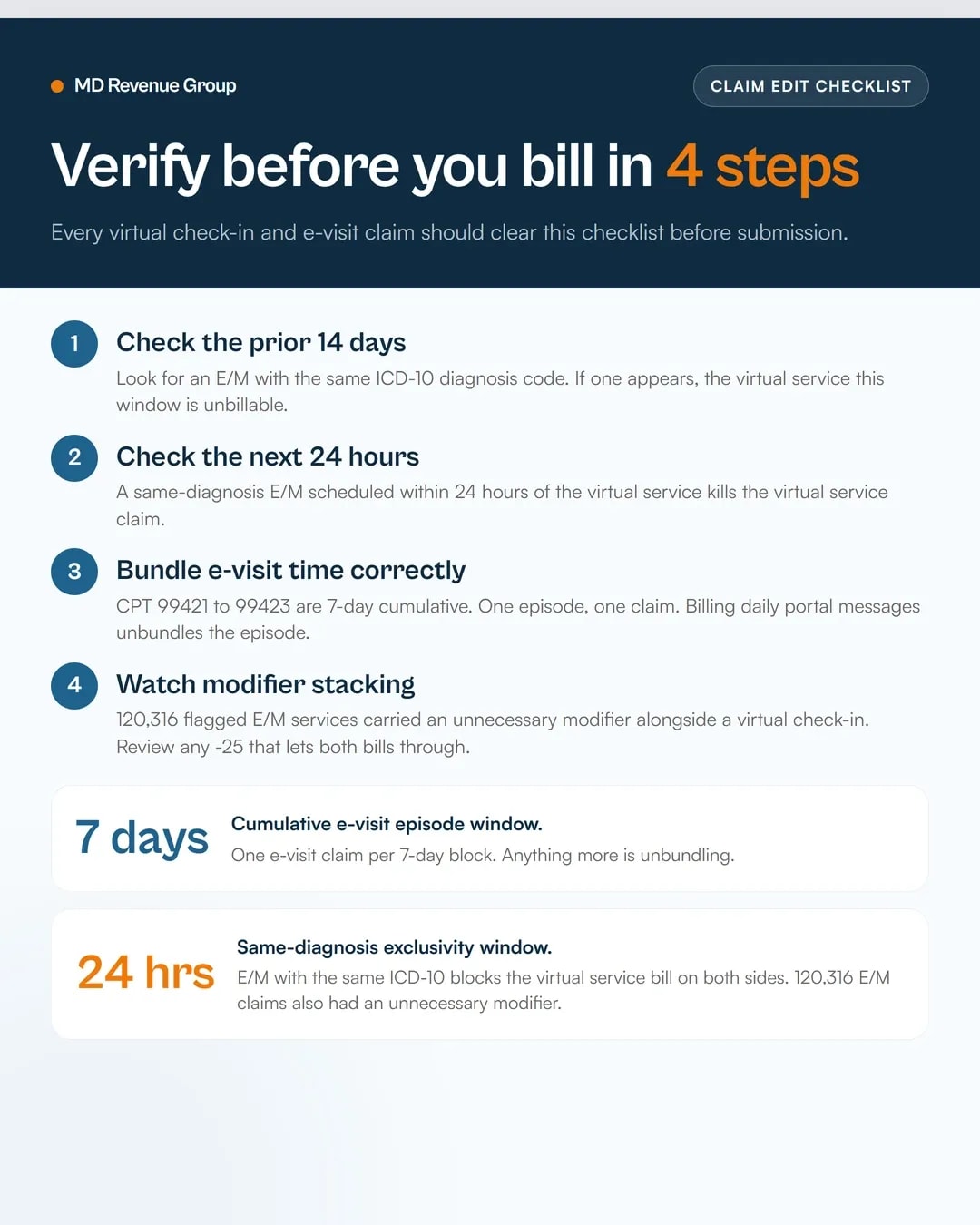
Strip the modifier override attempt. Of the flagged virtual check-in payments in the audit, 120,316 of the associated E/M services were also billed with an unnecessary modifier (OIG A-05-23-00001, page 3). That bundled the E/M and the virtual service into an untenable claim pair. If modifier -25 is routinely what keeps both codes payable on the same patient date, you are writing a check, not a defense.
Map e-visit time correctly. The 99421 to 99423 window is 7 days of cumulative time, not one conversation. Train your therapists to log portal minutes with timestamps. The CPT 99421 block is 5 to 10 minutes over 7 days. A therapist who answers one message does not hit 5 minutes; she should be logging every message and reply in that window against the same episode.
Verify the clinician category. MFT/MHC, psychologists, and psychiatrists now have permanent distant-site status for behavioral telehealth, but the supervision and billing ownership rules differ by provider type. Confirm each clinician's telehealth enrollment status in PECOS and CAQH before the first claim goes out. If your enrollment workflow needs a full check, the credentialing services team can audit it.
A 6-step verification workflow before submission
Run this before you bill any virtual check-in or e-visit claim. Six steps, none of them optional.
- Pull the patient's E/M claims for the prior 14 days. Look for the same ICD-10 diagnosis code. If it appears, the virtual service is not billable.
- Check the next 24 hours of scheduled visits. If the patient has an E/M on the calendar within 24 hours, suppress the virtual service claim.
- Confirm the patient verbally consented to the virtual service. Consent is a billing requirement, not a nice-to-have.
- Verify the code family matches the provider type. CPT 98016 for brief check-ins, 99421-99423 for e-visits, G2061-G2063 for therapy digital E/M. Do not mix sets.
- Bundle e-visit time over the 7-day window. One claim per episode. Log cumulative minutes.
- Document the patient-initiated contact for e-visits. The message thread must be in the chart. Without it, the claim fails audit.
The workflow is the same one we recommend to every behavioral-health billing operation we audit. It is boring, and it is why the practices that run it have clean telehealth claims while the ones that skip it are the ones OIG's numbers come from. If you want the full audit picture of lacing telehealth claims to payer behavior, our psychiatry claims denial analytics covers the dashboards that surface these leaks.
FAQ
Can I bill a virtual check-in on the same day as a psychotherapy session?
No, if the check-in and session share a diagnosis code. The virtual check-in rule blocks E/M services with the same diagnosis code within 24 hours on either side. If they have different diagnosis codes, the same-diagnosis test does not apply, but payers sometimes still question it. Documentation is your defense.
What is the difference between an e-visit and a virtual check-in?
An e-visit (CPT 99421 to 99423) is a patient-initiated portal message thread billed for cumulative time over 7 days. A virtual check-in (CPT 98016, formerly G2012) is a brief real-time communication about an existing concern, billed once. Both are subject to the 7-day and 24-hour same-diagnosis edits.
Do behavioral telehealth in-person visit requirements still apply?
Not through December 31, 2027. The Consolidated Appropriations Act of 2026 (H.R. 7148) paused the requirement that a patient have an in-person visit within 6 months of initial behavioral telehealth service and annually thereafter. It also extended audio-only and group practice flexibilities through the same date.
Why did my Medicare claim with CPT 98016 deny?
Most likely one of three reasons: the patient had an E/M with the same diagnosis code within 7 days before or 24 hours after the virtual service, the provider type is not enrolled for distant-site behavioral telehealth, or the patient consent was not documented. Pull the denial reason code and map it back to the workflow above.
Where can I see the OIG audit findings directly?
The full report is HHS OIG A-05-23-00001, published April 2026: "CMS Could Strengthen Medicare Program Safeguards To Prevent and Detect Potentially Improper Payments for Virtual Check-in and E-visit Services."
Author: MD Revenue Group behavioral health billing team. We run these verification workflows in production for psychiatry and therapy practices.
Disclosure: Code descriptions and payment rules are from CMS provider fact sheets, the 2026 Medicare Physician Fee Schedule, and HHS OIG audit A-05-23-00001 (April 2026). Commercial payer policies vary and often do not mirror Medicare. Verify every edit logic change against the payer's current provider manual before assuming it applies to your claims.
Need a second set of eyes on your telehealth claims? Request a free revenue audit and we'll review your virtual check-in and e-visit coding against the OIG audit findings.