
CMS FY 2025 Improper Payments: Why Documentation, Not Fraud, Is the Revenue-Cycle Lesson
CMS reported $28.83B in FY 2025 improper payments, with 51.5% caused by documentation errors. Learn how medical billing auditing companies protect revenue.

CMS FY 2025 Improper Payments: Why Documentation, Not Fraud, Is the Revenue-Cycle Lesson
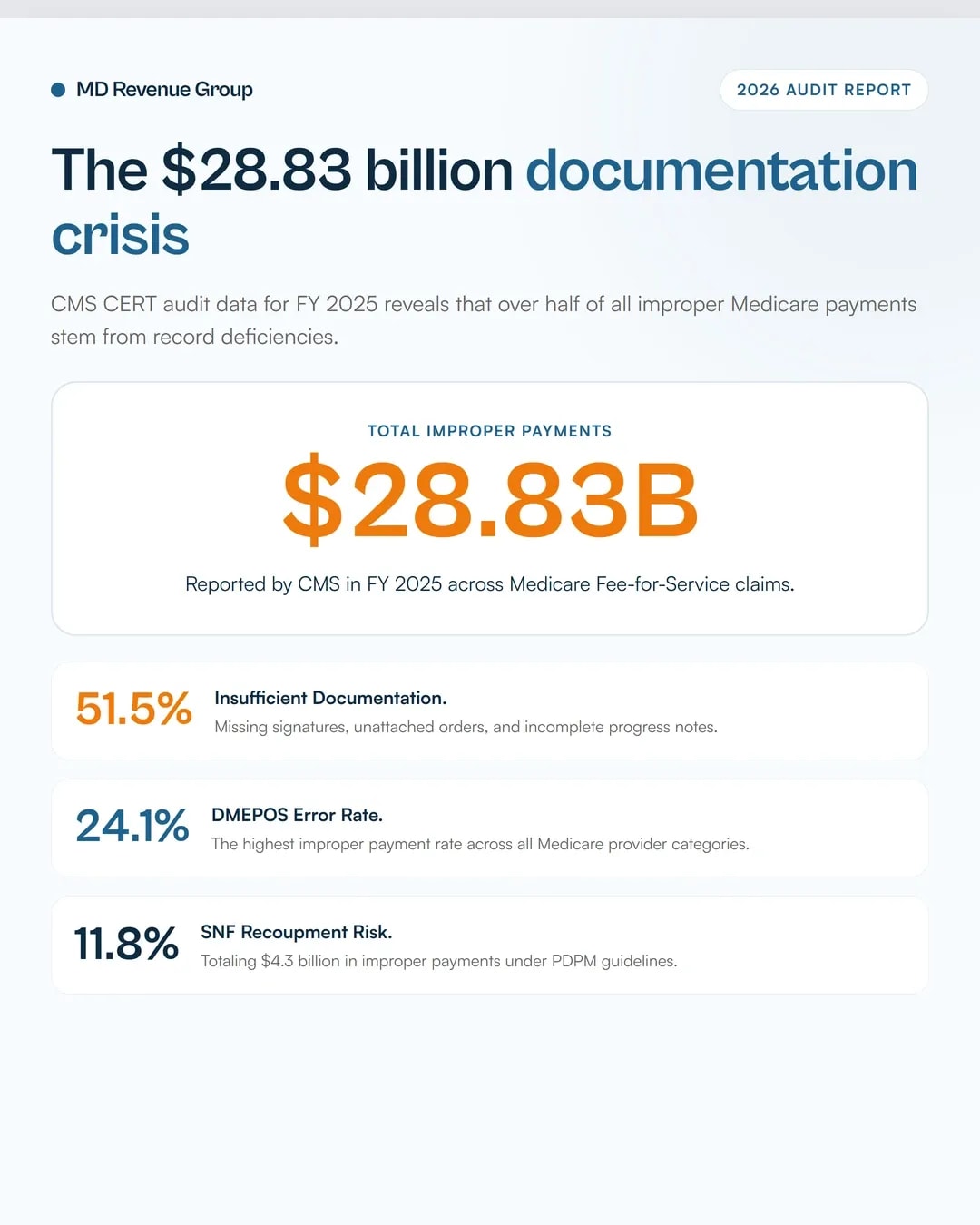
In Fiscal Year 2025, the Centers for Medicare & Medicaid Services (CMS) reported a Medicare Fee-for-Service (FFS) improper payment rate of 6.55%, representing $28.83 billion in misallocated funds. While government headlines often spark fears of federal fraud investigations, CMS Comprehensive Error Rate Testing (CERT) data reveals a very different operational reality for medical practices. Insufficient documentation accounted for 51.5% of all improper payments, making incomplete medical records, unauthenticated order forms, and missing progress notes a far greater financial threat than billing fraud.
For medical practice managers, CFOs, and physician owners, partnering with specialized medical billing auditing companies is no longer just a defensive compliance exercise. It is a direct strategy for recovering lost collections, preventing payer clawbacks, and fixing clinical documentation workflows before post-payment audits occur.
Key Takeaways
- The $28.83 Billion Headline: CMS estimated Medicare FFS improper payments at 6.55% for FY 2025, down from 7.66% ($31.70B) in FY 2024.
- Documentation Is the Primary Vulnerability: 51.5% of improper payments stemmed from insufficient documentation, compared to 17.8% for medical necessity and 10.8% for incorrect coding.
- High-Risk Provider Categories: Durable Medical Equipment (DMEPOS) recorded a 24.1% error rate, Inpatient Rehab Facilities hit 21.5%, and Skilled Nursing Facilities reached 11.8% ($4.3B).
- The Financial Impact: A 10-physician specialty practice billing $5 million annually faces an estimated $168,000 in uncollected or clawed-back revenue due to preventable record defects.
- Systemic Auditing Prevents Recoupment: Professional external billing audits isolate root-cause documentation gaps before Medicare Administrative Contractors (MACs) issue Additional Documentation Requests (ADRs).
What the CMS FY 2025 CERT Report Reveals About Medical Revenue Leakage
Every year, CMS evaluates a statistically valid sample of Medicare FFS claims through the CERT program to measure whether claims meet federal coverage, coding, and billing rules. The FY 2025 report marked the ninth consecutive year that the national improper payment rate remained below the 10% statutory threshold established by the Payment Integrity Information Act.
See your practice reimbursement variance before rule changes impact cash flow.
We model your practice's historical code utilization against the updated conversion factors and regional GPCIs.
Calculate Practice Variance →CMS FY 2025 Medicare FFS Improper Payment Breakdown ($28.83 Billion Total)
┌─────────────────────────────────────────────────────────┬────────────┐
│ Error Category │ Share (%) │
├─────────────────────────────────────────────────────────┼────────────┤
│ Insufficient Documentation │ 51.5% │
│ Medical Necessity Deficiencies │ 17.8% │
│ No Documentation Submitted │ 11.7% │
│ Incorrect Coding │ 10.8% │
│ Other Administrative Errors │ 8.2% │
└─────────────────────────────────────────────────────────┴────────────┘The difference between improper payments and billing fraud is vital for healthcare leaders. CMS explicitly clarifies that an improper payment is not an automatic indicator of intentional deception. In most cases, the healthcare provider rendered medically necessary care to an eligible patient, but the submitted record lacked a required element (such as a legible physician signature, a dated treatment plan, or a specific intent-to-order statement).
When independent auditors review practice records, they discover that administrative oversights create systemic revenue leakage. Practices routinely perform clinical work but fail to collect the full contracted reimbursement because their charts cannot withstand formal scrutiny. Implementing structured oversight through comprehensive revenue cycle management ensures clinical effort translates directly into compliant, protected cash flow.
Why Insufficient Documentation Drives 51.5% of All Medicare Payment Rejections
Insufficient documentation occurs when the medical record submitted for review contains some documentation, but not enough to support the specific service or payment amount billed. Out of the $28.83 billion in FY 2025 improper payments, over $14.8 billion vanished due to incomplete notes.
CMS auditors and MAC reviewers identify five recurring documentation breakdowns across physician practices and facility settings:
- Missing Physician Signatures or Attestations: Progress notes or diagnostic orders entered into EHR systems without a verified electronic signature, date stamp, or physician credential.
- Incomplete Encounter Details: Notes that fail to record total face-to-face time for time-based CPT codes, or fail to detail physical examination findings required for complex Evaluation and Management (E/M) levels.
- Unauthenticated Intent to Order: Billing for diagnostic testing or therapy without a separate, written physician order or documented intent in the progress note.
- Unsigned Plans of Care: Therapy or home health services rendered without a physician signature on the formal care plan within statutory deadlines.
- Cloned EHR Documentation: Copy-pasted clinical text across multiple patient visits that lacks patient-specific details, triggering medical necessity denials.
These documentation flaws directly fuel post-payment demand letters and clawbacks. When commercial payers emulate Medicare audit criteria, practice denial rates climb. Reviewing targeted strategies on how to reduce claim denials helps practice administrators identify these chart vulnerabilities before claims are submitted to clearinghouses.
High-Risk Sectors: SNFs, DMEPOS, and Inpatient Rehab Under the Microscope
While the overall Medicare FFS improper payment rate landed at 6.55%, specific healthcare sectors experienced far higher error rates in the FY 2025 CERT report. Practice managers operating in multi-specialty groups or post-acute facilities must pay close attention to these targeted areas.
FY 2025 CERT Improper Payment Rates by Provider Setting
┌───────────────────────────────────────┬────────────────────┬─────────────────────┐
│ Provider Setting                      │ Improper Rate (%)  │ Total Dollars       │
├───────────────────────────────────────┼────────────────────┼─────────────────────┤
│ Durable Medical Equipment (DMEPOS)    │ 24.1%              │ $2.3 Billion        │
│ Inpatient Rehabilitation Facilities   │ 21.5%              │ $1.1 Billion        │
│ Skilled Nursing Facilities (SNFs)     │ 11.8%              │ $4.3 Billion        │
│ Outpatient Hospital Departments       │ 5.4%               │ $3.2 Billion        │
│ Physician Services / Clinics          │ 4.8%               │ $4.9 Billion        │
└───────────────────────────────────────┴────────────────────┴─────────────────────┘
In Skilled Nursing Facilities, improper payments reached $4.3 billion, largely driven by non-compliance with Patient Driven Payment Model (PDPM) documentation requirements. For DMEPOS suppliers, missing Certificate of Medical Necessity (CMN) forms and proof of delivery documentation produced a staggering 24.1% error rate.
Physician practices with billing setups across regions face additional state-level compliance variances. For instance, practices navigating medical billing in Texas must align their internal chart audits with Novitas Solutions MAC guidelines, whereas providers managing medical billing in New Jersey must adhere to jurisdictional criteria set by National Government Services (NGS). Failure to tailor documentation reviews to local MAC expectations increases audit exposure.
Calculating Your Practice's Audit Exposure: A Worked Revenue Model
To understand the financial consequence of documentation defects, consider a 6-physician orthopedic practice billing $4,500,000 annually across Medicare and commercial payers.
Financial Impact of Documentation Errors on a 6-Physician Practice
─────────────────────────────────────────────────────────────────────────────
Annual Gross Collections:                            $4,500,000
Medicare / Managed Care Share (60%):                 $2,700,000
Estimated Baseline Error Rate (CERT Baseline 6.55%): $176,850
Documentation-Specific Share (51.5% of Errors):       $91,077
Estimated Annual Recoupment Risk:                    $91,077
─────────────────────────────────────────────────────────────────────────────
The Cost of Inaction Breakdown
If 5% of the practice's E/M claims are selected for a post-payment audit and rejected due to missing time records or incomplete signatures, the payer demands full repayment.
- Direct Repayment Demand: $91,077 in clawbacks.
- MAC Pre-Payment Review Penalty: Being placed on 100% pre-payment review delays cash flow by 60 to 90 days across all claims.
- Administrative Appeal Expenses: Spending $150 per hour in staff time to locate charts, draft appeal letters, and resubmit documentation.
By calculating your financial risk using our interactive revenue integrity calculator, medical practice leaders can visualize how small documentation adjustments yield significant net revenue protection.
How Medical Billing Auditing Companies Prevent Documentation-Driven Clawbacks
Engaging external auditing specialists bridges the gap between clinical care and billing compliance. Independent auditing firms examine charts through the exact lens used by Medicare CERT contractors, Zone Program Integrity Contractors (ZPICs), and Unified Program Integrity Contractors (UPICs).
Structure of a Professional Medical Billing Audit Workflow
┌──────────────────┐     ┌──────────────────┐     ┌──────────────────┐
│ 1. Data Sampling │ ──► │ 2. Chart Review  │ ──► │ 3. Root Cause    │
│ 10-50 charts per │     │ Comparing notes  │     │ Identifying missing│
│ provider         │     │ vs CPT/ICD codes │     │ signatures & E/M │
└──────────────────┘     └──────────────────┘     └──────────────────┘
                                                            │
                                                            ▼
┌──────────────────┐     ┌──────────────────┐     ┌──────────────────┐
│ 6. Continuous    │ ◄── │ 5. Remediation   │ ◄── │ 4. Provider      │
│ Monitoring       │     │ Updating EHR     │     │ Education        │
│ Quarterly checks │     │ templates        │     │ 1-on-1 feedback  │
└──────────────────┘     └──────────────────┘     └──────────────────┘
Professional auditors do not simply count coding errors. They evaluate clinical workflows to identify structural flaws:
- EHR Template Optimization: Modifying EHR prompts so physicians cannot sign a note without recording mandatory elements (such as time spent or ROS details).
- Order Verification Protocols: Ensuring diagnostic test results are paired with a signed physician order prior to claim creation.
- Modifier Accuracy Reviews: Checking that modifiers 25, 59, and XE/XS are supported by separate, distinct clinical documentation.
A structured audit aligns practice operations with federal enforcement priorities. Keeping up with the latest OIG work plan medical billing audit guide helps practices anticipate federal focus areas, including telehealth documentation, remote patient monitoring, and split/shared E/M visits.
Internal Review vs. External Audit: A Decision Table for Practice Managers
Practice administrators often debate whether to handle chart auditing internally or hire external billing compliance specialists. The decision table below compares key operational factors.
Comparing Internal Self-Audits vs. External Auditing Services
┌──────────────────────────┬───────────────────────────────┬───────────────────────────────┐
│ Evaluation Factor        │ Internal Staff Review         │ External Auditing Firm        │
├──────────────────────────┼───────────────────────────────┼───────────────────────────────┤
│ Primary Focus            │ Speed and basic code matching │ Deep regulatory compliance    │
│ Auditor Qualification    │ In-house biller or coder      │ Certified CPMA, CPC, CCS      │
│ Objectivity & Bias       │ High internal bias risk       │ 100% independent objectivity  │
│ Regulatory Currency      │ Limited to local experience   │ Multi-payer national insights │
│ Legal Protection         │ Standard internal records     │ Attorney-client privilege opt │
│ Root Cause Detection     │ Surface-level error fixes     │ EHR & workflow remediation    │
│ Cost Structure           │ Fixed staff overhead          │ Project or retainer based     │
└──────────────────────────┴───────────────────────────────┴───────────────────────────────┘
While internal reviews are useful for basic monthly spot-checks, they frequently miss subtle documentation defects because in-house coders become accustomed to their physicians' writing habits. External auditing firms bring unbiased, certified expertise to uncover hidden financial risks before payers issue recoupment demands.
Action Plan: Building an Audit-Ready Revenue Cycle in 5 Steps
Establishing an audit-ready medical practice requires systematic controls across intake, documentation, coding, and billing.
5-Step Implementation Checklist for Practice Administrators
Step 1: Conduct a Baseline Chart Audit
    Sample 10 random charts per provider across top 5 billed CPT codes.Step 2: Audit Signature & Attestation Workflows
    Verify all EHR system signatures contain time, date, and provider credentials.Step 3: Standardize High-Risk EHR Templates
    Disable auto-populating fields for E/M histories and physical exams.Step 4: Institute Provider-Specific Feedback Loops
    Deliver monthly 15-minute chart reviews with individual physicians.Step 5: Schedule Annual Independent Audits
Engage certified external auditors to validate compliance.- Perform a Baseline Sample: Review 10 randomly selected medical records per provider across your highest-volume CPT codes to benchmark your current documentation compliance.
- Enforce E-Signature Compliance: Confirm that every entry in your EHR software automatically logs an unalterable signature timestamp and credential stamp.
- Eliminate Dangerous EHR Macros: Deactivate uncontrolled "copy-forward" features that populate identical clinical text across consecutive patient visits.
- Provide Targeted Physician Coaching: Share specific audit findings with physicians in short, 1-on-1 sessions focused on documentation habits rather than coding rules.
- Schedule Periodic External Reviews: Work with certified auditing professionals to perform unbiased annual or bi-annual reviews.
Requesting a comprehensive free revenue audit gives your management team an immediate analysis of active coding patterns, denial rates, and documentation compliance gaps.
Frequently Asked Questions About Medical Billing Audits
1. Does an improper payment finding automatically mean my practice committed fraud?
No. CMS CERT guidelines state that an improper payment indicates a claim did not meet statutory, administrative, or documentation requirements. Over half of all improper payments stem from insufficient documentation, such as missing signatures or unattached orders, rather than intentional fraud.
2. How many medical charts should be included in an internal audit?
A standard baseline audit reviews 10 to 15 charts per provider per year. For high-volume practices or specialties under active MAC scrutiny, auditing 5 charts per provider quarterly provides better risk mitigation.
3. What is the difference between a pre-payment audit and a post-payment audit?
In a pre-payment audit, the payer holds claim payment until medical records are submitted and approved. In a post-payment audit, the payer pays the claim initially but requests charts later, issuing a refund demand or clawback if documentation is insufficient.
4. How long does a typical medical billing audit take?
A focused chart audit for a small-to-mid-size practice (3 to 8 providers) typically takes 2 to 3 weeks from data extraction to final reporting and provider debriefing.
Protect your practice from documentation-driven clawbacks. Request your customized free revenue audit today or test your cash flow health with our interactive revenue integrity tool.
Protect your Medicare & fee schedule revenue.
Get a custom code-by-code reimbursement impact analysis for your practice. Measure your financial variance in 48 hours.