
Medical Billing in California, Florida, and New York: How to Manage Multi-State Enrollment Without Revenue Gaps
Medical billing services in California pay late claims at 75% and 50%. New York denies at 90 days. Here's the 3-state enrollment and filing playbook.
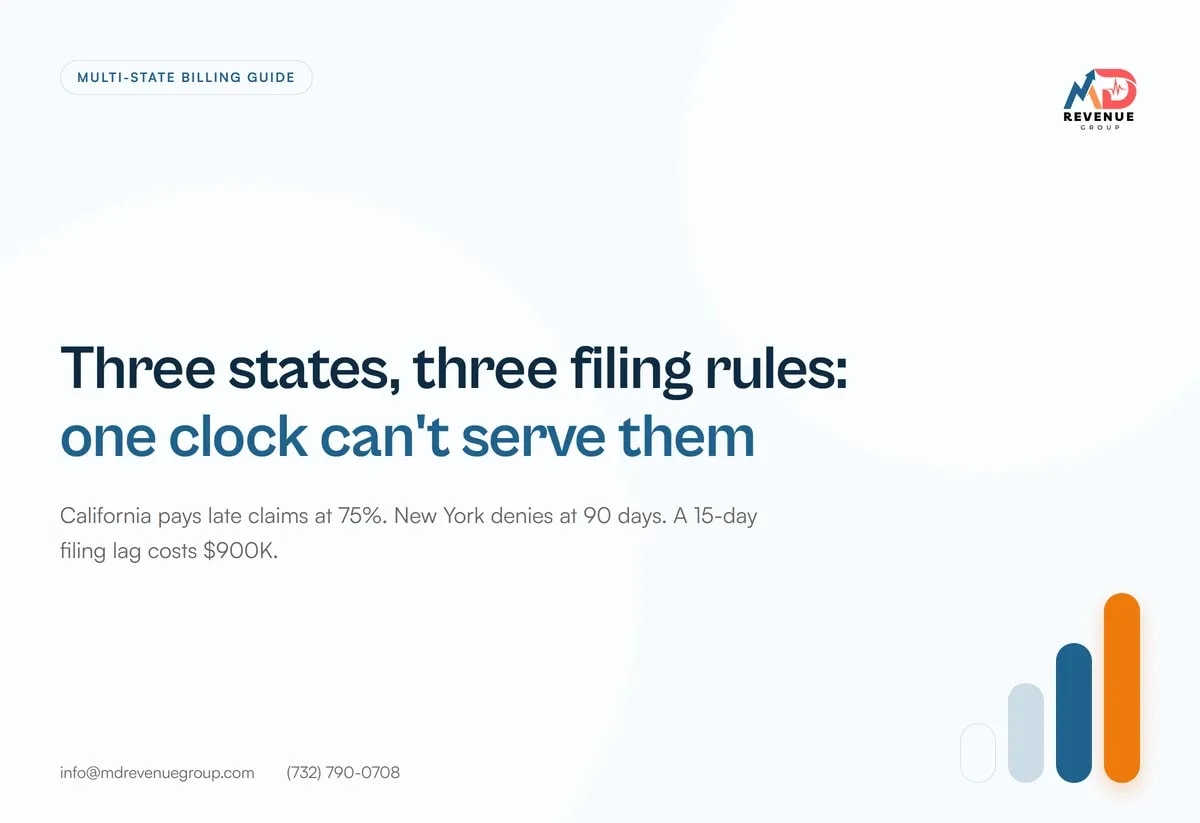
Medical billing services in California, Florida, and New York sit under one federal filing rule and three completely different state Medicaid rules underneath it. Medicare claims everywhere must be filed within 1 calendar year of the date of service, per 42 CFR 424.44. That is the only rule that travels.
Below it, the three states disagree on almost everything. California pays a late Medi-Cal claim at 75% and then 50%. New York denies at 90 days and stops paying at 2 years. Florida allows 12 months, and for inpatient stays the clock starts at discharge rather than date of service.
A practice that runs one submission queue across all three states will optimize for whichever state it happens to configure first and lose money in at least one of the others. This guide gives you the three rule sets side by side, a filing exposure calculation you can run on your own numbers, and the enrollment obligations that changed in 2026.
Key takeaways
- Medicare's filing deadline is federal and uniform: 1 calendar year from date of service, 42 CFR 424.44(a)(1).
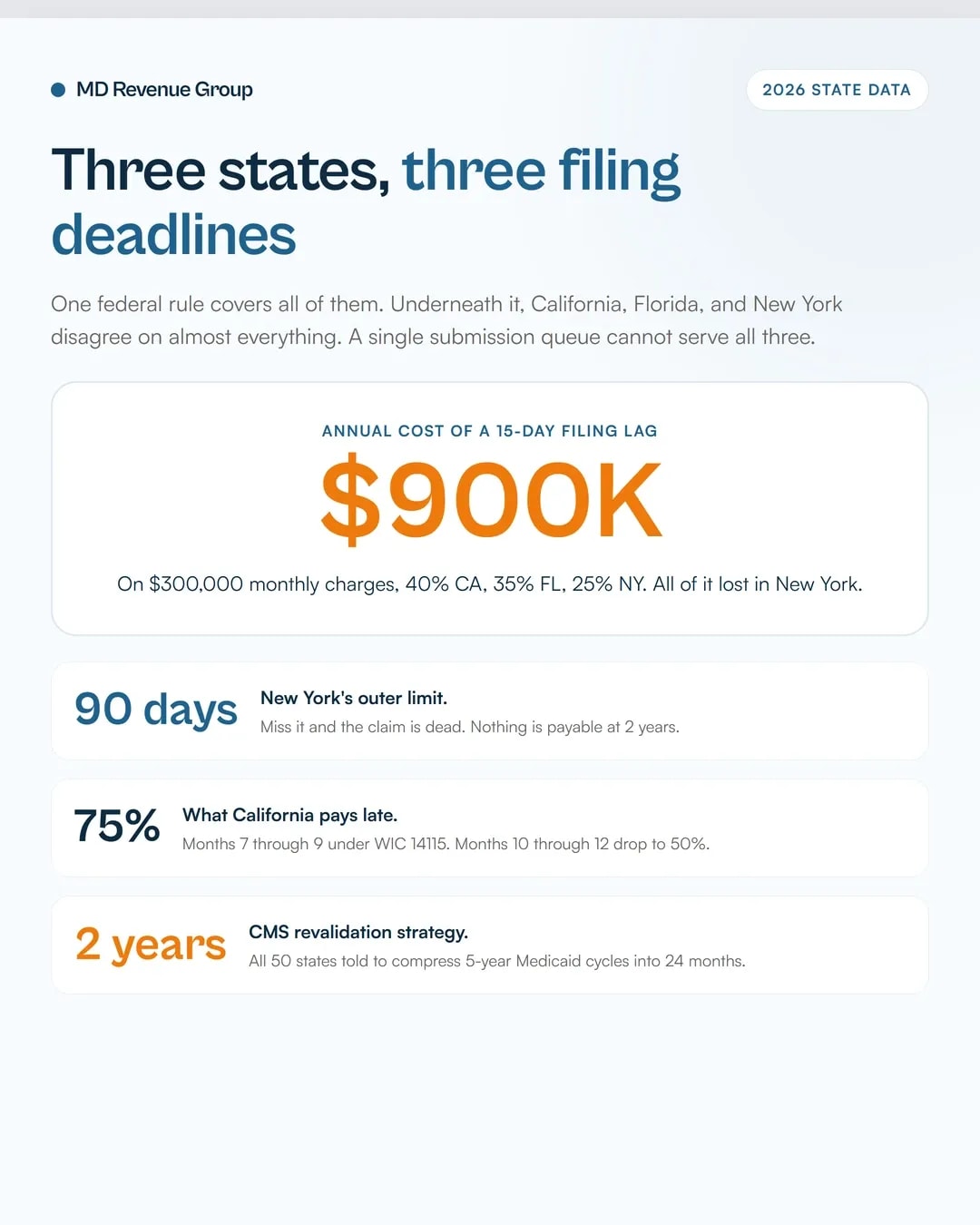
- California WIC 14115 pays late Medi-Cal claims at 75% (months 7-9) and 50% (months 10-12). Nothing after 12 months.
- New York requires initial claims within 90 days of date of service, and nothing is payable once it reaches eMedNY at 2 years or more.
- Florida allows 12 months, and for inpatient stays the window starts from the discharge date.
- If your revenue mix is 40% California, 35% Florida, and 25% New York, submitting at day 100 instead of day 85 costs $900,000 a year in New York alone.
- CMS told all 50 states on April 23, 2026 to build two-year provider revalidation strategies, prioritizing high-risk provider types and providers without an NPI.
- Medicare does not reimburse any services during a deactivation period, and reactivating requires a complete new enrollment application.
What filing rule applies in all 50 states plus three states?
One. 42 CFR 424.44(a)(1) requires claims for services furnished on or after January 1, 2010 to be filed no later than the close of the period ending 1 calendar year after the date of service. No state variation, no plan variation.
The regulation also lists narrow exceptions where CMS or its contractor extends the deadline. They cover HHS or contractor error, retroactive Medicare entitlement following a state Medicaid recovery 6 or more months after service, and retroactive entitlement following a Medicare Advantage plan recovery. Each extension runs through the last day of the sixth calendar month after the month you received notification. If the deadline lands on a Federal nonworkday, it moves to the next workday.
Everything else is state or contract driven. Which means the practical question for a multi-state practice is not what the deadline is, it's which deadline your submission system was built to satisfy.
Our California medical billing services work is built around California's specific DHCS rules, including the county-by-county managed care models that decide where a claim goes.
What are the Medicaid timely filing deadlines in California, Florida, and New York?
Rule | California | Florida | New York |
|---|---|---|---|
Medicaid FFS initial filing | 6 months after the month of service | 12 months from date of service | 90 days from date of service |
Inpatient claims | Same rule | Clock starts from discharge date | 90 days from date of service |
Late claim outcome | Reduced, not denied: 75% months 7-9, 50% months 10-12 | Denied | Denied |
Outer wall | Nothing payable after 12 months | 12 months | Not payable at 2 years |
Extension mechanism | Director may extend up to 1 year for circumstances beyond the provider's control | Exceptions per state rule | Delay codes; circumstances outside provider control |
Managed care plans | Plan contract terms apply | SMMC plans may set shorter windows, commonly 180 days | Plan contract terms apply |
Record retention | Program requirements | Program requirements | 6 years from date of service (18 NYCRR 504.3(a)) |
Florida's 12-month window and its discharge-date treatment of inpatient claims come from the AHCA Provider Handbook and consistent secondary summaries of it. AHCA's site blocks automated lookups, so confirm both against your current handbook copy before you rely on them.
The California rule is the outlier. It's the only state in this group that pays a claim submitted late, at a reduced rate, rather than denying it.
WIC 14115(a) sets the 6-month outer limit measured from the end of the month of service, not 180 days from the date. A service on April 15 must reach the fiscal intermediary by October 31. Under 14115(c)(1), a claim submitted in the 7th through 9th month after the service month is reduced by 25 percent, and one submitted in the 10th through 12th month is reduced by 50 percent.
Florida's 180-day managed care figure is contract language, not state law. Sunshine Health's provider guidelines, for example, set initial filing at 180 calendar days from date of service, with coordination of benefits at 180 days from date of service or 90 days from the primary payer's determination, whichever is later, and corrected or reconsidered claims at 90 days from the payment or denial.
Why California's late-claim rule works against New York and Florida
Here is the operational trap. California gives you six months and then still pays you 75% for two more months. A team that watches a Medi-Cal claim get paid at 75% learns that late is survivable.
New York does not teach that lesson. Claims must be initially submitted within 90 days of date of service to be valid and enforceable, unless delayed by circumstances outside the provider's control. The eMedNY program maintains dedicated delay code instructions for claims over 90 days and over 2 years.
So a California-calibrated submission habit, say filing 100 days after service, is comfortably safe in California and Florida and completely fatal in New York. And because California is where most multi-state practices learned their Medicaid workflow, New York is where the money disappears.
Our New York medical billing and Florida medical billing service pages cover the state-specific mechanics on their own. This article is about running all three at once.
The three-state filing exposure calculation
Model one month of charges split 40% California, 35% Florida, and 25% New York, on total monthly charges of $300,000. Then run the same submission behavior against all three states.
State | Monthly charges | Submission at day 85 | Submission at day 100 | Submission at day 200 |
|---|---|---|---|---|
California | $120,000 | $120,000 (100%) | $120,000 (100%) | $90,000 (75%) |
Florida | $105,000 | $105,000 (100%) | $105,000 (100%) | $105,000 (100%) |
New York | $75,000 | $75,000 (100%) | $0 (denied at 90 days) | $0 (denied) |
Monthly collected | $300,000 | $300,000 | $225,000 | $195,000 |
Annual shortfall | $0 | $900,000 | $1,260,000 |
Fifteen days of drift between day 85 and day 100 costs $75,000 a month. The entire amount comes from New York, and none of it is recoverable, because a claim that misses the 90-day New York window is simply not payable.
The third column is the more dangerous habit. Submitting at day 200 assumes California's 6-month window is safe everywhere. It isn't. That assumption costs $1.26 million a year, and the California portion of the loss is entirely self-inflicted, since the claim would have paid 100% at day 85.
Run this against your own numbers. Take last quarter's charges by state, pick your actual average submission lag per state, and apply the table above. Most practices find their submission lag is measured in weeks, not days, because the queue batches monthly.
What California's AB 3275 changed on January 1, 2026
California Assembly Bill 3275 took effect January 1, 2026 and rewrote the prompt payment rules for every health care service plan and insurer operating in the state.
Before the change, plans subject to the Knox-Keene Act and Department of Insurance-regulated insurers had 30 working days to reimburse, contest, or deny. When more information was needed, the clock reset to another 30 working days after receipt of that information. HMOs had 45 working days.
After the change, there is one uniform 30-day timeline to pay, contest, or deny, across all plans including HMOs and Medi-Cal managed care plans. Working days became calendar days, so weekends and holidays now count.
Two consequences matter for billing operations.
Automatic interest. Statutory interest rates did not change, 15 percent per annum for health care service plans and 10 percent per annum for health insurers. But plans must automatically include accrued interest in late payments rather than waiting for the provider to request it. Late paid claims must also carry a penalty payment of the greater of $15 or 10 percent of the accrued interest.
Unfair payment patterns. Repeated failures to timely adjudicate complete claims, or to automatically include required interest, can be treated as unfair payment patterns under California law. That may operate to extend a provider's window to dispute or appeal an unpaid or underpaid claim from the date of the most recent late payment or omitted interest. A chronically late payer can hand you more time, not less. Track adjudication dates per claim so you know where that window actually sits.
What revalidation requires now after the April 2026 CMS directive
Medicare revalidation has not changed its cycle, but Medicaid revalidation is about to compress.
Under CMS's revalidation guidance, providers and suppliers generally revalidate every five years, with DMEPOS suppliers on every three years. CMS posts due dates seven months in advance, and your enrollment contractor sends notice three to four months before the due date. There are no exemptions from revalidation and CMS does not grant extensions.
The consequence of missing it is severe. If your Medicare billing privileges are deactivated, you must submit a complete new Medicare enrollment application to reactivate, and Medicare will not reimburse you for any services during the period you were deactivated. That converts a paperwork deadline into a multi-month revenue hole.
Medicaid's baseline is 42 CFR 455.414: state agencies must revalidate all providers, regardless of provider type, at least every 5 years. That is changing.
On April 21, 2026, CMS Administrator Dr. Mehmet Oz announced an initiative requiring all states to submit plans to revalidate Medicaid providers on an expedited timeline. On April 23, 2026, letters went to all 50 governors and state Medicaid directors requesting a comprehensive two-year provider revalidation strategy, with plans due within 30 days. States were directed to prioritize high-risk provider types, particularly those with less rigorous enrollment standards or without a National Provider Identifier. The risk tiers come from 42 CFR 455.450, which requires every state to screen initial applications and any application responding to a revalidation request against a categorical risk level of limited, moderate, or high.
Practices enrolled in California, Florida, and New York Medicaid should expect off-cycle credentialing reviews they were not previously warned about. Our Medicare revalidation control calendar covers the recurring lookup-and-submit cadence, and our credentialing services page covers the state enrollment side.
One more federal point worth knowing. Under 42 CFR 455.410(b), a state Medicaid agency must require ordering or referring physicians and other professionals providing services under the state plan or a waiver to be enrolled as participating providers. A referring provider who lapses takes your claim with them.
What New York requires that California and Florida don't
Two New York rules have no counterpart in the other two states.
Six-year record retention. 18 NYCRR 504.3(a) requires a provider to keep, for six years from the date care, services, or supplies were furnished, all records necessary to disclose the nature and extent of services furnished and all information regarding claims for payment submitted. The same section requires disclosure of ownership and control interests under Title 18 Part 502, acceptance of Medicaid payment as payment in full except where law provides otherwise, submission of claims only for services actually furnished and medically necessary when furnished, and audit access covering patient histories, case files, and patient-specific data.
Single enrollment portal. New York moved all provider enrollment, reinstatement, and maintenance onto the Provider Services Portal. The flow is 4 steps: obtain an NPI from NPPES as a prerequisite, submit the application in the portal, respond if NYSDOH staff contacts you electronically, then receive a written determination carrying your MMIS number or PID and your effective date.
Electronic claims require an ETIN. New enrolling providers complete Certification Statement for Provider Billing Medicaid, form 490602. Providers joining an existing group under someone else's ETIN use form 490501. You must wait for ETIN set-up confirmation before submitting claims with it, which adds a hard lead time to your first paid claim in New York.
What to fix first
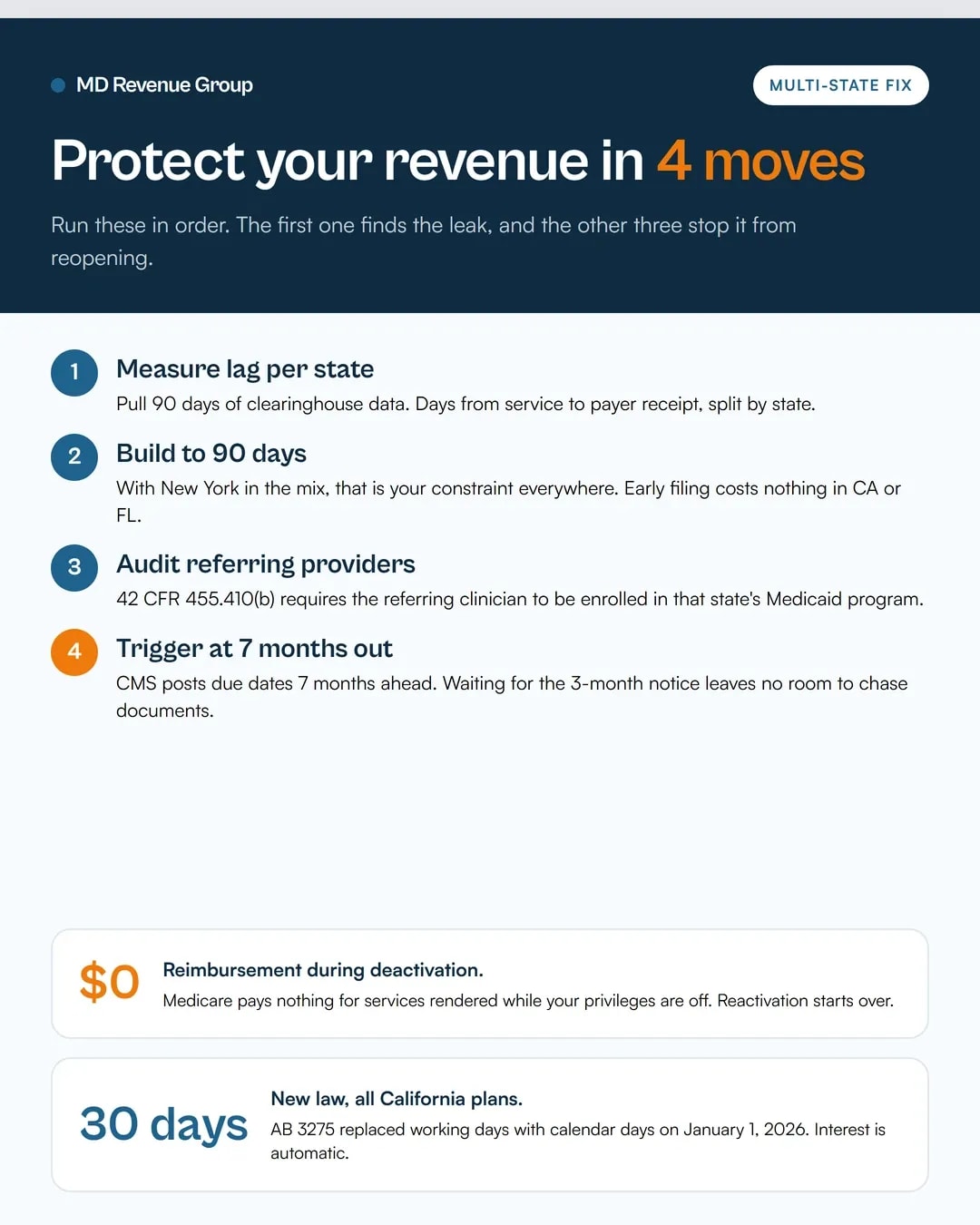
Four steps, in order of revenue impact.
Find your submission lag per state. Pull 90 days of clearinghouse and portal data. Measure days from date of service to payer receipt, separately for California, Florida, and New York. Most multi-state practices have one number, and it is a blend of three incompatible deadlines.
Build to the strictest deadline. If New York is in your mix, 90 days is your architectural constraint for every state. California and Florida both accept early filing without penalty. New York is the only state that punishes you for being slow.
Check every ordering and referring provider's enrollment status today. Under 42 CFR 455.410(b) the referring provider must be enrolled. Verify across all three states, not just the one where the practice is headquartered.
Put revalidation dates on a single calendar with a 7-month lead trigger. CMS publishes due dates seven months ahead. A practice that acts when the notice arrives, at three to four months out, has left itself no room for a document chase.
Practices running revenue across more than one state usually find the gaps sit in enrollment status tracking rather than in claim submission. That's what a multi-state revenue cycle review covers.
Frequently asked questions
What is the Medicare timely filing deadline? 1 calendar year from the date of service, per 42 CFR 424.44(a)(1), for services furnished on or after January 1, 2010. Applies uniformly in every state, and late claims generally deny with no appeal right.
What is California's Medi-Cal timely filing deadline? Bills must be submitted not more than 6 months after the month in which the service was rendered, per California Welfare and Institutions Code 14115(a). Claims in months 7 through 9 are paid at 75% of the otherwise payable amount, and claims in months 10 through 12 at 50%. Nothing is payable after 12 months unless an exception applies.
How long does New York Medicaid allow for initial claim submission? 90 days from the date of service, unless the claim was delayed by circumstances outside the provider's control. Separately, no claim is payable if it reaches eMedNY two years or more after the date of service.
Does Florida use 12 months for inpatient claims? Florida's fee-for-service window is 12 months from date of service, and for inpatient stays the clock starts from the discharge date rather than the date of service. Verify both against the current AHCA Provider Handbook. Florida managed care plans under SMMC may apply shorter windows under their own contracts.
Can a late Medi-Cal claim still be paid? Yes. California is the exception. Under 14115(b) the director may extend the submission period by up to one year where delay was caused by circumstances beyond the provider's control. Under 14115(a), where the patient did not identify himself or herself to the provider as a Medi-Cal beneficiary within four months after the month of service, the provider may submit within 60 days after that certified date.
What changed in California on January 1, 2026? AB 3275 replaced the split 30 working day and 45 working day HMO timelines with a uniform 30 calendar day window to pay, contest, or deny across all health care service plans and insurers, including Medi-Cal managed care plans. Plans must now automatically pay interest at 15 percent per year (service plans) or 10 percent (insurers) on late payments.
How often must providers revalidate with Medicare? Every five years for most providers and suppliers, and every three years for DMEPOS suppliers. CMS posts due dates seven months in advance and contractors notify three to four months before the due date. CMS grants no exemptions and no extensions.
What did the April 2026 CMS directive change for Medicaid? CMS asked all 50 states to submit two-year provider revalidation strategies within 30 days of April 23, 2026, prioritizing high-risk provider types and providers without an NPI, and using off-cycle intervals above the five-year floor in 42 CFR 455.414.
Can I bill a state Medicaid program without enrolling there? No. Under 42 CFR 455.410(b), ordering or referring physicians and other professionals furnishing services under the state plan or a waiver must be enrolled as participating providers. An out-of-state provider billing into California, Florida, or New York Medicaid needs active enrollment in that program.
If your practice collects across more than one state, the filing lag data tells you which gap costs you the most, and it usually isn't the state you expect. We'll run it with your actual charge mix and show you the exposure line by line.
Book a revenue-cycle consultation.
About the author
Arslan Ahmad leads revenue cycle strategy at MD Revenue Group, overseeing denial recovery, credentialing, and multi-state enrollment operations for behavioral health and multi-specialty practices. The team holds AAPC CPC and CRCR credentials and manages payer enrollment across California, Florida, New York, and 15 other states.