
IDR Batching by Specialty: New Opportunities for Radiology, Pathology, Laboratory, and Anesthesia Claims
Learn how the 2026 CMS Federal IDR Final Rule transforms batching for radiology, pathology, lab, and anesthesia claims under No Surprises Act.
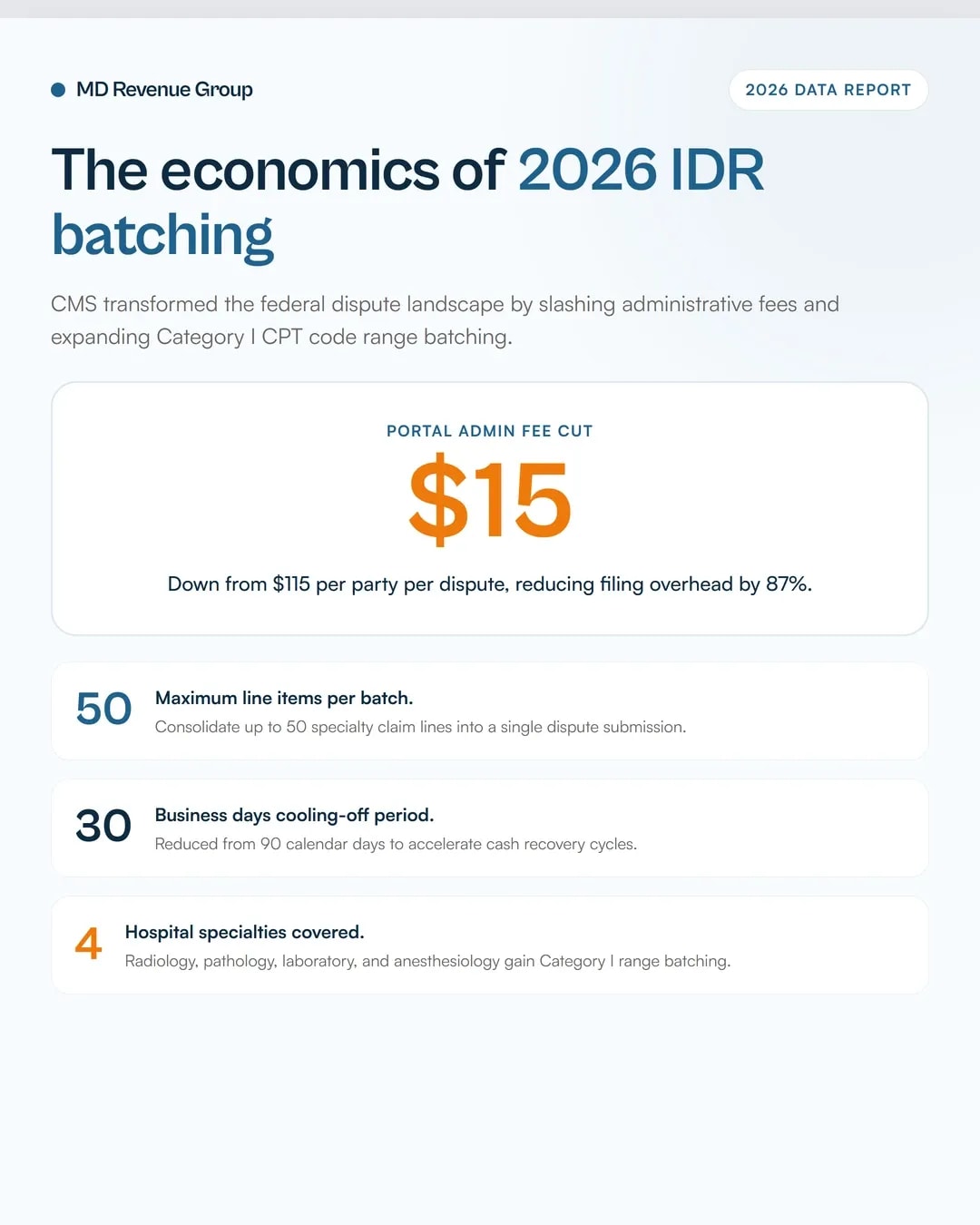
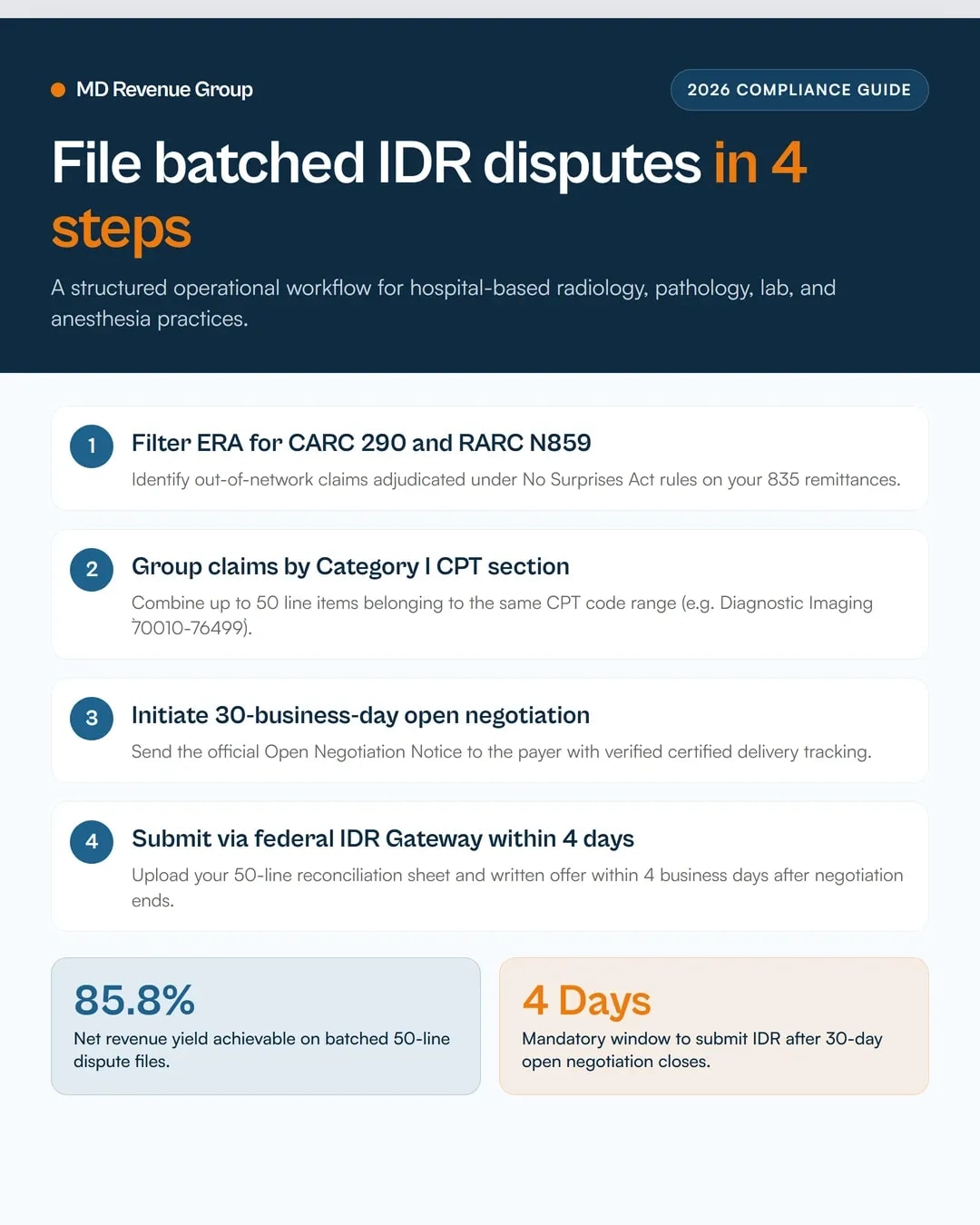
Under the Federal Independent Dispute Resolution (IDR) Operations Final Rule effective August 3, 2026, healthcare practices in hospital-based specialties can now batch up to 50 claims per dispute across the same Category I CPT code section. The federal administrative fee has dropped from $115 down to $15 per party, per dispute, while the cooling-off period is reduced to 30 business days. For high-volume specialties like radiology, pathology, laboratory, and anesthesia, these changes reduce dispute filing costs by up to 87% and allow practices to turn small out-of-network payment variances into viable recovery claims. To qualify for batching under the new CMS rules, all claims in a dispute must be billed under the same CPT code section, share a 30-business-day open negotiation period, and be submitted within 4 business days after open negotiation closes.
Key takeaways
- 50 line item cap: Batched IDR disputes are strictly limited to a maximum of 50 qualified items or services per filing.
- $15 administrative fee: The federal portal fee dropped from $115 to $15 per party per dispute, drastically lowering entry barriers for small claims.
- Category I CPT range batching: Radiology, pathology, lab, and anesthesia practices can batch distinct codes if they belong to the same Category I CPT section.
- 30-business-day cooling-off period: Reduced from 90 calendar days, enabling faster re-filing and tighter cash collection cycles.
- Standardized EOB remarking: Payers must include specific CARCs and RARCs on electronic 835 remittances to identify eligible out-of-network claims.
How the 2026 IDR final rule changes specialty batching
The May 28, 2026 Federal IDR Operations Final Rule reshapes how out-of-network hospital-based providers challenge commercial payer underpayments under the No Surprises Act (NSA). Previous batching regulations required claims to feature the exact same service code, which severely restricted hospital-based groups. An anesthesia practice managing multiple surgical cases could not batch an abdominal procedure code with a spinal anesthesia code, even when both suffered identical payer downcoding.
Find the unbundled units and modifier downcodes payers are stripping.
Payers process high-volume specialty codes differently by region. We review 50 encounters to uncover hidden downcoding and uncollected units.
Audit My Specialty Encounters →CMS addressed this bottleneck by introducing specialty-specific batching criteria for four key hospital disciplines: radiology, pathology, laboratory, and anesthesiology. Practitioners in these fields can combine up to 50 claim line items into a single IDR submission, provided the services fall within the same Category I CPT code section.
Old IDR Batching Rule (Pre-2026):
[Same CPT Code Only] + [$115 Admin Fee] + [90-Day Cooling Off] = High Dispute Cost
2026 IDR Operations Final Rule:
[Same CPT Section Range] + [$15 Admin Fee] + [30-Business-Day Cooling Off] = Economical Recovery
The CMS portal update scheduled for full release on November 1, 2026 incorporates these batching parameters directly into the federal IDR Gateway. Practices conducting a formal medical billing audit service can identify historical claim underpayments that meet these revised criteria and build structured dispute files before open negotiation windows close.
Specialty-specific CPT code ranges for IDR batching
To batch claims successfully under the 2026 rule, your billing team must organize claim files by Category I CPT code sections rather than individual 5-digit procedure codes. CMS established that service comparability is satisfied when codes belong to the same anatomical or procedural heading in the AMA CPT manual.
The following decision table outlines the approved Category I CPT code ranges, bundling constraints, and qualifying parameters for each eligible specialty.
Specialty | Approved CPT Code Range | Batching Qualifying Criteria | Common Denial / Variance Trigger |
|---|---|---|---|
Anesthesiology | 00100 – 01999 | Same CPT section, same clinical group, max 50 line items | Payer reduced base unit value or disallowed physical status modifiers |
Radiology | 70000 – 79999 | Same sub-section (e.g., Diagnostic Imaging 70010-76499) | Downcoding professional component (Modifier 26) on contrast CT/MRI |
Pathology & Laboratory | 80000 – 89999 | Same testing class (e.g., Chemistry 82000-84999) | Payer bundling panel codes or capping daily quantitative specimen limits |
Single Patient Encounter | Any valid CPT code | Billed on same claim form, consecutive dates of service | Emergency department multi-specialty intervention underpayments |
Anesthesia practices can batch a thoracic surgery anesthesia claim (CPT 00540) with a vascular anesthesia claim (CPT 00500) because both reside within the intrathoracic anesthesia CPT section. However, you cannot combine a head anesthesia code (CPT 00100) with a lower leg anesthesia code (CPT 00800) in the same batched dispute, as they span different CPT sub-headings.
Proprietary batching ROI calculation: $15 fee vs. individual filings
The financial feasibility of the IDR process hinges on administrative fee overhead relative to the total disputed revenue variance. Under the prior $115 per-party fee structure, filing single disputes for low-dollar out-of-network underpayments resulted in negative net returns. The combination of the $15 administrative fee and 50-line-item batching changes that math completely.
Consider a hospital pathology group with 50 disputed surgical pathology claims (CPT 88305), where the payer paid $65 per unit against a Qualifying Payment Amount (QPA) benchmark of $145. The net underpayment variance is $80 per claim, totaling $4,000 across 50 line items.
Scenario A: Filing 50 Individual Disputes (Pre-2026 Fee Structure)
Total Disputed Amount:                   $4,000
Federal Admin Fees (50 x $115):        - $5,750
IDR Entity Arbitrator Fees (50 x $350): - $17,500
Net Potential Financial Outcome:        - $19,250 (Filing is mathematically unviable)
Scenario B: Filing 1 Batched Dispute of 50 Lines (2026 Final Rule)
Total Disputed Amount:                   $4,000
Federal Admin Fee (1 x $15):           - $15
Batched IDR Arbitrator Fee (1 x $550): - $550
Net Potential Financial Recovery:      + $3,435 (85.8% Net Revenue Yield)
By consolidating 50 claims into one batched dispute, the pathology group converts an unviable $19,250 administrative loss into a $3,435 net cash recovery. Integrating these automated ROI calculations into your practice's broader revenue cycle management solutions ensures your billing team only escalates batches that meet positive yield thresholds.
Mandatory CARC and RARC remittance codes for NSA disputes
To prevent payers from obscuring out-of-network claim processing rules, the 2026 Final Rule mandates that commercial health plans supply standardized Claim Adjustment Reason Codes (CARCs) and Remittance Advice Remark Codes (RARCs) on all 835 electronic remits. Payers that fail to provide these codes face federal compliance notices from CMS.
Your payment posting team must flag the following remittance codes immediately upon receipt:
- CARC 252: An attachment or documentation is required to adjudicate this claim or service.
- CARC 290: Deemed a Qualified IDR Item/Service. Payment adjusted based on No Surprises Act provisions.
- RARC N858: Claim subject to Independent Dispute Resolution process under federal law.
- RARC N859: Payment reflects the Qualifying Payment Amount (QPA) calculated by the plan.
When an 835 remittance posts with CARC 290 and RARC N859, the 30-business-day open negotiation clock starts ticking immediately. If your billing staff misses this remittance signal, you risk forfeiting your right to file an IDR dispute.
Literal documentation requirements for the 50-line-item dispute package
CMS certified IDR entities reject over 22% of submitted disputes due to incomplete or improperly formatted documentation packages. When submitting a 50-line-item batched dispute through the federal IDR Gateway, your documentation package must contain exact, verifiable evidence for every line item in the batch.
Your dispute package must include the following literal items:
DOCUMENTATION CHECKLIST FOR BATCHED IDR SUBMISSION:
Open Negotiation Notice (Copy of original form sent to payer with certified mail receipt or electronic portal delivery timestamp).Proof of Open Negotiation Window (Date calculation log proving 30 business days elapsed).835 ERA or EOB Copies (Showing CARC 290 / RARC N859 for all 50 line items).Line-Item Reconciliation Sheet (CSV export containing: Claim ID, DOS, Provider NPI, CPT Code, Billed Charge, Allowed Amount, QPA, and Disputed Amount).Written Offer Statement (Exact settlement dollar figure submitted for the batch).
Here is a literal example of how your Open Negotiation description should be framed in the portal:
"Initiating party hereby submits 48 batched out-of-network professional radiology claim line items (CPT 71260 - CT Thorax with Contrast) furnished at St. Jude Medical Center between October 1, 2026, and October 15, 2026. All items belong to the Diagnostic Imaging Category I CPT code section. The plan reimbursed an average allowed amount of $110 against a documented median QPA of $245. Initiating party seeks an IDR settlement determination of $225 per line item based on local market median contracted rates and physician training credentials."
Real-world case study: Texas radiology group recovers $42,000
A 6-physician independent radiology group in Houston, Texas, provided on-call professional interpretation services for an out-of-network hospital emergency department. Over a 60-day period, a major commercial payer systematically reimbursed 180 chest CT interpretations (CPT 71260) at a flat rate of $75 per study, despite a regional QPA benchmark of $285.
Under pre-2026 rules, the group's practice manager determined that filing individual disputes was financially impossible due to portal fees. Once the 2026 Final Rule took effect, the practice audited its unpaid volume and organized the claims into four distinct batches of 45 line items each.
Texas Radiology Recovery Summary:
Total Disputed Line Items:       180 claims
Total Initial Payer Remittance:  $13,500 ($75/claim)
Total Disputed Balance:          $37,800 (Seeking $285 QPA rate)
IDR Administrative Expenses:
Federal Admin Fees (4 batches x $15):      $60IDR Arbitrator Fees (4 batches x $550):   $2,200
Total Dispute Costs:                       $2,260
Final IDR Arbitrator Ruling:     Found in favor of Provider on all 4 batches
Total Cash Collected:            $51,300
Net Recovery After Fees:         $49,040 (Net yield of $35,540 over initial remittance)
The practice manager leveraged medical billing services in Texas to configure automated ERA tracking for CARC 290, ensuring open negotiation notices were triggered within 5 days of remittance posting. The entire recovery process from open negotiation to cash deposit took 62 calendar days.
Operational checklist for IDR batching readiness
Preparing your practice for the November 1, 2026 IDR Gateway portal release requires structural changes to your front-end registration, billing, and payment posting workflows. Practices operating a medical billing team in New Jersey or managing multi-state hospital contracts must align their staff with federal compliance timelines.
Follow this 5-step operational checklist to ensure your revenue cycle team is ready:
Practices that fail to monitor these filing deadlines lose their dispute rights permanently, as payers are not obligated to negotiate past statutory windows.
When to partner with specialized medical bill review companies
Managing federal IDR disputes internally demands significant administrative bandwidth, precise legal tracking, and constant regulatory monitoring. Small to mid-sized specialty practices often find that their billing staff lacks the time needed to manage 30-day negotiation timelines while maintaining daily claim submissions.
Working with experienced medical bill review companies allows your practice to offload complex batching logistics. Specialized RCM partners maintain dedicated IDR arbitration desks that track QPA variances, manage certified mail delivery, and analyze arbitrator ruling patterns across specific geographic regions.
If your practice is struggling with out-of-network underpayments or wants to evaluate historical claim recovery potential, review our detailed guide on how to reduce claim denials. You can also explore the benefits of outsourcing medical billing operations to eliminate revenue leakage entirely.
Ready to recover your out-of-network revenue?
Don't let commercial payers underpay your specialty claims. MD Revenue Group audits your out-of-network remittances, builds compliant 50-line-item IDR batches, and handles the entire arbitration process for your practice. Request a free revenue audit today to discover how much uncollected revenue your practice can recover under the 2026 IDR rules.
See your specialty billing leaks in dollars.
Get a free 50-claim forensic specialty audit with your exact regional MAC and commercial payer policies applied.