
Medical Billing Company Near Me vs. National RCM Partner: How to Compare Operational Coverage
Choosing a medical billing company near me used to mean the local shop down the road. Here is how national RCM partners actually compare on cost, denials, and staffing.
A medical billing company near me sounds safer than a national vendor. You can drive to their office, put a face to the rep, and ask the hard questions at lunch. That used to be a real advantage. In 2026 it mostly isn't.
Geography has stopped being the variable that decides whether your revenue cycle performs. What decides it is payer rule coverage, denial follow-up speed, and whether the team working your claims has seen your payer's edits this week. Local shops and national RCM partners can do well or badly on all three. So the comparison has to be made on the work itself, not the zip code.
This article gives you the decision framework: what "near me" actually buys you, where local vendors still win, where national partners earn their fees, and the exact questions that separate a real revenue cycle operation from a call center with a local fax number.
Key takeaways
- Distance is the least important variable. Response time, specialty payer coverage, and denial follow-up speed matter more than a local address.
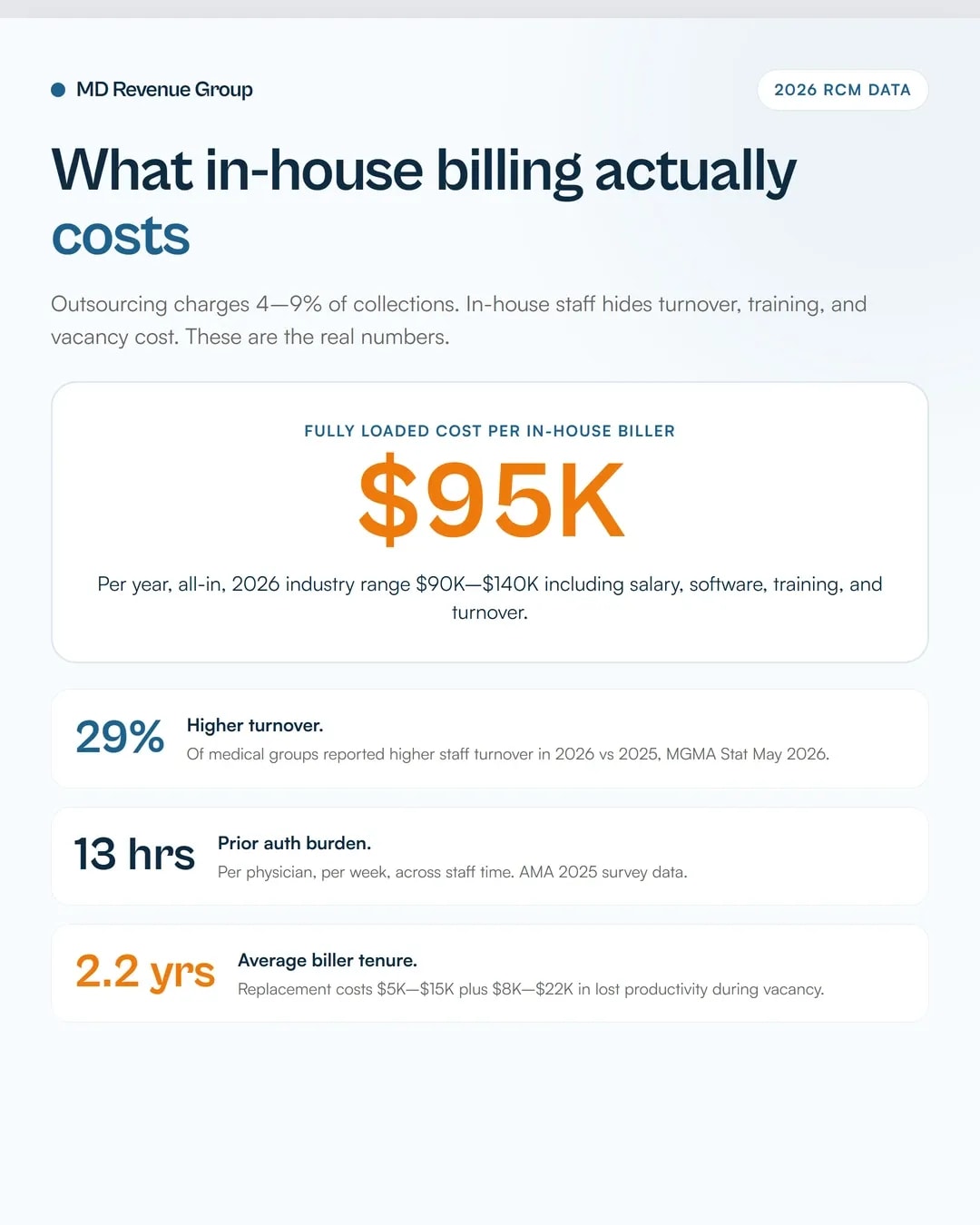
- In-house billing runs $90,000 to $140,000 per biller per year fully loaded; outsourced billing typically charges 4% to 9% of collections. (Industry cost data, 2026.)
- 29% of medical groups reported higher staff turnover in 2026 vs. 2025 (MGMA Stat, May 2026). Turnover is the hidden cost of local teams, and it is why many practices outsource.
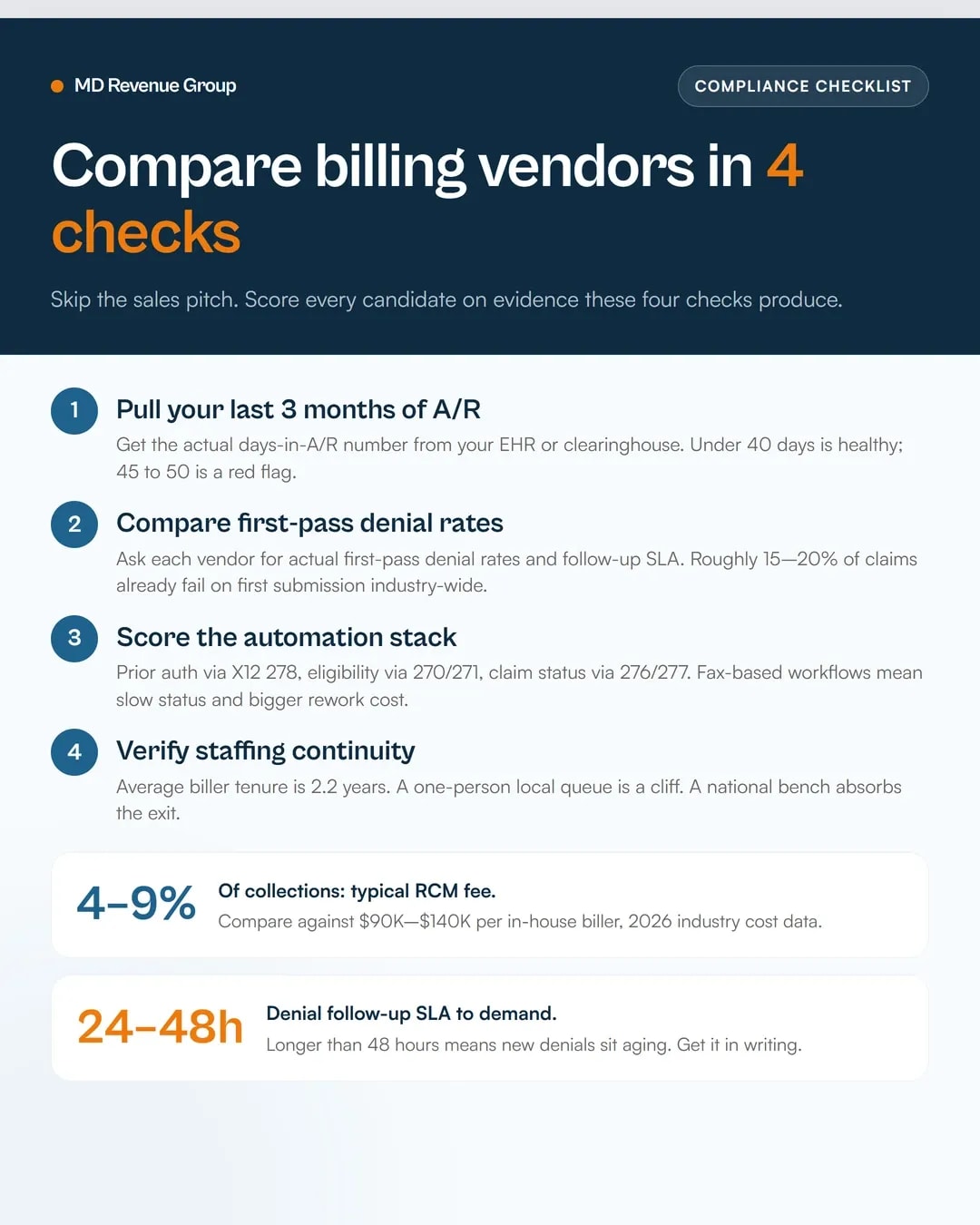
- Days in A/R above 45 to 50 means the revenue cycle is bottlenecking (MGMA/HFMA benchmark: under 40 days).
- The right vendor is usually a hybrid: national tech and staffing depth, local payer knowledge.
What "medical billing company near me" actually buys you
The honest list is short. A local vendor gives you in-person meetings, familiarity with the dominant commercial payers in your state, and someone who knows the state Medicaid quirks. That is genuinely useful if your payer mix is concentrated in one state and the vendor's team is the same people year over year.
What it does not give you: better denial rates, faster follow-up, or cheaper staffing. MGMA's May 2026 poll found 29% of medical groups had higher staff turnover this year. Billing teams in small towns compete for the same shrinking pool of credentialed billers as everyone else, and a 3-person local shop loses its senior biller, you feel it immediately. The average biller tenure is 2.2 years (MGMA-cited industry data), so every local vendor relationship carries a staffing cliff built into it.
A national partner smooths that cliff out by spreading work across larger teams. You stop being one resignation away from unbilled claims. This is the single biggest argument for looking beyond proximity.
The numbers that matter when you compare vendors
Stop comparing on price per claim. Compare on these six metrics, and ask every candidate to show you their actual numbers for a practice of your size and payer mix:
Metric | Healthy benchmark | Where to get it |
|---|---|---|
Days in A/R | Under 40 days; above 45 to 50 is a red flag | MGMA/HFMA performance bands |
First-pass denial rate | Under 5% for a competent RCM shop | Your own clearinghouse reports |
Denial follow-up turnaround | 24 to 48 hours for new denials | Ask the vendor directly |
Clean claim rate | 95%+ is the target | Clearinghouse or EHR data |
Cost to rework a denied claim | About $57 per claim (2026 data from Premier/Experian) | Use for vendor ROI math |
Prior auth cost | 13 staff hours per physician per week, 39 request (AMA 2025 survey) | Use to scope staffing |
Here is the proprietary math most buyers skip. Take a 3-biller internal team, fully loaded at $90,000 each, so $270,000 a year. Apply MGMA's 29% turnover reality: one biller resigns roughly every year. Replacement runs $5,000 to $15,000 in recruiting, plus $8,000 to $22,000 in lost productivity during the vacancy (industry turnover cost data). Call it $20,000 on a rough year. Add software, clearinghouse fees, training, and compliance review at $1,500 to $4,000. You are at roughly $292,000 for a team that spends 13 hours a week per physician just on prior auth follow-up.
Outsourced billing at 6% of collections on a practice collecting $1.8 million a year costs $108,000. The gap funds itself. This is why the medical billing service cost breakdown keeps pointing to outsourcing once you count every hidden cost.
Where local billing companies still have an edge
Local wins in three specific situations.
Concentrated single-state payer mix. If 80% of your revenue comes from two commercial payers in one state, a local shop that bills those plans every day knows their edits cold. National vendors sometimes rotate staff across states and industries; the local team does not rotate.
State Medicaid and HMO quirks. Texas Medicaid, for example, has enrollment and timely-filing behavior that changes on its own cycle, separate from federal CMS rules. A Texas-based biller lives in that cycle every week. If you are a Texas practice, medical billing services in Texas exist for exactly this reason, and the same logic applies to California or Florida pages on our site.
Relationship-heavy payers. Some payer medical directors answer the phone for local billers but route national vendors to a portal queue. That access is worth real money on complex appeals.
Where national RCM partners usually pull ahead
National partners earn their premium on four things that a 5-person local office cannot match.
Staffing depth. When your senior biller quits, a national vendor reassigns coverage the same day. A local shop leaves you exposed for weeks. Billing under 29% industry turnover (MGMA, May 2026) means someone is always the new hire, and depth is how that gets covered.
Technology stack. National vendors run automated claim scrubbing, X12 clearinghouse integration, and AI-assisted denial prediction. CAQH's 2025 Index found the industry spent $82 billion on manual administrative tasks and avoided $258 billion through automation. They put perspective on what good tech should save you: prior auth at $11.44 manual vs $3.82 electronic, claim status at $15.96 vs $0.75. The CAQH $21 billion automation guide has the full table. A local vendor faxing claims does not get you there.
Specialty coverage. If you bill psychiatry, cardiology, or DME one month and hospitalist services the next, a national partner has seen all of it. A local shop usually specializes in what walks through their door.
Reporting. You should get a real dashboard: days in A/R by payer, denial rate by reason, net collection rate, and a monthly root-cause note. If a vendor's "report" is a PDF they email you, that is a local-shop red flag.
The security and compliance gap nobody asks about
Local does not mean safer on HIPAA. In fact, small local vendors often run older servers, skip penetration testing, and have no business associate agreement template that legal would approve. A national RCM vendor should have HIPAA-compliant systems, encrypted workflows, audit logs, and signed BAAs for every client. Ask to see them.
Medicare enrollment and revalidation also intersect here. A billing company that misses revalidation cycles can cause your enrollment to lapse, and Medicare does not pay during that gap. The Medicare revalidation control calendar explains why that matters. A national partner with a credentialing desk tracks it for every client. A local shop may not.
How to compare them side by side
Use this table to score any candidate, local or national. Score them 1 to 5 on each row. If a vendor cannot show you proof for a row, that row scores a 1 by default.
Comparison area | Local vendor | National partner | What to ask for |
|---|---|---|---|
Days in A/R | 28 to 38 days if well-run | 28 to 38 days if well-run | Last 3 months of their actual AR aging report |
Denial follow-up | 3 to 7 days if staffed | 24 to 48 hours | Written SLA, not verbal promise |
Prior auth handling | 13 hours/week per physician in-house hours can stay hidden | Dedicated queue, real-time status | Which payers they touch via X12 278 vs fax |
Staffing turnover | High exposure; 2.2-year mean tenure | Spread across bench | Team tenure average and coverage plan |
Credentialing support | Usually manual | Automated tracking, 120-day CAQH re-attestation alerts | Proof of CAQH monitoring |
Tech stack | Often practice-management software only | Scrubbers, automation, analytics | Demo of their dashboard |
Security | Varies widely; ask directly | Usually HIPAA-compliant with BAAs, audit logs | Their last security review or SOC 2 |
The table will tell you something important: the winner is rarely "local" or "national." It is whoever shows you evidence on the rows that matter for your payer mix.
Why the answer is usually hybrid
Most practices that switch end up on a three-layer model. A national RCM backbone handles the volume work: claims scrubbing, payment posting, denial queue, and reporting. Your state-specific footprint still needs local eyes, so you keep one person (or a small partner) who owns state Medicaid, BCBS roster updates, and local payer escalations. Your local staff handles scheduling, eligibility at the front desk, and patient collections.
The split should be explicit. Name the owner of each function in writing: eligibility, prior auth, coding, claim submission, payment posting, denial follow-up, credentialing, and patient balances. When the contract says "comprehensive services," it usually means nobody owns eligibility verification until a denial shows up.
Check the math again after 90 days. Run the same six metrics twice: before the switch and 90 days after. You want to see A/R days fall by at least 5, denial follow-up turnaround fall to 48 hours, and first-pass denials drop by 2 to 3 points. If those three numbers do not move, the vendor's dashboard is telling you a story your bank account is not.
Questions to ask before you sign
Borrow these from our questions to ask a medical billing company guide, plus a few the local-vs-national debate adds:
- What is your current denial rate by payer, and what is the denial follow-up SLA? If they cannot answer with a number, walk away.
- How many billers will work my account, and what is their average tenure? One named biller and no backup is a staffing cliff.
- Which payers do you work via X12 270/271, 276/277, and 278, and which do you still fax? Fax means slower status.
- Who handles credentialing and revalidation, and how do I see it? You should never learn about a lapse from a denial.
- What is your security posture? HIPAA policies, BAA, encryption, audit logs, and a recent security review.
- What does the contract cost to leave? A national vendor should offer month-to-month or a 30-day exit. Six-month lock-ins are a warning.
If you want the full scoring framework, our outsourcing medical billing vendor scorecard compares vendors on denial prevention, revalidation, APIs, security, reporting, and staffing. For smaller practices, medical billing for small practices covers when outsourcing pays for itself.
Author: MD Revenue Group revenue cycle team. We manage billing operations for practices across 30+ states and track vendor performance against MGMA benchmarks in production.
Disclosure: Benchmarks cited come from MGMA Stat polls (May and September 2026), AMA 2025 Prior Authorization Survey, CAQH 2025 eSolutions Index, and HFMA A/R performance standards. Figures vary by specialty, payer mix, and region; treat them as planning baselines, not guarantees.
Ready to compare? Book a revenue-cycle consultation and we will walk your current vendor numbers against a real benchmark set.