
Psychiatric Billing Services and Medical-Necessity Appeals: How to Build an Evidence Packet Payers Can Review
Psychiatric billing services teams overturn 95% of appealed denials. Build the evidence packet, meet the deadlines, and know when to write off.
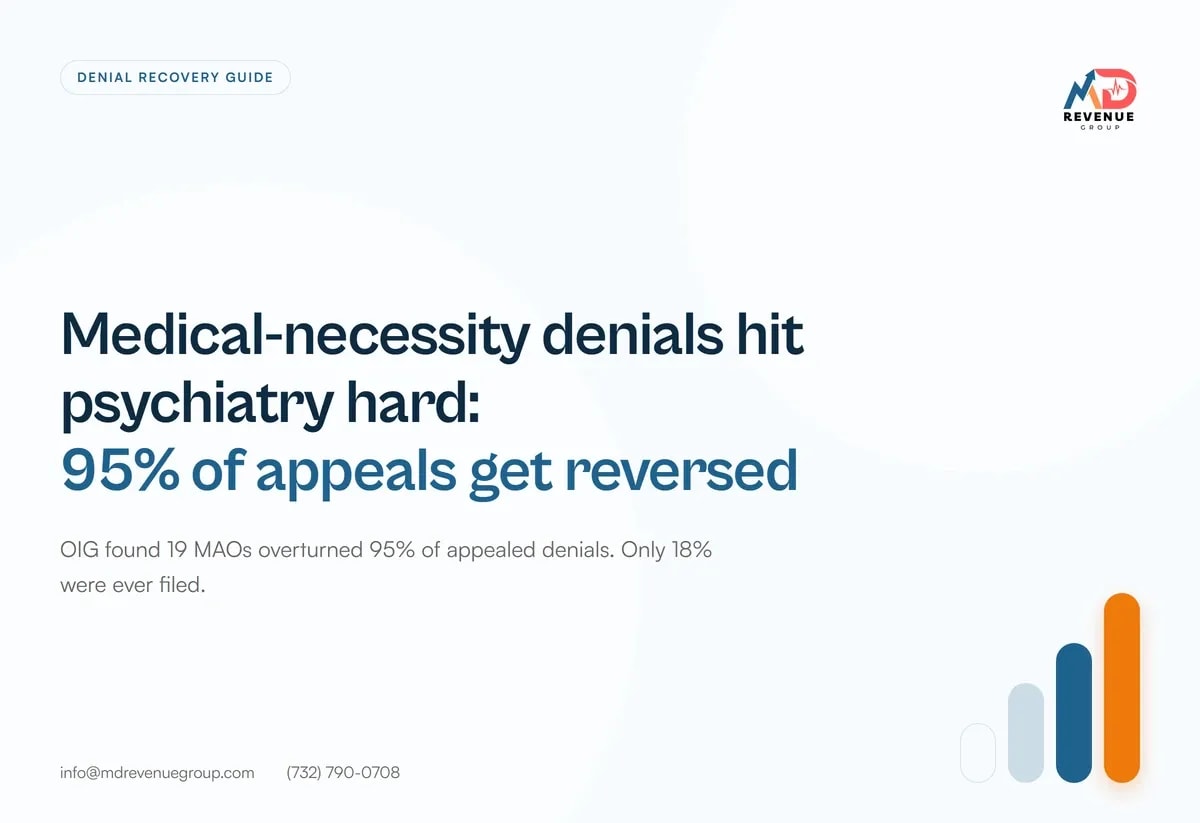
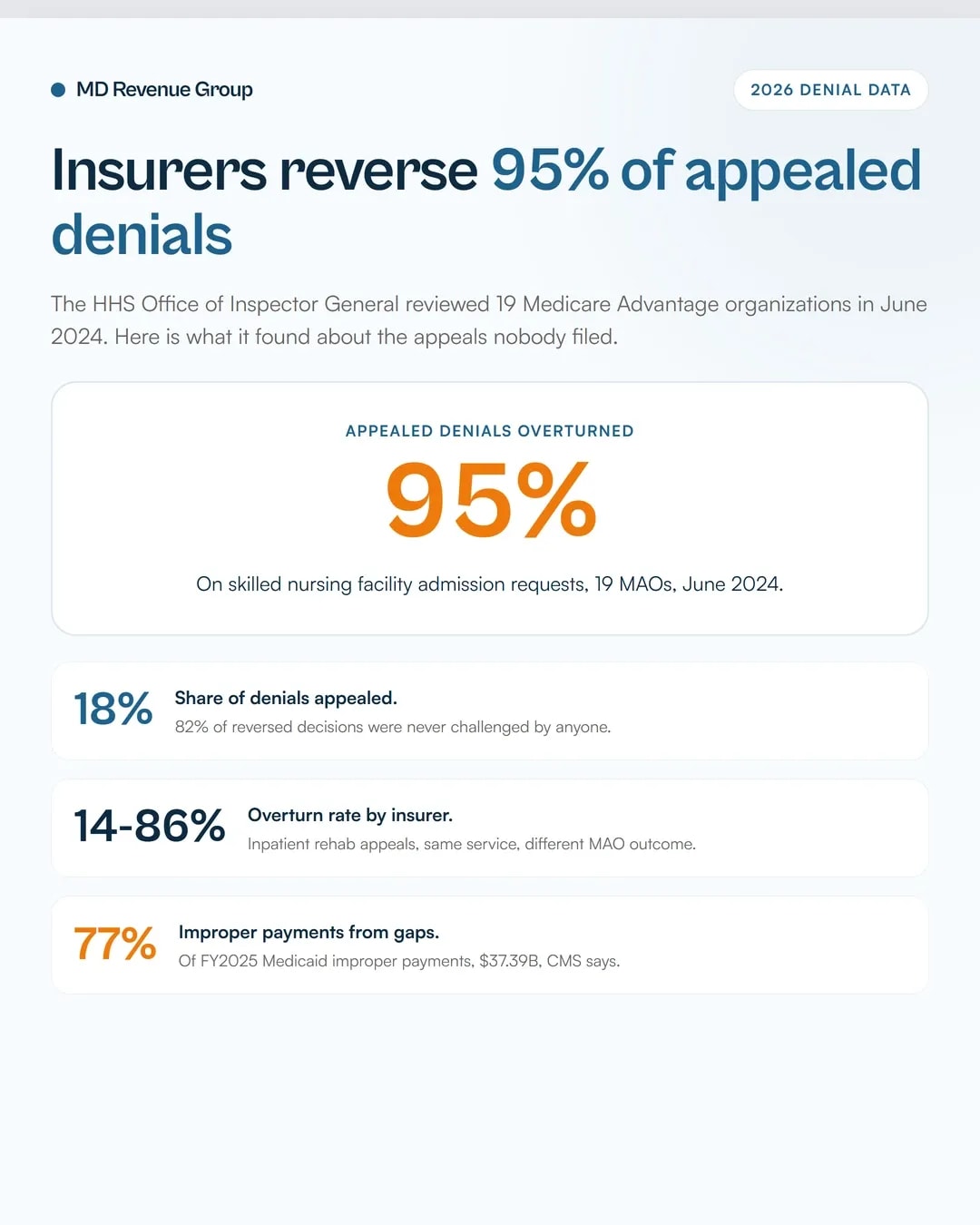
Medical-necessity denials land harder on psychiatric billing services than on almost any other specialty line, and the appeal data explains why. In June 2026, the HHS Office of Inspector General reported that 19 Medicare Advantage organizations denied 12 percent of skilled nursing facility admission requests in June 2024. Enrollees and providers appealed 18 percent of those denials. When they appealed, the plans reversed 95 percent of them.
Read that twice. The plans got the first decision wrong on a large share of cases, and 82 percent of those wrong decisions were never challenged.
The gap between the denial letter and the appeal packet is where your revenue sits. This guide covers what belongs in that packet, the federal deadlines that govern when you can still file, and the one calculation that tells you which denials are worth appealing at all.
Key takeaways
- OIG found Medicare Advantage plans overturned 95% of appealed skilled nursing facility denials, and only 18% of denials were appealed at all.
- Medicare reconsideration evidence submitted after the notice of reconsideration is barred absent good cause. 42 CFR 405.966 makes this a hard cutoff.
- A medical-necessity appeal breaks even at a 32.9% overturn rate. The OIG's inpatient rehab overturn rates ranged from 14% to 86% by insurer, so the same packet makes money or loses it depending on which MAO holds the authorization.
- Medicaid managed care plans must now publish denial and appeal overturn percentages by March 31 for the prior year. 42 CFR 438.210(f) has been in force since January 1, 2026.
- Partial hospitalization requires a documented 20 hours per week of therapy. Intensive outpatient requires 9 hours per week. Both are 7-condition tests, and only one condition changes between them.
What goes in a medical-necessity appeal packet
A payer reviewing a medical-necessity denial wants to answer one question: does this record support the level or service billed? Everything in the packet serves that question.
Seven documents cover it. Most behavioral health practices have four of them.
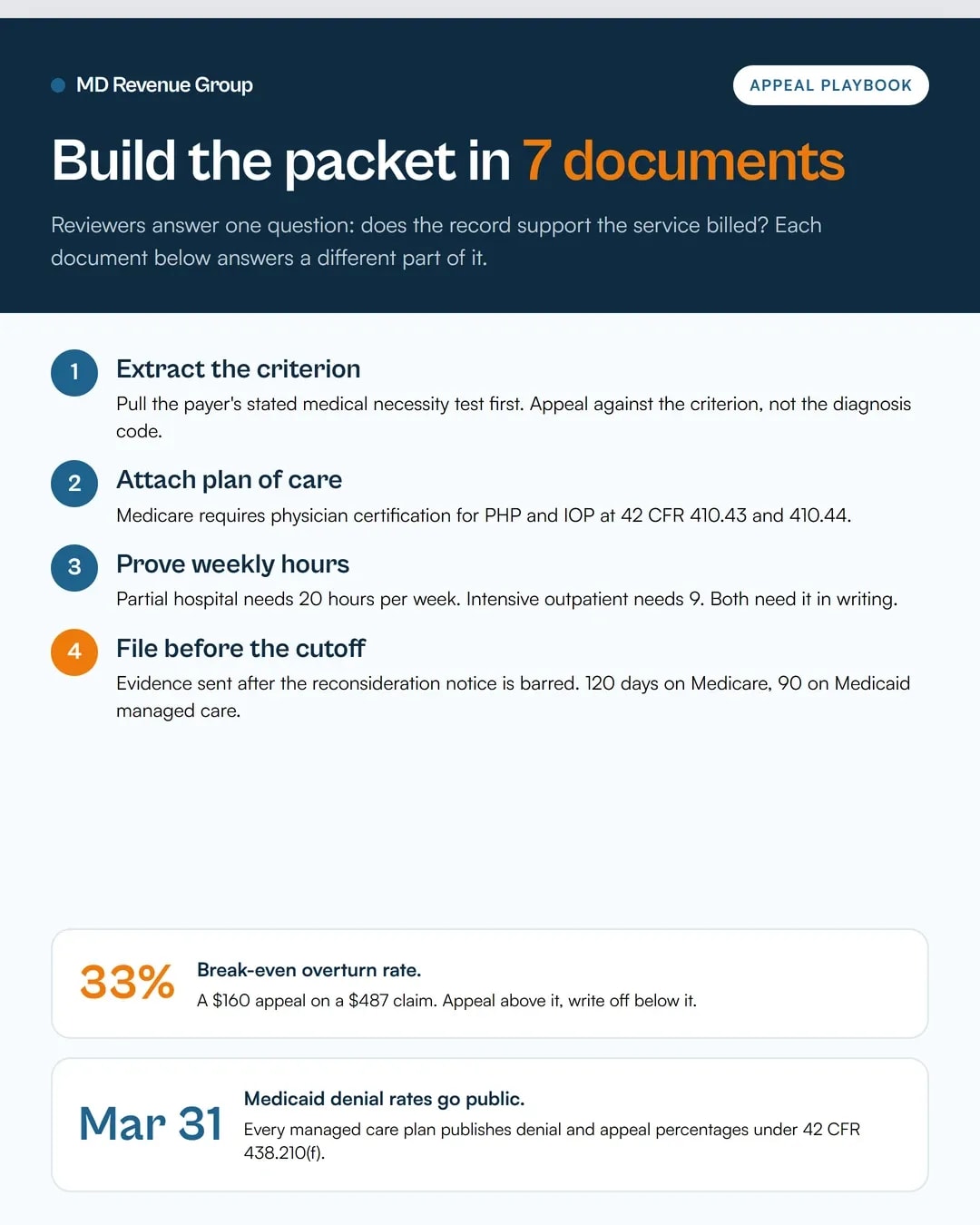
1. The denial notice, with the criterion extracted
Start here. Under 42 CFR 438.404(b)(2), a Medicaid managed care plan must give the enrollee the right to reasonable access to and copies of all documents and information relevant to the determination. That includes medical necessity criteria, and any processes, strategies, or evidentiary standards used in setting coverage limits.
Many practices skip this and appeal against the diagnosis code rather than the payer's stated criterion. That guarantees a loss. Pull the actual criterion, write it at the top of your working file, and treat it as the exam question.
A denial reason code tells you which lever to pull. Medical necessity denial and insufficient-information denial get opposite treatment, and the same specialty billing workflow handles both poorly. Our psychiatric billing services page covers how the reason codes map to payer behavior for this specialty.
2. The plan of care and the treatment plan
For partial hospitalization and intensive outpatient, this is the core document. 42 CFR 410.43(a)(3) and 410.44(a)(3) both require services furnished in accordance with a physician certification and plan of care.
3. Diagnosis and symptom documentation
The mental status exam, the onset and history of illness, and the functional findings that tie symptoms to the service billed.
4. Progress notes showing course of treatment
For inpatient psychiatric facilities, 42 CFR 482.61(d) sets the floor: progress notes at least weekly for the first 2 months and at least monthly thereafter, with recommendations for revisions to the treatment plan and precise assessment of progress against the original or revised plan.
5. Authorization history
Every authorization, denial, peer-to-peer conversation, and utilization review contact, with dates. A denial letter that cites an authorization gap is refuted by the authorization log.
6. Prescribing and medication records
Supports medical necessity for the treatment provided and shows why a higher level of care was required.
7. The cover letter that maps record to criterion
One page. Each criterion the payer cited, then the page of the record that answers it. Reviewers read hundreds of these. Make yours skimmable.
What Medicare medical necessity requires for behavioral health
The coverage criteria are specific and they are published. For partial hospitalization at 42 CFR 410.43(c) and intensive outpatient at 42 CFR 410.44(c), Medicare runs an identical 7-condition test with one number changed.
Condition | Partial hospitalization (410.43) | Intensive outpatient (410.44) |
|---|---|---|
Minimum weekly therapeutic services, documented in plan of care | 20 hours | 9 hours |
Likely to benefit from a coordinated program, more than isolated outpatient sessions | Required | Required |
Does not require 24-hour care | Required | Required |
Adequate support system while not actively engaged | Required | Required |
Mental health or substance use disorder diagnosis | Required | Required |
Not judged dangerous to self or others | Required | Required |
Cognitive and emotional ability to participate and tolerate intensity | Required | Required |
The two levels differ on a single number. If a chart does not document hours of therapy per week against a plan of care, the level-of-care argument has nothing to rest on.
Separately, 42 CFR 410.155 governs the outpatient mental health treatment limitation. It phased to full recognition in CY 2014 and later years, where recognized incurred expenses are 100 percent and the split is 80 percent Medicare, 20 percent patient. Hospital inpatients are excluded from the limitation, as are partial hospitalization and intensive outpatient services not directly provided by a physician.
How long do you have to appeal a medical-necessity denial?
Deadlines are where most practices lose recoverable money, because the deadline depends on the payer type and nobody tracks all of them. Here is the full set.
Payer type | First appeal level | Deadline | Receipt presumption |
|---|---|---|---|
Medicare Original (redetermination) | Redetermination | 120 calendar days from notice | Presumed received 5 days after notice date |
Medicare Original (reconsideration) | QIC reconsideration | 60 calendar days to review a dismissal | Presumed received 5 days after notice date |
Medicare Advantage (organization determination) | Reconsideration | Per plan; standard decision now 7 calendar days for PA services from Jan 1, 2026 | Plan-specific |
Medicaid managed care appeal | Plan appeal | 30 calendar days from receipt; expedited 72 hours | State-established |
Medicaid State fair hearing | Fair hearing | 90 to 120 calendar days from notice of resolution | State-established |
ERISA group health plan (commercial) | Internal appeal | At least 60 days from the adverse determination notice | Plan-specific |
Two rules in that table carry more weight than the rest.
The evidence cutoff at 42 CFR 405.966(a)(2). A reconsideration request must include any missing documentation identified in the notice of redetermination. And absent good cause, failure to submit all evidence prior to the issuance of the notice of reconsideration precludes subsequent consideration of that evidence. You get one shot at the record. Each additional evidence submission after filing extends the QIC's 60-day decision window by up to 14 calendar days.
Deemed exhaustion under 42 CFR 438.408(c)(3). If a Medicaid managed care plan misses its own notice and timing requirements, the enrollee is deemed to have exhausted the plan's appeal process and may go straight to State fair hearing. Track the plan's compliance dates and use their miss.
Expedited pathways are available and clinicians rarely ask for them. Under 42 CFR 438.410, a provider can indicate that standard resolution could seriously jeopardize the enrollee's physical or mental health. And 42 CFR 422.570 prohibits a Medicare Advantage organization from taking punitive action against a physician who requests an expedited determination.
Authorization history only exists if somebody tracked it. Our behavioral health prior authorization workflow records every submission, status change, and peer-to-peer contact against the member, which is what makes document 5 buildable under deadline.
The 33% break-even overturn rate
Here is the number to run against your own denial log.
An appeal costs clinician time pulling records and writing the clinical rationale, plus AR staff time assembling and filing it. Price that at 90 minutes of clinician time and 30 minutes of AR time. At a loaded clinician rate of $95 per hour and AR staff at $34 per hour, one medical-necessity appeal costs about $160.
Divide by the average allowed amount on a denied behavioral health claim. At $487 average allowed, your break-even overturn rate is $160 / $487 = 32.9%.
So the rule is direct: appeal when your expected overturn rate exceeds 33%. Below that, the appeal costs more than it recovers and you should write the claim off, document the reasoning, and move on.
Now put the OIG numbers next to that threshold:
Setting | Overturn rate on appeal | Net position on a $487 claim |
|---|---|---|
Skilled nursing facility admission | 95% | +$303 |
Inpatient rehabilitation facility, best-performing MAO | 86% | +$259 |
Inpatient rehabilitation facility, collective average | 43% | +$49 |
Long-term acute care hospital, collective average | 36% | +$15 |
Inpatient rehabilitation facility, worst-performing MAO | 14% | -$92 |
That last row is why blanket appeal policy wastes money. The same packet, the same record, the same reviewer skill, and the appeal loses money against one insurer's own track record.
Why the same appeal wins with one insurer and loses with another
OIG report OEI-09-24-00330, issued June 8, 2026, found IRF overturn rates ranging from 14 percent to 86 percent depending on the MAO. Same service type, same appeals process, same federal appeal window.
Contractor routing explains part of it. In OEI-09-24-00331, naviHealth processed half of all SNF admission requests and denied 14 percent of them, against 11 percent for MAOs processing internally and 9 percent for other contractors. When enrollees appealed, MAOs overturned 97 percent of naviHealth's denials.
The pattern generalizes. Contract-run denials get reversed at higher rates, because the reversal happens at the MAO level where someone with more context reviews the same request.
Two operating consequences follow.
Segment appeals by payer's overturn rate, not by denial code. Track overturn percentage by payer for your own medical-necessity denials. Route appeals toward the payers where your packets win and away from the ones where they don't. A generic appeal queue sorts by date and loses money on the tail. Our psychiatry claims denial analytics breakdown shows the dashboard structure for tracking that rate by reason and by owner.
Use the published Medicaid data. Since January 1, 2026, Medicaid managed care plans must publicly report prior authorization metrics by March 31 for the prior calendar year under 42 CFR 438.210(f). The required disclosures include the percentage of standard requests denied and the percentage approved after appeal. Every Medicaid MCO's denial and overturn rates are now public, by plan, annually. Before you appeal into a plan, look up its numbers.
What to write in the chart so the reviewer finds it
Reviewers scan. If the reasoning is buried in a progress note, it does not exist. Write it where criteria are addressed.
Here is a real level-of-care statement a psychiatrist can sign for an intensive outpatient plan of care under 42 CFR 410.44(c):
Treatment plan: Patient meets criteria for intensive outpatient level of care under 42 CFR 410.44(c). Plan of care requires 12 hours weekly of therapeutic services, documented in the weekly service schedule. Diagnosis F32.1 major depressive disorder, recurrent, severe, without psychotic features, with co-occurring F10.21 alcohol use disorder, severe. Coordinated program of care required rather than isolated sessions; patient has attempted outpatient therapy twice in the last 14 months with relapse each time. Does not require 24-hour supervision. Adequate support system: sister resides in the same household, confirmed at intake. Not judged dangerous to self or others. Demonstrates cognitive and emotional capacity to participate in the group process: consistent attendance, 11 of 12 sessions, and completes weekly safety plan review without difficulty.
That single paragraph answers 6 of the 7 conditions. The seventh, weekly hours, is documented in the service schedule it references.
For inpatient psychiatric facilities, 42 CFR 482.61(b) requires the psychiatric evaluation within 60 hours of admission and specifies what it must contain: medical history, a record of mental status, onset of illness and circumstances leading to admission, attitudes and behavior, an estimate of intellectual functioning, memory functioning, and orientation, plus an inventory of the patient's assets described rather than interpreted.
For treatment plans, 482.61(c) requires a substantiated diagnosis, short-term and long-range goals, the specific treatment modalities utilized, the responsibilities of each member of the treatment team, and adequate documentation to justify the diagnosis and the treatment and rehabilitation activities carried out.
Write against that list. Every time.
When to appeal and when to write off
Situation | Move | Why |
|---|---|---|
Expected overturn rate above 33% | Appeal with full packet | Recovers more than it costs |
Expected overturn rate below 33% | Write off, document the reasoning | Appeal costs $160 and returns less |
Denial cites a missing authorization | Appeal with authorization log | Documentary conflict, high win probability |
Denial cites level of care and weekly hours are undocumented | Appeal only after the clinician documents hours | No argument exists until the record exists |
Denial cites medical necessity and criteria were never supplied | Request criteria, appeal in parallel | 438.404(b)(2) entitles you to the criterion |
Denial is a duplicate service edit | Correct and resubmit, do not appeal | No new evidence will change it |
Late claim denial after the filing window closed | Appeal only if a 424.44(b) exception applies | Narrow exceptions, high documentation burden |
Practices that route every denial to appeals end up spending 90 clinician minutes on claims they had no chance at winning. Segment first, then file. Where a practice has already given up on a category of denials entirely, medical revenue recovery is usually where the remaining balance sits.
How to stop these denials before the letter arrives
The cheapest appeal is the one you never file. CMS's own improper payment data supports the emphasis on documentation. For FY 2025, Medicaid's improper payment rate was 6.12 percent, or $37.39 billion, and 77.17 percent of those improper payments were caused by insufficient documentation. Medicare Part C improper payments at 6.09 percent were mostly cases where the plan's documentation failed to substantiate the diagnosis data supporting payment.
Three controls do most of the work.
Score the chart against the criterion before submission. Build a checklist from the 7-condition test in 410.43(c) or 410.44(c), then from the payer's own medical necessity criteria when you have them. A chart missing the weekly-hours documentation should never reach submission.
Log the plan-of-care hours at scheduling, not at claim time. The 20-hour and 9-hour thresholds are scheduling facts. If your schedule doesn't produce and record them, no appeal can recover them.
Track denial reason by payer monthly. You need your own overturn rate by payer to run the 33% test. Most practices have no idea where they sit, which means they're filing blind. The denial management resource library covers how to structure that monthly review so the numbers drive the work.
Behavioral health denial patterns tend to cluster by reason rather than scatter, so monthly reason-level review catches problems while the batch is still fixable. Our behavioral health claim denial management service builds that review around the criterion your payer actually cites, not a generic denial list.
Frequently asked questions
What is the deadline to appeal a Medicare medical necessity denial? 120 calendar days from the date you receive the notice of initial determination, per 42 CFR 405.942. Receipt is presumed 5 calendar days after the notice date unless evidence shows otherwise. Good cause extensions exist for serious illness, records destroyed by fire or similar, contractor error, or a request sent to the wrong government agency in good faith.
Can I submit more evidence after filing a Medicare reconsideration? Yes, and the QIC's 60-day decision window extends by up to 14 calendar days per submission. But 42 CFR 405.966(a)(2) bars consideration of evidence submitted after the notice of reconsideration, absent good cause. Get the record complete before you file.
Does a Medicare Advantage denial have to be appealed to the plan first? Yes. The standard organization determination is the first level. Beginning January 1, 2026, Medicare Advantage plans must decide requests for services subject to prior authorization rules within 7 calendar days, under 42 CFR 422.568(b)(1)(ii). Failure to issue timely notice is itself an appealable adverse organization determination.
How long do I have to appeal a Medicaid managed care denial? 30 calendar days from the plan's receipt of the appeal, or 72 hours for an expedited appeal, per 42 CFR 438.408(b). Either can be extended up to 14 calendar days. Once the plan issues its resolution notice, you have no fewer than 90 and no more than 120 calendar days to request a State fair hearing.
What documentation do I need for a partial hospitalization appeal? A physician certification and plan of care under 42 CFR 410.43(a)(3), plus evidence of at least 20 hours per week of therapeutic services, and support for the other 6 conditions in 410.43(c). If you bill IOP instead, the threshold drops to 9 hours per week under 42 CFR 410.44(c).
Can the reviewer use LCDs against me? At the Medicare reconsideration level, no. Under 42 CFR 405.968(b)(2), QICs are not bound by LCDs, LMRPs, or CMS program guidance, though they give substantial deference when applicable. A QIC that declines to follow a policy must explain why in writing, and that decision has no precedential effect.
Is a peer-to-peer review worth requesting? Often yes. Where a reviewing professional must be a physician, the peer-to-peer conversation happens with a clinician who can speak to the criteria directly. It also creates a dated record if the denial proceeds. Two federal provisions protect the requester: 42 CFR 422.570(f) bars punitive action against a physician requesting expedited treatment, and 438.410(b) does the same for Medicaid providers supporting an expedited appeal.
Medicaid managed care plans now publish denial and appeal percentages annually under 42 CFR 438.210(f). If your team is appealing without knowing its own overturn rate by payer, we map that in a free audit: which denials to appeal, which to write off, and where the documentation gaps sit upstream.