
Hospital Price Transparency Enforcement in 2026: What Healthcare Billing Teams Need to Check Now
CMS enforces 2026 hospital price transparency rules on April 1. Review MRF standards, NPI data, and civil monetary penalties for healthcare billing teams.
Hospital Price Transparency Enforcement in 2026: What Healthcare Billing Teams Need to Check Now
Hospital price transparency enforcement enters a strict phase as CMS requires healthcare billing operations to publish standardized machine-readable files based on historical claim remittances rather than estimates. On April 1, 2026, the Centers for Medicare & Medicaid Services began enforcing updated Hospital Outpatient Prospective Payment System rules that mandate exact allowed amounts, percentile distributions, organizational NPIs, and executive attestations for every hospital operating in the United States. Civil monetary penalties range from $300 daily for small facilities up to $2,007,500 annually for hospitals with over 30 beds.
Key Takeaways
- Enforcement start date: CMS enforcement of the CY 2026 Hospital Price Transparency standard began on April 1, 2026.
- No estimated charges: Machine-readable files must report actual allowed amounts derived from a 12 to 15 month remittance lookback period.
- Mandatory 2026 fields: Files must display median, 10th percentile, and 90th percentile allowed amounts alongside claim line counts.
- Executive attestation: A senior officer (CFO or VP of Revenue Cycle) must be explicitly named in the file attestation statement.
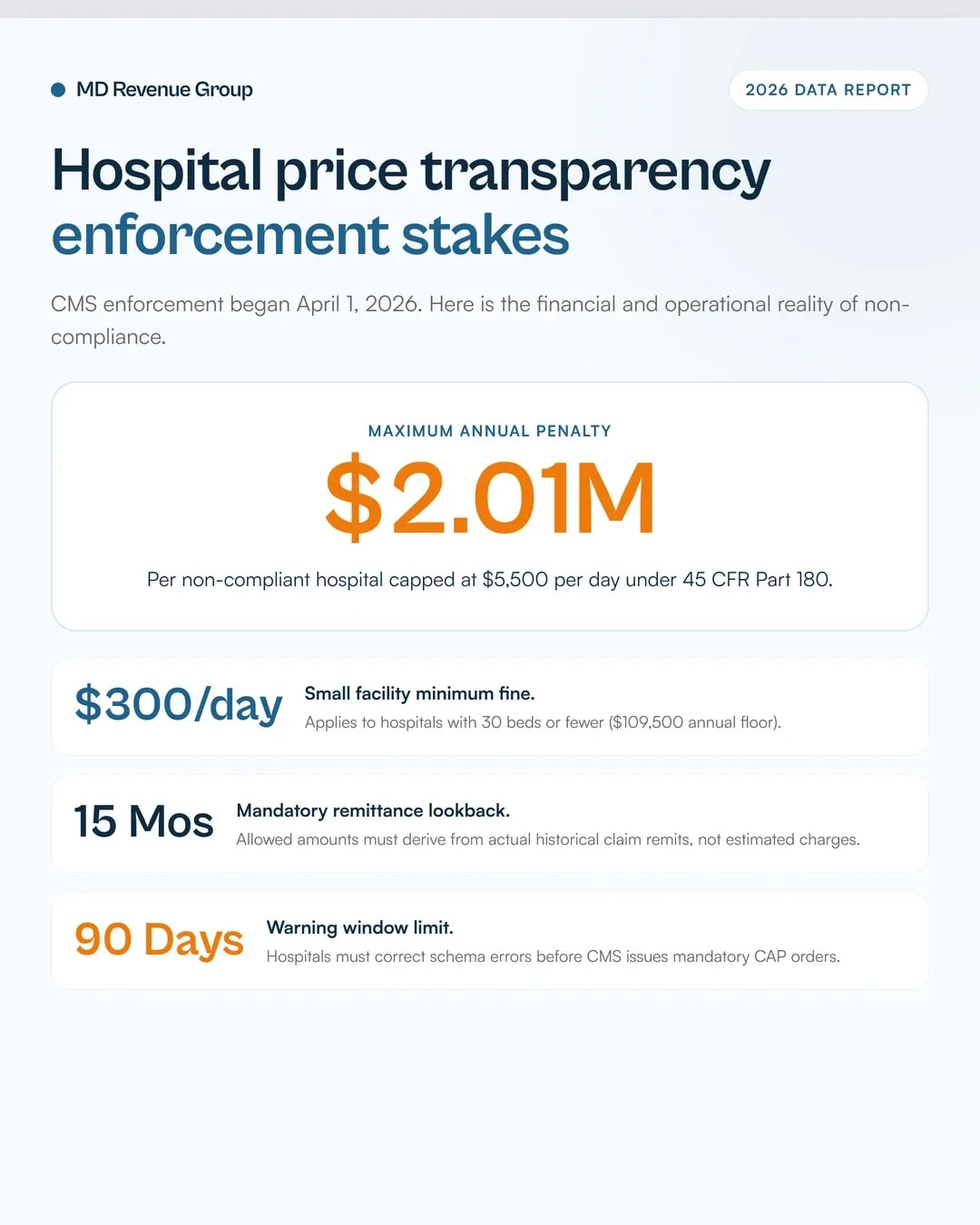
- Maximum penalty: Non-compliant hospitals face daily fines up to $5,500, totaling $2,007,500 per year.
What Changed in 2026 Price Transparency Rules
CMS shifted its audit criteria from checking file existence to evaluating file credibility and schema compliance. Under previous enforcement rounds, hospitals satisfied basic requirements by posting estimated payer rates or charge master extracts. The 2026 rule eliminates estimated rate reporting.
Hospitals must compile machine-readable files (MRF) using CSV or JSON templates conforming to CMS Schema Version 3.0. Every file must include the hospital's Type 2 Organizational National Provider Identifier (NPI) associated with its primary taxonomy.
2026 CMS MRF REQUIRED FIELDS
| Field Name | Required Value / Standard |
|---|---|
| Organizational NPI Lookback Period Median Allowed Amount 10th & 90th Percentiles Total Claim Count Executive Attestation | Type 2 NPI linked to primary taxonomy 12 to 15 months of claims remittance data Exact 50th percentile calculated reimbursement Distribution floor and ceiling values Number of claims used in calculation Named CFO/VP signature and title |
When contracting through complex fee schedules or percentage-of-charge arrangements, pricing teams must calculate the exact median, 10th percentile, and 90th percentile allowed amounts for each payer. Your data team must pull these figures directly from electronic remittance advice (835 ERA) files.
If your facility struggles with complex payer contracts, integrating professional medical billing services ensures that claim remittance data matches chargemaster files before public posting.
Technical Machine-Readable File Standards and Schema 3.0
The technical specifications under CMS Schema 3.0 require exact data structures to ensure automated Web web crawlers can ingest price files across all U.S. hospitals.
1. NPI and Licensing Verification
Each machine-readable file must contain the hospital's primary legal entity name, physical address, and Type 2 Organizational NPI. Facilities operating multiple licensed locations under a single provider agreement must list each campus NPI separately within the header metadata block.
2. Payer-Specific Negotiated Charge Coding
For every billable item or service, the file must reference standardized code sets, including CPT, HCPCS, ICD-10-PCS, MS-DRG, and National Drug Codes (NDC). When a service is reimbursed under a capitated contract or bundled payment model, the file must specify the contract type code rather than leaving fields blank or inserting text strings like "N/A" or "not applicable."
3. Server Configuration and Access Requirements
Files must be stored in the root folder of the hospital's primary website or linked through a dedicated text file named hospital-price-transparency.txt. CMS web crawlers verify that web servers do not enforce Cross-Origin Resource Sharing (CORS) blocks, user registration prompts, or CAPTCHA barriers that prevent automated data indexing.
CMS Civil Monetary Penalties and Enforcement Timeline
The penalty structure established under 45 CFR Part 180 imposes daily fines based on licensed bed counts. CMS conducts random web scrapes, analyzes public complaints, and issues formal warning notices.
Hospital Size | Daily Penalty Formula | Annual Maximum Penalty |
|---|---|---|
30 beds or fewer | $300 fixed per day | $109,500 |
31 to 550 beds | $10 per bed per day | $113,150 to $2,007,500 |
More than 550 beds | $5,500 capped daily rate | $2,007,500 |
The enforcement cycle follows a strict 3-stage progression:
- Warning Notice: CMS notifies the hospital of specific file errors and grants 90 calendar days to correct the deficiencies.
- Corrective Action Plan (CAP): If errors persist, the hospital must submit a written CAP within 45 days detailing technical remediation milestones.
- Civil Monetary Penalty (CMP) Imposition: Failure to complete the CAP results in immediate daily fines. CMS posts non-compliant hospital names and fine amounts on the public CMS.gov portal.
Hospitals may request a 35% penalty reduction by waiving their right to an Administrative Law Judge hearing for technical schema errors. However, CMS rules explicitly prohibit penalty reductions for core failures, such as failing to host a machine-readable file or blocking access to shoppable service tools.
Reviewing your compliance posture alongside broader federal oversight, such as the 2026 OIG Work Plan medical billing audits, prevents unexpected regulatory scrutiny.
Real-World Scenario: Remediating a Non-Compliant Health System
In late 2025, a 180-bed acute care hospital in the Mid-Atlantic region received a CMS Warning Notice citing invalid percentile values in its price transparency file. The hospital had published contract fee schedule estimates rather than actual historical remittance data.
The hospital's revenue cycle team executed a 60-day remediation plan:
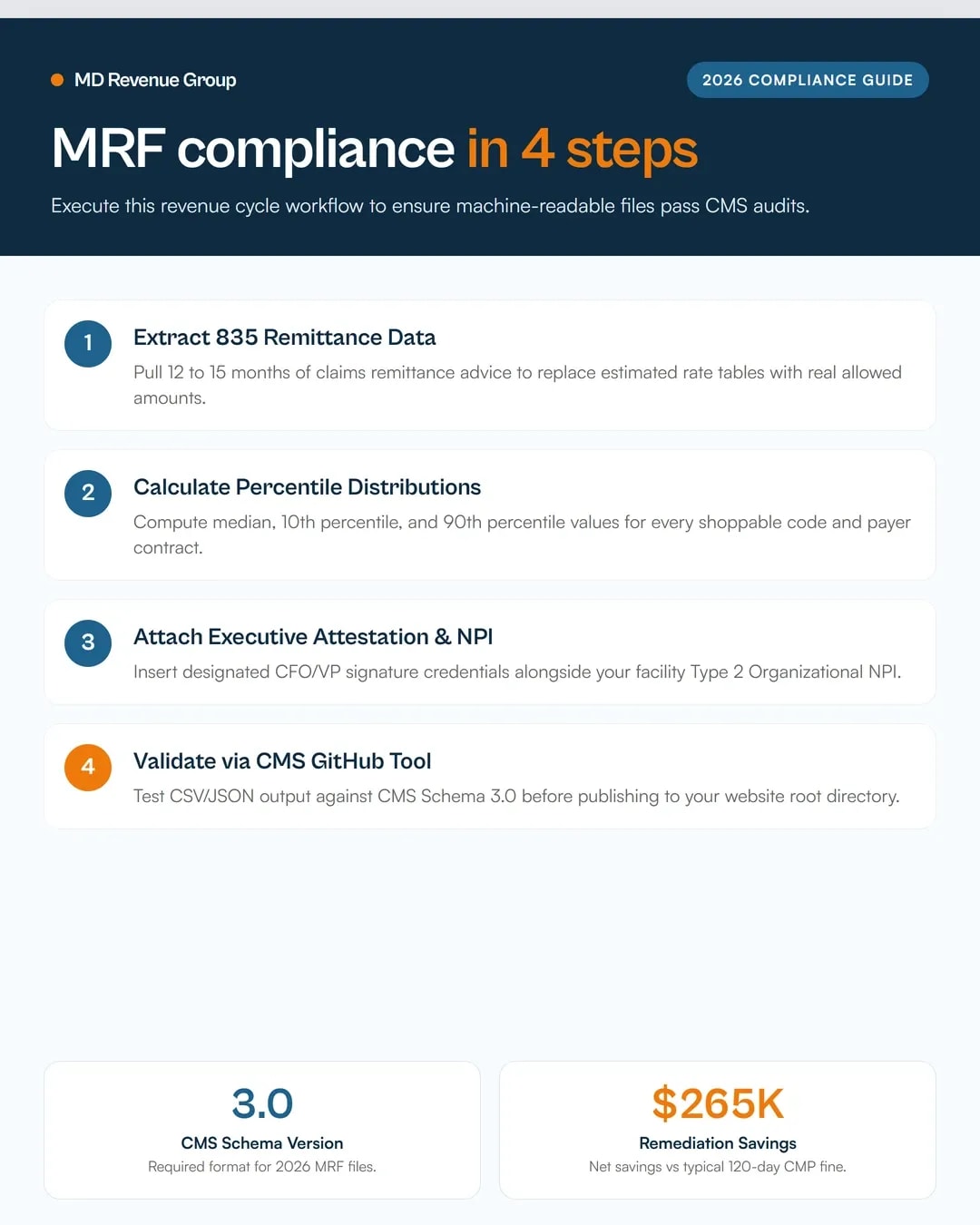
- ERA Extraction: The IT department pulled 14 months of electronic remittance files (835 ERAs) representing 142,000 adjudicated claim lines across five major commercial payers.
- Data Cleansing: The billing team filtered out zero-dollar secondary payer adjustments, secondary coordination-of-benefit claims, and duplicate reversal lines that skewed percentile math.
- Percentile Calculation: Using Python data scripts, the team calculated the exact 10th percentile, median, and 90th percentile allowed amounts for every shoppable surgical, diagnostic, and evaluation code.
- Validation and Attestation: The team submitted the formatted CSV through the CMS online validator, achieved a zero-error report, and secured signed attestation from the Chief Financial Officer before redeploying the file.
By completing remediation within 60 days of the initial warning, the hospital avoided a formal CAP order and protected $450,000 in potential daily fines.
The 2026 Revenue Cycle Governance Checklist
Achieving compliance requires collaboration across finance, IT, and health information management. Revenue cycle leaders should execute this four-step checklist quarterly:
1. File Placement and Accessibility
2. Remittance Data Normalization
3. Schema Validation
Conducting a thorough medical billing audit helps identify discrepancies between posted chargemaster rates and actual commercial reimbursements.
Proprietary Calculation: Penalty Exposure vs. Data Remediation
To understand the financial risk of non-compliance, consider a 250-bed regional hospital system. If CMS identifies invalid percentile calculations across its MRF file, daily penalties accrue rapidly.
Model Assumptions:
- Bed Count: 250 beds
- Daily Penalty: 250 beds x 2,500 per day
- Notice Window: 90-day warning period + 45-day CAP window = 135 days before CMP imposition
- Average Enforcement Duration: 120 days of active penalty collection
Penalty Exposure Calculation:
120 days x $2,500/day = $300,000 in direct CMP fines
Internal Remediation Cost:
Data Extraction & Remittance Normalization (100 hours @ $150/hr) = $15,000
CMS Schema Validation & IT Deployment = $8,000
Third-Party RCM Compliance Verification = $12,000
Total Remediation Cost = $35,000
Net Financial Benefit of Immediate Action:
$300,000 penalty exposure - $35,000 remediation cost = $265,000 saved
Fixing file structures during the initial 90-day warning window saves $265,000 in net capital while preventing public disclosure on the CMS penalty registry.
Implementing end-to-end revenue cycle management ensures your billing systems automatically capture remitted rates for continuous transparency reporting.
State-Level Price Transparency Laws to Watch
Federal enforcement sets the national floor, but state legislatures are adding stricter disclosure mandates and patient billing protections.
For example, health systems operating under medical billing New Jersey regulations must comply with state-specific out-of-network disclosure requirements and itemized bill delivery rules alongside federal CMS rules. State regulators in New York and Pennsylvania have similarly introduced legislation linking facility licensing renewals to price transparency compliance.
Hospitals that align their federal MRF files with state-level patient estimation tools lower patient payment friction and improve cash collections. Tracking metrics like your clean claim rate benchmark ensures that front-end pricing accuracy translates into faster back-end claim adjudication.
Frequently Asked Questions
When did CMS begin enforcing the 2026 hospital price transparency rules?
CMS began enforcing the CY 2026 Hospital Outpatient Prospective Payment System price transparency requirements on April 1, 2026. Hospitals must publish machine-readable files containing actual historical allowed amounts instead of estimated rates.
What happens if a hospital fails to publish a machine-readable file?
CMS issues a written warning notice giving the hospital 90 days to correct the failure. If non-compliance continues, CMS requires a Corrective Action Plan within 45 days. Continued non-compliance results in daily civil monetary penalties ranging from $300 to $5,500 per day.
Can hospitals use estimated charges in their 2026 price transparency files?
No. The 2026 rule requires hospitals to calculate actual median, 10th percentile, and 90th percentile allowed amounts derived from 12 to 15 months of historical remittance data.
Does a BAA cover price transparency data extraction?
Price transparency files contain aggregated statistical data rather than patient health information (PHI). However, the internal claims remittance files used to calculate allowed amounts contain PHI and must be processed within HIPAA-compliant systems.
Next Steps for Your Practice
Ensuring hospital price transparency compliance requires aligned billing data, validated schemas, and disciplined revenue operations.
If your team needs to audit remittance data, clean up charge masters, or optimize billing workflows, we can help. Request a free audit with our revenue cycle specialists to identify data leaks and ensure complete regulatory compliance.