
No Surprises Act IDR Batching: Medical Billing and Collection Workflow for 50-Line Disputes
Learn how CMS-9897-F caps No Surprises Act IDR batching at 50 line items. Operational workflow for medical billing and collection teams.
No Surprises Act IDR Batching: Medical Billing and Collection Workflow for 50-Line Disputes
CMS-9897-F establishes a 50-line-item cap on batched Independent Dispute Resolution (IDR) claims under the No Surprises Act. For any medical billing and collection team managing out-of-network reimbursement disputes, this 50-item limit changes how claims get filed, grouped, and reconciled.
The Federal IDR Operations Final Rule took effect on August 3, 2026, with mandatory compliance on batching caps applying to open negotiations started on or after November 1, 2026. This guide details the rules, math, and step-by-step workflow required to protect practice reimbursement under the new framework.
Key Takeaways
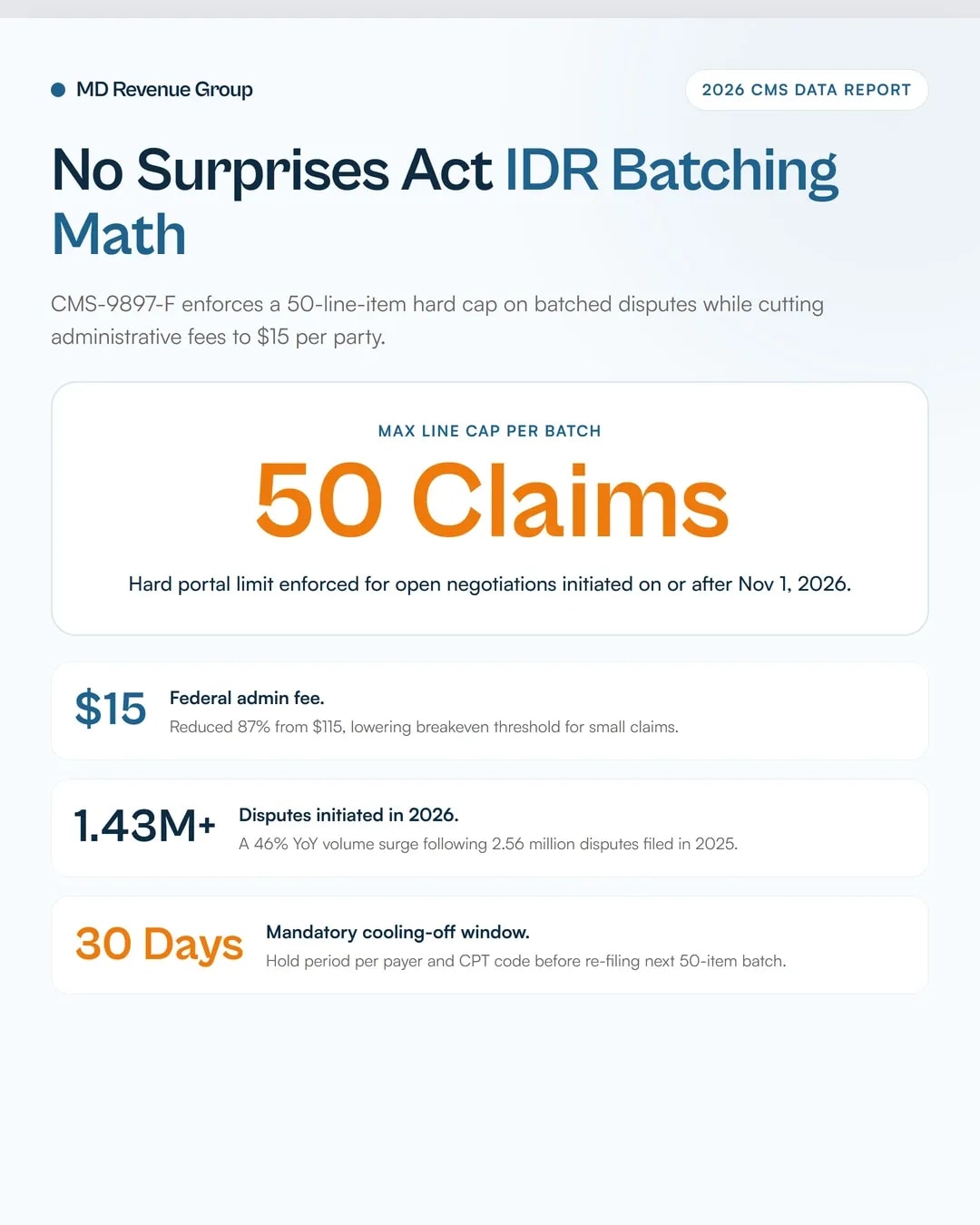
- 50-Line Hard Cap: CMS-9897-F limits batched IDR disputes to a maximum of 50 qualified line items per single filing for negotiations opened on or after November 1, 2026.
- $15 Federal Admin Fee: The federal administrative fee dropped from $115 to $15 per party per dispute on June 11, 2026, altering the breakeven threshold for small claims.
- 30-Day Cooling-Off Rule: Winning or losing a payment determination triggers a 30-business-day cooling-off window during which identical service codes cannot be re-entered into IDR against the same payer.
- 87% Cost Reduction: Batching 50 line items cuts non-refundable administrative fees from $750 (50 individual filings) to $15 total.
- Dispute Volume Growth: Over 1.43 million Federal IDR disputes were filed through May 31, 2026, representing a 46% year-over-year increase from 2025.
CMS-9897-F Batching Rules: The 50-Line-Item Cap
The Department of Health and Human Services (HHS), Department of Labor, and Department of the Treasury finalized CMS-9897-F to resolve massive backlogs in the Federal IDR portal. In 2025 alone, providers initiated 2.56 million disputes. Certified IDR entities struggled to review oversized submissions containing hundreds of disparate claim lines.
35 days in AR is the benchmark. Anything over 50 is uncollected revenue.
We conduct a forensic 90-day cash flow audit to identify unworked claims, fee schedule underpayments, and clearinghouse leaks.
Audit My Cash Flow Leaks →Under CMS-9897-F, certified IDR entities enforce a strict upper limit of 50 line items per batched dispute. Any submission exceeding 50 line items gets rejected automatically at portal intake.
The administrative fee adjustments released alongside the rule directly impact dispute strategy. On June 11, 2026, federal agencies reduced the administrative fee from $115 to $15 per party per dispute. Certified IDR entity fees remain set between $200 and $840 for single determinations, and between $268 and $1,173 for batched determinations.
For group practices seeking to improve cash flow through structured medical billing services, understanding these fee splits determines whether a claim balance justifies arbitration.
Financial Math: 50 Single Disputes vs. One Batched Filing
To evaluate the financial return of batching, billing managers must calculate total upfront cash outlay versus expected recovery. IDR entity fees are paid upfront by both parties, with the prevailing party receiving a full refund of their entity fee. The $15 administrative fee is non-refundable regardless of outcome.
Here is a worked proprietary calculation comparing 50 individual claim disputes against a single batched filing of 50 line items for emergency physician claims with an average disputed delta of $150 per line item.
Worked Calculation: Disputed Portfolio of 50 Emergency Claim Lines ($150 Delta Each)
- Total Disputed Value: 50 claims × 7,500 total disputed revenue.
- Assumption: Certified IDR Entity Fee = $400 for single, $600 for batched filing. Historical provider win rate = 70%.
Fee Component | Option A: 50 Individual IDR Filings | Option B: 1 Batched Filing (50 Lines) | Variance / Savings |
|---|---|---|---|
Federal Admin Fee (Non-refundable) | 50 × 750 | 1 × 15 | +$735 saved |
Upfront IDR Entity Fee | 50 × 20,000 | 1 × 600 | +$19,400 liquidity saved |
Total Upfront Cash Required | $20,750 | $615 | +$20,135 lower capital risk |
Entity Fee Refund (70% Win Rate) | $14,000 returned | $600 returned (100% refund on win) | Full entity fee recovered on win |
Net Unrecovered Administrative Cost | $6,750 ($750 admin + $6,000 lost entity fees) | $15 (Admin fee only) | +$6,735 net profit retained |
Net Financial Recovery | +$750 ($7,500 collected - $6,750 net cost) | $5,235 ($5,250 collected - $15 net cost) | +$4,485 higher net revenue |
Filing 50 separate claims requires $20,750 in upfront cash (nearly three times the total value of the disputed claims). Batching reduces the upfront requirement to $615 and preserves $4,485 in net practice revenue.
Practices managing multi-state billing operations, such as Texas healthcare providers, rely on this calculation to prevent administrative fees from eroding arbitration gains.
Qualifying Criteria for 50-Item IDR Batches
CMS-9897-F defines clear boundaries for which claim lines can sit within the same 50-item batch. Items that do not satisfy all four statutory criteria will be unbundled by the IDR entity, forcing separate administrative fees.
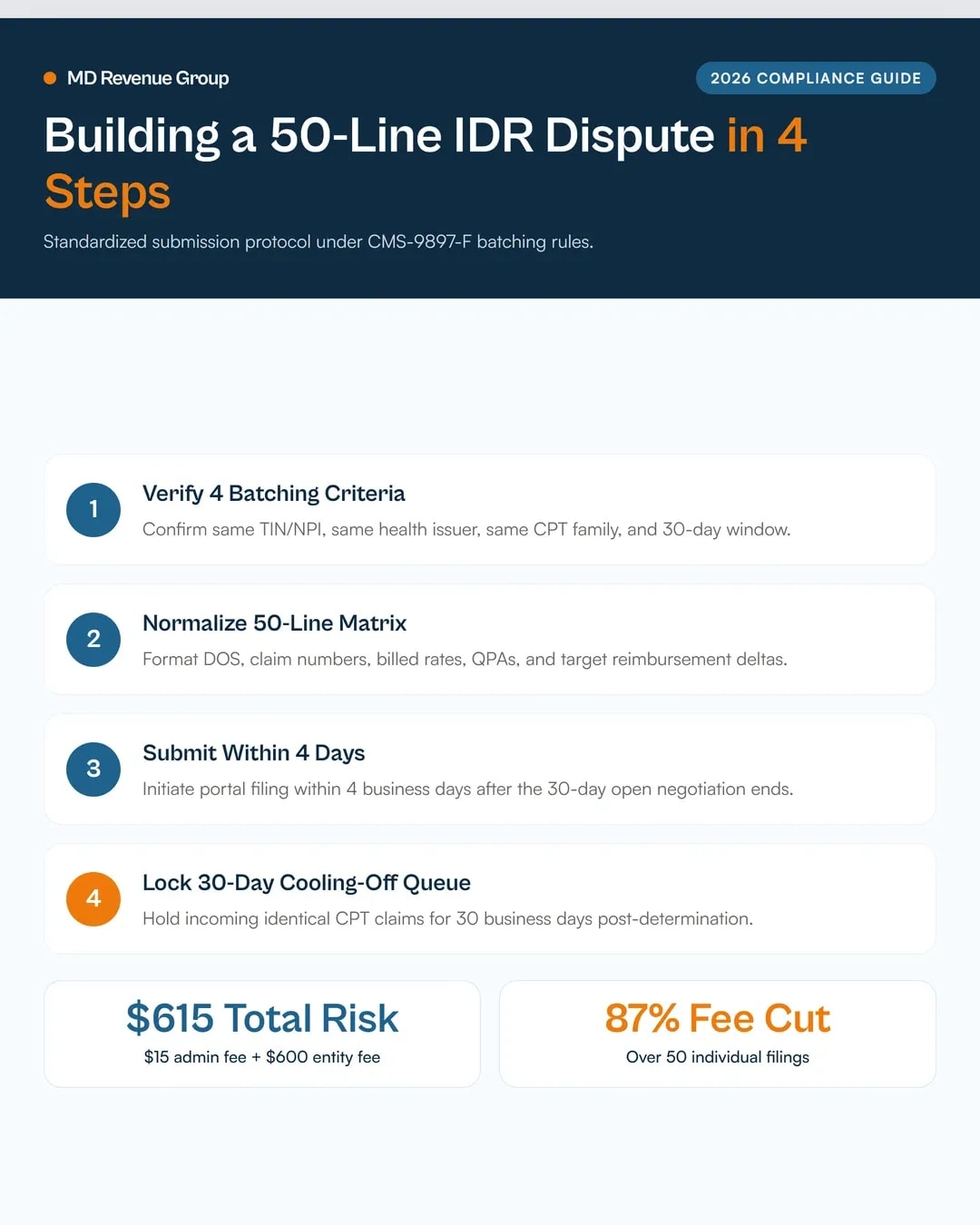
To qualify for a 50-line batch, claims must meet the following four conditions:
- Same Provider or Facility: All claim lines must be billed under the same National Provider Identifier (NPI) or Tax Identification Number (TIN).
- Same Health Plan or Issuer: All claims must involve the exact same insurance issuer or plan sponsor. Grouping claims from different sub-plans under a single parent payer is prohibited unless the claims share identical plan contract terms.
- Same or Comparable Service Code: Service codes must share the same first 3 digits of the CPT/HCPCS code or fall within specific clinical categories (e.g., anesthesiology codes within CPT 00100–01999, radiology within 70010–79999).
- 30-Business-Day Window: All items must have been furnished within the same 30-business-day period, or be part of open negotiations initiated within the same 30-business-day window.
The 30-Business-Day Cooling-Off Period Rule
A critical operational constraint introduced in the Federal IDR Operations Final Rule is the 30-business-day cooling-off period.
Once a certified IDR entity renders a payment determination on a batched dispute, the initiating party cannot submit a new IDR dispute involving the same payer for the same service code for 30 business days.
Operational Impact of the Cooling-Off Window
- Queue Holding: Claims for that specific service code and payer arriving during the 30-day window must be held in a staging queue.
- Open Negotiation Timing: Open negotiation notices for incoming claims must be timed so the 30-business-day open negotiation period ends after the cooling-off window expires.
- Batch Building: Staff must aggregate up to 50 accumulated claims during the queue hold, ready for instant submission on business day 31.
Failing to track this timeline results in immediate portal rejection. Many billing departments conduct a periodic medical billing audit to verify that dispute queues comply with federal cooling-off deadlines.
Step-by-Step 50-Line IDR Dispute Workflow
Building a compliant dispute pipeline requires standardized data collection and verification. The following six-step workflow handles claims from initial remittance to portal submission.
[Step 1: Remittance & QPA Intake]
               │
               ▼
[Step 2: 30-Day Open Negotiation Notice]
               │
               ▼
[Step 3: Line-Item Batching & 50-Cap Check]
               │
               ▼
[Step 4: IDR Portal Initiation (Days 1-4)]
               │
               ▼
[Step 5: Entity Selection & Offer Submission]
               │
               ▼
[Step 6: Payment Reconciliation & Queue Hold]
Step 1: Remittance & QPA Intake
Extract the initial payment or notice of denial from the 835 ERA. Identify the Qualifying Payment Amount (QPA) reported by the payer. Calculate the disputed delta (Billed Amount minus QPA). Flag claims where the delta exceeds $100.
Step 2: Open Negotiation Initiation
Send the formal Open Negotiation Notice to the payer within 30 business days of receiving the ERA. State the exact disputed service lines and requested payment amount. Log the start date in your RCM tracking software.
Step 3: Batch Assembly and Line Normalization
As open negotiations reach Day 20, aggregate claims by TIN, payer ID, and CPT code family. Format claim lines into a standardized 50-item dispute matrix.
Literal Documentation Example: IDR Batch Normalization Format
Batch ID: NSA-2026-0820-RAD01
Payer ID: 95382 (BCBS NJ) | Provider TIN: 22-XXXXXXX
CPT Code Family: 71260 (CT Chest w/ Contrast)
Line Count: 48 / 50 Max
Line 01: DOS 2026-06-12 | Claim # C88401 | Billed: $850 | QPA: $210 | Offered: $210 | Target: $520
Line 02: DOS 2026-06-14 | Claim # C88490 | Billed: $850 | QPA: $210 | Offered: $210 | Target: $520
...
Line 48: DOS 2026-07-02 | Claim # C89102 | Billed: $850 | QPA: $210 | Offered: $210 | Target: $520
Total Disputed Delta: $14,880 | Aggregate Upfront Fee Risk: $615 ($15 Admin + $600 Entity)
Step 4: Federal IDR Portal Initiation
If open negotiations close without settlement, initiate IDR on the federal portal within 4 business days. Upload the normalized 50-line matrix and proof of open negotiation delivery. Pay the $15 federal administrative fee.
Step 5: Entity Selection & Offer Submission
Select a mutually agreed certified IDR entity within 3 business days, or allow CMS auto-assignment. Within 10 business days of entity selection, submit your final offer and supporting evidence (QPA methodology flaws, provider training, patient acuity, local market cost data).
Step 6: Payment Reconciliation and Cooling-Off Queue
When the IDR entity issues a determination, verify payment receipt within 30 calendar days. Record the determination date and lock the cooling-off queue for that payer and service code for 30 business days.
Practices needing to standardize this pipeline often combine internal workflows with comprehensive revenue cycle management support to maintain clean submission queues.
Decision Matrix: When to Batch vs. File Single IDR Claims
Not every disputed claim belongs in a 50-line batch. Use this decision table to choose the correct filing model based on claim volume, unit value, and payer behavior.
Clinical & Financial Scenario | Recommended Filing Structure | Upfront Fee Outlay | Key Rationale |
|---|---|---|---|
High-volume routine diagnostics (e.g., 40+ CT/MRI lines, $150 delta each) | Batched IDR (up to 50 lines) | $15 Admin + $600 Entity = $615 | Dilutes fixed administrative fee across 40+ lines; lowers breakeven delta to $15/claim. |
High-dollar surgical procedure (e.g., 1 complex spinal line, $12,000 delta) | Single IDR Filing | $15 Admin + $400 Entity = $415 | High individual margin justifies individual entity review without waiting to accumulate 50 lines. |
Mixed CPT codes across different specialties (e.g., ED visit + Pathology + Ortho) | Split into 3 Separate Batches | 3 × ($15 + $600) = $1,845 | Prevents total portal rejection due to mixed service code families. |
Low-volume, low-delta claims (e.g., 3 therapy lines, $45 delta each, $135 total) | Internal Appeal / Write-off | $0 | Upfront IDR fee ($415+) exceeds maximum possible recovery ($135). IDR is economically non-viable. |
Frequently Asked Questions
What happens if an IDR batch contains 51 line items?
The Federal IDR portal rejects the submission automatically during initial intake validation. You must remove the extra claim line and resubmit a 50-item batch within your 4-business-day initiation window.
Can I batch claims from different insurance plans if they are managed by the same TPA?
Only if the underlying health plan issuer and contract terms are identical. If Third-Party Administrator (TPA) handles two distinct employer group plans with different plan numbers, CMS rules require separate IDR filings.
How does the $15 administrative fee change our practice's dispute strategy?
The lower fee makes smaller batched disputes financially viable. Under the former $115 fee, filing 50 individual claims cost $5,750 in non-refundable admin fees. At $15, a 50-line batch costs just $15 in admin fees, drastically lowering the risk threshold for medical billing and collection teams.
What should practices do if payers fail to pay winning IDR determinations within 30 days?
Submit an enforcement complaint to CMS through the Federal IDR portal with the determination document attached. CMS tracks non-compliant payers and levies civil monetary penalties up to $100 per day per violation.
For practices reviewing dispute workflows or looking to reduce claim denials, implementing a systematic IDR batching framework ensures compliance while recovering earned practice revenue.
See your revenue leaks in dollars.
Get a forensic 90-day cash flow audit of your practice. 100% confidential, 48-hour delivery, zero obligation.