
The Complete Guide to the Louisa Carman Medical Debt Relief Act for NJ Providers
What the Louisa Carman Medical Debt Relief Act changes for NJ practices: interest caps, credit reporting, wait periods, and how to stay compliant.
The Louisa Carman Medical Debt Relief Act, answered directly
If your practice bills patients in New Jersey, the Louisa Carman Medical Debt Relief Act already governs how you do it. Governor Murphy signed it on July 22, 2024, and it applies to unpaid balances for healthcare services rendered in New Jersey by licensed providers.
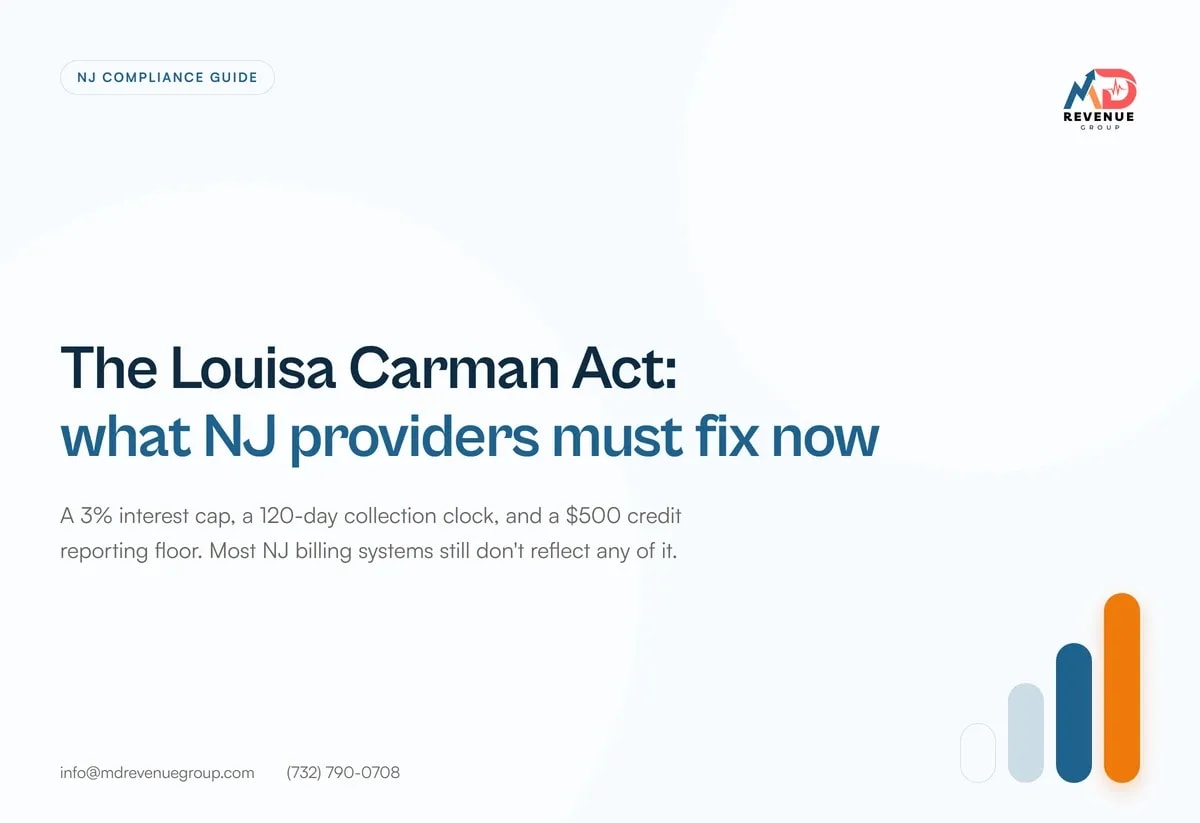
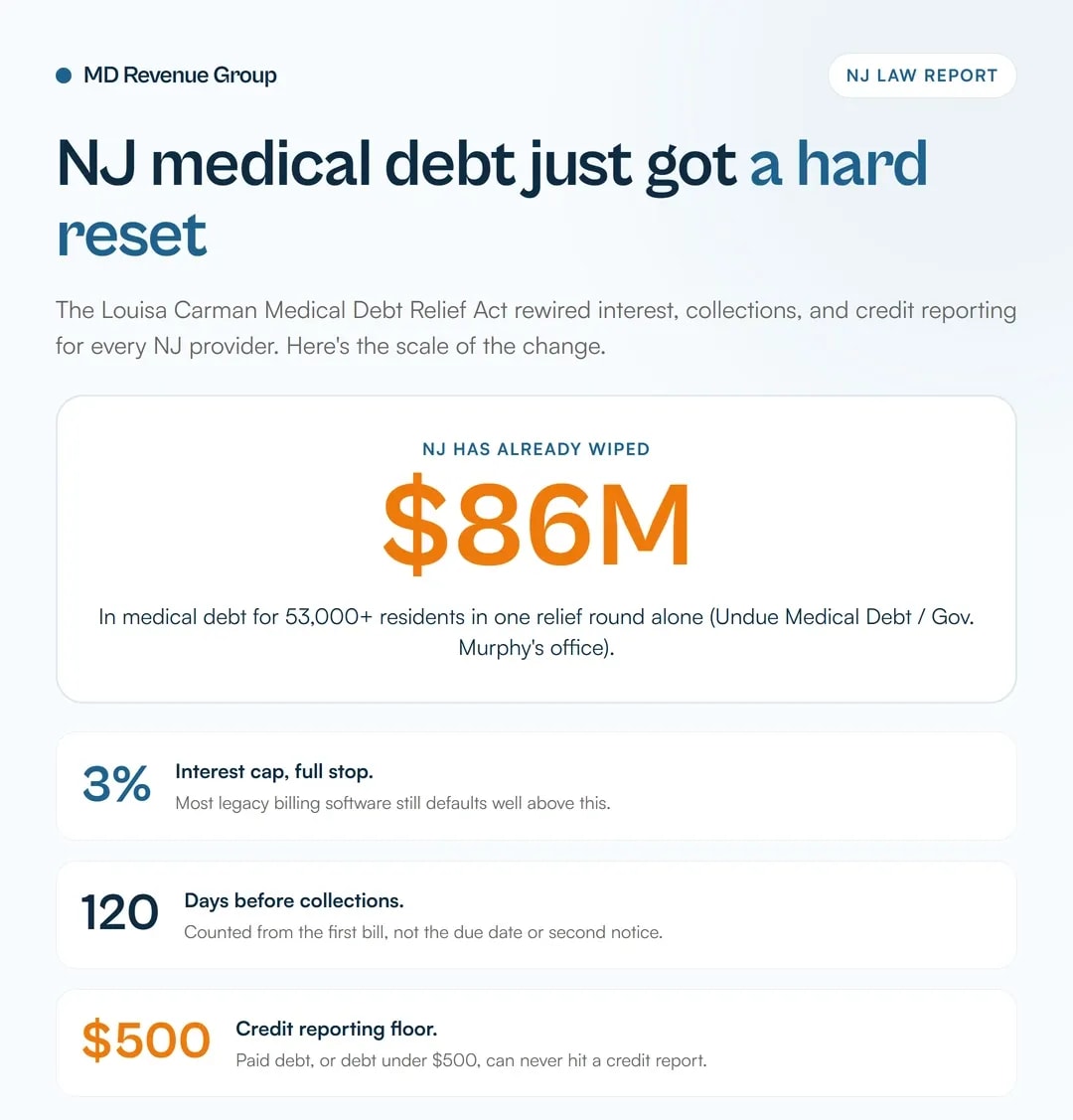
Three numbers matter most: 3%, 120, and $500. Interest on medical debt is capped at 3% per year. You have to wait 120 days after sending the first bill before starting collection action. And once paid, or under $500, that debt cannot show up on a patient's credit report at all (N.J. Governor's Office, July 2024; njleg.gov S2806).
Get any one of those three wrong in your billing workflow and you're not just annoying a patient. You're creating a violation the state Attorney General can enforce directly.
Key takeaways
- Interest on medical debt in New Jersey is capped at 3% per year, full stop, regardless of what your current billing software defaults to.
- You must wait 120 days from the first bill before sending an account to collections or reporting it anywhere.
- Paid medical debt and any medical debt under $500 cannot be reported to consumer reporting agencies. Ever.
- The Act applies to services rendered on or after July 22, 2024. Anything billed before that date follows the old rules.
- The Attorney General can void the debt entirely if you report it improperly, not just fine you.
Who this law applies to
Every licensed healthcare provider running medical billing services for New Jersey patients falls under this law. Solo practices, multi-specialty groups, ASCs, hospitals. It doesn't matter if you bill in-house or through a third party.
If you outsource collections, your vendor's mistakes are still your exposure. New Jersey Citizen Action tracked this closely in the year after passage and found practices still running old billing software defaults were the ones getting flagged, not the ones deliberately breaking the law.
That's the trap. Most non-compliance here isn't malicious. It's a billing system still set to a 30-day collections trigger and a 12% interest default from five years ago.
The law doesn't carve out exceptions for practice size. A solo family medicine office running a $40-a-month billing platform is held to the same 3% cap and 120-day clock as a multi-site orthopedic group running enterprise RCM software. Neither gets a grace period for "we didn't know the software was set wrong."
It also doesn't matter which payer relationship the balance came from. Whether the unpaid amount is a patient's coinsurance after Horizon BCBS processed the claim, a self-pay balance, or a deductible from AmeriHealth or UnitedHealthcare, the moment the balance sits with the patient, Louisa Carman applies to how you bill and collect it.
What actually changed in your billing workflow
Before July 2024, New Jersey followed the same patchwork most states use: providers set their own interest rates, collections timelines varied by policy, and medical debt hit credit reports the same way a defaulted credit card would.
The Louisa Carman Act rewired three specific mechanics.
Interest rate cap. Your billing system probably has an interest rate field that's been the same since before this law existed. If it's above 3% for any NJ patient balance, it's wrong now (S2806, njleg.gov).
Collection timing. You can't send an account to a collector, report it, or take legal action until 120 days have passed since the first bill went out. Not the due date. The first bill.
Credit reporting floor. Consumer reporting agencies can't include medical debt once it's paid, and they can't include any medical debt under $500 regardless of payment status. If your billing office still reports every unpaid balance to a bureau as a default workflow step, that workflow itself is now non-compliant.
There's a fourth piece worth knowing even though it's a separate but related reform: New Jersey also requires itemized, plain-language billing statements. No bare CPT codes standing in for a description. No "miscellaneous charges" line items. Every charge has to be described in language an ordinary patient can actually read, with dates, providers, and line-item pricing (NJ statute governing consolidated itemized statements, effective for statements issued after discharge or within 7 days of a written request).
Drug charges follow the same rule. List the brand or generic name of a medication, not just the drug code. Hospital-based physician charges have to appear on the statement too, not buried in a separate bill the patient never connects to the visit.
Payment plans aren't optional paperwork either. The Act requires medical creditors to offer a reasonable, income-based payment plan before pursuing collections at all. "Reasonable" isn't defined as a flat number. It has to reflect what the specific patient can actually afford, which means your intake or billing team needs a real income-based framework, not a single default plan offered to everyone regardless of circumstance.
The Louisa Carman Act quick reference
Requirement | Rule | Applies to |
|---|---|---|
Interest rate cap | 3% per year maximum | All medical debt for services on/after 7/22/2024 |
Collection wait period | 120 days from first bill | Before any collection action or reporting |
Credit reporting floor | No reporting under $500 or once paid | Consumer reporting agencies |
Payment plans | Must offer reasonable, income-based plans | Before pursuing collections |
Itemized statement | Plain-language, line-item detail | Within 7 days of written request or after discharge |
Screenshot this table. Your front desk and billing team need it more than they need the full bill text.
What your practice must do before your next billing cycle
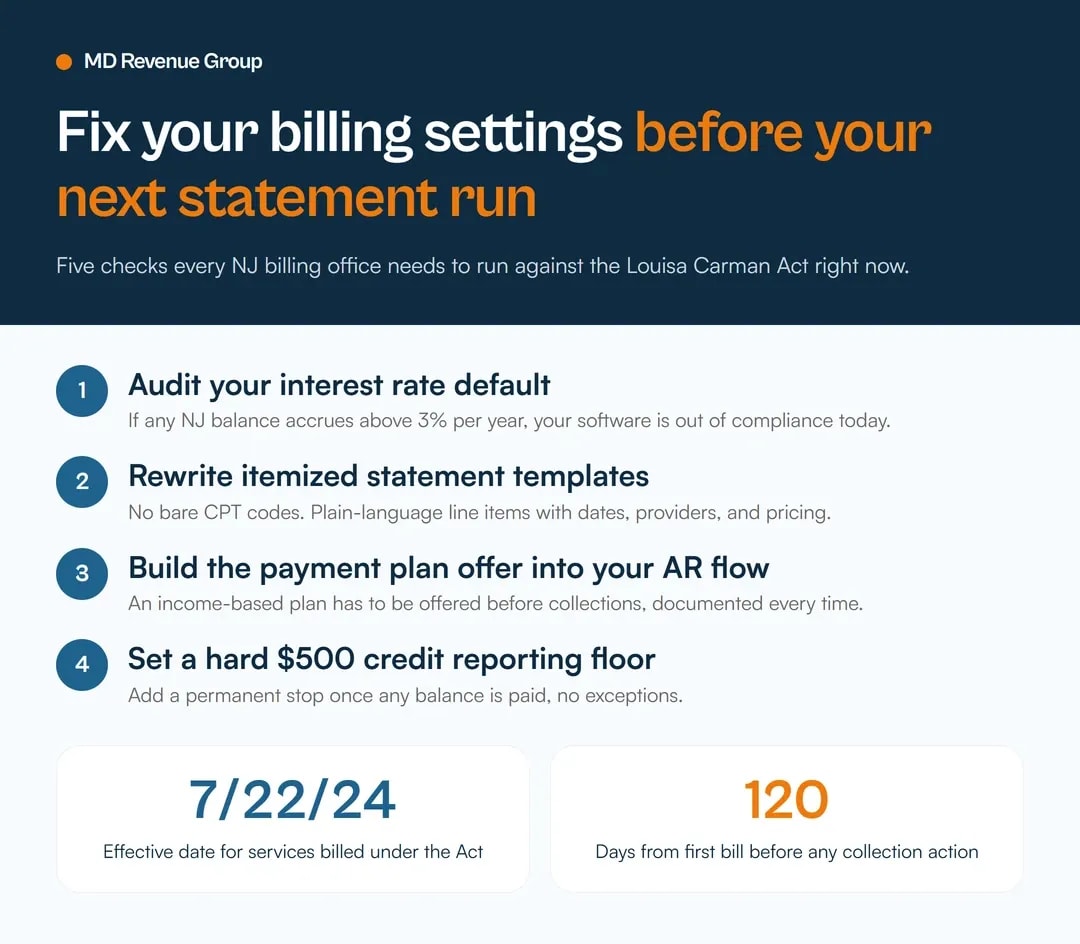
1. Audit your billing software's interest and timeline defaults. Pull up your practice management system's collection rules right now. If the interest field says anything above 3%, or the auto-escalation trigger is set below 120 days, fix it before your next statement run, not after. If you've never run a full billing audit against your own settings, this is the moment to do it.
2. Rewrite your itemized statement template. If a patient can't understand a line item without a coding manual, it fails the plain-language standard. Replace CPT-only descriptions with a plain description plus the code, not the code alone.
3. Build a payment plan offer into your workflow, not just your policy manual. The law requires you to offer a reasonable, income-based plan before collections. That has to happen at a specific point in your AR workflow, documented, every time. Not "available on request."
4. Stop reporting anything under $500, permanently. If your billing software auto-reports past-due balances to a bureau at a fixed dollar threshold, that threshold needs a hard floor at $500, and a hard stop once any balance is paid.
5. Train front desk and billing staff on the 120-day clock. The clock starts at the first bill, not the due date, not the second notice. Get this wrong once and you're technically in violation on every account it touches.
What happens if you don't comply
New Jersey doesn't just fine you here. The Act voids any portion of medical debt reported improperly to a credit bureau, meaning the debt itself becomes unenforceable (njleg.gov S2806, Section on enforcement).
The Attorney General can pursue restitution and order the return of any money collected through a violation. For a practice with a backlog of accounts still running on pre-2024 collection settings, that's not a hypothetical exposure. It's every account in that backlog.
New Jersey has already shown it will use this law at scale. The state's sixth round of medical debt relief eliminated more than $86 million in medical debt for over 53,000 New Jersey residents (Undue Medical Debt, press release with Governor Murphy's office). That's the state actively working to clear debt the law now regulates, which tells you enforcement attention here isn't going away.
That relief program and the Act aren't the same mechanism, but they share a message. New Jersey has made medical debt a political priority at the state level. A billing office that treats Louisa Carman as a minor administrative footnote is reading the room wrong.
There's a practical revenue angle here too, separate from the legal risk. Debt that gets voided because you reported it improperly isn't debt you can re-collect later by fixing the paperwork. It's gone. Every account run through a non-compliant workflow before you catch the problem is a receivable you've already lost, whether or not anyone ever files a complaint about it. A revenue integrity review catches these leaks before they turn into voided accounts.
How MDRG builds this into your RCM
We rebuilt collection timing and interest defaults into every NJ client's revenue cycle management workflow the same month this law took effect, not the month a patient complaint or an AG inquiry forced the issue.
That's the difference between reading about a compliance deadline and having someone already inside your billing system checking for it. We've corrected interest-rate defaults left over from old software migrations more than once. It's a five-minute fix if you catch it. It's a voided receivable if you don't.
If this feels like one more regulatory layer stacked on an already complicated billing operation, that's because it is. That's exactly why NJ practices bring us in specifically for this kind of compliance work, not just claims.
Need someone to audit your actual billing system settings instead of just the policy on paper? Talk to our team about a compliance review.