
Automatic Downcoding: The New Payer Algorithm 'Tax' on Level 4 & 5 E/M Visits
Payer algorithms are automatically downcoding your Level 4 and 5 E/M visits. Learn what triggers it, how to detect it, and how to appeal and recover lost revenue.
Automatic Downcoding: The New Payer Algorithm 'Tax' on Level 4 & 5 E/M Visits
Automatic downcoding by payer algorithm is hitting independent practices harder than most realize. When your billing team submits a 99214 or 99215, payer software runs that claim through a proprietary outlier model before a human ever sees it. If your pattern looks statistically high, the system cuts the code to 99213 and issues a remittance. No clinical review. No conversation. Just a smaller check.
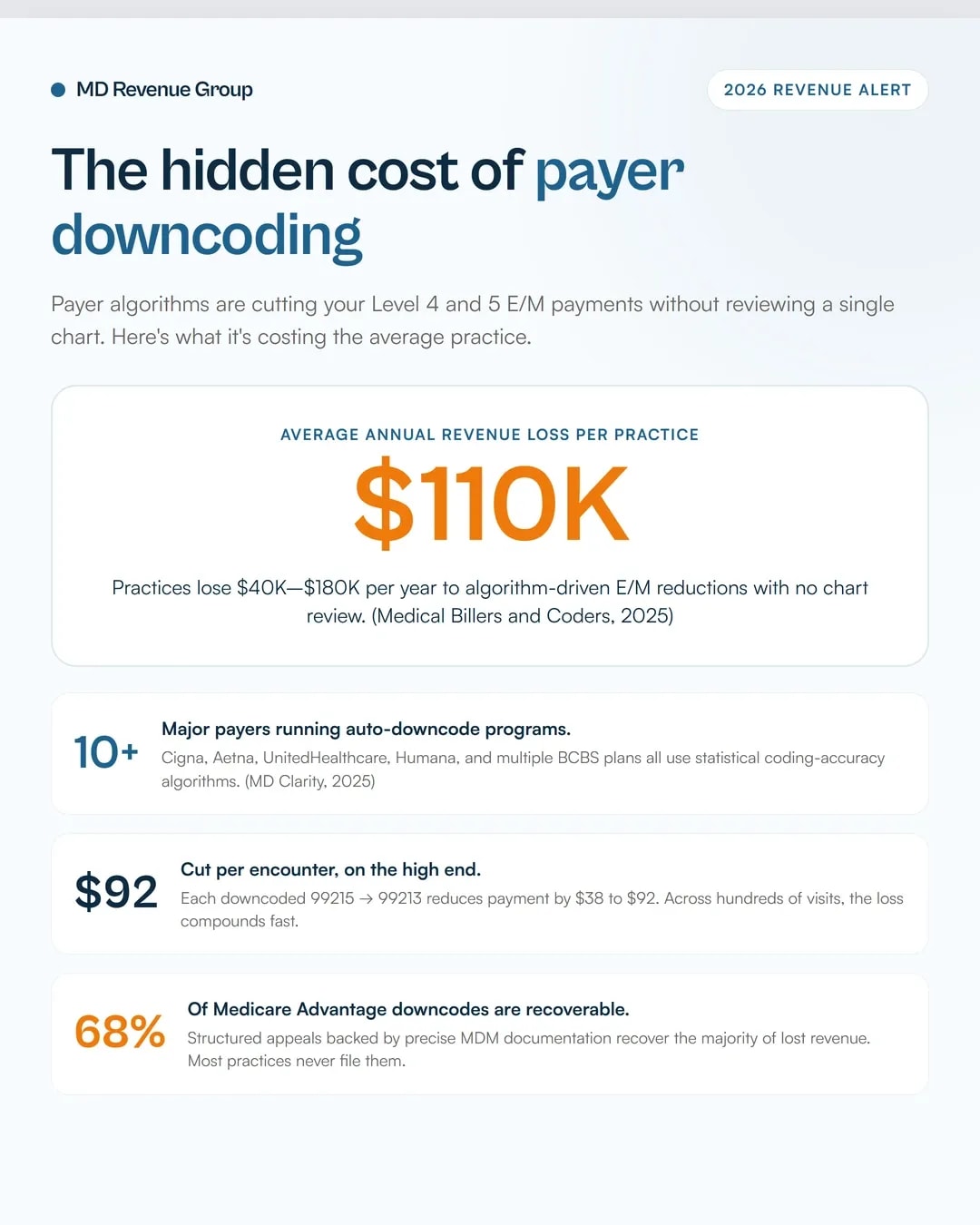
The average multi-specialty practice loses between $40,000 and $180,000 annually to these reductions, at roughly $38 to $92 per affected encounter (Medical Billers and Coders, 2025). Multiply that across a busy primary care or cardiology panel and you're looking at a real revenue problem, one that most practices don't fully detect until someone runs a comparative payment analysis.
Key takeaways
- More than 10 major payers (including Cigna, Aetna, UnitedHealthcare, and Humana) use automated coding-accuracy algorithms that downcode E/M claims without chart review.
- $38 to $92 per encounter is the typical payment cut when a Level 4 or 5 visit gets automatically reduced.
- 68% of downcoded Medicare Advantage claims are recoverable through structured appeals backed by precise documentation.
- CARC code 186 on your EOB is the clearest signal that an automatic coding-accuracy reduction was applied.
- The AMA and CMS both state E/M levels should be set by Medical Decision Making (MDM) or total time. Payer algorithm overrides have no standing under 2026 guidelines.
What automatic downcoding actually is
Payers call it a "coding accuracy" or "payment integrity" program. What it actually does is run your submitted E/M code against a statistical model built from your region's billing patterns. If you bill 99214 more often than the algorithm's expected percentage for a provider with your specialty and geography, it flags you as an outlier.
The system then reduces your code (automatically, without reading your chart) and issues payment at the lower level. The adjustment typically appears on the Explanation of Benefits under CARC code 186 ("Level of service reduced based on payment edit").
This is a fundamentally different problem from a standard claim denial. There's no missing authorization. No eligibility issue. The claim processes and pays, just at a lower rate. Many practices miss it entirely because the payment arrives and the shortfall gets absorbed.
Which payers are doing it and how their algorithms work
By 2026, more than 10 major national and regional insurers have deployed automated payment integrity programs targeting E/M coding (MD Clarity, 2025). The most documented programs include:
Cigna (R49 policy): Cigna's "Coding Accuracy" edits run claims through a proprietary statistical model. When a practice's 99214/99215 frequency exceeds regional norms, Cigna reduces the code and processes at 99213. The reduction appears on the EOB, but no prior notice is given.
UnitedHealthcare: UHC uses claims history to flag providers whose high-complexity coding rate deviates from specialty benchmarks. Practices billing a high proportion of Level 4 and 5 visits across large patient volumes are the primary targets.
Aetna and Humana: Both have similar outlier-detection models, generally triggered by patterns over a rolling 6-to-12 month period rather than individual claims. They look at the ratio of high-level codes relative to the payer's expected distribution for your specialty.
Blue Cross Blue Shield plans (regional): Individual BCBS plans vary by market. Many use third-party payment integrity vendors that apply their own algorithms, which makes detection harder because the CARC codes can differ from plan to plan.
What all these algorithms share: they make a statistical inference about coding accuracy without reviewing a single medical record. The AMA's position is clear: E/M code selection must be based on the documentation in the chart, not on how the payer's model expects you to code relative to your peers (AMA, 2026 E/M Guidelines).
Who gets hit hardest
The algorithm targets practices that consistently bill a high proportion of 99214s and 99215s. That description fits the highest-acuity specialties and the busiest primary care clinics.
Internal medicine and family medicine see the highest exposure. These practices manage complex chronic disease patients (diabetes, hypertension, COPD, multiple comorbidities) where a Level 4 or 5 visit is frequently the correct code. A family medicine billing practice that bills 70% Level 4 visits across a high-volume panel will consistently trigger outlier flags, even if every code is fully supported by MDM. Our internal medicine billing clients who face this problem most often are the ones treating the sickest populations: the practices doing the most medically appropriate work.
Cardiology is the other major target. Complex cardiac workups, post-procedure follow-ups, and patients with multiple cardiac diagnoses routinely justify 99214 and 99215. See cardiology medical billing for the specific payer rules this specialty deals with.
Multi-specialty groups face a compounding problem: payer algorithms often analyze codes at the provider NPI level. A hospitalist or internist within a multi-specialty group may still be flagged individually if their personal code distribution sits outside the algorithm's expected range.
How to detect it in your remittance data
Most practices running standard AR workflows will not catch automatic downcoding consistently. The payment arrives. The claim closes. The loss is permanent.
You need to run 3 specific checks:
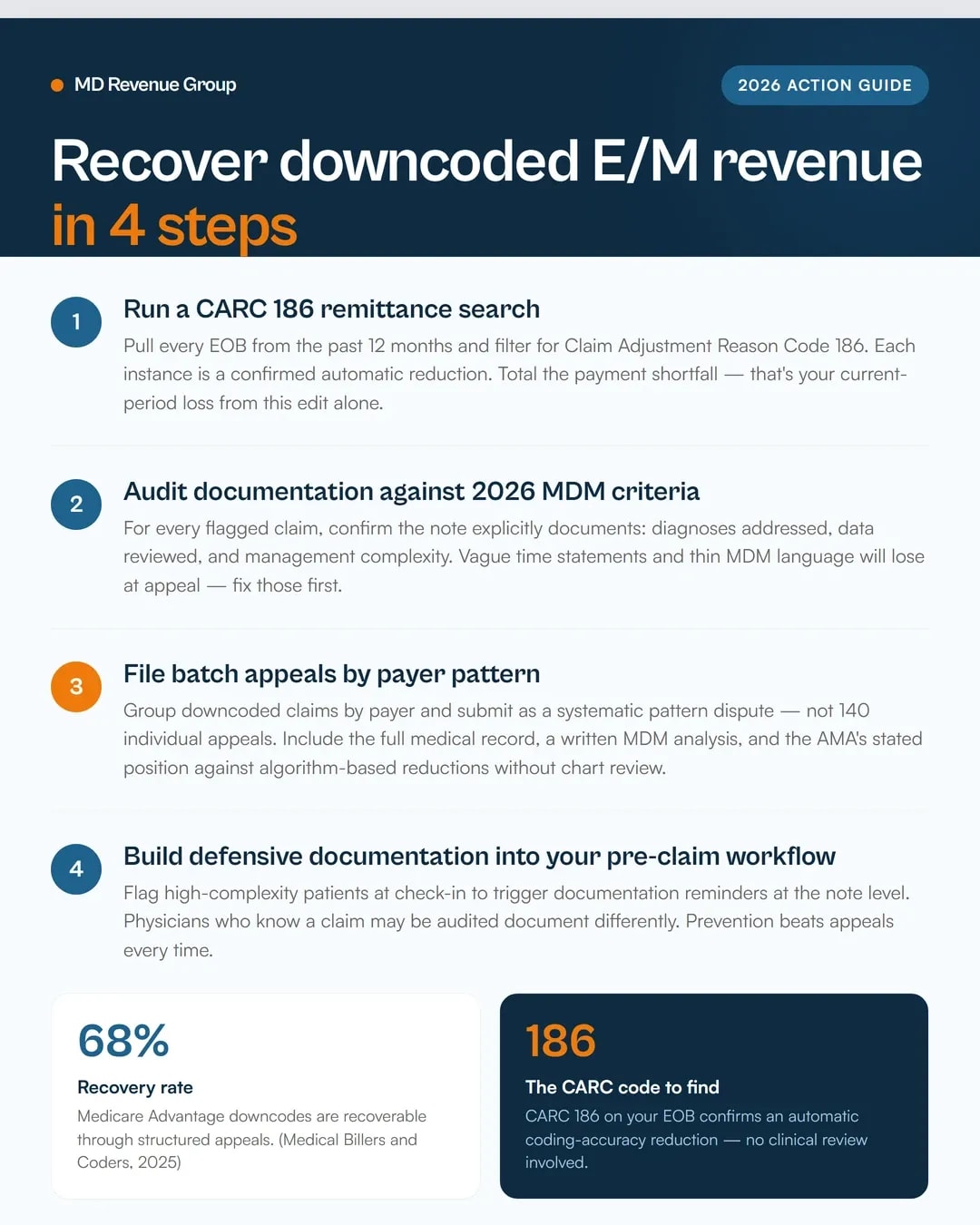
1. CARC 186 search. Pull every EOB from the past 12 months and filter for Claim Adjustment Reason Code 186. Each instance is a confirmed automatic reduction. Calculate the payment difference between what was submitted and what was paid. That number is your current-period loss from this specific edit.
2. Code-level payment variance by payer. Export your 99214 and 99215 claims by payer and calculate the average payment per code per payer. If one payer is paying 15% to 25% less than your other payers for identical codes, algorithm-driven reductions are the most likely cause.
3. Code distribution shift over time. Run your E/M code mix by quarter. If the proportion of 99214s and 99215s is declining even as your patient complexity stays constant, payer edits may be forcing a code-level shift in how your claims are processing.
A medical billing audit that includes remittance-level code analysis is the fastest way to quantify exactly how much is leaving your practice through this channel.
Building a documentation defense before the claim goes out
The most cost-effective strategy isn't appeals. It's making your documentation appeal-proof before submission.
Payer algorithms target statistical outliers. The way to defeat them is documentation so precise that an appeal is automatic and fast, and your audit exposure is zero.
Anchor every high-level visit to MDM. The 2026 E/M guidelines (CMS, AMA) define code level by Medical Decision Making or total time. Document MDM explicitly: list the number of diagnoses, the data reviewed, and the complexity of management. A note that says "patient has multiple chronic conditions, medication adjusted" does not support 99215. A note that details 3 comorbidities, 2 outside records reviewed, and a prescription change with documented risk assessment does.
When billing by time, be specific. Vague time documentation ("spent over 30 minutes") is consistently flagged by payer audit tools. Document the start and end time, or state the total time explicitly: "Total time spent on date of service, including face-to-face and non-face-to-face work: 45 minutes."
Flag complex encounters at check-in. Build a workflow where your front desk flags patients with 4 or more chronic diagnoses or high-acuity presentations before the physician sees them. This triggers a documentation reminder at the note level. Physicians who know a claim may be audited document differently than those who don't.
Your revenue cycle management workflow should include a pre-claim documentation quality check for high-level E/M encounters, not just a coding review.
How to appeal a downcoded claim and what to include
68% of downcoded Medicare Advantage claims are recoverable through structured appeals (Medical Billers and Coders, 2025). The recovery rate for commercial payer appeals is lower, but for a well-documented 99215 that was cut to 99213, you should expect a meaningful win rate.
A strong downcoding appeal includes 4 elements:
1. The specific remittance code and payer's stated reason. Reference CARC 186 or the payer's specific adjustment reason by name. Establish that this is a coding-accuracy edit, not a clinical necessity denial. The appeal process and documentation requirements differ.
2. The complete medical record for the encounter. Don't summarize the visit. Submit the full note. Let the record speak to MDM complexity directly.
3. A written MDM analysis. Prepare a brief (one-page) written analysis explaining, with reference to the 2026 AMA/CMS guidelines, why the documented MDM supports the submitted code level. Reference the number of diagnoses addressed, data reviewed, and complexity of management. Be specific about which column of the MDM table the visit falls under.
4. The AMA's position on algorithm-driven reductions. Include a reference to the AMA's documented opposition to unilateral algorithm-based downcoding without chart review. Some payers respond to appeals more quickly when the appeal is framed as a guideline compliance issue, not just a payment dispute.
File appeals within the contractual window, typically 90 to 180 days from the date of service. Check your payer contracts. Some BCBS plans have shorter windows.
For practical guidance on the full appeal workflow, the how to reduce claim denials post walks through the process in detail. And if you want to know where your practice stands on denial rates overall, the clean claim rate benchmark gives you the industry numbers to compare against.
When to escalate beyond a standard appeal
Some payer programs are designed to make appeals economically unattractive. The per-claim recovery is $38 to $92. The cost to prepare and file a thorough appeal can exceed that for a single claim, especially if the appeal requires physician time to write an MDM analysis.
The math changes when you escalate the strategy:
Batch appeals by payer and code. If Cigna has downcoded 140 of your 99215 claims in the past 6 months, don't file 140 individual appeals. File a batch appeal citing a systematic pattern of coding-accuracy reductions across multiple dates of service. Some payer contracts require the payer to respond to systemic pattern disputes differently than individual claim disputes.
Escalate to your payer contract team. If a payer is systematically downcoding a specialty-specific code across your practice, that may constitute a contract violation, depending on how your fee schedule agreement handles coding accuracy policies. Engage your contract representative and request a meeting. Document everything.
Consider state regulatory channels. Several states have successfully challenged or constrained automatic downcoding programs through insurance department complaints or legislation (AAOS, 2025). If your state insurance commissioner has issued guidance on algorithm-based reductions, reference it in your dispute.
What MDRG does differently
Most billing companies catch a denial and file an appeal. What they don't do is run a systematic remittance-level analysis to detect automatic reductions that aren't coded as denials.
At MD Revenue Group, our audit workflow specifically includes CARC-level remittance analysis for E/M code reductions. We identify the payer pattern, quantify the revenue impact, and build a batched appeal strategy that recovers at scale, not claim by claim.
If you're billing a high proportion of Level 4 and 5 visits and you haven't run a CARC 186 analysis in the last 12 months, you're almost certainly losing money you don't know about.
Schedule a free revenue audit and we'll show you exactly which payers are cutting your E/M codes and what the recovery looks like.