
Digital Mental Health Bundles: The New 2026 Revenue Stream for Multi-Specialty Groups
Master CMS 2026 digital mental health billing. Learn HCPCS G0552-G0554, CoCM code changes, and revenue strategies for multi-specialty practices.
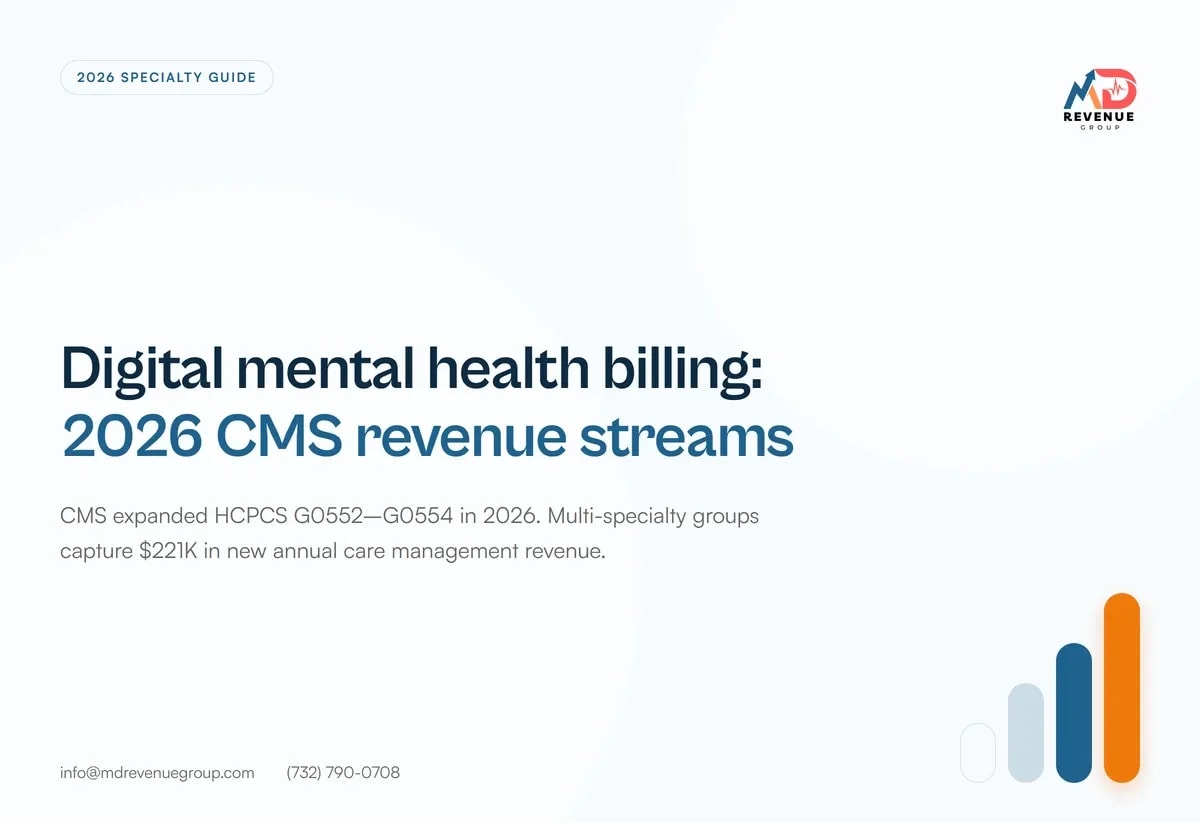
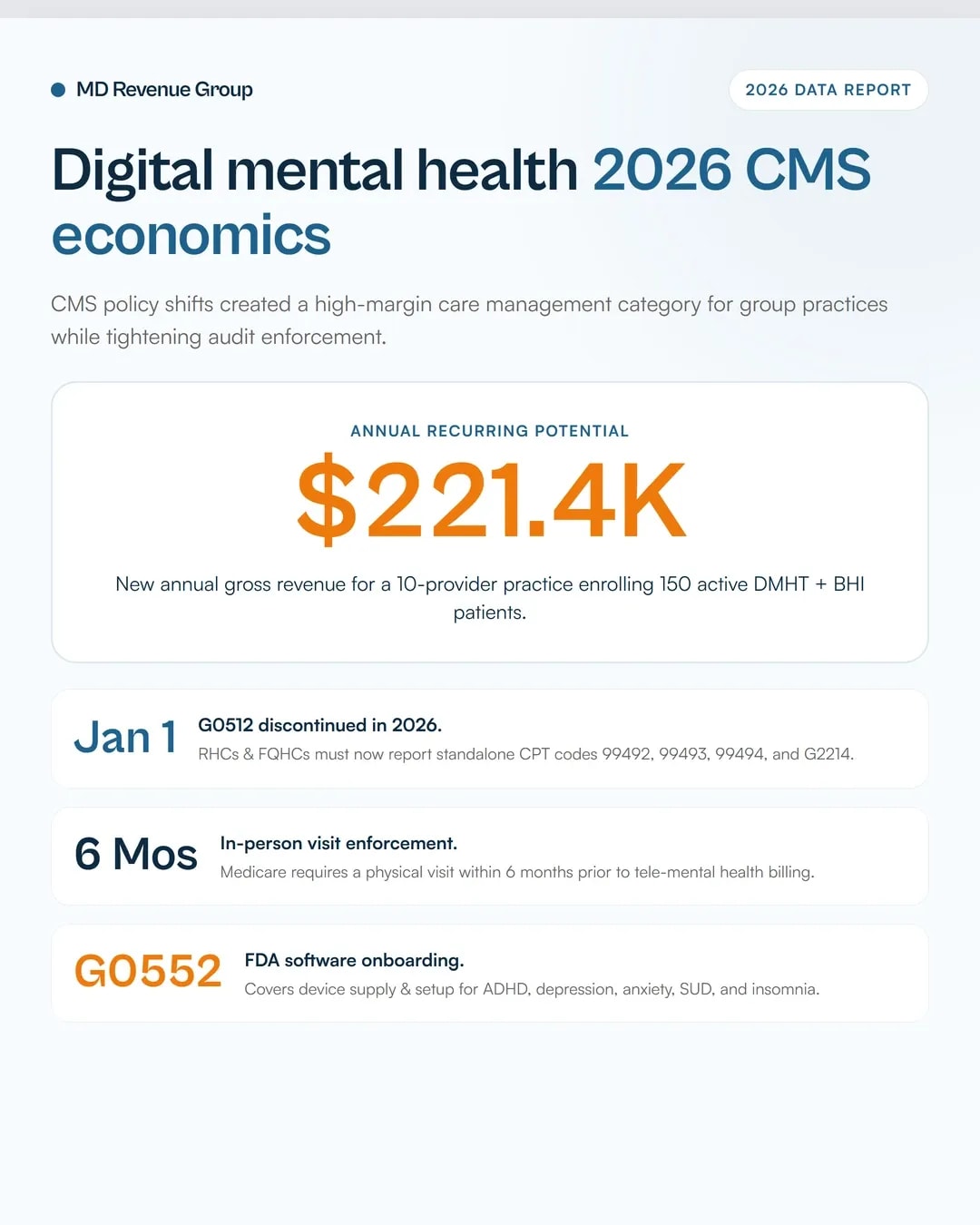
CMS expanded Medicare coverage in 2026 for Digital Mental Health Treatment (DMHT) and Collaborative Care Model (CoCM) billing, opening a direct revenue stream for multi-specialty practices. Under the 2026 Physician Fee Schedule, practices billing HCPCS codes G0552, G0553, and G0554 for FDA-cleared digital therapeutics can capture 2,200 in annual recurring revenue per patient. Concurrently, CMS retired HCPCS code G0512 for Rural Health Clinics and FQHCs on January 1, 2026, requiring all practices to report standalone CoCM CPT codes 99492, 99493, 99494, and G2214.
Multi-specialty practices integrating digital behavioral health into primary care workflows face strict compliance rules. Medicare enforces mandatory in-person visit requirements for tele-mental health, requiring a physical visit within 6 months prior to initial remote therapy and every 12 months thereafter. Group practices that pair FDA-cleared devices with general Behavioral Health Integration (BHI) code 99484 create clean care management bundles while staying fully compliant with Medicare Administrative Contractor (MAC) audit standards.
Key Takeaways
- HCPCS G0552–G0554 allow practices to bill for FDA-cleared digital mental health devices, covering initial setup plus monthly 20-minute patient management blocks.
- 2026 Scope Expansion: CMS expanded DMHT code coverage to include FDA-cleared ADHD digital therapy devices under 21 CFR § 882.5803 alongside depression, anxiety, SUD, and insomnia tools.
- G0512 Discontinued: RHCs and FQHCs must now report individual CPT codes 99492, 99493, 99494, and G2214 instead of bundled code G0512.
- In-Person Requirement: Tele-mental health claims require a documented in-person encounter within 6 months before initiating remote care, plus annual follow-ups.
- Audit Mandate: MACs require time-stamped activity logs, baseline PHQ-9 or GAD-7 scores, and documented psychiatric consultant oversight.
The 2026 CMS Digital Mental Health Coding Framework
CMS fundamentally restructured behavioral health reimbursement in the 2026 Physician Fee Schedule. Medical groups can now bill for digital prescription therapeutics furnished incident-to a physician's professional services.
Practices combining primary care, neurology, cardiology, and psychiatry can establish unified care management workflows. By deploying digital interventions for chronic illness distress, medical groups capture billable monthly care management time without adding physical clinical space.
Understanding the distinction between digital therapeutics, general behavioral health integration, and formal collaborative care models dictates your billing strategy. Practices seeking to optimize reimbursement should review their overarching revenue cycle management services to ensure front-end intake and clinical documentation systems capture every billable minute.
Service Category | Primary Codes | Time Requirement | Required Supervision | Average Medicare Reimbursement |
|---|---|---|---|---|
Digital Mental Health Treatment (DMHT) Setup | HCPCS G0552 | Initial Setup / Onboarding | Incident-to (General Supervision) | $120.00 (One-time) |
DMHT Monthly Treatment Management | HCPCS G0553 | First 20 mins / month | General Supervision | $65.00 / month |
DMHT Extended Treatment Management | HCPCS G0554 | Add-on 20 mins / month | General Supervision | $42.00 / month |
General Behavioral Health Integration (BHI) | CPT 99484 | 20 mins / month | General Supervision | $48.00 / month |
Psychiatric Collaborative Care (CoCM Initial) | CPT 99492 | 70 mins (First Month) | Direct / General Oversight | $162.00 / month |
Psychiatric Collaborative Care (CoCM Subsequent) | CPT 99493 | 60 mins (Subsequent) | Direct / General Oversight | $128.00 / month |
CoCM Short-Duration Services | HCPCS G2214 | 30 mins / month | General Supervision | $68.00 / month |
Medical practices must distinguish between physician-administered digital tools and direct-to-consumer mobile applications. CMS reimbursement explicitly excludes wellness apps, self-guided meditation software, or general mental health trackers that lack formal FDA Medical Device clearance or De Novo authorization.
HCPCS G0552, G0553, and G0554: Billing Digital Therapeutics
CMS established HCPCS Level II G-codes specifically for FDA-cleared digital mental health treatment software. These codes cover patient onboarding, software device supply, and ongoing clinical data review.
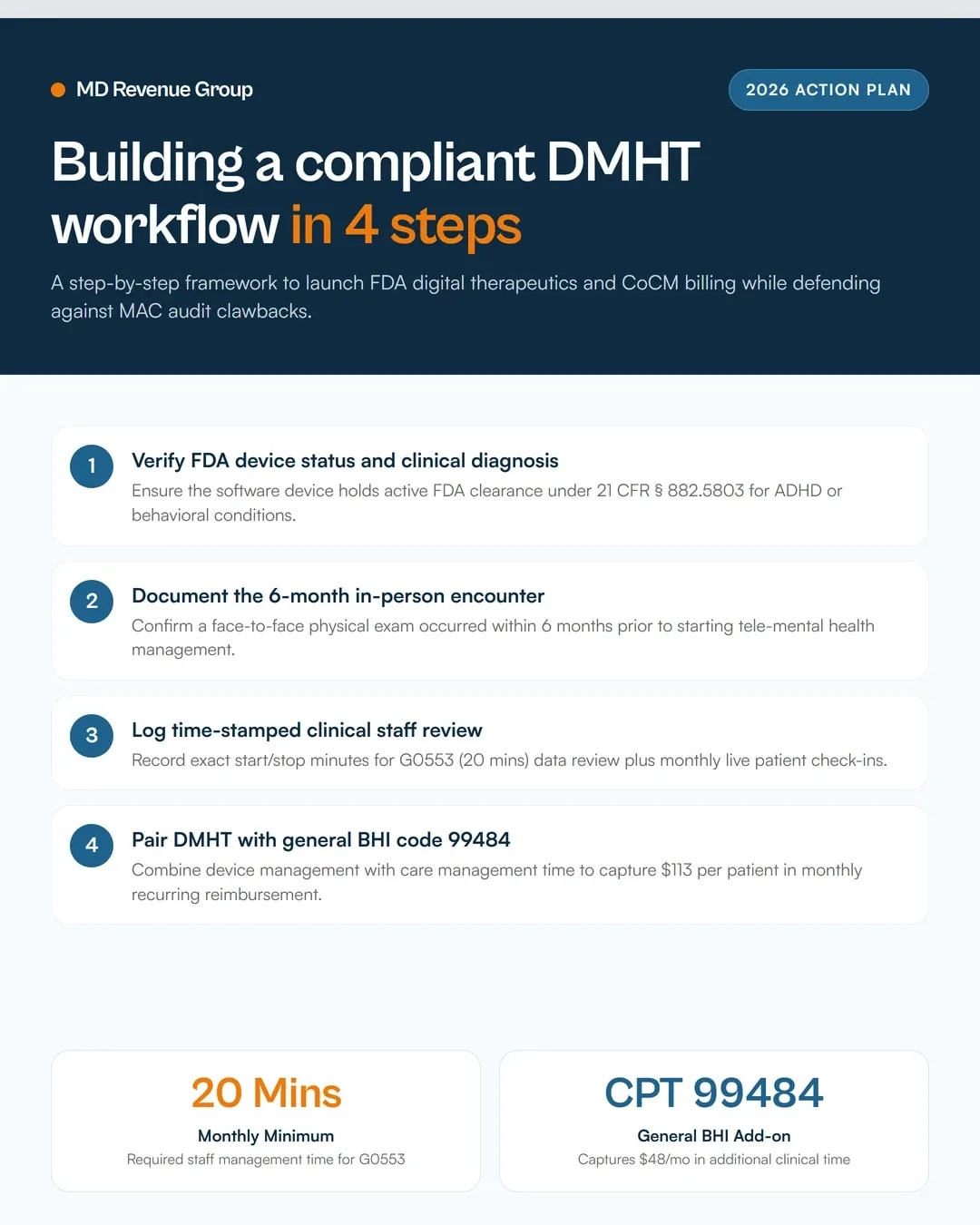
Practices bill G0552 once per course of treatment for initial software supply and patient onboarding education. The billing practitioner or clinical staff must incur the device acquisition cost; patients cannot purchase the software independently off-the-shelf and request practice billing.
Monthly treatment management relies on G0553 for the first 20 minutes of clinical staff time and G0554 for each additional 20 minutes. Management time requires reviewing software usage metrics and completing at least one live interactive communication with the patient or caregiver per calendar month.
G0552: Device supply & onboarding (1-time per course of treatment)
↓
G0553: First 20 mins/month of data review & patient contact
↓
G0554: Add-on 20 mins/month of extended management
CMS expanded these codes in 2026 to cover FDA-cleared digital therapeutics for Pediatric and Adult ADHD under 21 CFR § 882.5803. This builds on previous coverage for major depressive disorder, generalized anxiety disorder, opioid use disorder, and chronic insomnia.
Practices using these codes must maintain clean claim submission protocols. Medical groups facing claim rejections on new code sets often benefit from a targeted medical billing audit to identify missing modifiers or diagnostic pairing errors before submitting high-volume claims.
Clinical staff must track exact data review intervals. If a medical assistant spends 14 minutes reviewing software compliance dashboards and 8 minutes on a secure video check-in with the patient, the cumulative 22 minutes fulfills the 20-minute threshold required to bill G0553 for that calendar month.
RHC and FQHC CoCM Changes: Replacing G0512 in 2026
Effective January 1, 2026, CMS retired HCPCS code G0512 for Rural Health Clinics (RHCs) and Federally Qualified Health Centers (FQHCs). Previously, G0512 served as a single bundled code for psychiatric collaborative care in safety-net clinics.
RHCs and FQHCs now bill the exact CPT code set used by physician private practices:
- CPT 99492: Initial psychiatric collaborative care management, first 70 minutes in the first calendar month.
- CPT 99493: Subsequent collaborative care management, first 60 minutes in a subsequent month.
- CPT 99494: Add-on collaborative care management, each additional 30 minutes per month.
- HCPCS G2214: Short-duration collaborative care management, 30 minutes per month.
This transition brings payment parity to safety-net organizations but requires updated EHR order templates. Billing teams must unbundle historic G0512 encounter setups and train clinical staff on minute tracking.
To review foundational billing structures for integrated care management, consult our comprehensive behavioral health integration billing guidelines for step-by-step coding rules.
Safety-net clinics transitioning from G0512 must also update their fee schedules within their EHR practice management modules. Billing CPT 99492 alongside G2214 allows FQHCs to capture variable patient engagement levels while preventing administrative claim rejections.
Financial Model: 10-Provider Multi-Specialty Group Revenue Projections
Integrating digital behavioral health creates recurring practice revenue while reducing emergency department readmissions for complex patients.
Consider a 10-provider multi-specialty group (incorporating internal medicine, neurology, and cardiology) that enrolls 150 active patients per month into a combined DMHT and BHI care management protocol.
Monthly DMHT Onboarding (G0552): 150 patients × 18,000 one-time
Monthly DMHT Management (G0553): 150 patients × 9,750/month ($117,000/year)
Monthly BHI Coordination (99484): 150 patients × 7,200/month ($86,400/year)
-----------------------------------------------------------------------------------------------------
Total First-Year Gross Revenue Impact: $221,400
Billing Code | Description | Monthly Volume | Avg Medicare Reimbursement | Annual Gross Revenue |
|---|---|---|---|---|
HCPCS G0552 | DMHT Device Supply & Onboarding | 150 (One-time) | $120.00 | $18,000 |
HCPCS G0553 | DMHT 20-Min Monthly Management | 150 / month | $65.00 | $117,000 |
CPT 99484 | General BHI 20-Min Monthly Service | 150 / month | $48.00 | $86,400 |
Combined Total | Integrated Digital Care Bundle | 150 Active Patients | $113.00 / patient / month | $221,400 |
This revenue stream requires zero additional exam rooms. Clinical staff track software adherence dashboard metrics during non-peak clinical hours, transforming passive patient downtime into active revenue capture.
Practices expanding this care model across secondary specialties such as endocrinology or gastroenterology can scale recurring care management revenue even further. Patients managing chronic illnesses frequently present with co-occurring depressive or anxiety symptoms, making them ideal candidates for structured digital therapeutics.
Tele-Mental Health Compliance: The 6-Month In-Person Rule
Medicare enforced strict in-person visit requirements for tele-mental health services starting January 31, 2026. The Consolidated Appropriations Act previously delayed this mandate, but CMS rules now require physical encounters.
To bill Medicare for tele-mental health or remote psychiatric consultations, practices must document:
- An initial in-person, face-to-face examination by the billing practitioner within 6 months prior to the first tele-mental health encounter.
- A subsequent in-person, face-to-face visit at least once every 12 months for the duration of remote mental health treatment.
In-Person Baseline Visit (Month 0)
↓
Tele-Mental Health Sessions (Months 1–6)
↓
Mandatory In-Person Annual Review (Month 12)
Exceptions exist for rare clinical circumstances, such as patient mobility constraints or severe geographic isolation, but these require explicit documentation in the patient chart. Failure to document required in-person visits results in automatic claim denials that MAC auditors will not overturn.
Practices navigating compliance enforcement should examine the 2026 OIG compliance enforcement signals to understand how federal regulators monitor tele-health claim patterns.
Billing managers must ensure EHR scheduling systems flag tele-mental health patients who approach their 11th consecutive month of remote care. Automatically generating an alert for an in-person follow-up protects ongoing monthly billing continuity.
Documentation Standards and MAC Audit Defense
Payer audits for digital care management codes focus on proof of time, clinical necessity, and outcome tracking. MAC auditors scrutinize G0553 and 99484 claims for templated notes.
To defend claims during post-payment audits, your medical records must contain four specific elements:
- Validated Baseline Assessment: Documented PHQ-9, GAD-7, or Vanderbilt assessment scores prior to initiating digital treatment.
- Time-Stamped Care Logs: Precise start and stop times for data review, phone check-ins, and portal communications. Vague entries like "reviewed patient data" trigger immediate line-item clawbacks.
- Named Psychiatric Consultant: For CoCM codes (99492–99494), chart notes must explicitly list the credentialed psychiatric consultant participating in weekly registry reviews.
- Device Software Verification: Confirmation that the digital mental health device holds current FDA clearance or De Novo authorization for the targeted diagnosis.
Patient Chart Verification
├── Validated Scale (PHQ-9 / GAD-7 score)
├── Exact Minute Log (Start/Stop timestamps)
├── FDA Clearance Code (21 CFR reference)
└── Named Consultant Sign-off (CoCM cases)
Audit defense requires tight coordination across your front desk, clinical team, and billing staff. Outsourcing complex claims processing to specialized medical billing services ensures your claims carry the exact modifier combinations required by commercial and Medicare payers.
In addition, clinical coordinators must document patient response to the digital therapeutic at least quarterly. If a patient shows zero engagement with the software over a 30-day window, continuing to bill G0553 without documented intervention raises immediate red flags during RAC audits.
State-Specific Billing Nuances for Regional Group Practices
Commercial payers follow CMS guidance at varying speeds. While Medicare covers G0552–G0554 nationally, regional commercial health plans enforce local coverage determinations (LCDs).
Group practices operating across multiple states must account for regional payer variations:
- New Jersey: Horizon Blue Cross Blue Shield requires prior authorization for FDA-cleared digital therapeutics billed under G0552. Practices operating in the state should partner with specialized New Jersey medical billing specialists to navigate regional payer rules.
- New York: Empire BCBS and Fidelis Care require specific CPT modifier 95 for remote treatment management communications linked to G0553. Practices in the state can review New York medical billing rules for local commercial guidelines.
- Pennsylvania: Independence Blue Cross requires annual re-authorization for digital mental health bundles after 6 consecutive months of treatment. Regional practices can check Pennsylvania medical billing services to manage local commercial payer submissions.
Practices expanding across state lines can view our directory of state-by-state medical billing solutions to align local billing workflows with regional payer mandates.
Implementation Action Plan for Medical Practice Administrators
Rolling out a digital mental health billing initiative requires a structured 30-day onboarding timeline to align clinical workflows with billing rules.
Days 1–10: Software Vendor Verification & EHR Template Setup
↓
Days 11–20: Staff Clinical Training & Minute-Tracking Protocols
↓
Days 21–30: Pilot Patient Enrollment & Payer Clearinghouse Tests
- Software Verification: Confirm that your chosen digital mental health software partner provides 21 CFR device clearance documents and exports automated, audit-ready patient engagement time logs directly to your EHR.
- EHR Template Configuration: Build custom clinical encounter templates in your practice management software for G0552, G0553, G0554, and 99484. Ensure fields capture exact start/stop minutes and PHQ-9 progress scores.
- Payer Clearinghouse Testing: Run a test batch of G0552 and G0553 claims through your clearinghouse to verify payer ID mapping and clearinghouse scrubbing rules before scaling enrollment.
Maximize Your Digital Health Reimbursement
Digital mental health billing transforms patient care management into a predictable revenue stream for multi-specialty practices. MD Revenue Group audits your clinical documentation, updates EHR templates for 2026 CMS codes, and recovers every dollar your practice earns.