
The 'Zero-Touch' Prior Auth Myth: Why Automation Is Failing and How to Fix Your Workflow
Prior authorization automation failure costs practices 14 hours per week. Learn why 'zero-touch' PA tools fall short and how to build a workflow that works.
The 'Zero-Touch' Prior Auth Myth: Why Automation Is Failing and How to Fix Your Workflow
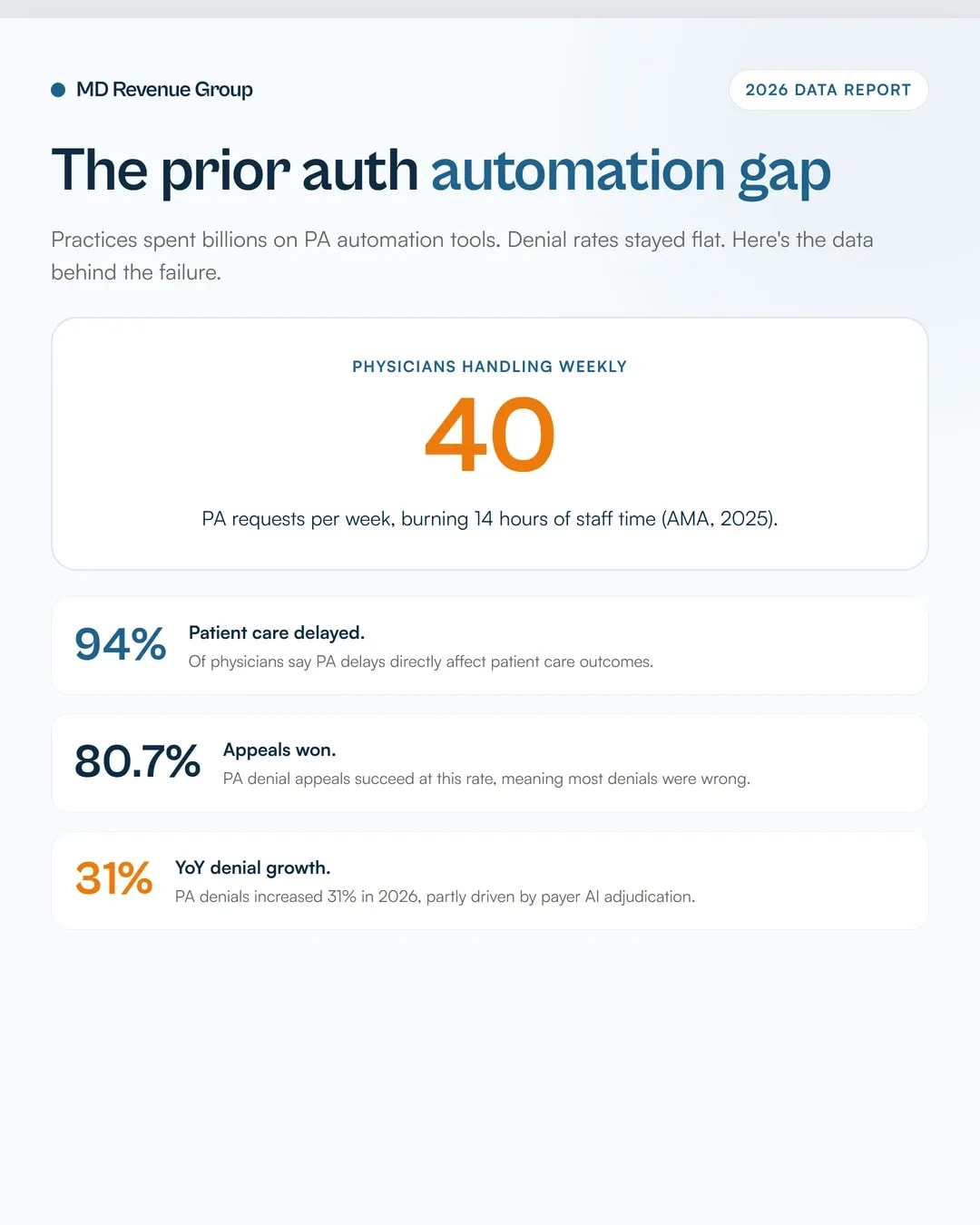
Prior authorization automation failure is costing your practice more than you think. The AMA's 2025 survey found that physicians still handle 40 prior auth requests per week, burning 14 hours of staff time, even at practices that bought automation software. The tools promised zero-touch submissions. What most practices got instead: faster form-filling on top of the same broken process. If your PA denial rate hasn't dropped since you implemented automation, the tool isn't the only problem. Your workflow is. This guide breaks down why most PA automation fails, what the CMS 2026 mandate actually requires from payers, and the 6 steps to build a prior auth workflow that prevents denials instead of just submitting them faster.
Key takeaways
- 94% of physicians say prior auth delays affect patient care, and 79% report patients abandoning treatment because of PA hurdles (AMA, 2025 survey).
- Most PA automation tools speed up form submission but ignore the clinical reasoning payers actually evaluate, which is why denial rates stay flat after implementation.
- The CMS Interoperability and Prior Authorization Final Rule (CMS-0057-F) requires MA plans to respond within 72 hours for urgent requests and 7 calendar days for standard requests starting in 2026.
- PA denial appeals succeed 80.7% of the time, meaning most denials were wrong in the first place.
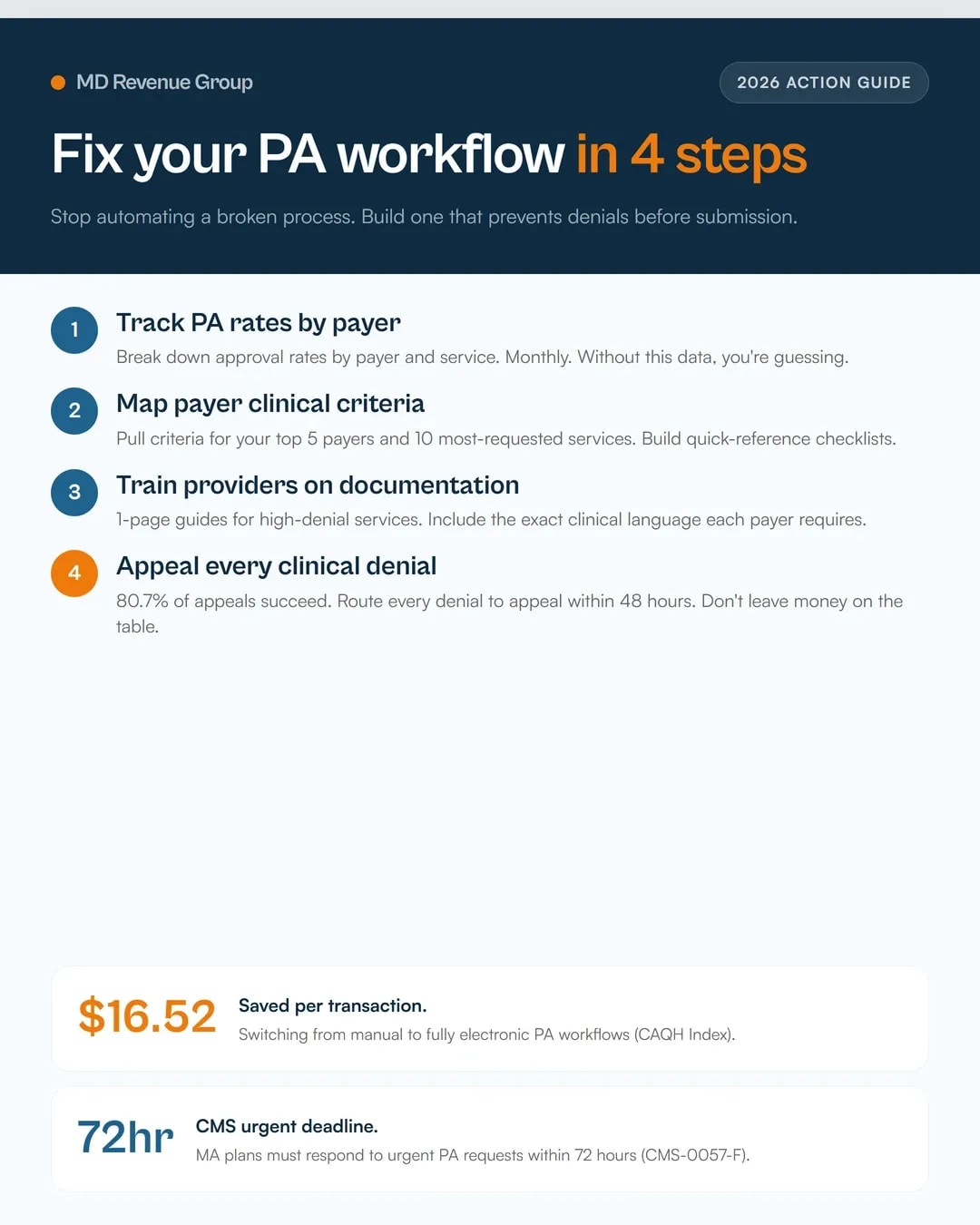
- Manual prior auth transactions cost practices $10.97 each (CAQH Index), and switching to fully electronic workflows saves $16.52 per transaction.
What "zero-touch" actually means (and what vendors leave out)
The pitch from most PA automation vendors goes like this: connect your EHR, our software reads the order, fills the form, submits it electronically, and the authorization comes back without anyone touching it. Zero-touch. Here's the part they skip. Payers don't approve or deny based on whether the form fields are populated correctly. They approve or deny based on whether the clinical justification meets their proprietary criteria for medical necessity. And those criteria change by payer, by plan, by state, and sometimes by quarter. A tool that fills forms faster is a fax machine with better branding. The submission speed was never the bottleneck. The bottleneck is knowing what each payer needs to see before they'll say yes, and making sure that documentation exists in the chart before anyone clicks "submit." The denial management breakdown tells the same story from the other end: most denied claims fail on documentation gaps, not submission errors.
35 days in AR is the benchmark. Anything over 50 is uncollected revenue.
We conduct a forensic 90-day cash flow audit to identify unworked claims, fee schedule underpayments, and clearinghouse leaks.
Audit My Cash Flow Leaks →Why prior authorization automation keeps failing
There are 3 specific reasons PA automation tools underdeliver. All 3 are fixable, but none of them are fixed by buying better software.
1. The tool submits. The payer evaluates.
Automation tools focus on the mechanics of getting the request out the door. But payers run each request through clinical criteria engines (often powered by their own AI) that look for specific clinical data points: diagnosis severity, treatment history, step therapy documentation, lab results within a defined timeframe. If that data isn't attached, the request gets denied regardless of how fast it was submitted. The AMA found that 32% of physicians report PA requests are "often or always" denied. That number hasn't moved in 3 years despite widespread automation adoption. Your clean claim rate benchmarks should include a PA-specific metric. If you aren't tracking first-pass PA approval rates separately, you don't know where your money is going.
2. Payer rules are fragmented and they change constantly
There is no universal prior auth rulebook. UnitedHealthcare's requirements for a lumbar MRI are different from Aetna's, which are different from your state Medicaid plan's. And each payer updates their PA lists multiple times per year. The 2025 CAQH Index reported that electronic PA adoption reached only 40% (up from 31% in 2023). The reason adoption is slow is partially technical, but it's mostly because the underlying rules are too fragmented for any single system to keep current across all payers. MGMA's 2026 data backs this up: over 90% of practices have had to hire or reassign staff specifically to manage PA volume. The automation didn't eliminate that need. It shifted it from "filling forms" to "chasing payer-specific rule changes."
3. Documentation gaps happen before the PA request exists
The clinical note that supports a PA request gets written during the patient encounter. If the provider doesn't document the specific data points that the payer's criteria require (failed conservative treatment, symptom duration, functional limitations), no amount of automation downstream will rescue the request. This is a physician education problem, not a technology problem. And it's the gap that separates practices with 90%+ PA approval rates from practices stuck below 70%. When payers automatically downcode your E/M visits using their own algorithms, the same documentation specificity gap is at play. Weak clinical language invites payer pushback across every part of the revenue cycle.
The CMS 2026 mandate: what it changes and what it doesn't
The CMS Interoperability and Prior Authorization Final Rule (CMS-0057-F) is the biggest regulatory shift in PA in a decade. Here's what it actually requires:
Requirement | Deadline | Impact |
|---|---|---|
Urgent PA responses within 72 hours | January 2026 | MA, Medicaid, CHIP plans |
Standard PA responses within 7 calendar days | January 2026 | MA, Medicaid, CHIP plans |
FHIR-based ePA APIs for non-drug items | Phased through January 2027 | Payers must build interoperable systems |
Public reporting of PA approval/denial rates | March 31, 2026 (first reports) | Payers publish annual PA metrics |
The CMS 2026 physician fee schedule added further pressure on reimbursement rates, making each PA denial more costly to your bottom line. What it doesn't change: CMS-0057-F covers non-drug items and services. Prescription drug PA requirements are addressed in a separate proposed rule (CMS-0062-P) released in April 2026, which hasn't been finalized yet. So if your practice is heavy on Part B drugs (oncology infusions, rheumatology biologics), the drug PA process is still unregulated by this rule. The other catch: enforcement. Early analysis of the first public reports (published March 2026 covering the 2025 calendar year) shows an average PA denial rate of about 7.7% across carriers. But those numbers are aggregated at such a high level that you can't tell which services or specialties get hit hardest. KFF flagged this as a significant data limitation.
How payer AI is making the problem worse
Here's where the prior authorization automation failure loop gets circular. Payers are deploying their own AI to process PA requests. Some carriers now issue automated denials within seconds of receiving a request, using automated utilization controls that flag cases based on statistical patterns rather than individual clinical review. The AMA survey found that 60% of physicians expect payer AI to increase denials, not decrease them. And PA denials grew 31% year over year in 2026 (some analyses attribute this directly to AI-assisted adjudication on the payer side). Only 24% of physicians believe PA reviews are conducted by appropriately qualified clinicians. When a machine denies and a machine reviews the denial, the clinical reasoning gap widens. The AI arms race in claim denials covers how payers weaponize automation, and why your response can't be more automation alone. You need documentation precision, payer-specific awareness, and human judgment on complex cases. One stat worth sitting with: 80.7% of PA denial appeals are won by the provider. That means 4 out of 5 denials were wrong. The payer AI flagged them anyway, banking on the fact that most practices don't have the staff to appeal every one.
Gold carding: the exemption most practices overlook
Gold carding laws let physicians with high PA approval rates bypass the prior auth process entirely. At least 10 states have active gold carding programs, including Texas (the pioneer in 2021), Louisiana, West Virginia, Arkansas, Michigan, and Vermont. The threshold is typically a 90%+ approval rate over a defined lookback period. If you're already getting approved at that rate, you qualify, and every PA request you skip saves your practice $10.97 per transaction (CAQH) plus the staff time. UnitedHealthcare runs a national Gold Card program that provides immediate authorization numbers for qualifying clinicians. Highmark has a similar enterprise program. The problem: most practices don't know they qualify. And the ones that do know often haven't applied because the application process itself is buried in payer portals. If your practice handles credentialing and provider enrollment, add gold card eligibility checks to your annual payer review. It's 30 minutes of work that could eliminate hundreds of PA transactions per year.
6 steps to fix your prior auth workflow
This isn't about buying new software. It's about building a process where the clinical documentation is right before the PA request goes out.
Step 1: Track PA approval rates by payer, by service
Most practices track PA volume. Few track approval rates broken down by payer and service category. Without that data, you're guessing which payers and procedures are causing the most friction. Set up a simple spreadsheet or EHR report that captures: payer name, procedure/service, approval or denial, reason for denial, and turnaround time. Run it monthly.
Step 2: Map each payer's clinical criteria
For your top 5 payers by volume, pull their current PA criteria for your 10 most-requested services. Build a quick-reference checklist for each one. This is tedious work, but it's the single highest-ROI activity in your PA process. A medical billing audit can identify which payer and service combinations are generating the most denials, so you know where to focus first.
Step 3: Train providers on documentation triggers
The clinical note written during the visit is the PA request's foundation. Physicians need to know what the payer's criteria require for each service before they finish the encounter note. Build 1-page documentation guides for your highest-denial services. Include the specific clinical language each payer looks for (functional limitations, failed conservative treatment, symptom duration, diagnostic test results).
Step 4: Submit with supporting documentation attached
Don't send the request and wait for the payer to ask for more information. Attach the clinical notes, relevant test results, and any prior treatment records with the initial submission. Front-loading documentation cuts back-and-forth cycles and shortens turnaround times. A well-run revenue cycle management process catches PA documentation gaps before the claim is submitted, not after.
Step 5: Build an appeal protocol for every denial
Given that 80.7% of appeals succeed, you need a system that automatically triggers an appeal for every clinically appropriate denial. Assign a staff member or workflow rule that routes denials to appeal within 48 hours. Understanding how to reduce claim denials starts with treating appeals as a default response, not an exception.
Step 6: Check gold card eligibility quarterly
Review your PA approval rates by payer each quarter. For any payer where you're above 90%, check their gold card or exemption program. Apply immediately. The time savings compound fast across hundreds of annual PA requests.
What this costs you if you do nothing
The math is direct. At 40 PA requests per week, 52 weeks per year, at $10.97 per manual transaction (CAQH), your practice spends $22,817 per year just on the cost of submitting PA requests. That's before you count the 14 hours of weekly staff time, the revenue lost on abandoned treatments (79% of physicians report this), or the cost of reworking denials. If your denial rate on PA requests is 30% (the AMA says 32% of physicians report this), and each denied PA delays reimbursement by 2 to 6 weeks, the cash flow impact on a mid-size practice is real. Every week of delayed authorization is a week of delayed revenue. And the patients: 26% of physicians reported that PA delays caused a serious adverse event (hospitalization, permanent impairment, or death) for a patient in their care. That's from the AMA's survey, not a hypothetical. You can audit your own PA workflow or let someone else find the leaks. Either way, the data says the current process is broken, and faster form-filling isn't the fix. If your practice is losing revenue to PA delays and denials, request a free audit and we'll show you exactly where the breakdown is. Sources cited: AMA 2025 Prior Authorization Physician Survey (published May 2026), CMS Interoperability and Prior Authorization Final Rule (CMS-0057-F), 2025 CAQH Index, MGMA 2026 regulatory burden reports, KFF PA transparency analysis (2026).
See your revenue leaks in dollars.
Get a forensic 90-day cash flow audit of your practice. 100% confidential, 48-hour delivery, zero obligation.