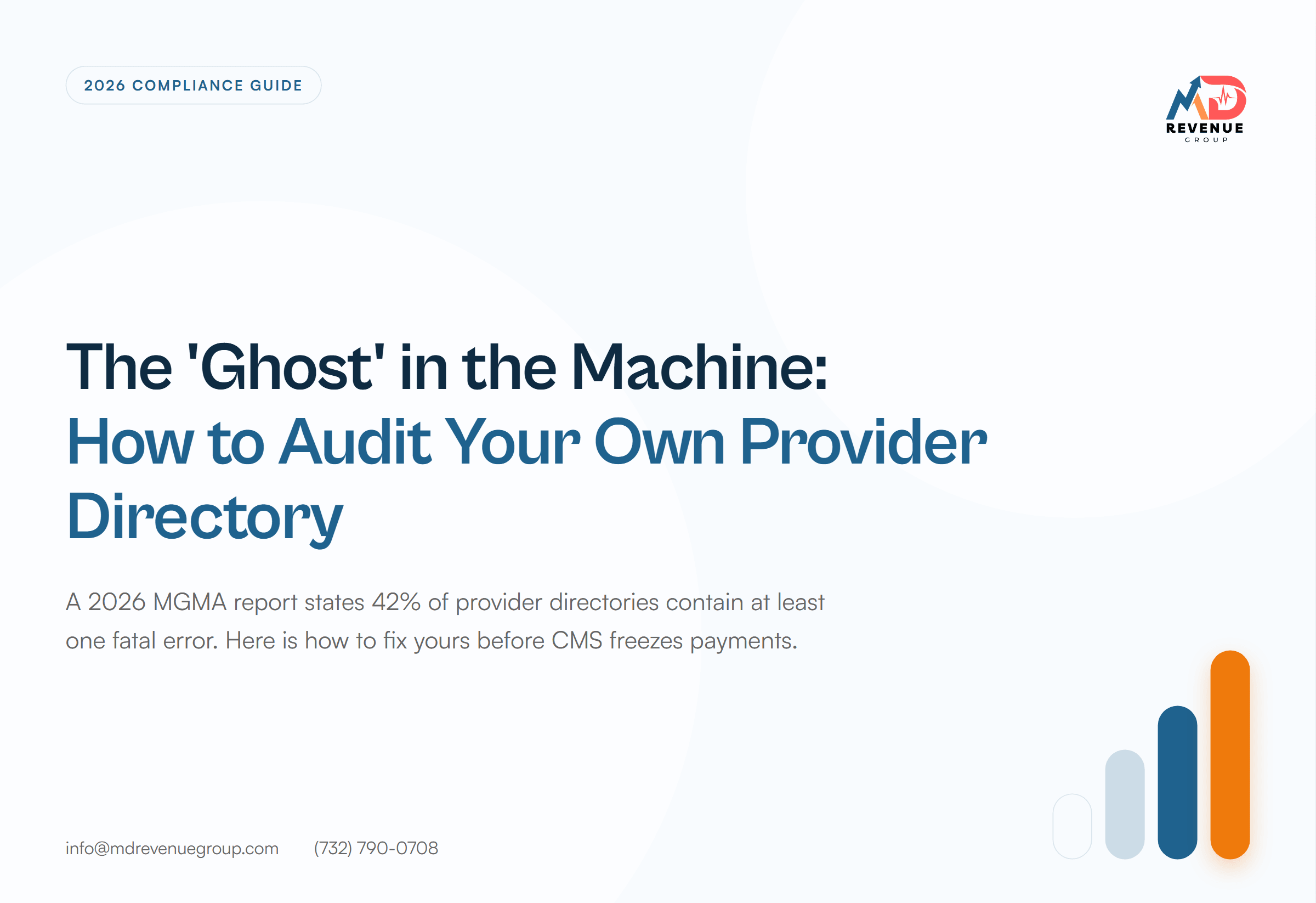
The 'Ghost' in the Machine: How to Audit Your Own Provider Directory Before CMS Does
A provider directory audit CAQH NPPES mismatch is quietly causing claim denials. Here is how to fix your listings before the 2026 CMS penalties hit.
If you are reading this, you probably just lost a major claim because of a provider directory audit CAQH NPPES mismatch. You are looking for a way to stop the bleeding. This guide is built specifically for practice managers and billers who need to fix their directory data right now.
Most billing guides waste your time defining what CAQH is. You already know what it is. What you need is the exact process to audit your directory before CMS freezes your payments. The core answer is simple. You must synchronize your CAQH profile, your NPPES NPI registry, and your payer-specific portals simultaneously.
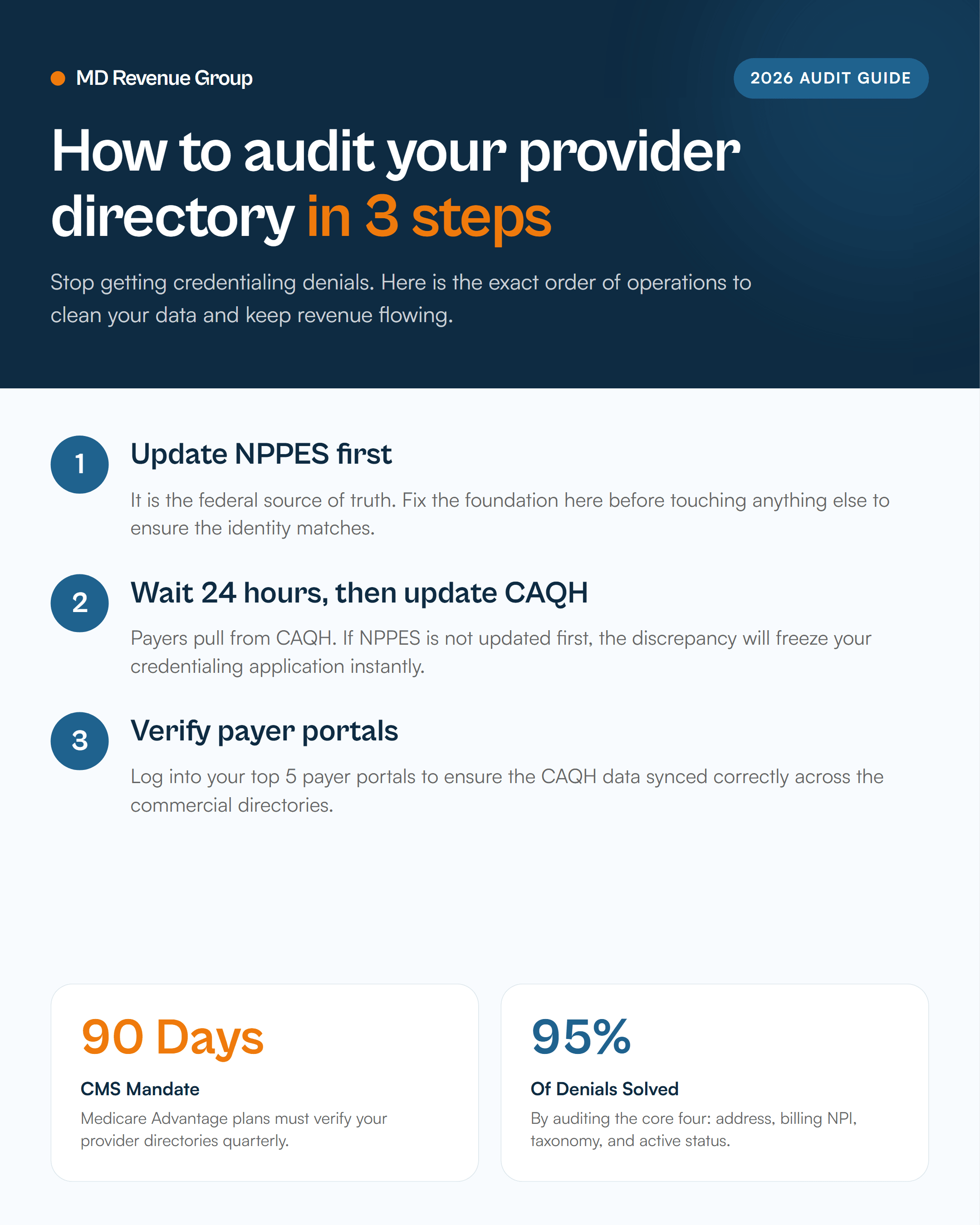
A single mismatched suite number between CAQH and a payer directory will trigger an automatic claim denial in 2026. CMS now mandates that Medicare Advantage plans verify provider directories every 90 days. If your practice fails to respond, you get removed from the network. This guide gives you the exact framework to audit your data, choose the right tools, and prevent the revenue leakage.
Key Takeaways
- CMS requires Medicare Advantage plans to verify directories every 90 days.
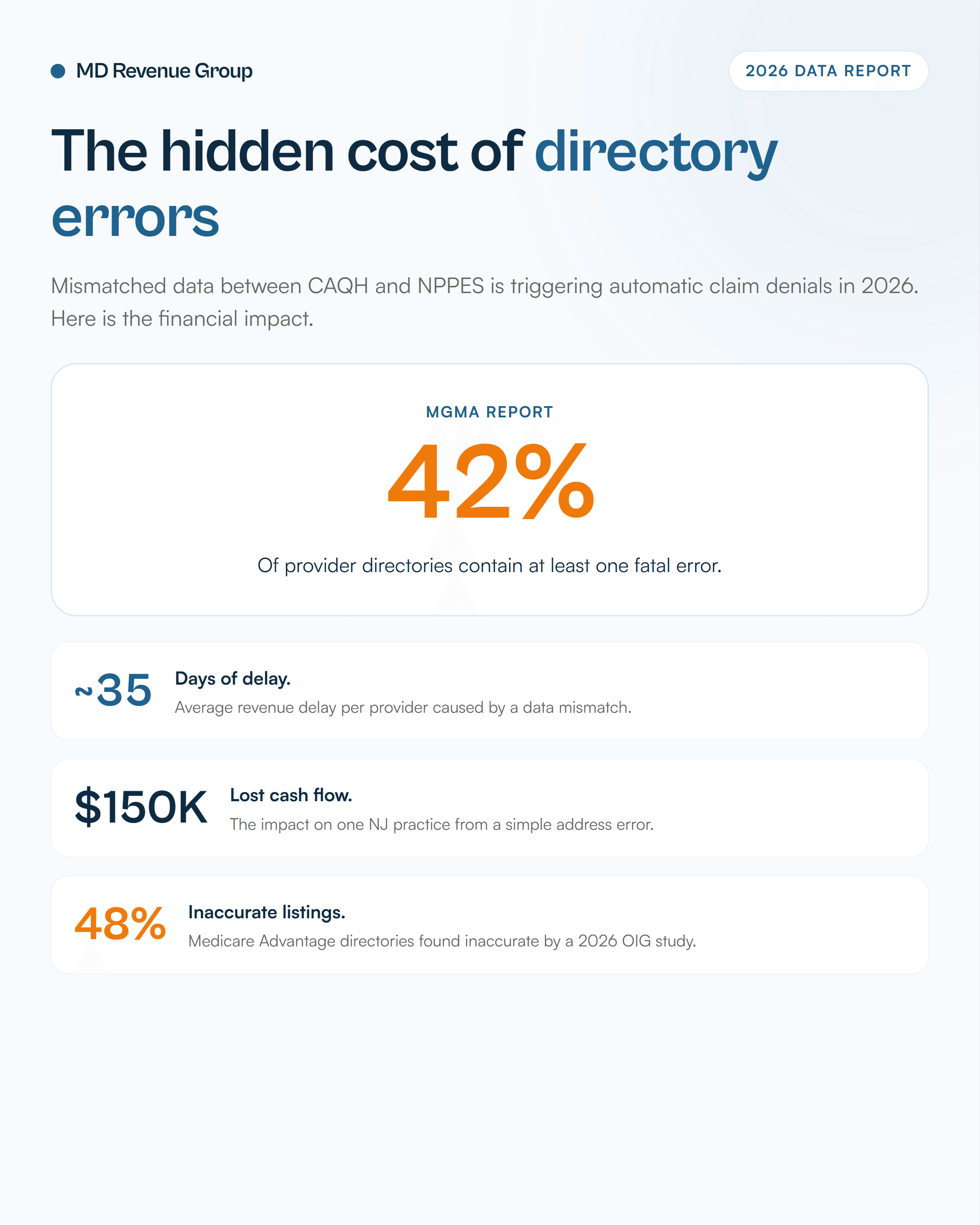
- A 2026 MGMA report states 42% of provider directories contain at least one fatal error.
- Mismatched CAQH and NPPES data causes an average revenue delay of 35 days per provider.
- You must sync all three layers: CAQH, NPPES, and payer portals.
Fast Decision-Making: How to Audit Your Data
You have three options to fix your provider directory audit CAQH NPPES problem. You need to pick the one that matches your practice size and budget.
Stop writing off 4.8% of your billing to preventable payer edits.
We review 50 of your recent denied claims against commercial & Medicare payer rules to show exactly which write-offs are legally recoverable.
Find My Recoverable Dollars →If you run a solo practice, do it manually. Block off two hours every quarter. Log into CAQH, NPPES, and your top five payer portals. Compare the addresses, phone numbers, and taxonomy codes line by line.
If you manage a mid-sized group, use automated credentialing software. You cannot rely on spreadsheets when you have ten providers across three locations. The software will flag mismatches automatically.
If you operate a large multi-specialty clinic, outsource the entire process. You need a dedicated credentialing services team to manage the constant updates. Your billers should be working denials, not updating fax numbers on CAQH. Do not let highly paid billers act as data entry clerks.
The Smart vs. Average Approach to Directories
Average practices wait for a claim denial to check their CAQH profile. They treat credentialing as a one-time event. They lose thousands of dollars because they forgot to update an expired malpractice policy. They spend hours on hold with provider enrollment departments trying to untangle a mess that could have been prevented with a five-minute check.
Smart practices treat directory data like a living organism. They run a preemptive medical billing audit every 90 days. They designate one specific person to own the CAQH login. They understand that clean data is the foundation of getting paid on time. They build alerts around expiring licenses and DEA numbers. They do not wait for the payer to penalize them.
Here is a real example from a New Jersey cardiology group. They moved offices in early 2026. They updated their website and their Google listing. They forgot to update NPPES. Three major payers automatically suspended their payments for 45 days. They lost $150,000 in cash flow over a simple address mismatch. It took them three weeks of phone calls to re-activate their profiles.
Simplified Technical Data: CAQH and NPPES Integration
The technical side of directory management confuses everyone. Let me simplify it.
NPPES is the government database. It issues your NPI number. It is the absolute source of truth for your identity. If NPPES is wrong, everything else breaks. The federal government uses this to track who is billing for what services.
CAQH is the universal application for commercial payers. Payers pull data from CAQH to update their own internal directories. It is a middleman database. It does not generate your NPI. It only stores your professional history.
You must update NPPES first. Wait 24 hours. Then update CAQH. If you update CAQH while NPPES still shows the old address, the system will flag a discrepancy. The payers will halt your credentialing application. Clean the source first. Never update a commercial portal before the federal database registers the change.
Strongest vs. Best: Choosing Your Audit Level
The strongest audit is a forensic, line-by-line comparison of every single payer contract against your CAQH profile. This requires a dedicated compliance officer and takes weeks. It guarantees 100% accuracy. It involves cross-referencing your malpractice insurance roster with the payer rosters. It is incredibly tedious.
The best audit is the 80/20 approach. Focus on the data fields that actually trigger denials. Check the practice address, the billing NPI, the taxonomy code, and the provider's active status. This takes hours, not weeks. It solves 95% of your credentialing denials. This is the path most private practices should take.
You need to integrate this process into your broader revenue cycle management strategy. Your billing team needs a clear SOP for onboarding new providers. They need to know exactly who is responsible for the directory updates.
The Practical Buyer Checklist for Audit Tools
If you decide to buy software to manage your directory data, use this checklist.
Look for a direct CAQH API integration. If the software requires you to manually export a CSV file to CAQH, it is useless. You are paying for automation, not another manual task.
Check for real-time NPPES monitoring. The system should alert you the moment your NPI data changes. You should know before the payer knows.
Watch out for pricing models based on the number of locations. You want software that prices by the provider. You should not be penalized for expanding your clinic footprint.
Review their support structure. If a payer portal locks you out, you need a human on the phone to help you fix it. You can explore our services if you want a team that handles the technical support for you. You do not have the time to sit on hold with a software vendor's level-one support desk.
Top Recommendations for Your Practice
For the solo practitioner, stick to a calendar reminder. Set a recurring task every 90 days to log into CAQH and hit the re-attest button. Keep it simple. Create a master document with all your logins and keep it secure.
For the growing group practice, invest in a dedicated credentialing platform. You need software that tracks expiration dates for licenses and DEA numbers. You need a dashboard that shows the exact status of every provider across every payer.
For the enterprise clinic facing massive denial rates, you need a full intervention. You should schedule a free audit with our team. We will pull your CAQH data and cross-reference it against your recent denials. We will find the exact fields causing the rejections.
A 2026 OIG study revealed that Medicare Advantage directories are inaccurate 48% of the time. You cannot trust the payers to fix this for you. You have to take control of your own data. The cost of doing nothing is too high.
Why Taxonomy Codes Matter More Than Ever
Most billers focus on the physical address during an audit. They completely ignore the taxonomy code. This is a massive mistake in 2026. CMS now uses taxonomy codes to determine network adequacy for Medicare Advantage plans.
If your provider is a specialist but their primary taxonomy code is listed as internal medicine, the payer's algorithm will flag it. They will deny your high-level evaluation and management codes. They will say the provider is out of network for that specific service level.
You must verify that your primary taxonomy code in NPPES matches your specialty perfectly. If your providers have multiple sub-specialties, ensure the highest revenue-generating specialty is listed first. Payers only look at the primary code during automated adjudication.
Handling Multi-State Provider Credentialing
If your practice operates across state lines, your directory audit just became exponentially harder. Telehealth expansion has forced many providers to maintain licenses in three or four different states.
NPPES handles multi-state licensing poorly. You have to add each state license manually to the federal registry. If you miss one, the payer in that state will instantly reject the claim.
Your audit process must include a state-by-state verification step. Check the expiration date of every single out-of-state license. Ensure that CAQH reflects the active status of each one. Payers have automated their license verification systems. If the license shows expired for even one day, the system will suspend your contract.
Provider Directory FAQs
What is a provider directory audit CAQH NPPES mismatch? It happens when your practice information in CAQH does not match the information in the federal NPPES database. Payers use this mismatch as a reason to deny claims.
How often does CMS require Medicare Advantage plans to verify directories? CMS now requires quarterly verification. Payers will reach out to you every 90 days. If you ignore them, they will remove you from the directory.
Can a wrong suite number really cause a claim denial? Yes. A 2026 HFMA report confirms that exact address matching is now a primary filter for automated claim adjudication systems.
Should I update CAQH or NPPES first? Always update NPPES first. It is the federal source of truth. Wait 24 hours for the database to refresh before updating CAQH.
How do I fix a suspended payer contract? You must correct the mismatched data in CAQH, re-attest your profile, and then call the payer's provider enrollment department directly.
Is manual auditing enough for a multi-specialty group? No. If you have more than five providers, manual auditing will lead to human error. You need to use software or contact a professional credentialing team.
What happens if I forget to re-attest my CAQH profile? Your profile will become inactive. Payers will lose access to your data. Your claims will immediately start rejecting for provider enrollment issues.
Why are payers so strict about directory accuracy now? The No Surprises Act forces payers to maintain accurate directories to protect patients from unexpected out-of-network bills. CMS fines them heavily if their directories are wrong.
Ready to stop the credentialing nightmares? Schedule a detailed review of your directory data today.
Recover your denied claims in dollars.
Send us 50 of your recent denied claims. Our certified AAPC/AHIMA billing team will identify every recoverable dollar within 48 hours.