
The 'AI Arms Race': How Providers Are Using Counter-AI to Overturn Algorithmic Denials
Payers use AI to deny claims in seconds. See how providers fight back with counter-AI appeals, the 2026 CMS rules, and a step-by-step workflow.
Payers now deny claims with algorithms that scan thousands of charts a minute. The fix isn't more staff reading denial letters by hand, it's an AI appeal tool that matches that speed on your side. Practices using AI-drafted, evidence-backed appeals are turning around denials that used to take a coder half a day into a 10-minute review, and they're doing it against a payer system built to bank on providers never appealing at all.
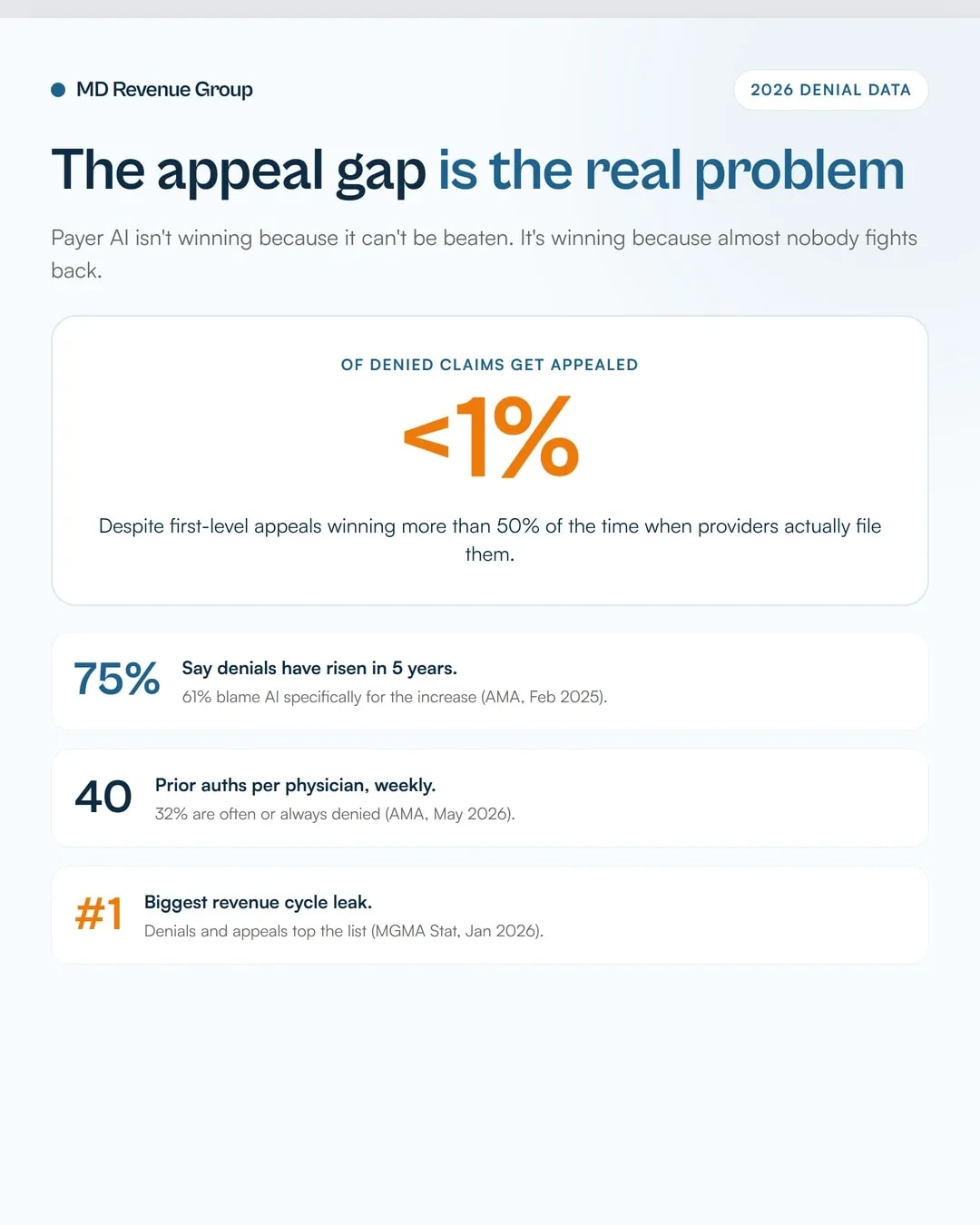
That last part is the real story. Less than 1% of denied claims ever get appealed, even though first-level appeals succeed more than half the time when providers actually file them. Payer AI isn't winning because it's unbeatable. It's winning because most practices don't fight back.
Key takeaways
- Fewer than 1% of denied claims get appealed, but first-level appeals win more than 50% of the time when providers file them.
- 75% of physicians say prior authorization denials have increased over the last 5 years, and 61% blame AI specifically for the increase (AMA, Feb 2025 survey).
- CMS's 2024 Medicare Advantage rule bars payers from denying care based solely on an algorithm when it conflicts with a patient's actual medical history or physician notes.
- Counter-AI appeal tools work by matching a denial's stated rationale against clinical documentation and payer policy, then drafting the response in the format that AI reviewers are trained to approve.
- The biggest single revenue cycle leak practices report right now is denials and appeals (MGMA Stat, Jan 2026).
Why algorithmic denials are different
A human reviewer denying a claim has to read the chart, or at least skim it. An algorithm doesn't. It pattern-matches your claim against a model trained on historical approvals and denials, flags anything that doesn't fit the pattern, and moves on. That's how a payer can process thousands of claims in the time it takes your billing team to review ten.
The output looks identical to a traditional denial letter. Same codes, same boilerplate language about medical necessity. What's different is the speed and the volume, which means the old approach (one biller manually building one appeal at a time) can't keep pace anymore.
Waystar alone processes roughly $1.8 trillion in annual claims through a platform that pairs denial and appeal management with AI-driven prediction models and a payer-specific intelligence layer. That scale is the point. Payers aren't running a handful of AI-flagged denials a week, they're running a system that touches nearly every claim that crosses their desk, and your appeal process has to operate at a comparable scale to keep up.
Physicians feel this directly. 75% report prior authorization denials have gone up over the past 5 years, and 61% say they're specifically worried AI is driving that increase (AMA Prior Authorization Physician Survey, Feb 2025). By May 2026, that concern hadn't eased. Physicians reported completing 40 prior authorizations a week on average, with 32% saying requests are often or always denied (AMA, May 2026).
What payer AI is actually looking for
Algorithmic denial engines aren't reading your note for nuance. They're checking for specific documentation triggers: does the diagnosis code support the procedure code, does the note include the exact phrasing their model was trained to accept, is there a gap between the requested service and the documented severity of the condition.
That's exploitable, in your favor. If a denial engine is trained to look for specific documentation patterns, an appeal that's structured to hit those same patterns has a much higher chance of clearing the same automated review, or at least forcing a human reviewer to look at it directly. This is the actual mechanic behind "counter-AI": not fighting the algorithm's logic, but understanding it well enough to write directly to it.
Denials and appeals rank as the single biggest source of revenue cycle leakage practices report today, ahead of front-end issues, billing and collections, and coding combined (MGMA Stat, Jan 2026). If your practice runs high denial volumes, a medical billing audit that isolates algorithmic denial patterns specifically (versus generic coding errors) is where the leak usually gets found.
The counter-AI appeal workflow, step by step
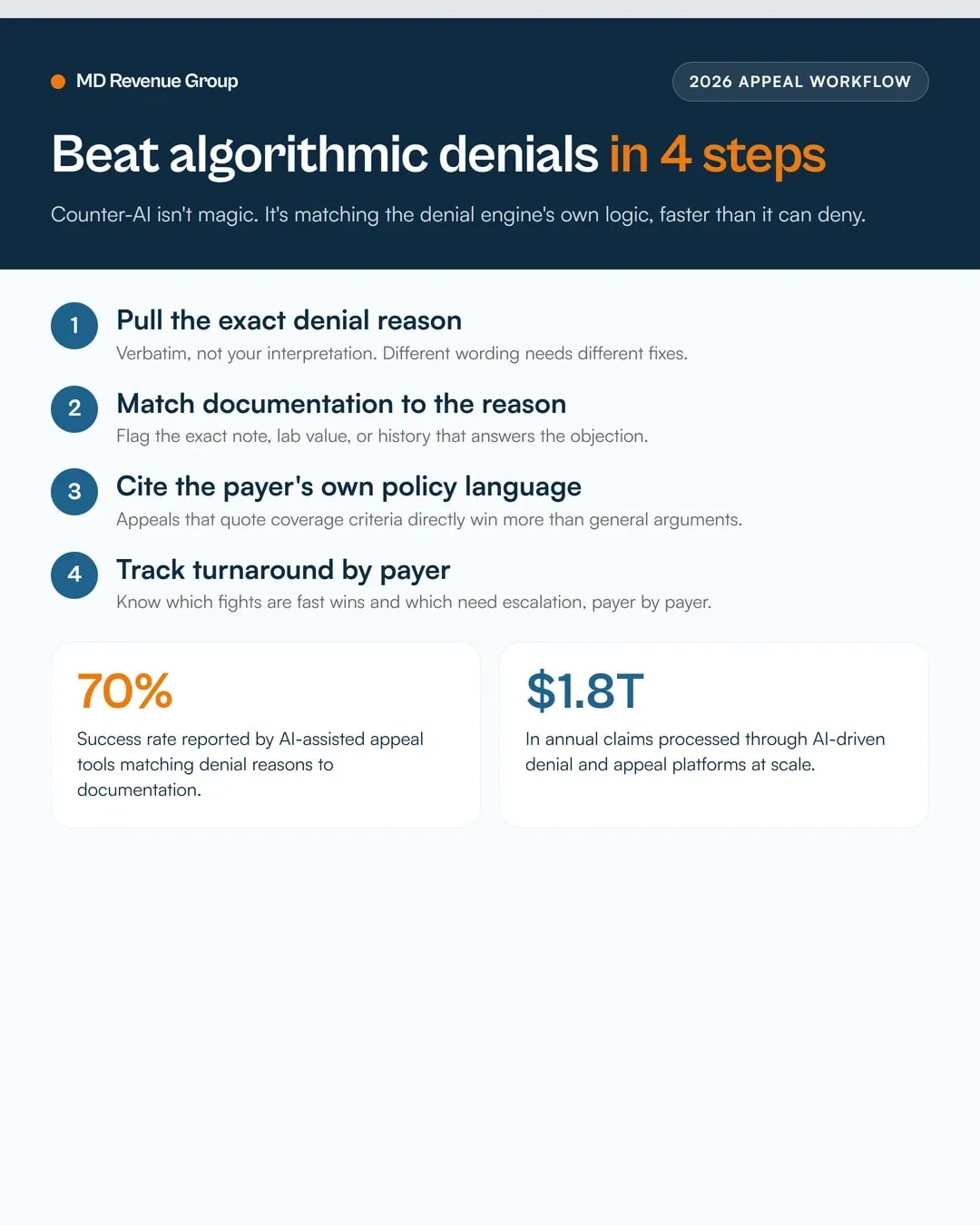
Start by pulling the denial's stated reason verbatim, not your assumption of what it means. "Not medically necessary" and "insufficient documentation of medical necessity" trigger different response strategies even though they sound similar.
Next, match the denial reason against the specific clinical documentation that addresses it directly. This is where AI appeal tools save the most time: instead of a coder re-reading the full chart, the tool flags the exact note, lab value, or prior treatment history that answers the payer's stated objection.
Then draft the appeal using the payer's own coverage policy language where possible. Denial engines and the human reviewers who oversee them respond better to appeals that cite the specific policy criteria being met, not a general argument that the care was reasonable.
Finally, track turnaround by payer. Some plans respond to first-level appeals in days, others take weeks. If your revenue cycle management team isn't logging appeal timelines by payer, you're flying blind on which fights are worth escalating and which aren't.
Patient-facing tools like Counterforce Health report a 70% success rate helping individuals appeal denials, largely by applying this same match-the-documentation-to-the-denial-reason approach. Providers running the same logic at scale, across every denied claim instead of one patient at a time, is the practice-side version of the same fight.
What CMS actually allows payers to do with AI
CMS's calendar year 2024 Medicare Advantage final rule set the boundary that matters most here. Medicare Advantage organizations can't deny basic benefits based solely on an algorithm's output when it conflicts with a patient's individual medical history, physician recommendations, or clinical notes. Coverage denials have to trace back to specific, permissible coverage criteria, not a model's aggregate prediction.
That rule gives you a direct appeal lever. If a denial letter cites an algorithmic risk score or an aggregate scoring model without tying it to the patient's actual chart, that's a documented compliance gap you can cite in the appeal itself. CMS also announced routine and focused audits to check Medicare Advantage plans against this standard, so a well-documented appeal isn't just fighting for one claim, it's building a paper trail that plan has to answer for elsewhere too.
This rule only covers Medicare Advantage directly. Commercial payers aren't bound by the same language, but the enforcement pressure on MA plans is shaping how AI-driven utilization management gets built industry-wide, since most payers run the same underlying denial engines across product lines.
Congressional oversight is adding pressure too. Lawmakers sent CMS a formal letter in mid-2024 pushing for tighter auditing of how Medicare Advantage plans use AI in coverage decisions, specifically flagging concerns that algorithmic tools were being used to justify denials that a human reviewer would likely have approved. That kind of scrutiny doesn't disappear once a rule is finalized. It tends to show up later as stricter audit findings, which is another reason a documented, policy-cited appeal is worth filing even on claims that feel like long shots.
Prevention checklist: reduce algorithmic denials before they happen
- Document medical necessity in the exact clinical terms the payer's policy uses, not generic language
- Attach prior treatment history and failed conservative care whenever a payer's policy references step therapy
- Verify prior authorization status immediately before the visit, not just at scheduling
- Flag high-denial-rate CPT codes for your specialty and pre-review documentation before submission
- Run a revenue integrity check on denial patterns monthly, not quarterly, since algorithmic denial criteria shift faster than manual review criteria used to
Specialties with device-intensive or high-cost procedures see this hardest. If you're running cardiology billing or oncology billing, your denial-to-appeal pipeline needs to be near-automatic, because the dollar value per denied claim is too high to leave sitting in a queue.
When to appeal vs. write off
Not every denial is worth fighting, but the default should lean toward appeal far more than most practices currently do. With over half of first-level appeals succeeding, writing off a denial without appealing is usually the more expensive choice, not the safer one.
Write off fast when the claim is small, the documentation genuinely doesn't support the service, or the timely filing window has already closed. Appeal immediately when the denial reason is documentation-based (the most winnable category), when the dollar value is high, or when the same denial reason keeps recurring across multiple patients with the same payer, since that pattern usually signals a fixable documentation gap rather than a one-off judgment call.
Stop losing appealable claims to the write-off pile
Most practices write off denials they could have won, simply because appealing manually doesn't scale against payer AI. We build denial and appeal workflows that match payer algorithms claim for claim, so the revenue you're owed doesn't quietly disappear into an aging report. Request a free revenue audit and we'll show you exactly which denials in your last 90 days were worth appealing.