
CMS 2026 physician fee schedule: what every practice needs to know
The conversion factor dropped. Again. $32.35 for 2026, down from $33.29 in 2025. That's a 2.8% cut on every Medicare CPT code you bill starting January 1.
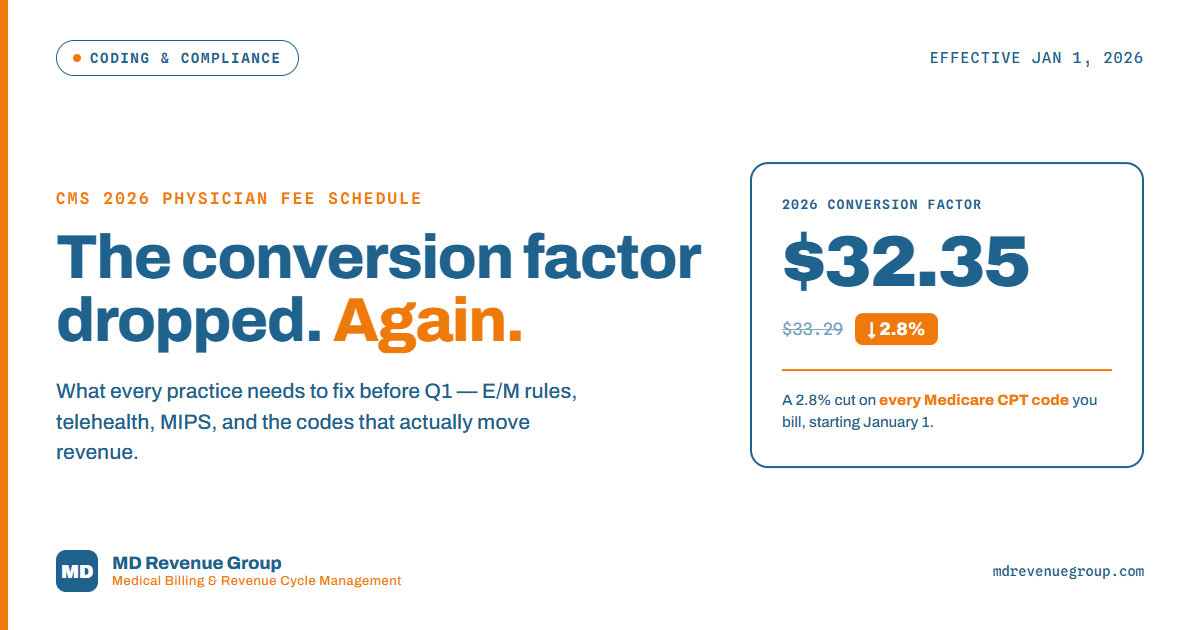
The conversion factor dropped. Again.
$32.35 for 2026, down from $33.29 in 2025. That's a 2.8% cut on every Medicare CPT code you bill starting January 1.
CMS calls it budget-neutral. That's technically true at the system level and irrelevant to your practice. For a primary care office billing $1.2 million annually to Medicare, 2.8% is $33,600 gone before you touch a single denial. Oncology and neurology practices with heavier Medicare panels feel that number harder.
Congress might patch it in December. They've done it before, sometimes 3 days before the new year. But you can't build a budget on maybe.
Here's what actually changed in 2026, and what you need to fix before Q1.
E/M billing: 2 changes, both with teeth
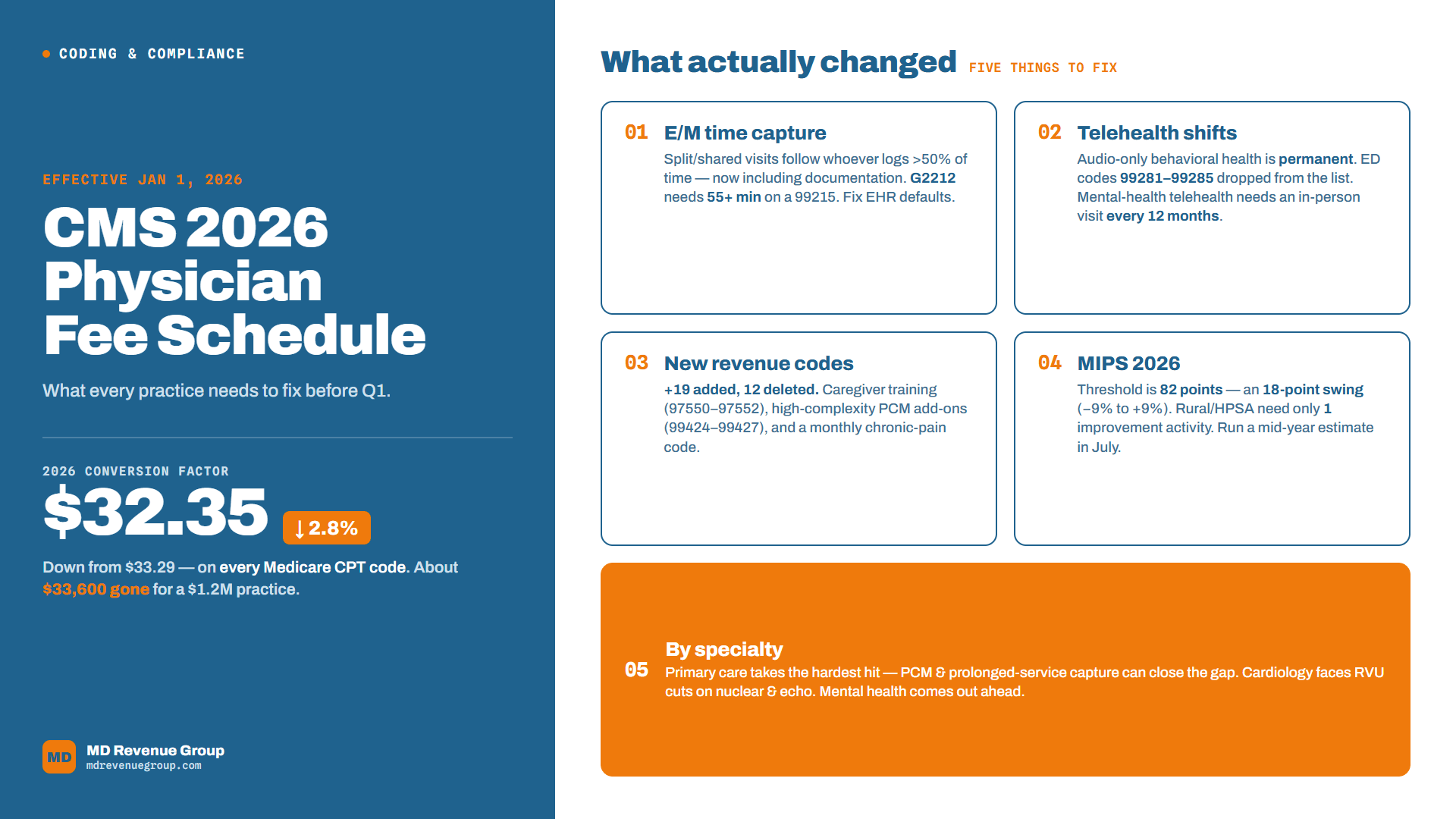
Split/shared visits. When a physician and a non-physician practitioner both contribute to an inpatient visit, billing goes to whoever spent more than half the total time. CMS clarified in 2026 that "time" includes documentation time on the date of the encounter.
If you're billing these under the physician automatically to capture the higher RVU, audit that now. You need documented time dominance. Without it, you're exposed.
G2212 thresholds for prolonged services. You can bill G2212 as an add-on when total time exceeds the base E/M code's maximum by at least 15 minutes. For a 99215, that means total time must hit 55 minutes or more.
Check your EHR defaults. If the system auto-fills time fields, the thresholds need to be updated before January 1. Most systems aren't set correctly out of the box.
Telehealth: what stayed, what got pulled
Audio-only mental health and substance use disorder billing is now permanent. That's a real win for behavioral health practices that serve patients without reliable video access.
For everything else, the geographic restrictions that existed before the pandemic technically came back when the public health emergency ended. But Congress extended most flexibilities through December 31, 2026. You can keep billing from patient homes and rural health sites the same way you did in 2025.
What changed: CMS removed emergency department visits (99281-99285) from the approved telehealth list when billed by a non-treating provider. Those codes are no longer reimbursable under the PFS. Check your claim history now. If your team has been billing these for remote ED consultation, update the protocols before your January claims go out.
One more change for mental health practices. Medicare now requires an in-person visit at least once every 12 months for any patient receiving ongoing telehealth-based mental health treatment. This isn't optional and it isn't waivable.
Build it into your scheduling workflow. Flag every Medicare mental health patient 90 days before their 12-month mark so you can get them in before the window closes. Missing this creates both a compliance gap and a billing risk: if the in-person visit isn't documented, you're billing telehealth treatment that technically shouldn't be reimbursed.
New codes that will actually move revenue
CMS added 19 CPT codes for 2026 and deleted 12. The ones worth knowing:
Caregiver training services (97550, 97551, 97552). These cover time you spend training a patient's caregiver on therapeutic interventions. CMS assigned work RVUs to them for the first time, making them billable under Medicare Part B when medical necessity is documented. Pediatrics, neurology, and physical therapy practices should review eligibility. If you've been doing this work and not billing it, you've been leaving money in the room.
PCM complexity add-ons. The principal care management codes (99424-99427) now have high-complexity add-ons for patients with multiple chronic conditions requiring intensive care coordination. They stack on the base PCM code. You need documentation of the specific conditions you're managing and what coordination activities you actually performed. Vague notes won't hold up.
Chronic pain monthly code. A new monthly service code exists for structured chronic pain programs. To bill it, you need a prior E/M establishing the diagnosis, a documented treatment plan, and evidence of ongoing patient engagement. If you're running chronic pain management outside traditional interventional billing, check whether your existing programs meet the eligibility criteria. Some already do.
Not sure what is draining your practice?
Our Free Revenue Audit of your practice, if we dont find a leak, you dont pay us.
Get my free audit →MIPS 2026: your numbers
Performance year runs January through December. Payment adjustments apply to your 2028 Medicare reimbursements, which means what you do this year shows up in your checks two years from now.
The performance threshold is 82 points. Below 82, you get a negative payment adjustment. The ceiling is +9% for exceptional performers. The floor is -9%. That's an 18-point swing depending on where you land.
Low-volume threshold: if you bill less than $90,000 in Medicare Part B charges or have fewer than 200 Medicare patients, you're out of mandatory MIPS reporting. Know where you stand before you spend time on reporting you don't need.
2 specific updates for practices that do report.
Rural practices and Health Professional Shortage Areas now need only 1 medium-weight improvement activity instead of 2. If your practice qualifies, update your IA selection. You may have been doing more work than required.
The Cost category holds at 30% of your final MIPS score. Medicare Spending Per Beneficiary (MSPB) and Total Per Capita Cost (TPCC) drive this category. Practices with high-cost patient panels need to run attribution reports early in the year. Find your cost outliers in Q1 or Q2, not Q4, when there's still time to do something about them.
Don't wait until October to check your score trajectory. Run a mid-year MIPS estimate in July. 82 points is your number. If you're short, you need time to adjust your reporting, not a week before the deadline.
What this means by specialty
Primary care takes the hardest hit on the conversion factor because Medicare typically makes up a bigger share of the payer mix. The PCM add-ons and prolonged services changes can partially close that gap, but only if your billing team captures them. Practices that run PCM programs and document prolonged services correctly could see revenue impact close to flat. Practices that don't will absorb the full cut.
Cardiology got RVU reductions on nuclear cardiology studies and some echocardiography codes. CMS updated physician time surveys behind those numbers, and the reductions are real. Model your top 10 cardiology codes against 2026 rates now. Identify where revenue will decline and where there are coding alternatives before those remittances start coming back lower.
Mental health actually comes out ahead on balance. Permanent audio-only coverage plus expanded behavioral health integration codes give these practices more billing flexibility than in any prior PFS. The in-person visit requirement adds administrative work, but it's manageable with a scheduling protocol. The practices that set it up now won't think about it twice by summer.
Orthopedics didn't see structural changes to global surgery packages, but CMS revised the mandatory reporting list for services furnished within global periods. If you're doing high volumes of procedures in the 90-day global period, confirm your post-op visit documentation meets CMS requirements. Gaps here tend to surface during audits, not during regular billing reviews.
Before January 1
Pull your current Medicare fee schedule and compare it against 2026 rates line by line. Every code where reimbursement dropped more than 5% needs a flag. Some have documentation or coding substitution opportunities. Find them before your January claims go out.
Update your EHR time documentation templates. Split/shared visit rules and G2212 both depend on accurate time capture. If your templates don't prompt providers to record total time on the encounter, that's a fix you need before the first day of the new year.
Remove the 3 ED telehealth codes CMS struck from the approved list. Add the new behavioral health integration codes where your patients qualify.
If your practice is in a rural area or HPSA, update your MIPS improvement activity selection to reflect the new 1-activity requirement.
And actually run the MIPS estimate in July. The practices that check mid-year and adjust still have time to change their trajectory. The practices that check in November don't.
MD Revenue Group handles Medicare fee schedule updates, payer contract reviews, and denial management for practices across specialties. Contact our team to run a 2026 fee schedule impact analysis for your practice.