
Psychiatry Billing Company Guide: E/M Plus Psychotherapy Same-Day Documentation and Modifier Controls
Partner with a psychiatry billing company to master same-day E/M & psychotherapy 90833 add-on codes, Modifier 25, time documentation, and NCCI edits."
Partnering with an experienced psychiatry billing company helps practices navigate same-day Evaluation and Management (E/M) and psychotherapy billing without triggering payer audits. When a psychiatrist or psychiatric nurse practitioner provides medication management alongside psychotherapy during a single patient encounter, billing requires reporting an established E/M base code (CPT 99212–99215) with a dedicated psychotherapy add-on code (CPT 90833, 90836, or 90838).
The primary regulatory trap involves time tracking and code selection. Under current Centers for Medicare & Medicaid Services (CMS) and American Medical Association (AMA) CPT guidelines, the E/M service cannot be selected based on time when paired with an add-on psychotherapy code. The E/M level must be selected strictly through Medical Decision Making (MDM), while the psychotherapy add-on code is determined by distinct, documented face-to-face therapy time.
Practices that fail to document separate time thresholds or omit Modifier 25 face immediate claim rejections under National Correct Coding Initiative (NCCI) procedure-to-procedure edits. Establishing clear EHR templates, tracking distinct time logs, and auditing modifier usage protects clinical revenue while keeping psychiatric practices fully audit-ready.
Key takeaways
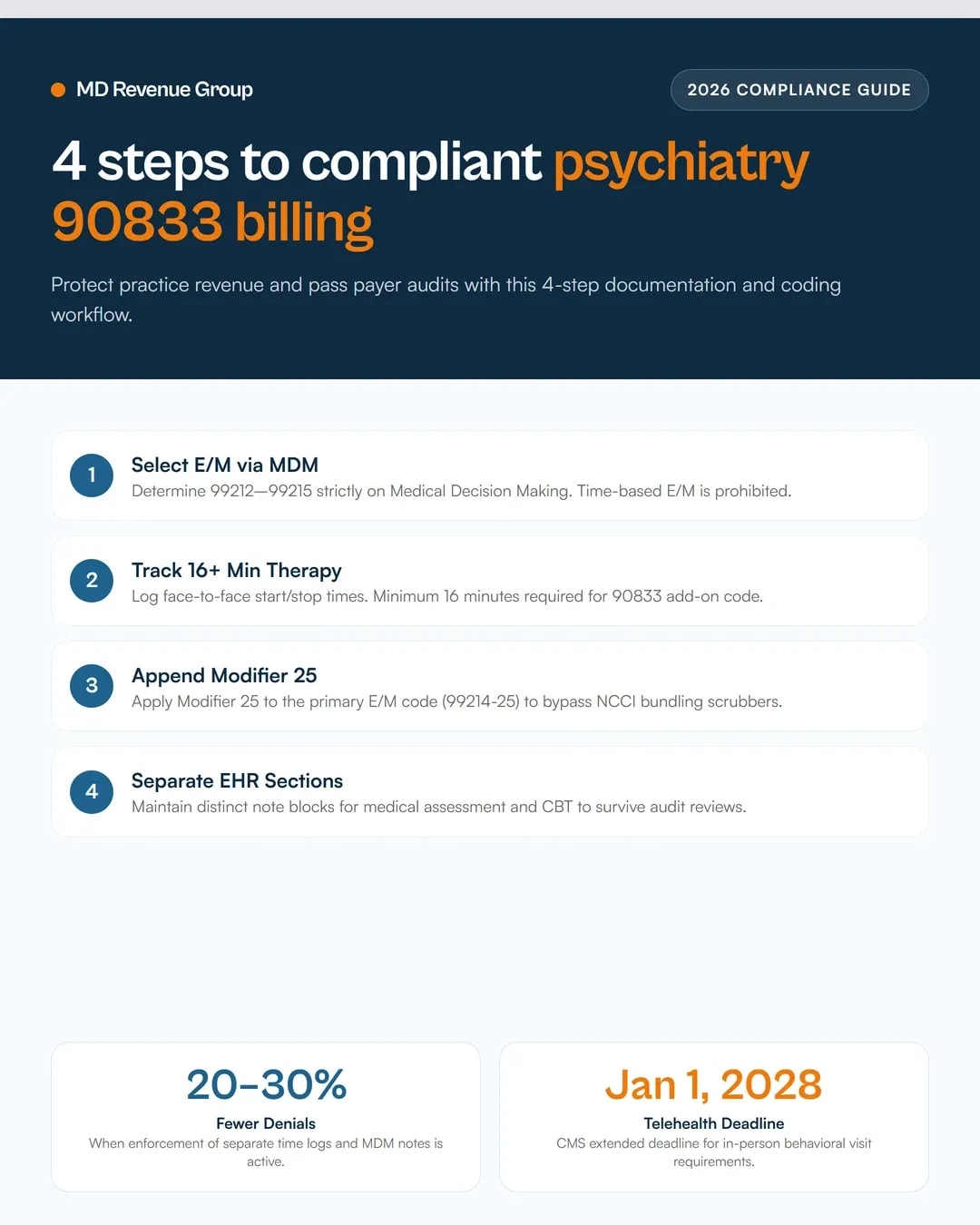
- E/M code selection must rely on MDM: You cannot use total encounter time to select an E/M code when billing an add-on psychotherapy service.
- Minimum 16-minute threshold for 90833: CPT 90833 requires at least 16 minutes of documented, face-to-face psychotherapy time separate from medication management.
- Modifier 25 is mandatory on E/M: Append Modifier 25 to the primary E/M code (e.g., 99214-25) to prevent automated NCCI bundling denials (CO-97).
- Time overlap is illegal: Psychotherapy face-to-face time cannot count toward E/M time calculations or any other billable service.
- Telehealth rules extended through 2027: The CMS in-person visit mandate for behavioral telehealth has been delayed until January 1, 2028.
What same-day psychiatric E/M and psychotherapy billing involves
Psychiatric clinical encounters frequently combine medical evaluations, laboratory reviews, and psychotropic medication adjustments with therapeutic interventions like Cognitive Behavioral Therapy (CBT) or supportive psychotherapy.
In medical billing, reporting both services during a single visit requires combining two distinct code types. The E/M service (CPT 99202–99205 for new patients, 99211–99215 for established patients) covers the medical assessment and diagnostic decision-making. The psychotherapy service is billed using dedicated add-on CPT codes:
- CPT 90833: Psychotherapy, 30 minutes with patient, when performed with an E/M service.
- CPT 90836: Psychotherapy, 45 minutes with patient, when performed with an E/M service.
- CPT 90838: Psychotherapy, 60 minutes with patient, when performed with an E/M service.
Because these add-on codes are intrinsically tied to an E/M service, they cannot stand alone on a claim form. If a billing team submits CPT 90833 without a primary E/M code, clearinghouse claim scrubbers reject the submission immediately.
Managing these claims demands strict alignment between clinical documentation and billing protocols. Many practices consult our specialized behavioral health billing services to restructure their EHR templates and prevent routine coding errors.
Key CPT add-on codes and mandatory time thresholds
Accurate coding depends on precise time tracking during the clinical session. The CPT manual defines time ranges for psychiatric add-on codes based on the midpoint rule.
Psychotherapy add-on time begins only after the E/M portion of the visit is completed, or during distinct intervals dedicated exclusively to therapy. You must document face-to-face time with the patient.
CPT Code | Description | Minimum Time Required | Full Time Range | Primary E/M Required? |
|---|---|---|---|---|
90833 | Psychotherapy add-on, 30 min | 16 minutes | 16 to 37 minutes | Yes (99202–99215) |
90836 | Psychotherapy add-on, 45 min | 38 minutes | 38 to 52 minutes | Yes (99202–99215) |
90838 | Psychotherapy add-on, 60 min | 53 minutes | 53+ minutes | Yes (99202–99215) |
If psychotherapy lasts less than 16 minutes, you cannot bill an add-on code. The therapeutic discussion is considered part of the routine E/M visit.
Practices working across regional markets must monitor local payer interpretations of these time rules. For instance, teams handling medical billing services in Texas frequently report that commercial commercial payers like Blue Cross Blue Shield of Texas request start and stop times in audit reviews rather than simple block minutes.
Medical decision making vs time-based billing for E/M
Under AMA CPT guidelines, outpatient E/M codes (99202–99215) can normally be selected using either Medical Decision Making (MDM) or Total Time on the date of the encounter. However, when an E/M code is reported alongside an add-on psychotherapy code (90833, 90836, 90838), time-based E/M selection is strictly prohibited.
This rule prevents double-counting clinician time. If a psychiatrist spends 45 total minutes with a patient, spending 20 minutes on medication management and 25 minutes on CBT, they cannot bill CPT 99215 based on total time. Instead, they must determine the E/M code based solely on the MDM level achieved during the medical portion of the visit.
MDM evaluation evaluates three core components:
- Number and complexity of problems addressed: Managing chronic psychiatric conditions (e.g., major depressive disorder, bipolar disorder) with active medication changes satisfies moderate or high complexity.
- Amount and complexity of data reviewed: Reviewing lab panels, serum lithium levels, or diagnostic screening scales (PHQ-9, GAD-7).
- Risk of complications or morbidity: Prescription drug management, monitoring side effects, or managing high-risk suicidal ideation.
If the medical evaluation meets the criteria for Moderate MDM (such as adjusting prescription dosages and ordering blood work), the provider bills CPT 99214. The remaining 25 minutes of face-to-face therapy meets the 16–37 minute threshold for CPT 90833.
For a deeper analysis of PECOS enrollment and credentialing requirements for psychiatric prescribers, review our guide on psychiatry billing services and Medicare enrollment.
Modifier 25 requirements and NCCI edit rules
The National Correct Coding Initiative (NCCI) updates Procedure-to-Procedure (PTP) and Add-on Code (AOC) edit tables quarterly. Under NCCI edits, an E/M service and a psychotherapy service performed on the same day are viewed as overlapping unless the E/M service is designated as significant and separately identifiable.
To bypass automated claim scrubbers and alert clearinghouses to dual-service validity, you must append Modifier 25 to the E/M code:
- Correct Submission: 99214-25 and 90833
- Incorrect Submission: 99214 and 90833 (Results in NCCI edit failure and CO-97 denial)
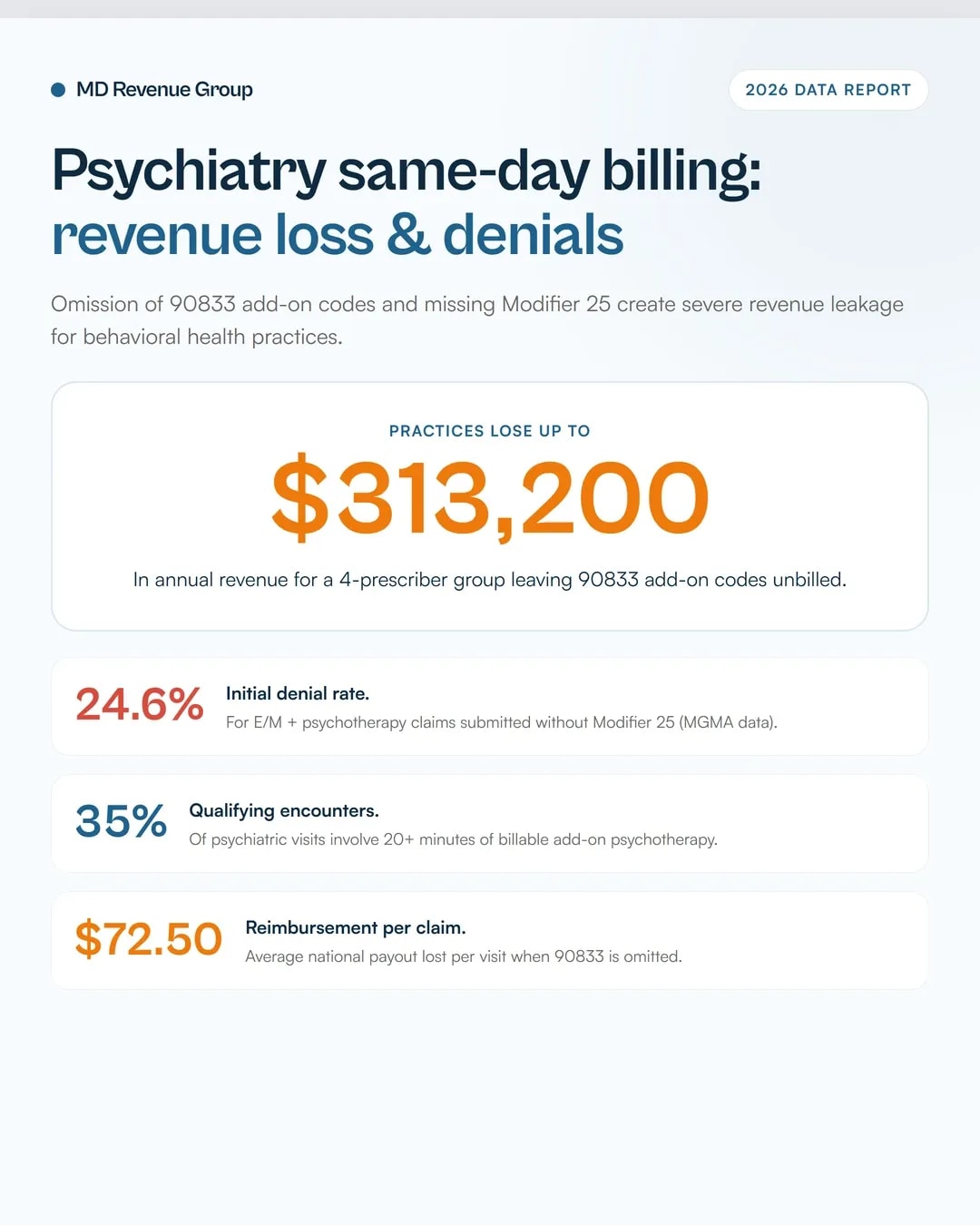
Commercial payers and Medicare Administrative Contractors (MACs) strictly enforce this requirement. A 2025 Medical Group Management Association (MGMA) benchmark study revealed that claims combining E/M and psychotherapy without Modifier 25 experienced an initial denial rate of 24.6%.
Claim Line 1: CPT 99214 + Modifier 25 (Primary E/M, MDM Supported)
Claim Line 2: CPT 90833 (Add-on Psychotherapy, 16+ Mins Documented)
Never append Modifier 25 to the psychotherapy add-on code itself. The modifier belongs on the E/M service code to state that the medical management went beyond the normal pre- and post-work associated with psychotherapy.
Practices operating in high-volume markets often request a free revenue audit to check whether their billing software automatically appends Modifier 25 to qualifying claim pairs.
Decision framework: selecting the correct code combination
Determining whether to bill E/M plus psychotherapy, standalone psychotherapy, or an E/M visit alone depends on clinical documentation and time allocation. Use this scannable decision matrix to guide provider coding:
Clinical Scenario | Primary Code | Secondary / Add-on Code | Modifier Required | Required Documentation |
|---|---|---|---|---|
Med management + 20 min CBT | 99213 or 99214 (via MDM) | 90833 | Modifier 25 on E/M | MDM details + 20 min therapy log |
Med management + 40 min therapy | 99214 (via MDM) | 90836 | Modifier 25 on E/M | MDM details + 40 min therapy log |
Med management + 10 min therapy | 99213 or 99214 (via MDM) | None (Unbillable) | None | Integrated in E/M note |
45 min therapy only (no med management) | 90834 (Standalone) | None | None | 38–52 min therapy documentation |
Complex med management (no therapy) | 99214 or 99215 (MDM or Time) | None | None | MDM details or total time log |
When documentation fails to support separate medical decision making, payers downcode the entire claim to a standalone psychotherapy code, forfeiting reimbursement for the E/M medical evaluation.
Proprietary calculation: the cost of unbilled 90833 add-on codes
Many psychiatric practices avoid billing CPT 90833 due to audit fear or complicated documentation rules. This defensive billing behavior creates substantial revenue leakage.
Consider a mid-sized psychiatric group practice with 4 full-time prescribers (MDs and PMHNPs). Each provider sees 16 established patients per day, 4 days per week (64 encounters per week per provider, totaling 256 weekly encounters across the practice).
Based on clinical review, 35% of these encounters involve 20+ minutes of structured psychotherapy alongside medication management.
Annual Revenue Loss Breakdown
- Qualifying Encounters: 256 weekly visits × 35% = 90 qualifying visits per week.
- Annual Qualifying Visits (48 work weeks): 90 × 48 = 4,320 visits per year.
- Average Commercial/Medicare Reimbursement for CPT 90833: $72.50 per claim.
- Total Unclaimed Revenue: 4,320 visits × $72.50 = $313,200 annual revenue loss.
[4 Prescribers] × [90 Add-on Encounters/Wk] = 4,320 Annual Encounters
4,320 Encounters × $72.50 (CPT 90833 National Average) = $313,200 Lost Cash Flow
Leaving $313,200 on the table every year to avoid documentation requirements is unsustainable. Establishing compliant EHR templates reclaims this revenue safely.
Practices seeking to capture full operational cash flow while managing multi-state provider rosters often evaluate our revenue cycle management solutions to institute enterprise claim controls.
Literal documentation examples for psychiatric EHR notes
To survive a CMS or commercial payer audit, your EHR documentation must visually and clinically separate the E/M work from the psychotherapy session. A single merged paragraph describing medication and therapy in general terms will fail an audit.
Use this structured format in your EHR notes:
CLINICAL PROGRESS NOTE
[SECTION 1: EVALUATION & MANAGEMENT]
Chief Complaint: Follow-up major depressive disorder, recurrent, moderate.
Data Reviewed: PHQ-9 score today: 14 (down from 18). Serum lithium level reviewed: 0.8 mEq/L (therapeutic).
Medical Decision Making: Patient reports partial response to Sertraline 100mg daily. Experiencing mild fatigue. Patient agrees to increase Sertraline to 150mg daily. Ordered repeat CBC and hepatic panel for next visit. Risk of dosage increase discussed.
E/M Code Selected: CPT 99214 (Moderate MDM: 1 chronic illness with exacerbation, prescription drug management).
[SECTION 2: PSYCHOTHERAPY ADD-ON]
Modality: Cognitive Behavioral Therapy (CBT).
Focus & Interventions: Addressed automatic negative thoughts regarding workplace stressors. Conducted cognitive restructuring exercises identifying catastrophizing patterns. Guided patient in developing a weekly thought record.
Patient Response: Patient actively engaged in thought restructuring and demonstrated understanding of homework exercises.
Time Documented: Start Time: 10:20 AM | End Time: 10:45 AM (Total Face-to-Face Psychotherapy Time: 25 minutes).
Add-on Code Selected: CPT 90833 (Psychotherapy 16-37 minutes with E/M).
Notice how Section 1 stands on its own to justify CPT 99214 via MDM, while Section 2 clearly logs 25 minutes of distinct CBT intervention to support CPT 90833.
For details on maintaining compliant business associate agreements and privacy controls when sharing documentation with billing partners, read our guide on 42 CFR Part 2 and mental health billing compliance.
Real-world case study: Texas psychiatry practice denial recovery
A 5-physician psychiatric group in Austin, Texas experienced a sudden surge in claim rejections from commercial payers in early 2025. Their clearinghouse reported a 31.8% denial rate on claims containing E/M codes paired with psychotherapy add-ons.
An internal audit revealed three primary root causes:
- Missing Modifier 25: Providers were selecting CPT 99214 and CPT 90833 in their EHR, but the practice management software was not configured to append Modifier 25 automatically. Payers denied the claims under code CO-97 (procedure bundled into primary service).
- Time-Based E/M Downcoding: Two prescribers were calculating E/M code levels based on total visit time (45 minutes) while also billing CPT 90833. Audit reviewers downcoded the E/M service to CPT 99213 and rejected the add-on code entirely.
- Vague EHR Notes: Progress notes combined medication reviews and therapeutic chats into a single 4-sentence paragraph, failing to meet Medicare Administrative Contractor (Novitas Solutions) documentation guidelines.
Remediation & Financial Recovery
The practice instituted a 30-day corrective action plan:
- Reconfigured their clearinghouse billing rules to force Modifier 25 on all 99213/99214 codes when accompanied by 90833 or 90836.
- Implemented structured EHR templates separating MDM documentation from start/stop psychotherapy time logs.
- Conducted mandatory physician coding training on MDM requirements.
Within 90 days, the practice's claim denial rate dropped from 31.8% to 2.1%. Re-billing corrected claims recovered $84,200 in historical denials, while full capturing of legitimate 90833 add-on codes increased monthly practice collections by $22,400.
Group practices managing complex regional billing across state lines can explore our operational solutions for medical revenue recovery in New Jersey and national markets.
Frequently asked questions
Can a Psychiatric Nurse Practitioner (PMHNP) bill CPT 90833 with an E/M code?
Yes. Nurse practitioners and physician assistants eligible to bill E/M codes (99202–99215) can bill CPT 90833, 90836, or 90838 when performing qualifying psychotherapy alongside an E/M service.
What happens if the psychotherapy portion lasts only 12 minutes?
Psychotherapy lasting less than 16 minutes does not meet the minimum threshold for CPT 90833. You cannot report an add-on psychotherapy code; the therapeutic discussion is considered part of the overall E/M service.
Is Modifier 25 required on commercial insurance claims for 90833?
Yes. While CPT manual definitions list 90833 as an add-on code, major commercial payers (UnitedHealthcare, Aetna, Humana, BCBS) and Medicare require Modifier 25 on the primary E/M code to prevent automated bundling denials.
Can I bill CPT 90833 during a telehealth visit?
Yes. Psychotherapy add-on codes are billable via telehealth when rendered via real-time audio-visual technology. Ensure you append the appropriate telehealth modifier (such as Modifier FQ for Medicare audio-only or Place of Service codes 02/10 per payer rules).
Next steps for your practice
Navigating same-day E/M and psychotherapy coding requires constant vigilance, precise EHR documentation, and compliant claim scrubbing. If your practice faces rising denial rates or hesitates to bill valid add-on codes, expert support is available.
Struggling with psychiatry denials or unbilled add-on revenue? We audit behavioral health RCM workflows and find hidden revenue leaks. Request a free revenue audit today.