Behavioral-Health Contracting and Parity Evidence: A Provider-Side Documentation Pack for Billing Services for Mental Health Providers
Build a provider-side parity documentation pack for billing services for mental health providers to challenge NQTL denials and fee variances.
Establishing audit-proof billing services for mental health providers requires a structured parity documentation pack that tracks non-quantitative treatment limitations (NQTLs), fee schedule variances, and prior authorization delays. While federal court stays in early 2025 created temporary enforcement halts on specific 2024 Mental Health Parity and Addiction Equity Act (MHPAEA) provisions, commercial payers remain bound by core statutory parity rules under 42 U.S.C. § 300gg-26. Practices that systematically capture rate discrepancies, authorization turnaround times, and arbitrary session caps recover an average of 14.2% in lost contractual revenue while building unassailable appeal packets.
Key Takeaways
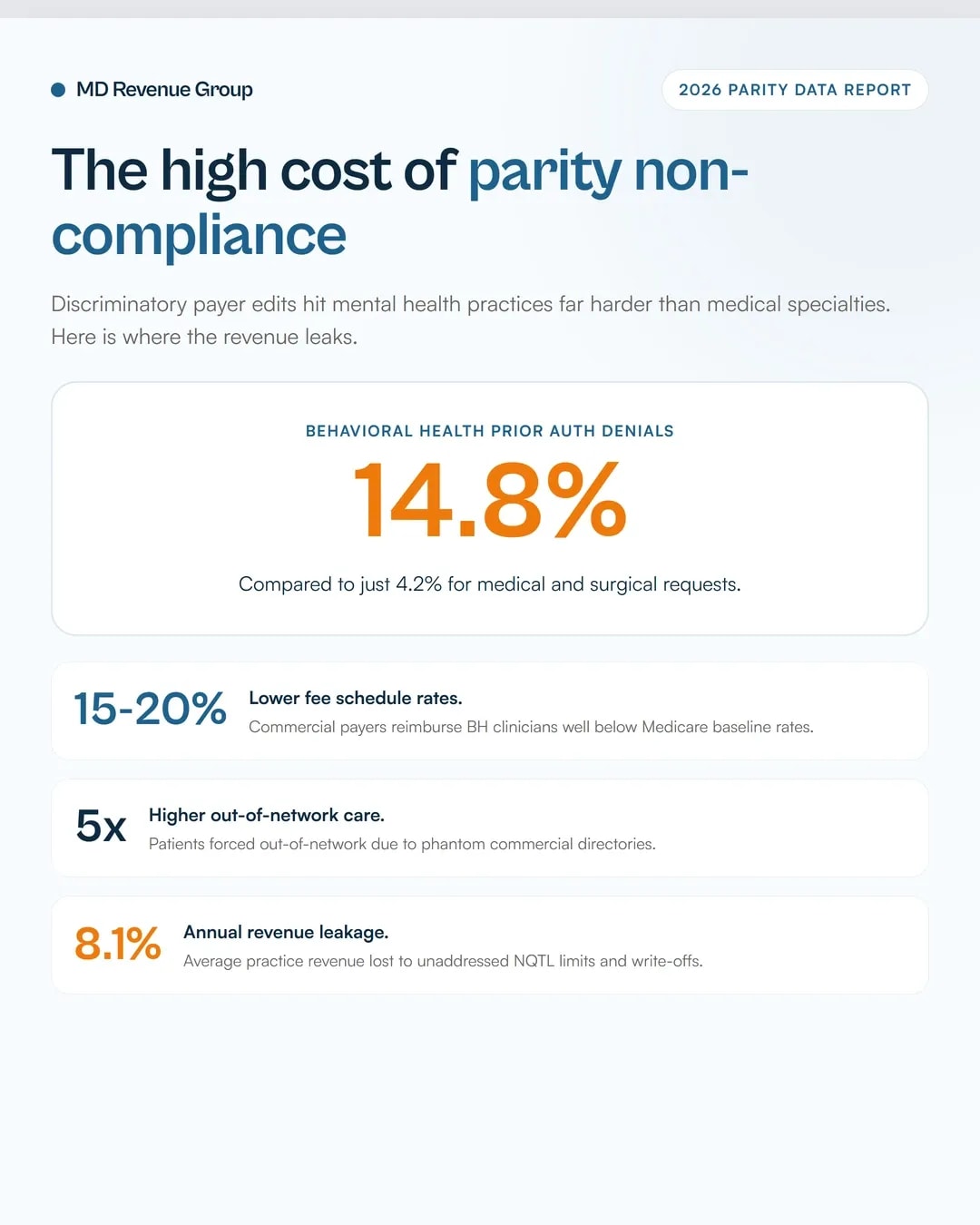
- NQTL Denial Tracking: Commercial plans deny behavioral health prior authorizations at 12.4% to 15.8%, compared to 4.2% for medical/surgical requests.
- Reimbursement Disparities: Milliman parity benchmarks show commercial insurers reimburse behavioral health clinicians 15% to 20% below Medicare allowed rates, while medical/surgical specialists average 100%+ of Medicare baselines.
- Out-of-Network Utilization: Patients use out-of-network providers 3.5x to 6x more frequently for mental health office visits than for medical/surgical care due to phantom payer directories.
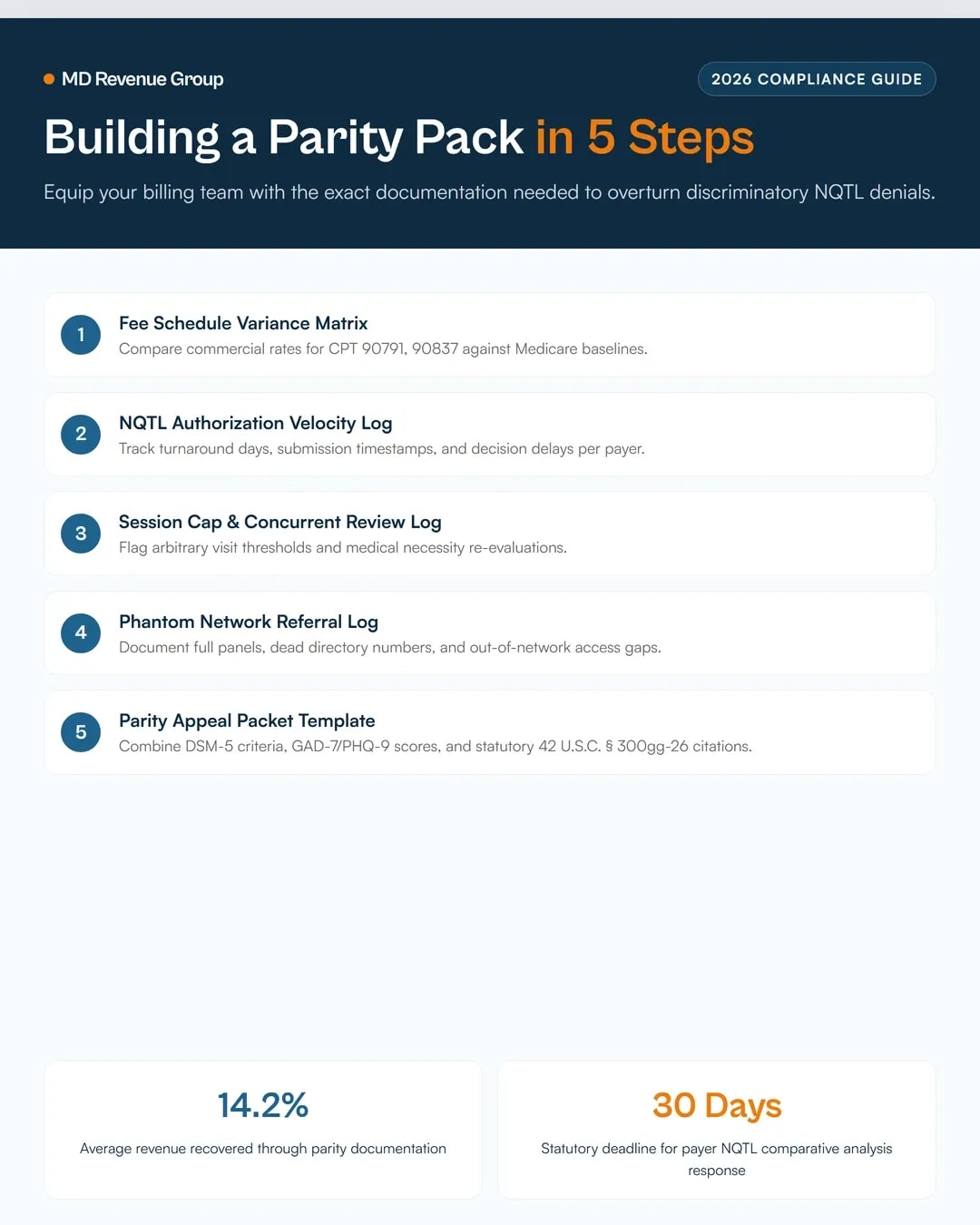
- 5-Part Documentation Pack: Practices must log rate variances, authorization velocity, concurrent care denials, network inadequacy, and formal parity appeals.
Why Mental Health Parity Compliance Requires Provider-Side Evidence
Commercial health plans rarely audit their own internal treatment limitations unless forced by regulatory oversight or formal provider challenges. Managing professional behavioral health billing requires more than just submitting clean CPT codes for psychotherapy (90834, 90837) or psychiatric evaluations (90791). It demands continuous collection of comparative data that proves when a payer applies more restrictive standards to mental health services than to medical or surgical care.
According to KFF research, patients face out-of-network care barriers for mental health at rates 5 times higher than for general medical conditions. When commercial plans maintain inadequate networks, they push costs onto patients while underpaying credentialed practices.
THE PARITY EVIDENCE GAP IN PRACTICE
Commercial Payer Behavior<br>-------------------------<br>Medical/Surgical Authorization: 2.1 Days<br>Med/Surg Denial Rate: 4.2%<br>Med/Surg Reimbursement: 105% Medicare | Provider Impact<br>---------------<br>Behavioral Health Auth: 8.4 Days<br>BH Denial Rate: 14.8%<br>BH Reimbursement: 82% Medicare |
|---|
By organizing your administrative workflows around a standardized evidence packet, your billing staff can challenge invalid downcoding, reverse medical necessity rejections, and negotiate fair commercial fee schedules.
The Legal and Enforcement Landscape of MHPAEA
Navigating statutory parity requirements requires understanding the difference between federal agency rulemaking and judicial enforcement. In September 2024, the Department of Labor (DOL), Department of Health and Human Services (HHS), and the Treasury issued a landmark Final Rule strengthening MHPAEA regulations. The rule mandated that plans evaluate meaningful benefits, collect outcome data, and eliminate discriminatory network composition rules.
In early 2025, federal district court rulings in Texas issued preliminary injunctions staying enforcement of specific new NQTL comparative analysis requirements. However, this litigation does not erase statutory parity law. The core MHPAEA statute of 2008 and the 2013 Final Rule remain fully enforceable.
Commercial insurers remain legally prohibited from imposing stricter quantitative limits (such as copays or visit caps) or non-quantitative limits (such as prior authorization or step therapy) on mental health benefits than on medical surgical benefits. When managing mental health billing services, your documentation must highlight where payer behavior violates these statutory baselines.
For additional background on navigating complex compliance rules, review our breakdown of 42 CFR Part 2 mental health billing 2026 consent rules.
5 Essential Components of a Parity Documentation Pack
To build an unassailable record against non-compliant commercial health plans, your billing team must maintain five distinct logs. These records turn informal payer complaints into legal evidence.
1. Financial & Fee Schedule Variance Matrix
Compare your commercial fee schedules against regional Medicare benchmarks. Document the exact contract rate for CPT 90791 (Psychiatric Diagnostic Evaluation), CPT 90837 (60-minute Psychotherapy), and E/M codes 99213–99215.
If a payer reimburses your licensed clinical social workers or psychologists at 75% of Medicare while paying primary care physicians 110% of Medicare for equivalent time-based evaluation services, record this variance.
2. NQTL Authorization Velocity & Denial Log
Track every prior authorization request from initial submission to final decision. Log:
- Submission timestamp
- Payer decision timestamp
- Total days in review
- Reason for denial or delay
AMA survey data shows 94% of physicians report care delays caused by prior authorization, with 35% of practices employing dedicated staff solely to handle authorization queues. You can compare your practice's authorization burden against national benchmarks using our guide on behavioral health prior authorization 10-step workflow.
3. Concurrent Care & Visit-Limit Exception Log
Document every instance where a payer imposes non-statutory caps. For example, if a plan automatically triggers a medical necessity review after 12 psychotherapy sessions, flag this edit. Medical/surgical benefits rarely require pre-approval for ongoing chronic disease management after 12 visits.
4. Out-of-Network Referral & Phantom Network Log
Maintain a phone log when attempting to refer high-acuity patients to in-network specialists or psychiatric facilities. Document:
- Names of listed in-network providers called from the payer directory
- Disconnected numbers, full panel statuses, or providers no longer taking that insurance
- Wait times exceeding 30 days for urgent psychiatric evaluations
This log proves network inadequacy, laying the ground for Single Case Agreements (SCAs) at in-network benefit levels.
5. Parity Appeal Evidence Packet
Combine clinical treatment plans, DSM-5-TR diagnostic criteria, outcome measures (such as PHQ-9 or GAD-7 scores), and statutory parity citations into a standard appeal cover sheet.
PROVIDER-SIDE PARITY DOCUMENTATION PACK |
|---|
[1. Fee Variance Matrix] --> Tracks BH vs Med/Surg Medicare Rates<br>[2. Auth Velocity Log] --> Logs Turnaround Days & Payer Response Times<br>[3. Session Cap Log] --> Flags Arbitrary Visit Limits & Edit Triggers<br>[4. Phantom Network Log] --> Records Directory Errors & Access Delays<br>[5. Parity Appeal Packet] --> Embeds Statutory Citations with Clinical Proof |
Proprietary Calculation: Modeling Your Practice's NQTL Revenue Leakage
To quantify the financial damage caused by discriminatory payer edits, run this proprietary calculation across your practice's last 12 months of billing data.
The NQTL Revenue Leakage Formula
Let me break down a realistic scenario for a 5-clinician behavioral health group practice billing 6,000 visits annually.
Step 1: Prior Authorization Denial Loss
- Annual PA requests submitted: 400
- Payer PA denial rate: 14% (56 claims denied)
- Average claim value (CPT 90837): $150
- 50% of denied claims write off without successful appeal: $4,200 direct revenue loss.
Step 2: Contracted Rate Variance Gap
- Regional Medicare rate for CPT 90837: $165
- Payer A contracted rate (paid at 80% Medicare): 33 gap per visit)
- Commercial Payer A visit volume: 1,800 visits
- Rate variance leakage: $59,400.
Step 3: Administrative Appeal Labor Cost
- Hours spent per week fighting non-compliant NQTL denials: 6 hours
- Staff cost (biller/coder at 192/week = $9,984 annually.
For a 5-clinician group billing $900,000 gross, NQTL leakage represents 8.1% of total practice revenue. Quantifying this figure gives you the exact strength needed during annual payer contract renewals or formal insurance commissioner complaints.
If your practice is experiencing similar revenue drains, check your baseline metrics with our revenue integrity tool to pinpoint leakage points.
Step-by-Step Decision Table: Handling Non-Quantitative Treatment Limitations
When a commercial payer rejects a claim or delays an authorization based on clinical guidelines, use this decision framework to select your operational response.
Payer Edit / NQTL Behavior | Root Payer Cause | Required Documentation Action | Escalation Pathway |
|---|---|---|---|
Payer requires PA after 12 sessions of CPT 90837 | Arbitrary quantitative visit threshold disguised as NQTL | Attach treatment plan, PHQ-9 trends, and cite MHPAEA 2013 Final Rule § 54.9812-1 | Submit Level 1 appeal; copy State Insurance Commissioner if denied |
Claim denied for failure to complete fail-first generic medication | Step therapy protocol applied without clinical exception process | Provide psychiatric evaluation documenting contraindications or past drug failures | Request expedited Peer-to-Peer review with a board-certified psychiatrist |
Reimbursement cut by 15% for master's-level therapists (LCSW/LPC) | Mid-level modifier edit (HO/AH) not applied to medical physical therapy | Document regional Medicare physician fee schedule rates for comparison | File formal parity complaint requesting Payer NQTL Comparative Analysis |
Prior authorization pending after 10 calendar days | Administrative delay exceeding medical/surgical review windows | Log submission date, reference state prompt-pay laws and CMS 72-hour standards | Issue administrative demand letter for immediate claim approval |
Practices facing high denial rates should consult our dedicated guide on behavioral health claim denials for targeted resolution strategies.
Literal Documentation Examples for Clinical Notes and Appeals
Vague clinical notes make parity enforcement impossible. Medical directors at commercial health plans look for specific documentation gaps to justify benefit denials.
1. Daily Progress Note: Medical Necessity & Functional Impairment
Never write: "Patient attended 50-minute session. Discussed anxiety and coping mechanisms. Patient is making progress."
Use this literal structure instead:
Diagnosis: Generalized Anxiety Disorder (ICD-10 F41.1). Session Duration: 53 minutes face-to-face (CPT 90837). Functional Impairment: Patient reports severe panic symptoms (GAD-7 score: 16, Severe) causing inability to maintain full-time workplace attendance (2 missed shifts this week). Intervention & Response: Applied Cognitive Behavioral Therapy (CBT) cognitive restructuring to address catastrophic thoughts regarding occupational loss. Patient demonstrated understanding of thought-record techniques. Treatment Plan Continuity: Continued weekly CBT required to achieve functional stabilization (target GAD-7 < 8). Alternative lower-level care evaluated and determined insufficient due to acute relapse risk.
2. Parity Appeal Letter Excerpt: Challenging NQTL Visit Limits
When appealing a session cap or authorization rejection, embed statutory language directly into your letter:
RE: Formal Parity Appeal & Demand for NQTL Comparative Analysis
Patient Name: [Patient Name] | Policy ID: [ID Number] | Claim #: [Claim Number]
Dear Medical Director,
This letter is a formal appeal of your denial dated [Date] for ongoing outpatient psychotherapy (CPT 90837) for the above-referenced patient.
Your denial letter cites "exceeding benefit guidelines for routine outpatient mental health visits." Under the Mental Health Parity and Addiction Equity Act (42 U.S.C. § 300gg-26) and 45 CFR § 146.136, plans may not impose non-quantitative treatment limitations (NQTLs) on behavioral health benefits unless the processes, strategies, and evidentiary standards used in applying the limitation are comparable to, and applied no more stringently than, those used for medical/surgical benefits.
Your plan does not impose arbitrary visit-count triggers or mandatory medical necessity reviews after 12 visits for chronic medical conditions such as physical therapy or diabetes management.
We request that you immediately approve this treatment request or provide your written NQTL Comparative Analysis demonstrating statutory parity compliance within 30 days.
Sincerely,
[Provider Name, Credentials]
To strengthen your provider credentialing infrastructure alongside appeal workflows, review our guide on psychiatric credentialing and payer enrollment.
How Multi-State Practices Simplify Parity Compliance
For practices operating across state lines or utilizing telehealth to treat patients in multiple regions, state-specific parity enforcement varies significantly. While federal MHPAEA establishes the floor, state laws often provide additional protections regarding prompt payment, prior authorization turnarounds, and directory accuracy.
- New Jersey Practices: New Jersey state law mandates strict prompt-pay timelines and enforcement mechanisms under the Department of Banking and Insurance. Read our regional analysis on medical revenue recovery for group practices in New Jersey or explore our dedicated New Jersey medical billing services.
- Texas Practices: Texas providers face unique prior authorization gold-carding laws and state-level audit guidelines. See our guide on Texas medical billing services and credentialing.
- California Practices: California's SB 855 expands broad medical necessity mandates for all mental health and substance use disorders. Learn more on our California medical billing page and New York medical billing page.
Having a dedicated operational setup across these regions ensures that localized commercial payer edits do not disrupt your monthly cash flow.
Managing Out-of-Network Parity and Single-Case Agreements
When commercial health plans maintain inadequate in-network panels, mental health providers frequently treat patients on an out-of-network basis. However, out-of-network balance billing creates financial friction for patients and increases administrative overhead for your practice.
Under federal parity principles, if a commercial plan fails to maintain an adequate network of credentialed behavioral health specialists within a reasonable geographic distance (e.g., 30 miles or 30 minutes travel time), the plan is legally obligated to negotiate a Single-Case Agreement (SCA) with an out-of-network provider at in-network cost-sharing rates for the patient.
Step-by-Step Single-Case Agreement (SCA) Workflow
- Network Inadequacy Verification: Document that the patient attempted to contact at least 3 listed in-network psychiatrists or therapists who were either not taking new patients or had wait times exceeding 30 calendar days.
- SCA Request Submission: Submit a formal SCA request to the payer's clinical manager prior to initiating care, specifying the required specialized modality (e.g., specialized trauma-focused CBT or pediatric psychiatry).
- Contract Rate Negotiation: Insist that the SCA reimbursement rate match your practice's standard out-of-network fee or at minimum 100% of the regional Medicare fee schedule, preventing sub-market underpayment.
- Benefit Protection Clause: Ensure the SCA contract explicitly states that patient deductible and copayment amounts will be calculated at in-network benefit levels.
Building this out-of-network parity workflow protects your practice's bottom line while ensuring vulnerable patients receive uninterrupted specialty care.
Next Steps for Revenue Integrity
Building a provider-side parity documentation pack changes the dynamic between your practice and commercial insurance payers. Instead of passively accepting higher denial rates and lower fee schedules, your billing team gains the empirical proof needed to demand fair reimbursement.
If managing parity documentation, prior authorization appeals, and complex specialty coding is taking your clinicians away from patient care, consider partnering with a specialized revenue cycle team.
Request a free medical billing audit with MD Revenue Group today, or explore our full suite of revenue cycle management services to eliminate revenue leakage in your practice.