
Medical Billing Services Guide: 2027 RPM/RTM Workflow Changes and Contractor Monitoring
Engage expert medical billing services to navigate proposed 2027 CMS RPM/RTM rules, W-2 staff mandates, initiating visits, and OIG compliance.
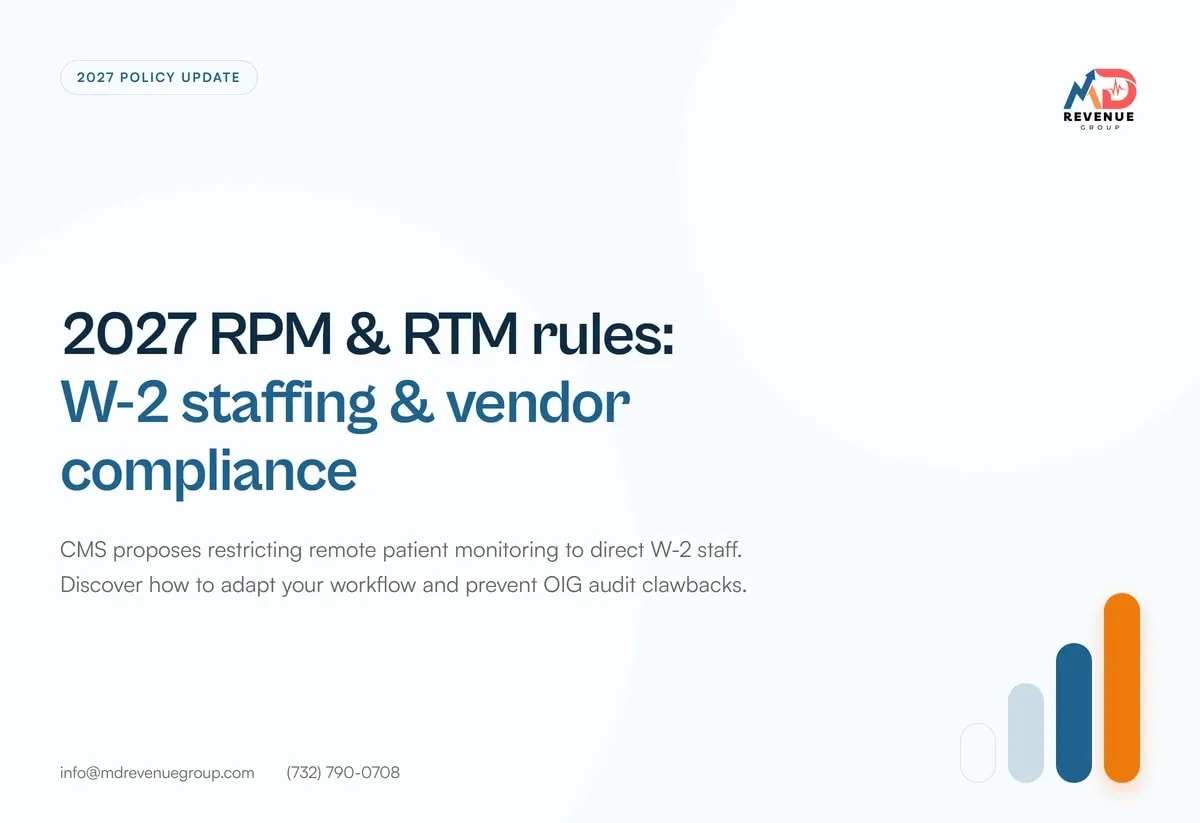
Engaging specialized medical billing services is critical as practices prepare for proposed CMS regulatory shifts governing Remote Patient Monitoring (RPM) and Remote Therapeutic Monitoring (RTM). In the CY 2027 Physician Fee Schedule proposed rule (CMS-1848-P), federal regulators outlined major structural revisions to remote care management. The most impactful change is a proposed mandate restricting RPM and RTM clinical staff billing strictly to direct, W-2 employees of the billing practice.
If finalized in late 2026, this rule will effectively dismantle outsourced third-party monitoring vendor arrangements where contracted clinical staff perform device setup, data monitoring, and patient outreach under general supervision. Practices relying on contracted monitoring vendors will need to restructure their operations by January 1, 2027, bringing clinical monitoring in-house or establishing formal joint-employment structures.
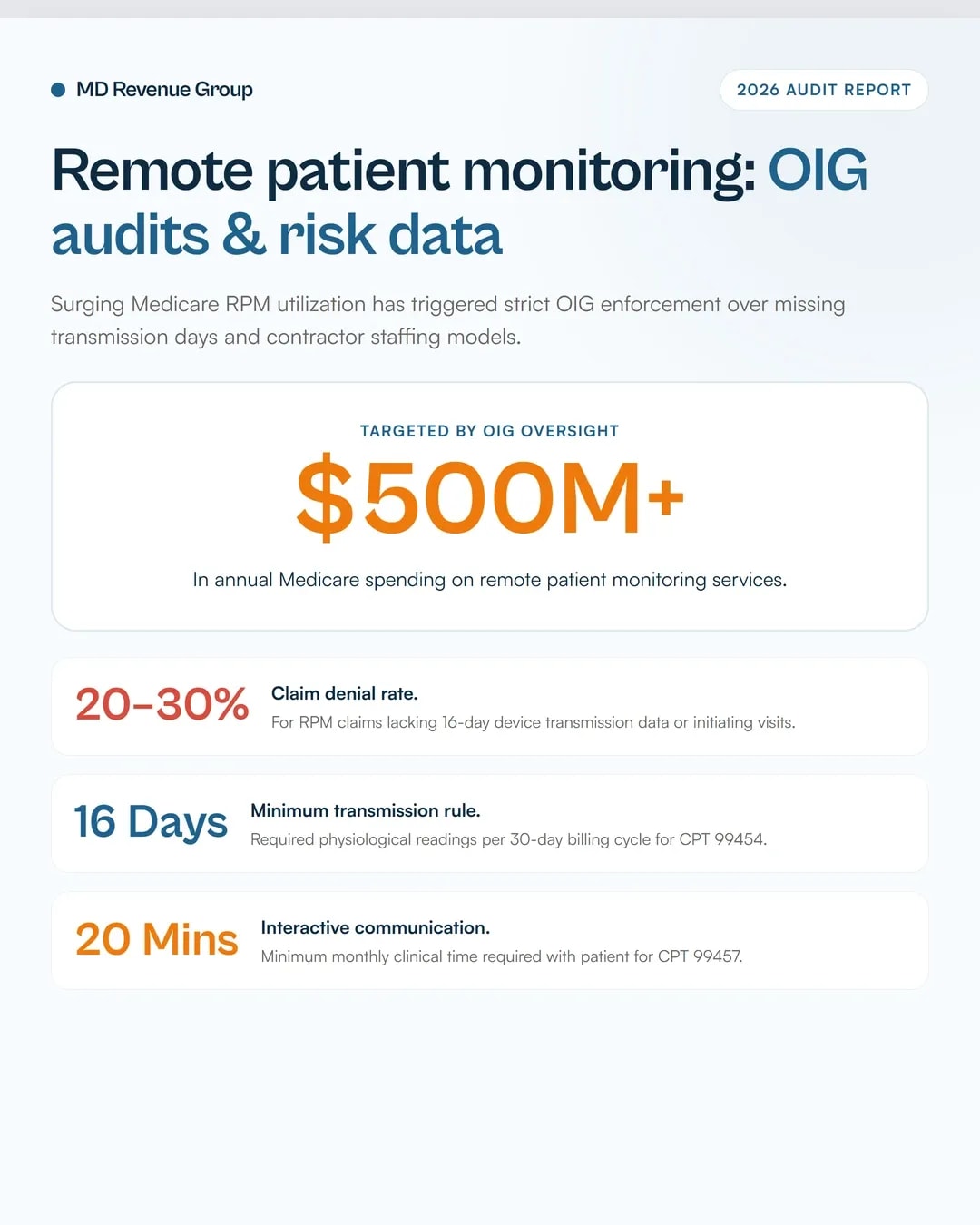
Simultaneously, the Office of Inspector General (OIG) has intensified audit scrutiny over remote care codes (CPT 99453, 99454, 99457, 98975, 98980), citing over $500 million in annual Medicare spending and a 20–30% claim denial rate caused by missing 16-day transmission data or unverified initiating visits. Navigating these regulatory updates requires establishing strict billing controls and evaluating staff employment frameworks now.
Key takeaways
- W-2 Employment Mandate: CMS proposes requiring clinical staff performing RPM/RTM monitoring to be direct W-2 employees of the billing practice starting January 1, 2027.
- End of Contracted Vendor Staffing: Third-party monitoring vendors using contracted nurses under general supervision will no longer qualify for billing under the proposed rule.
- Mandatory Initiating Visit: A face-to-face initiating E/M or Annual Wellness Visit (AWV) is required before enrolling patients in RPM or RTM programs.
- OIG Audit Focus: Medicare remote care spending topped $500 million, with auditors flagging claims lacking 16-day device transmission data or 20 minutes of interactive clinical time.
- 2026 Rules Unchanged: Current 2026 billing rules remain active under general supervision while CMS prepares the final rule release in November 2026.
What is changing in CMS RPM and RTM regulation
Remote care management transformed patient monitoring following the expansion of CPT codes for Remote Patient Monitoring (CPT 99453, 99454, 99457, 99458) and Remote Therapeutic Monitoring (CPT 98975, 98976, 98977, 98980, 98981). These codes allowed physicians to bill for medical devices transmitting physiological data (blood pressure, glucose, weight) and non-physiological data (respiratory effort, musculoskeletal therapy adherence).
However, rapid adoption led to fragmented care models. Many practices contracted with third-party vendors who supplied devices, enrolled patients, conducted monthly 20-minute check-ins using vendor-employed nurses, and delivered pre-packaged billing files to the practice.
In response, CMS proposed tightening program integrity in the CY 2027 Physician Fee Schedule proposed rule. The agency aims to reconnect remote monitoring directly to the primary care provider's clinical team.
Practices evaluating these regulatory transitions rely on comprehensive revenue cycle management strategies to adapt billing workflows before compliance deadlines take effect.
The proposed 2027 W-2 employment mandate explained
The cornerstone of the proposed 2027 CMS rule is the direct employment requirement for clinical staff. Under current 2026 regulations, auxiliary clinical staff (such as Registered Nurses or Medical Assistants) can perform RPM/RTM treatment management under the general supervision of a physician or qualified healthcare professional. Crucially, these staff members could be independent contractors or employees of an outsourced third-party vendor.
The proposed 2027 rule changes this definition:
- Current Rule (2026): Clinical staff may be W-2 employees, 1099 contractors, or leased staff from a third-party vendor operating under general physician supervision.
- Proposed Rule (2027): Clinical staff performing RPM (99457/99458) or RTM (98980/98981) must be direct W-2 employees of the billing practitioner or physician group practice.
2026 Model: Practice -> Contracts Vendor -> Vendor RNs Monitor -> Practice Bills CMS (ALLOWED)
2027 Proposed: Practice -> Direct W-2 Staff -> In-House RNs Monitor -> Practice Bills CMS (MANDATED)
If finalized, third-party companies can no longer provide "full-service monitoring staff" while allowing the physician to submit claims under their NPI. Vendor contracts must shift from staffing models to software-only or device-leasing agreements.
Practices managing multi-specialty clinics across state lines, such as groups utilizing medical billing services in California, must audit their current vendor agreements to identify non-compliant staffing arrangements.
Mandatory initiating visits and established patient rules
A second major proposed policy shift involves enrollment prerequisites. CMS proposes enforcing a mandatory, separately billable initiating visit before a patient can begin RPM or RTM services.
This initiating visit must be an in-person or telehealth Evaluation and Management (E/M) service, such as a comprehensive office visit (99202–99215), an Annual Wellness Visit (AWV), or an Initial Preventive Physical Examination (IPPE). During this visit, the billing practitioner must:
- Diagnose the chronic or acute condition requiring remote monitoring.
- Formulate a personalized clinical care plan.
- Obtain and document informed patient consent.
- Order the specific medical device.
CMS also proposes restricting RTM enrollment strictly to established patients, aligning RTM rules directly with existing RPM requirements. Enrolling new patients directly into remote monitoring via online forms or vendor marketing without an established clinical relationship will violate Medicare program rules.
For practices interested in how care management add-ons interact with primary care coding, review our detailed guide on G2211 and APCM billing integration.
OIG audit findings and red-flag billing patterns
Federal oversight of remote patient monitoring has expanded dramatically. A nationwide audit released by the HHS Office of Inspector General (OIG) revealed that Medicare payments for RPM surged past $500 million annually, driven by high claim volumes and automated billing scripts.
The OIG highlighted five "red-flag" operational patterns that trigger targeted audits and claim clawbacks:
Audit Red Flag | Regulatory Violation | Operational Impact |
|---|---|---|
Missing 16-Day Data | Billing 99454 without 16 days of readings in a 30-day period | Automated denial under code CO-16 |
No Interactive Communication | Billing 99457 without 20 mins of real-time clinical interaction | Complete claim clawback upon audit |
Unestablished Enrollees | Enrolling patients with no prior visit history with the practice | Program integrity investigation |
Multiple Device Billing | Submitting 99454 for multiple devices for one patient in one month | Duplicate service rejection (CO-18) |
Unsupervised Vendor Billing | Vendor staff operating without documented physician oversight | False Claims Act liability |
Industry data indicates that 20% to 30% of RPM claims are delayed or rejected on initial submission due to failure to verify the 16-day transmission threshold or lack of clinical time logs.
Performing regular internal audits is essential. Many healthcare leadership teams schedule a medical billing audit to evaluate their documentation logs against OIG compliance guidelines.
Decision framework: vendor revenue share vs in-house W-2 staffing
As practices evaluate the proposed 2027 CMS rule, leadership must decide whether to transition to in-house W-2 monitoring or restructure vendor partnerships into software-only models. Use this scannable decision matrix to compare options:
Operational Dimension | Full-Service Vendor Model (Phasing Out) | Software-Only Vendor + In-House W-2 Staff | Full In-House Infrastructure |
|---|---|---|---|
2027 Compliance | High Non-Compliance Risk | Fully Compliant | Fully Compliant |
Staffing Source | Vendor 1099/Leased RNs | Practice W-2 Medical Assistants / RNs | Practice W-2 RNs |
Device & Software | Included in Vendor Fee | Leased from Vendor | Purchased / Software License |
Financial Split | 40%–50% Revenue Share to Vendor | Software SaaS Fee (15/patient/mo) | Direct Overhead Costs |
Clinical Control | Low (External Vendor Touchpoints) | High (Practice Staff Handles Calls) | Maximum Clinical Oversight |
Transitioning to in-house W-2 staff supported by a software-only platform ensures compliance with proposed CMS rules while preserving practice profit margins.
Practices reviewing whether to manage these care management programs internally or partner with external specialists can read our detailed analysis on whether outsourcing medical billing is worth it.
Proprietary calculation: break-even analysis for in-house RPM clinical staff
Many medical groups assume that hiring dedicated W-2 clinical staff for RPM monitoring creates cost inefficiencies. However, a financial modeling exercise demonstrates that bringing monitoring in-house under a software-only model generates significantly higher net margin than a 50% vendor revenue-share model.
Consider a cardiology and internal medicine group with 300 active RPM patients.
1. Revenue Potential per Patient per Month (Medicare Averages)
- CPT 99454 (Device Data Supply): $52.00
- CPT 99457 (First 20 Min Management): $48.50
- Total Monthly Reimbursement per Patient: $100.50
- Total Monthly Gross Practice Revenue (300 patients): 300 × $100.50 = $30,150 per month ($361,800 annually).
2. Scenario A: Outsourced Vendor Revenue Share (50% Split)
- Vendor Fee (50%): $15,075 per month.
- Practice Net Monthly Revenue: $15,075 per month ($180,900 annually).
- Compliance Status: High risk under proposed 2027 W-2 rule.
3. Scenario B: In-House W-2 Dedicated Medical Assistant + Software SaaS Fee
- Software/Device SaaS Fee ($15/patient/mo): 300 × 4,500 per month.
- Dedicated W-2 Medical Assistant Salary & Benefits (0.5 FTE): $3,200 per month.
- Total In-House Monthly Operating Cost: 3,200 = $7,700 per month.
- Practice Net Monthly Revenue: 7,700 = $22,450 per month ($269,400 annually).
Outsourced Vendor Net Revenue: $180,900 / Year (Non-Compliant in 2027)
In-House W-2 Staff Net Revenue: $269,400 / Year (Fully Compliant in 2027)
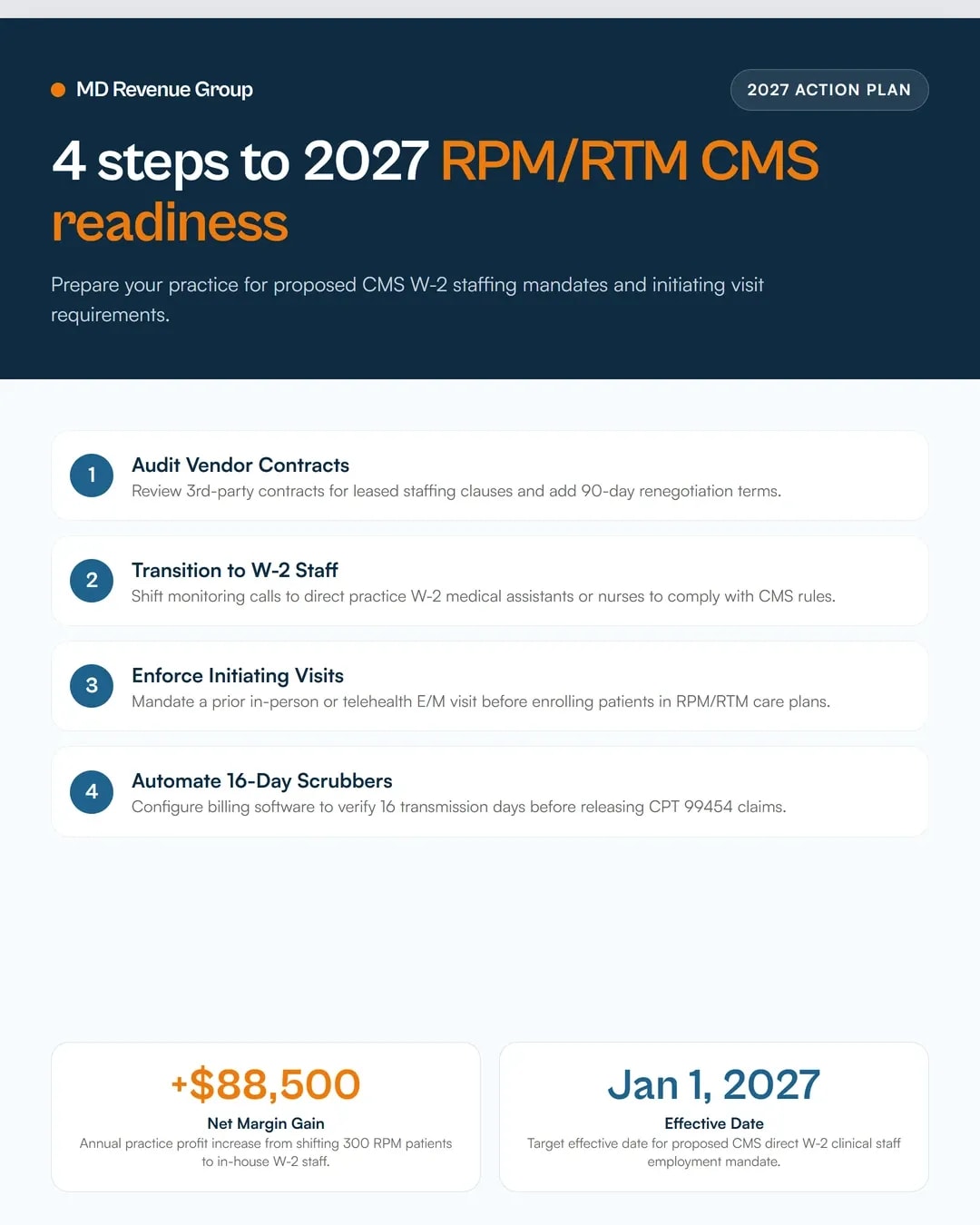
Annual Financial Gain from In-House Transition: +$88,500
Transitioning to an in-house W-2 staffing model increases annual practice cash flow by $88,500 while achieving total compliance with proposed CMS regulations.
Practices operating across Southeast markets, such as group practices utilizing medical billing services in Florida, frequently implement this exact model to maintain compliance and optimize collections.
Operational compliance checklist for 2027 readiness
Medical practices should execute these four action items before the CMS CY 2027 Final Rule is released in November 2026:
- Audit Existing Vendor Contracts: Review current RPM and RTM vendor contracts. Identify terms related to clinical staffing, patient outreach, and revenue sharing. Insert 90-day renegotiation clauses.
- Institute 16-Day Transmission Scrubbers: Configure billing software to hold CPT 99454 and 98977 claims automatically until the EHR verifies 16 distinct days of transmitted data within the 30-day billing cycle.
- Verify Initiating Visit Workflows: Establish an EHR hard-stop preventing RPM/RTM order creation unless an E/M visit or Annual Wellness Visit has occurred within the past 12 months.
- Transition to Software-Only Vendor Platforms: Begin shifting vendor relationships toward technology-only contracts where vendor software integrates into your EHR, but clinical care management calls are conducted by your practice's W-2 staff.
Practices seeking an objective evaluation of their current coding workflows can request a free revenue audit from our compliance specialists.
Frequently asked questions
When do the proposed CMS 2027 RPM/RTM rules take effect?
The rules were published in the CY 2027 Physician Fee Schedule proposed rule in July 2026. If finalized in the final rule (expected November 2026), changes will take effect on January 1, 2027.
Can a practice still outsource RPM software and devices?
Yes. The proposed restriction applies specifically to clinical staffing. Practices can continue to lease devices and license software platforms from third-party vendors, provided the clinical monitoring and patient interactions are conducted by the practice's direct W-2 employees.
What is the 16-day monitoring rule for CPT 99454?
CPT 99454 requires that the medical device transmit physiological data on at least 16 days out of a 30-day billing cycle. If data is transmitted for 15 days or fewer, CPT 99454 cannot be billed for that monthly period.
Does Chronic Care Management (CCM) have the same W-2 staffing proposal?
No. The specific W-2 employment restriction proposed in the 2027 fee schedule applies to RPM and RTM. Chronic Care Management (CCM) and Principal Care Management (PCM) continue to allow contracted clinical staff under general physician supervision.
Next steps for your practice
Preparing for major CMS regulatory shifts requires early operational adjustments, contract reviews, and strict billing controls. Practices that adapt early protect their revenue and avoid severe audit penalties.
Unsure if your RPM monitoring vendor contracts comply with upcoming 2027 CMS rules? We audit RCM operations and safeguard your compliance. Request a free revenue audit today.