AI and Administrative Workflows: What CAQH Data Means for Billing-Vendor Selection
Analyze 2025 CAQH Index data showing $21B in administrative savings. Learn how medical billing outsourcing vendors use AI for eligibility and prior auth.
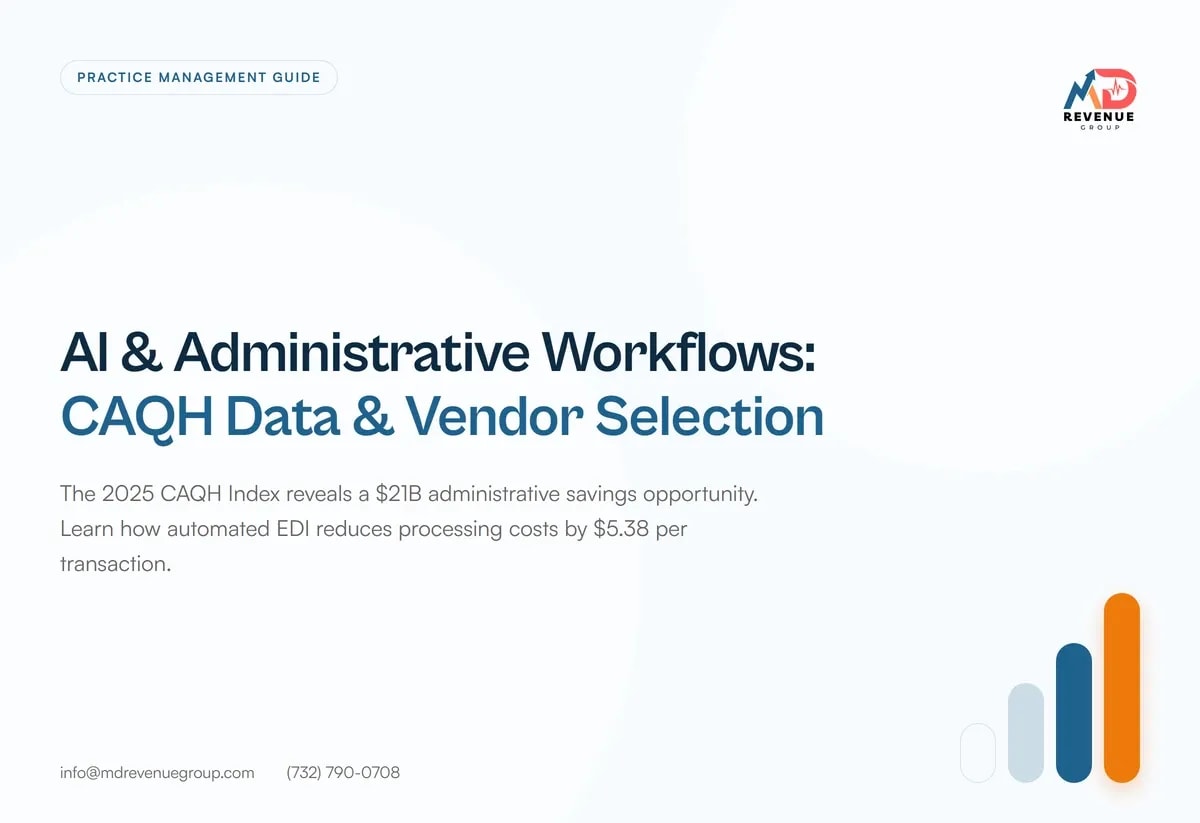
Choosing an RCM vendor requires looking beyond basic claims processing fees to evaluate how well their technology automates routine administrative transactions. The 2025 CAQH Index reveals a 258 billion in unnecessary processing costs. Shifting from manual phone calls, faxes, and web portals to standardized electronic data interchange saves practices an average of $5.38 per transaction. Evaluating how prospective billing partners handle eligibility verification (X12 270/271), prior authorization (X12 278), and claim status checks (X12 276/277) directly dictates your operational margin. This guide analyzes CAQH transaction benchmarks, outlines a 4-pillar vendor due-diligence scorecard, and shows how medical billing outsourcing companies deploy AI-driven automation while maintaining PHI security and human compliance oversight.
Key Takeaways
- Transitioning administrative transactions from manual or portal-based processing to electronic EDI standards yields an average savings of $5.38 per transaction.
- Electronic prior authorization adoption reached 40% in recent CAQH data, leaving 60% of authorizations bound to labor-intensive portal and phone workflows.
- Evaluating prospective billing partners requires auditing third-party security credentials like SOC 2 Type II and HITRUST CSF alongside first-pass clean claim rates.
- Implementing automated X12 transactions reduces claim status inquiry costs from 1.00 per automated request.
What the 2025 CAQH Index reveals about healthcare administrative costs
Healthcare organizations continue to spend significant staff hours managing basic administrative tasks across fragmented payer portals. The CAQH Index tracks transaction volumes and processing costs across medical and dental providers nationwide.
While electronic claim submission has reached over 90% industry adoption, front-end administrative workflows remain heavily dependent on manual intervention. Phone calls to verify patient benefits or manually checking claim status on individual payer websites drive up overhead costs for growing practices.
When practices evaluate external RCM partners, reviewing how vendors handle routine data exchange is critical. Choosing tech-enabled medical billing outsourcing services ensures your practice captures automated transaction savings without expanding in-house administrative headcount.
CAQH Administrative Benchmark Summary:
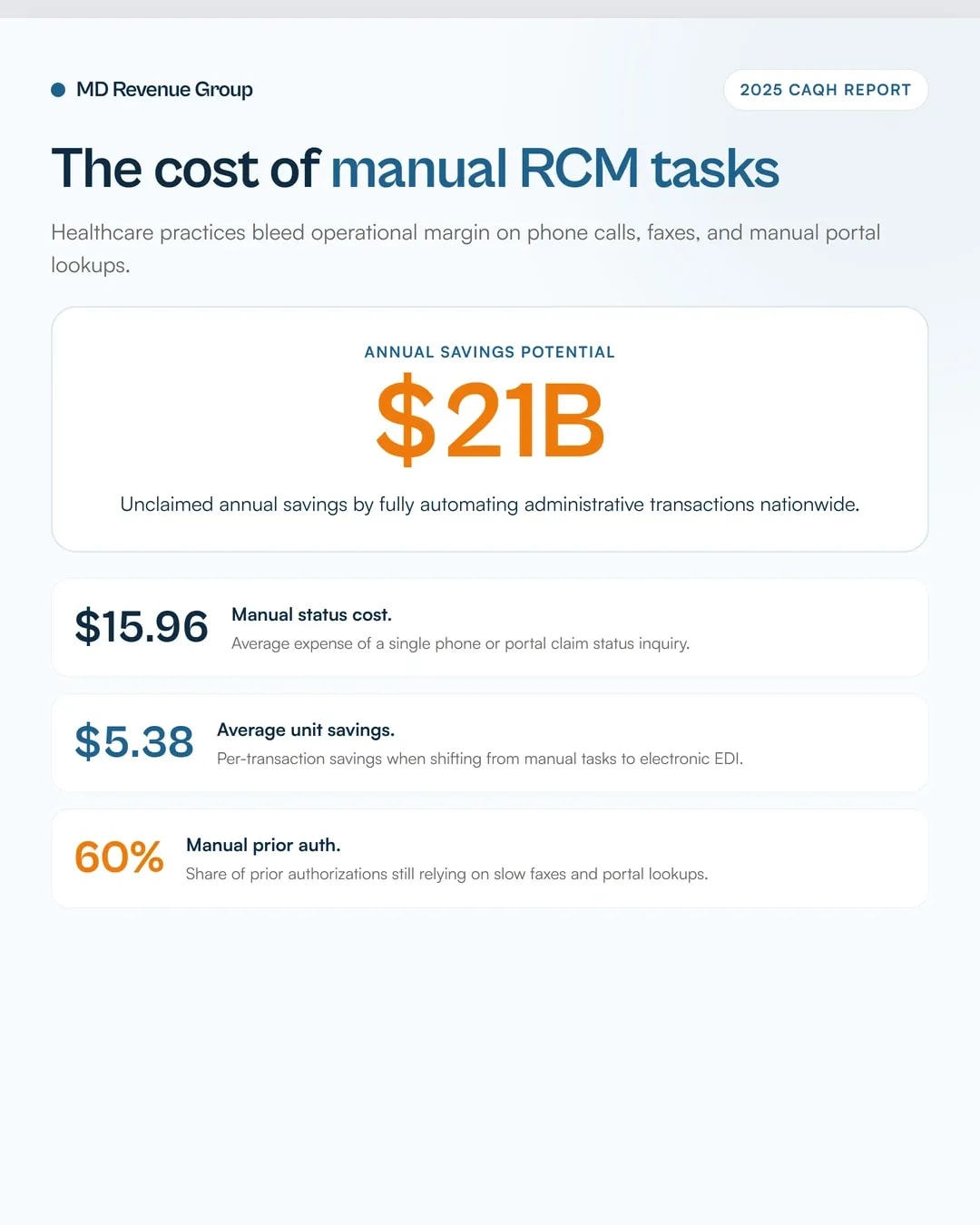
Industry Savings Potential: $21 Billion annually through full automationTotal Avoided Costs (2024): $258 Billion via existing electronic EDI channelsAverage Per-Transaction Savings: $5.38 saved by replacing manual workflows with electronic EDI
Medical group practice managers often overestimate their internal automation coverage. While standard billing software generates electronic claims (837 EDI format), front-desk staff frequently log into individual health plan portals to verify eligibility details manually.
These hidden manual workarounds waste hundreds of administrative hours annually. Outsourcing to a vendor with true API integrations eliminates double data entry and accelerates claim submission cycles.
Manual vs. electronic transaction costs: Where medical practices bleed margin
Administrative processing expenses vary dramatically depending on whether a transaction is conducted manually (phone/fax), via a web portal, or through fully integrated electronic EDI standards.
Manual prior authorizations cost providers an average of 3.82 per request, saving $7.62 per authorization.
Similarly, manual claim status inquiries cost approximately 1.00 per automated check.
Administrative Transaction | Manual Processing Cost | Fully Electronic Cost | Per-Transaction Savings |
|---|---|---|---|
Prior Authorization | $11.44 | $3.82 | $7.62 |
Claim Status Inquiry | $15.96 | $0.75 | $15.21 |
Eligibility & Benefits | $8.50 | $0.50 | $8.00 |
Payment Posting / Remittance | $6.20 | $0.85 | $5.35 |
Practices that rely on manual phone calls for benefit verifications waste dozens of staff hours each week. Conducting a thorough free practice revenue audit identifies where manual processing bottlenecks slow down cash flow.
Electronic remittance advice (ERA 835) adoption has reached 78% nationwide. However, matching unposted ERA files to bank deposits manually creates reconciliation errors. High-performing RCM partners automate payment posting and contract variance checks down to the line-item level.
How AI and EDI automation transform medical billing outsourcing
Modern medical billing companies use artificial intelligence to augment standard electronic data interchange. Rather than relying solely on static rules, machine learning models analyze historical clearinghouse data to predict claim denials before claims are transmitted.
For example, automated pre-bill scrubbing engines cross-reference patient eligibility records (X12 271) with procedure codes to catch modifier mismatches. When an exception occurs, the system routes the claim to a human biller with specific correction instructions.
Rule-Based Scrubbing vs. Machine-Learning RCM Automation:
Rule-Based Systems: Flag hardcoded errors (missing NPI, invalid ICD-10 code format).Machine-Learning Engines: Detect subtle payer-specific denial patterns based on historical remits.Human-in-the-Loop Threshold: Automatically escalates claims exceeding $2,500 for certified coder review.
Deploying AI in pre-submission scrubbing directly reduces initial denial rates. Understanding the operational controls behind these algorithms is detailed in our guide on ai in denial management governance controls, which explains how human-in-the-loop workflows protect claim integrity.
Advanced billing software uses optical character recognition and natural language processing to extract clinical documentation required for prior auth approvals. This artificial intelligence layer eliminates manual fax transmission between clinic staff and payer utilization management departments.
Automated clearinghouse rules analyze payer-specific claim attachment policies in real time. Flagging missing operative reports or lab results prior to submission prevents immediate claim rejections.
The 4-pillar vendor scorecard: Questions to test AI governance and security
Outsourcing revenue cycle operations to an automated vendor requires rigorous due diligence. Practices must verify that prospective billing companies maintain strict data security and compliance safeguards.
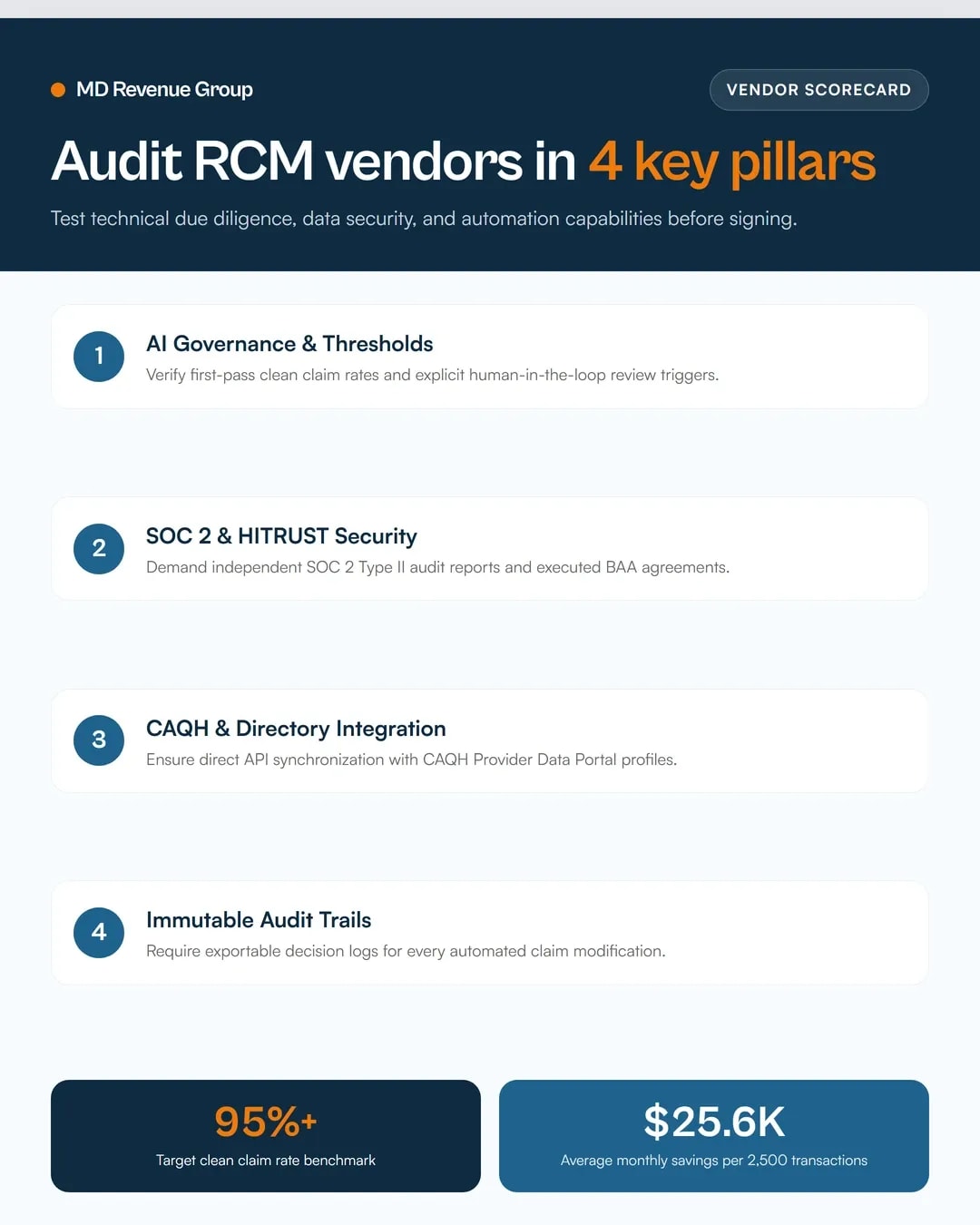
Ask vendor candidates specific technical questions across four key evaluation pillars:
- AI Governance & Escalation: "What is your system's first-pass automation rate, and what specific monetary threshold triggers human certified coder review for complex claims?"
- Data Security & Certifications: "Do you hold independent SOC 2 Type II or HITRUST CSF certifications, and will you execute a formal Business Associate Agreement (BAA)?"
- CAQH & Directory Integration: "Does your platform automatically sync provider credentialing profiles with the CAQH Provider Data Portal to prevent payment holds?"
- Auditability & Transparency: "Can your dashboard export immutable audit trails showing every automated edit and decision made on our claims?"
Regularly updating provider data prevents billing suspensions. Review our analysis on provider directory audit and caqh nppes updates to ensure your vendor maintains roster compliance across commercial payer networks.
Insist on reviewing actual vendor audit logs during final contract negotiations. A trustworthy RCM partner provides full visibility into machine decision logic, ensuring your practice remains compliant under federal HIPAA security mandates.
State enrollment and compliance risks: Texas, California, and multi-state rules
Multi-state medical practices face complex administrative hurdles when expanding across state lines. Payer enrollment requirements, Medicaid revalidation cycles, and timely filing windows vary significantly by jurisdiction.
For instance, practices operating in the Southwest must align provider rosters with regional contractor rules. Reviewing operational requirements for texas medical billing services helps administrators manage state-specific Medicaid revalidations without experiencing cash flow interruptions.
Similarly, billing in Western markets involves strict state disclosure and patient balance billing guidelines. Aligning your RCM workflows with california medical billing services ensures compliance with local surprise billing legislation and Knox-Keene plan regulations.
State-Level Compliance Checklist for Outsourced Billing:
Verify state-specific timely filing deadlines (e.g., 90 days vs. 185 days from DOS)Audit Medicaid provider revalidation calendars every 3 yearsConfirm vendor adherence to state surprise billing and itemized statement mandates
Failing to update state provider licenses or group reassignment forms in PECOS leads to immediate claim rejections. Your outsourcing partner must maintain an active revalidation tracking calendar to prevent credentialing-related revenue holds.
How to calculate your practice's automation ROI before signing a contract
Before committing to a medical billing outsourcing agreement, calculate the expected financial return from transaction automation. Compare your current manual handling costs against the vendor's technology-enabled rate structure.
Use this worked financial formula to model monthly administrative savings:
Consider a multi-specialty group practice performing 1,500 eligibility checks, 200 prior authorizations, and 800 claim status inquiries each month:
Calculating these savings proves that transitioning away from manual phone and portal tasks delivers immediate margin expansion. Partnering with a tech-forward RCM firm allows your medical practice to eliminate administrative backlog while reducing total collection costs.
If your practice wants to quantify its administrative automation potential, schedule a revenue cycle consultation with MD Revenue Group to analyze your claim workflows and lower your operational overhead.
Frequently Asked Questions
What is the CAQH Index?
The CAQH Index is an annual national benchmark report tracking the healthcare industry's adoption of electronic administrative transactions and measuring potential cost savings.
How does automation reduce medical billing outsourcing costs?
Automating routine transactions like eligibility and claim status inquiry replaces expensive staff phone calls and portal entries with instant electronic EDI transfers, cutting unit processing costs by over 80%.
What security certifications should a medical billing vendor possess?
A qualified RCM vendor should maintain SOC 2 Type II or HITRUST CSF security certifications, sign a Business Associate Agreement (BAA), and provide full audit logs for all claim modifications.
What is the difference between static EDI scrubbing and AI claim automation?
Static EDI scrubbing checks claims against rigid formatting rules (like missing fields). AI claim automation uses machine learning models to analyze historic payer denial patterns and predict rejections before claim submission.