
Therapy Practice Billing Services: A 30-Day Claim-Cleaning Sprint for PT, OT, and SLP
A 30-day claim-cleaning sprint for PT, OT, and SLP teams. The KX, CQ/CO, MPPR and documentation fixes that clear denials fastest.
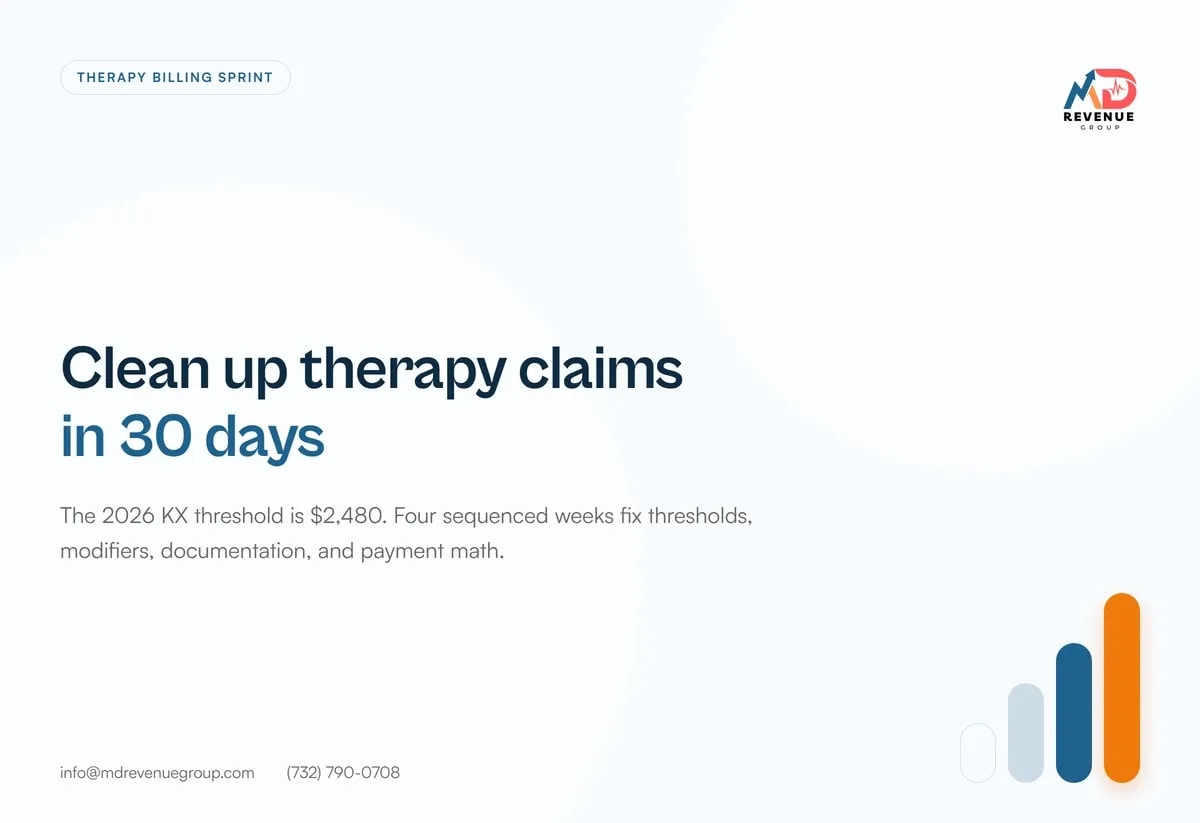
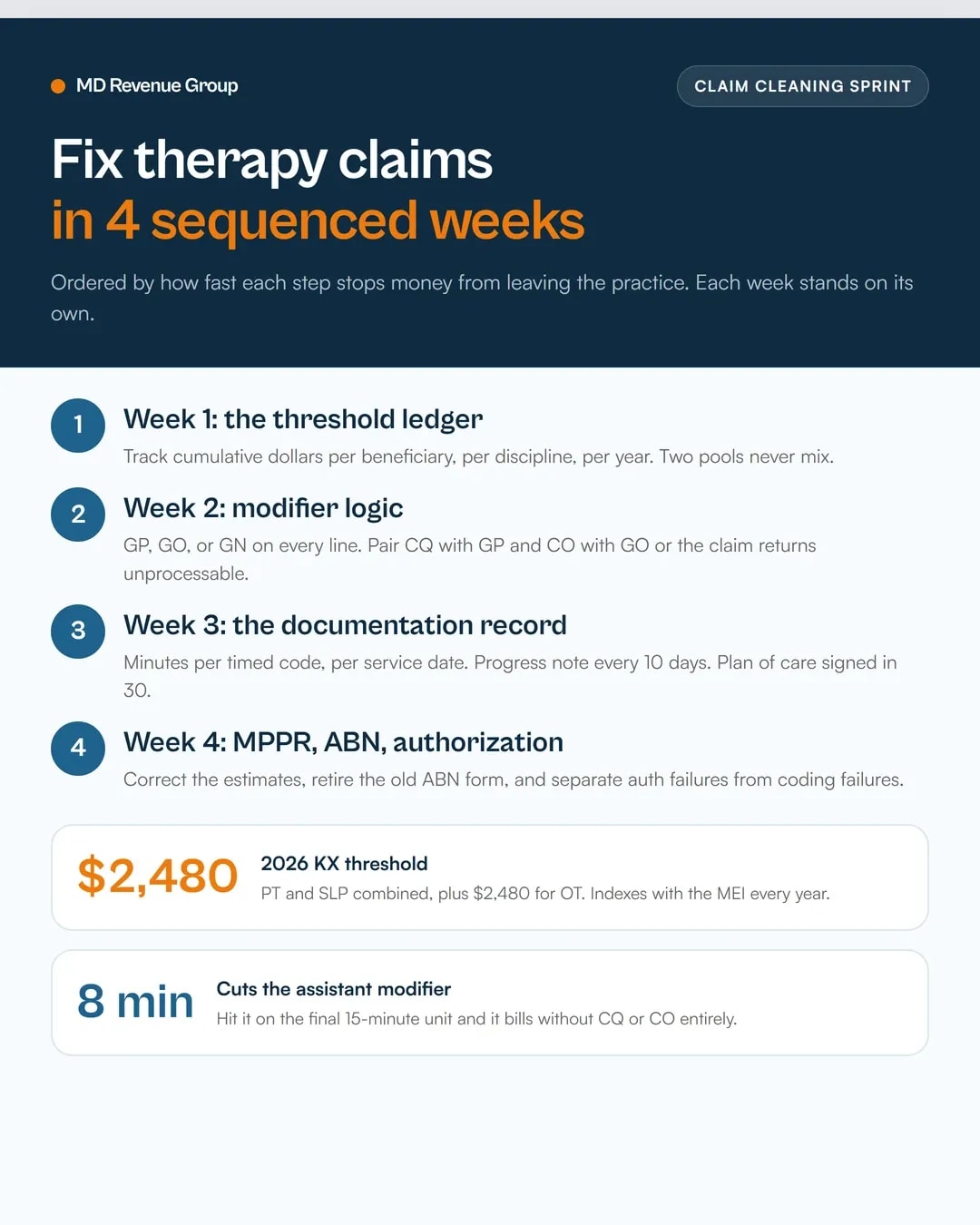
A 30-day claim-cleaning sprint is four weeks of sequenced fixes, ordered by how fast each one stops money from leaving the practice. It is not a full revenue cycle rebuild.
Here is the order that works for most physical therapy, occupational therapy, and speech-language pathology practices, built on 2026 Medicare rules.
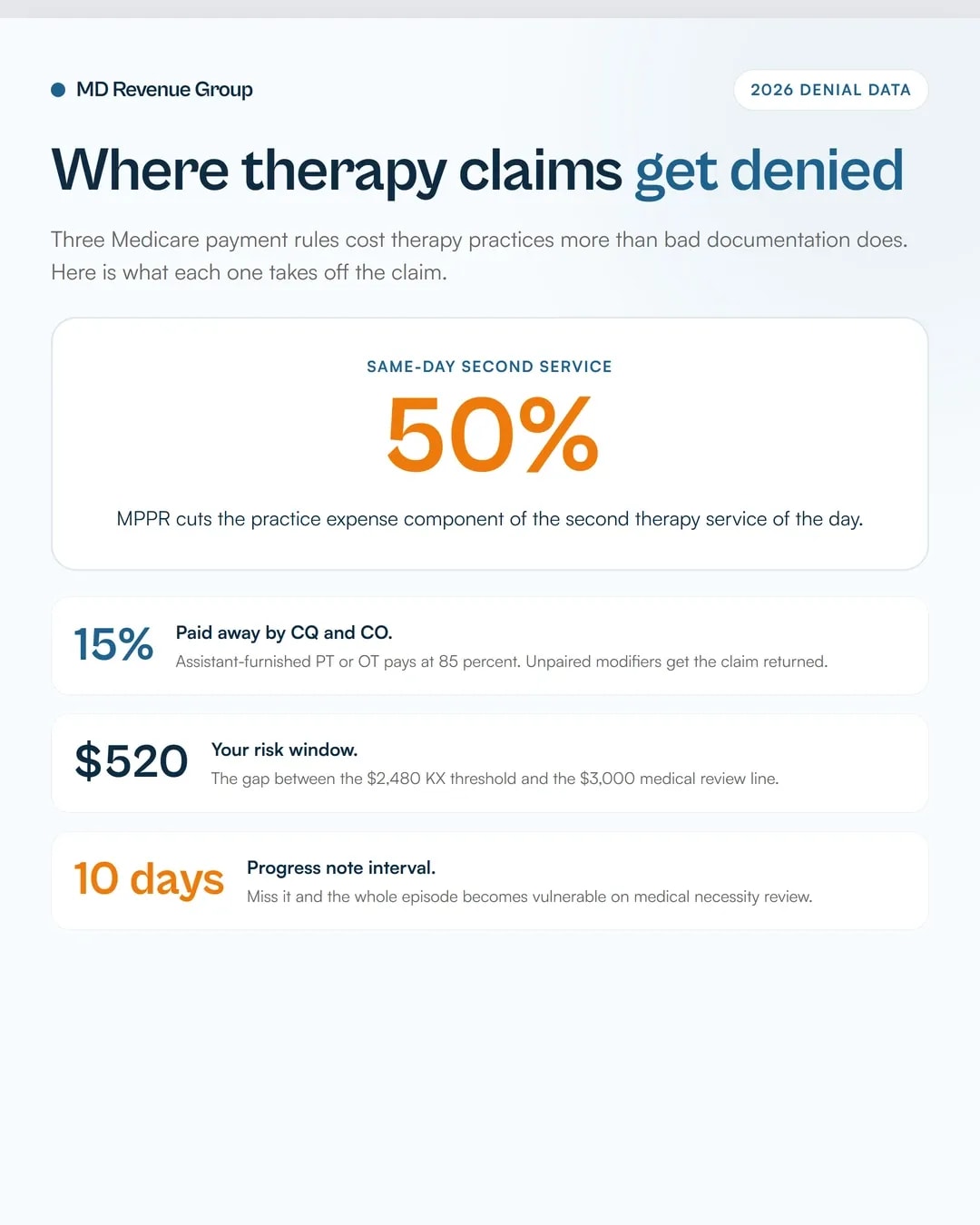
Week 1 clears the threshold math. CMS set the CY 2026 KX modifier threshold at $2,480 for physical therapy and speech-language pathology combined, and $2,480 for occupational therapy. Claims above the threshold without the KX modifier are denied outright. The targeted medical review threshold stays at $3,000 through 2028. The gap between the two is $520.
Week 2 rebuilds modifiers. Every outpatient therapy line needs GP, GO, or GN. CQ and CO lines pay at 85% and get returned as unprocessable when paired wrong.
Week 3 rebuilds documentation. Total minutes per timed code, per service date. Progress reports every 10 treatment days. Plan of care certification inside 30 calendar days.
Week 4 fixes the math you keep getting wrong. MPPR takes 50% off the practice expense component of the second and subsequent therapy service on a day.
Most practices can run this internally with two people and a spreadsheet. Where that breaks down is usually prior authorization, which is a separate build.
Key takeaways
- The CY 2026 KX threshold is $2,480 for PT and SLP combined, $2,480 for OT. Both are MEI-indexed annually.
- Targeted medical review stays at $3,000 through CY 2028, leaving a $520 gap.
- Missing KX above the threshold means the claim is denied, and the beneficiary keeps limitation-on-liability protection.
- CQ and CO pay at 85%. Unpaired with GP or GO, the claim returns as unprocessable.
- Check the MAC's NCCI PTP lookup before appending modifier 59. Some edits allow no bypass at all.
- Total timed-code minutes must be documented per service date. Progress reports are due every 10 treatment days.
- MPPR has been 50% on the practice expense component since April 1, 2013, office and institutional.
Week 1: Build the threshold ledger
You cannot manage what you are not tracking per patient.
Start by pulling cumulative paid amounts by beneficiary, per discipline, per calendar year. Two pools matter and they never mix:
Pool | CY 2026 threshold |
|---|---|
PT and SLP combined | $2,480 |
OT, separate | $2,480 |
When a patient crosses either number, every subsequent claim for that pool needs KX. Skip it and the line is denied.
The Bipartisan Budget Act of 2018 repealed the old therapy caps and turned them into thresholds. Practically, that removed the exceptions process while keeping the dollar trigger, so the denial risk on the crossing claim is the thing to engineer around.
Now the part practices get wrong. The targeted medical review threshold is a separate trigger. CMS held it at $3,000 for PT, SLP, and OT from 2021 through 2028, at which point it becomes MEI-indexed. It sits $520 above the KX threshold in 2026, which means the highest-risk zone for your practice is narrow and entirely predictable.
"Targeted" also matters. Not every claim above $3,000 gets reviewed. If your volume spikes in a single week, your risk concentrates.
Our KX modifier threshold walkthrough for 2026 covers the tracking mechanics in more detail, and our physical therapy billing services page covers the day-to-day service model.
Week 2: Rebuild the modifier logic
Every outpatient therapy claim line needs a discipline modifier. GP for physical therapy, GO for occupational therapy, GN for speech-language pathology. Without it, payers cannot identify the service and the claim fails on modifier grounds. If you bill SLP, our speech pathology billing services page has the code-specific details.
Then there is the assistant modifier layer. Section 53107 of the Bipartisan Budget Act of 2018 created them through Section 1834(v) of the Social Security Act:
- CQ marks PT furnished in whole or in part by a PTA
- CO marks OT furnished in whole or in part by an OTA
- Both pay at 85% of the otherwise applicable Part B amount, effective January 1, 2022
The pairing rule is absolute. CQ goes with GP. CO goes with GO. CMS states that claims with modifiers not paired this way are rejected and returned as unprocessable. That is a hard stop, not a denial you can appeal.
The two exceptions to the 10% rule
The de minimis standard says assistant time that does not exceed 10% of a service takes no reduction. Time above 10% needs CQ or CO. CMS has since carved out two situations.
The 8-minute rule. For the final 15-minute unit of a multi-unit day, if the PT or OT delivers 8 minutes or more, that unit bills without CQ or CO no matter how many minutes the assistant contributed. Once the therapist hits the 8-minute mark on the final unit, the assistant's minutes stop mattering.
The 13 time splits. When the therapist and assistant each give between 9 and 14 minutes of the same code and the combined total lands between 23 and 28 minutes, one unit bills with CQ or CO and one without. CMS lists every valid split: 9:14, 10:13, 10:14, 11:12, 11:13, 11:14, 12:12, 12:13, 12:14, 13:12, 13:13, 13:14, and 14:14.
Calculate the de minimis percentage by dividing remaining assistant time by total time for that code, multiplying by 100, and rounding to the nearest integer. 11% or more triggers the modifier. CMS also offers a floor method: divide assistant time by 10, round, then add 1 minute. The modifier applies when assistant minutes hit or exceed that floor.
We covered this in depth in CQ and CO modifiers for PTA and OTA billing. For practices running heavy assistant staffing, our occupational therapy billing services page covers the staffing model.
How to handle modifier 59 on therapy codes
Where a specific X modifier describes the reason better, use XE, XS, XP, or XU instead of modifier 59. CMS prefers the more specific modifier.
Two things to check before you append anything. First, some NCCI PTP edits permit no modifier at all: CGS states plainly that where no NCCI-associated modifier is allowed to bypass an edit, "Medicare will only pay for the Column 1 code." Check the edit direction in the MAC's PTP lookup rather than assuming a bypass exists.
Second, modifier 59 needs documentation behind it. The code pair has to be genuinely distinct: different body regions, different approaches, or demonstrably separate times within the session. Blanket use of 59 on a recurring pair is the kind of pattern payers audit.
CMS Policy Article A56566 draws the line plainly: do not bill 97110, 97112, 97116, or 97530 for the same time period. Verify the current PTP edit pair and modifier allowance in your MAC's lookup tool before each submission.
Week 3: Fix the documentation record
This is where medical necessity denials are won or lost, and no amount of coding cleanup substitutes for it.
Document total minutes for each timed code, per service date. CMS requires this to support the units and codes billed. A note that says "45 minutes of therapy" fails. A note that splits 97110 at 25 minutes, 97140 at 12 minutes, and 97530 at 8 minutes survives review.
Write a progress report every 10 treatment days. Qualified clinicians must complete progress reports at that minimum interval throughout the episode.
Certify the plan of care inside 30 calendar days. The physician or NPP certifies with a dated signature or verbal order within 30 calendar days of the therapist's initial evaluation. Recertification comes sooner when the plan duration is under 90 calendar days. CMS accepts certifications completed without justification up to 30 calendar days after the due date, and allows delayed certification when the reason is documented.
Report 1 in the unit field for evaluations, group therapy, and supervised services.
Remember that documentation time is billable coverage. Time spent producing the medical record is part of the CPT code coverage itself. There is no separate payment for it, which is the argument for making notes complete the first time.
CGS Medicare runs service-specific post-payment review that names 97110, 97112, 97140, and 97530 explicitly. Those are the four codes most likely to come back for review, and they are the four that appear on most PT claim forms.
For practices where documentation quality is the primary problem, a focused medical billing audit identifies which note elements are missing before a MAC finds them for you.
Week 4: Correct MPPR, ABN, and authorization
MPPR takes half the practice expense on same-day second visits
Multiple procedure payment reduction applies to the practice expense component of certain always-therapy services. The rate has been 50% since April 1, 2013, and it applies in both practitioner office and institutional settings.
Mechanically: the service with the highest practice expense RVU on the day pays at 100%. Every remaining therapy service that day pays its practice expense at 50%.
Note what this does to your estimate. The reduction hits practice expense only. Work and malpractice components still pay in full. If you assume the whole fee drops by half, you will overstate the loss and panic about a problem you have less of than you thought.
CMS updated the CY 2026 MPPR Rate File on 2/24/2026 to include code 97026. Download the current file rather than working from a saved copy. Our MPPR same-day claim math guide builds the worksheet.
The ABN version trap
Only the official CMS-R-131 ABN form may be used. The prior 01/26 version was usable only through May 11, 2026. The updated form became mandatory on May 12, 2026.
If your office is still printing old stock, that is a live liability right now.
One ABN covers a course of treatment for one year. A course running longer needs a new one. And ABNs apply to Original Medicare, not Medicare Advantage or Medigap.
Authorization is its own build
Original Medicare rarely requires prior authorization for therapy. Medicare Advantage is a different program. KFF found that 99% of Medicare Advantage enrollees are in plans that require prior authorization for at least some services, most often higher-cost ones, and at least one major plan requires it for all therapy and chiropractic services.
The direction of travel is worth watching. UnitedHealthcare announced in May 2026 that it would eliminate authorization requirements for 30% of services that previously required approval, and by the end of 2026 it plans to drop an additional 30% of remaining authorizations, including certain outpatient therapies and chiropractic care. Expect the landscape to keep moving.
If your volume is concentrated in one MA plan, this is worth a dedicated build rather than a cleanup task. Our 10-step prior authorization workflow covers the queue design, and authorization rules vary enough by state that practices in high-volume markets sometimes benefit from local review, as we discuss for Texas medical billing services.
Day 29 and 30: Post the payments and benchmark the result
Payment posting is where you find out whether the sprint worked.
Compare expected to posted on three lines:
- Payment per unit. Did the 85% assistant reduction and the 50% MPPR reduction land where the estimate said they would?
- Denial rate by CARC code. CO-4 means a procedure code inconsistent with the modifier used, or a required modifier missing. CO-50 means the payer does not deem the service medically necessary. Grouping denials by code tells you which week of the sprint still has a hole.
- Denial rate by CARC code for authorization. Separate this out so authorization failures don't get averaged into coding failures.
Then compare clean claim rate against the clean claim rate benchmark for your specialty. A practice that moved from 88% to 94% clean has a different problem than one sitting at 71%, and the fix is not the same.
Our outpatient therapy billing services page covers how this runs as an ongoing function rather than a monthly project.
Why a 30-day sprint beats a full rebuild
A full revenue cycle rebuild takes six months, requires a system migration, and depends on everyone agreeing to change at once. You will not finish it.
The sprint works because each week produces something measurable. Week 1 gives you a threshold ledger. Week 2 gives you claims that stop returning as unprocessable. Week 3 gives you documentation that survives medical necessity review. Week 4 gives you accurate payment estimates.
Each of those is verifiable in 30 days, and each one stands on its own if the next week slips.
Two 2026 changes worth tracking as you go. CMS added three new remote therapeutic monitoring codes, 98979, 98984, and 98985, as sometimes-therapy codes effective January 1, 2026 through Change Request 14250. And the CY 2026 PFS finalized a -2.5% efficiency adjustment on non-time-based work RVUs, with time-based codes carved out, so confirm the current treatment for your specific codes before modeling next year's rates.
Reviewed for accuracy October 2, 2026. Thresholds, modifier rules, and documentation requirements verified against the CMS Therapy Services page, CMS MLN Matters MM905365 and MM14250, the CMS CQ/CO billing examples, the 2026 NCCI Coding Policy Manual, and the CY 2026 Physician Fee Schedule final rule. Payer authorization requirements change; verify your current payer policy and MAC instructions before submitting claims.