
CAQH’s $21 Billion Automation Opportunity: Where a Medical Billing Team Should Start
Capitalize on CAQH's $21 billion healthcare automation savings. Learn manual vs electronic transaction costs and evaluate medical billing outsourcing companies.
The 2025 CAQH Index identified a $21 billion annual cost-savings opportunity for U.S. healthcare providers and health plans through administrative workflow automation. Evaluating top medical billing outsourcing companies allows medical practices to replace high-cost manual tasks with HIPAA-standard electronic data interchange (EDI). While electronic claim submission adoption exceeds 90%, significant friction remains in front-end eligibility verification, prior authorization tracking, and claim status follow-up. Transitioning from manual phone and portal checks to automated X12 transactions saves medical practices an average of $5.38 per transaction. This guide breaks down the CAQH cost benchmarks, models administrative labor savings, and provides a vendor scorecard to audit potential revenue cycle partners.
Key Takeaways
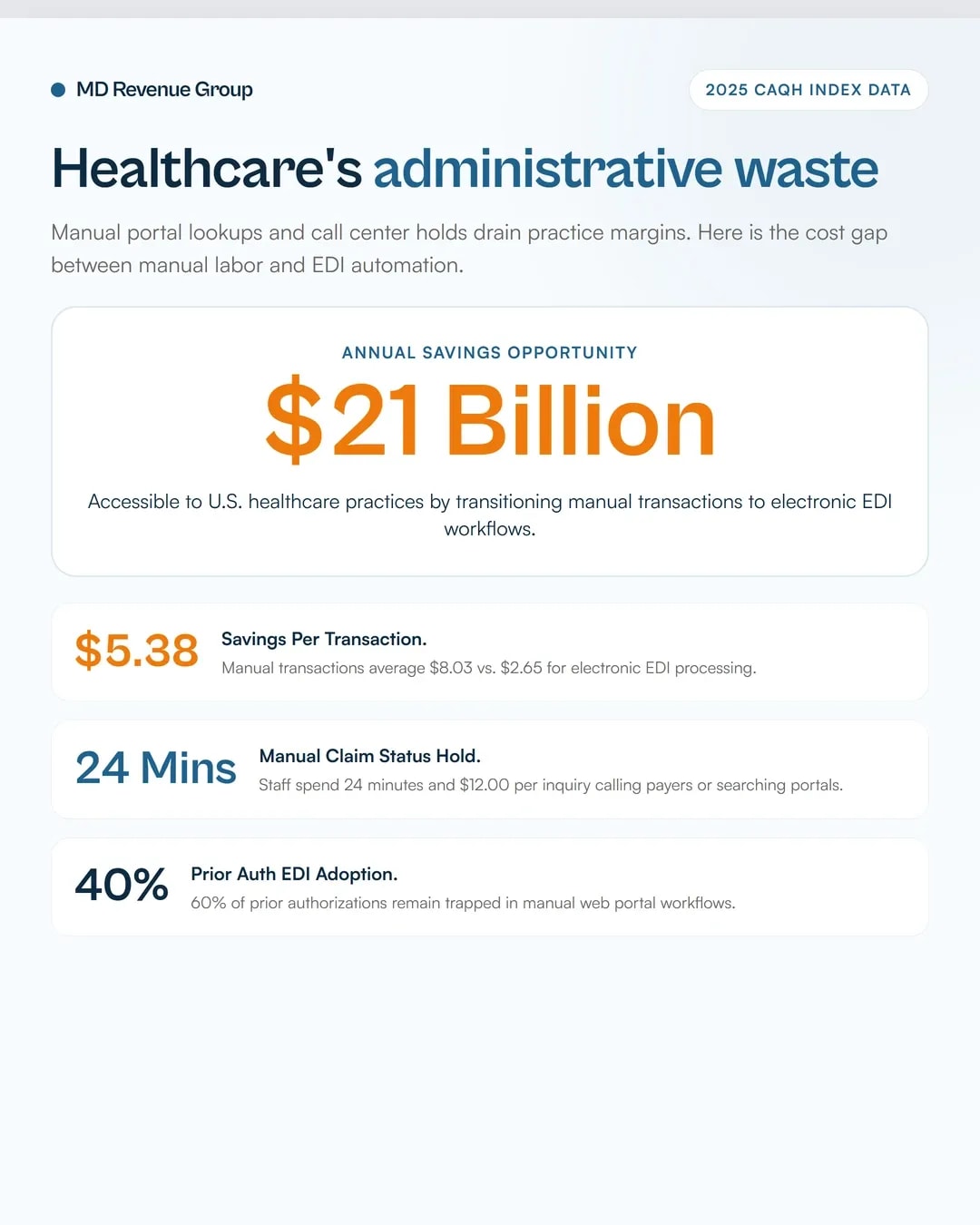
- $21 Billion Opportunity: The 2025 CAQH Index reports $21 billion in annual administrative savings accessible through full electronic workflow adoption across medical and dental practices.
- $5.38 Per-Transaction Savings: Processing transactions electronically costs $2.65 on average, compared to $8.03 for manual handling.
- 24-Minute Claim Status Drain: Manual phone calls and portal searches consume 24 minutes per claim status inquiry, costing practices roughly $12 per manual lookup.
- Prior Auth Adoption Gap: Electronic prior authorization adoption reached 40% in the 2025 report, leaving 60% of authorizations tied to manual web portals and faxes.
- Core EDI Standards: Standardizing on X12 270/271 (Eligibility), X12 276/277 (Claim Status), and X12 835 (ERA) eliminates manual billing backlog.
What the 2025 CAQH Index Reveals About Administrative Waste
The Council for Affordable Quality Healthcare (CAQH) tracks administrative transaction volume, adoption rates, and operational costs across 600 provider organizations and health plans representing 63% of insured lives in the United States. The 2025 CAQH Index highlights persistent cost disparities between manual administrative efforts and fully automated electronic data exchange.
Every uncredentialed provider costs $32,000/mo in unbilled encounters.
We audit your active payer applications to pinpoint where commercial plans and MACs have stalled your providers.
Audit My Enrollment Pipeline →Healthcare administrative spending continues to climb despite high adoption in basic claim submission. Inflation, clinical staff shortages, and complex payer prior authorization requirements drive up overall administrative overhead for medical practices.
While electronic claim submission sits at 90% industry adoption, post-submission tasks remain heavily manual. Practices relying on phone calls, payer web portals, and paper mail spend valuable staff hours on repetitive data entry.
Partnering with experienced medical billing services allows practices to tap directly into established clearinghouse networks, replacing manual administrative churn with continuous background EDI transactions.
The Manual vs. Electronic Cost Gap: $8.03 vs. $2.65
CAQH tracks operational expenses across eight core administrative workflows. The cost disparity between manual methods (phone calls, faxes, paper forms) and automated electronic transactions (HIPAA X12 EDI) remains substantial.
Across all tracked transactions, the national average operating costs show:
- Manual Transaction Cost: $8.03 per transaction (combining staff labor, phone time, and material overhead).
- Electronic Transaction Cost: $2.65 per transaction (clearinghouse transmission and automated EHR processing).
- Net Net Per-Transaction Savings: $5.38 saved on every transaction converted from manual to electronic.
For a medical practice handling 3,000 billing-related inquiries monthly (including eligibility checks, authorization tracking, and claim status verification), relying on manual workflows creates an annual administrative waste of $193,680.
Practices evaluating outsourcing medical billing evaluation guide metrics can quickly determine whether internal staff costs exceed commercial clearinghouse fees.
The Claim Status Bottleneck: 24 Minutes per Inquiry
Claim status inquiry represents one of the most severe labor bottlenecks in modern practice management. When payments stall, billing staff resort to calling payer call centers or navigating individual payer portals to determine why a claim remains unpaid.
CAQH data highlights the operational cost of manual claim status follow-up:
- Average Manual Time Spent: 24 minutes per manual claim status check.
- Average Manual Cost: $12.00 in labor per inquiry.
- Electronic Adoption Rate: 81% for X12 276/277 transactions.
While 81% of claim status inquiries occur electronically, the remaining 19% of manual inquiries generate disproportionate labor expense. Billing representatives spend up to two hours per day placed on hold with commercial and Medicaid payers simply to confirm receipt of documentation or initial claim entry.
Automated clearinghouse integrations initiate batch X12 276 inquiries overnight, receiving structured X12 277 response files before your billing team logs in every morning.
Practices operating in high-volume regions like Texas medical billing services rely on automated claim scrubbing to keep accounts receivable (AR) days well below the 35-day industry benchmark.
Prior Authorization Automation: High-Yield Savings
Prior authorization remains the single most expensive administrative task in outpatient medicine. The 2025 CAQH Index recorded an increase in electronic prior authorization adoption from 31% to 40%. However, 60% of all medical authorizations still rely on manual portal entry, phone calls, and paper documentation packages.
Manual prior authorization costs practices an average of $11.44 per request, compared to $3.82 for electronic X12 278 transactions. The American Medical Association (AMA) reports that physician practices spend an average of 13 hours per doctor per week managing prior authorization paperwork.
The friction stems from non-standardized payer requirements. Payers frequently modify medical necessity criteria, attachment specifications, and portal login procedures without advance notice.
Establishing an automated prior authorization workflow, supported by real-time attachment transmission, eliminates delayed care and prevents zero-pay administrative denials.
Our comprehensive revenue cycle management workflows combine automated API eligibility checks with dedicated prior authorization tracking to protect practice yield.
Proprietary Calculation: Administrative Labor vs. EDI Automation ROI
The worked calculation below models the annual administrative cost for a 10-provider multispecialty group processing 4,000 monthly transactions (eligibility checks, claim status inquiries, prior authorizations, and remittance posting).
Baseline Transaction Breakdown (Monthly Volume = 4,000)
- Eligibility & Benefit Verifications: 2,000
- Claim Status Inquiries: 1,200
- Prior Authorization Requests: 300
- Remittance Advice & Payment Postings: 500
Scenario A: Fully Manual / Web-Portal Workflow
- 2,000 Eligibility Checks @ 16,060
- 1,200 Claim Status Checks @ 14,400
- 300 Prior Authorizations @ 3,432
- 500 Manual Remittance Postings @ 2,250
- Total Monthly Manual Cost: $36,142
- Total Annual Manual Cost:
Scenario B: 90% Automated Electronic EDI Workflow
- 90% Electronic (3,600 transactions @ 9,540
- 10% Manual Residual (400 complex exceptions @ 3,212
- Total Monthly Automated Cost: $12,752
- Total Annual Automated Cost:
Net Annual Financial Savings
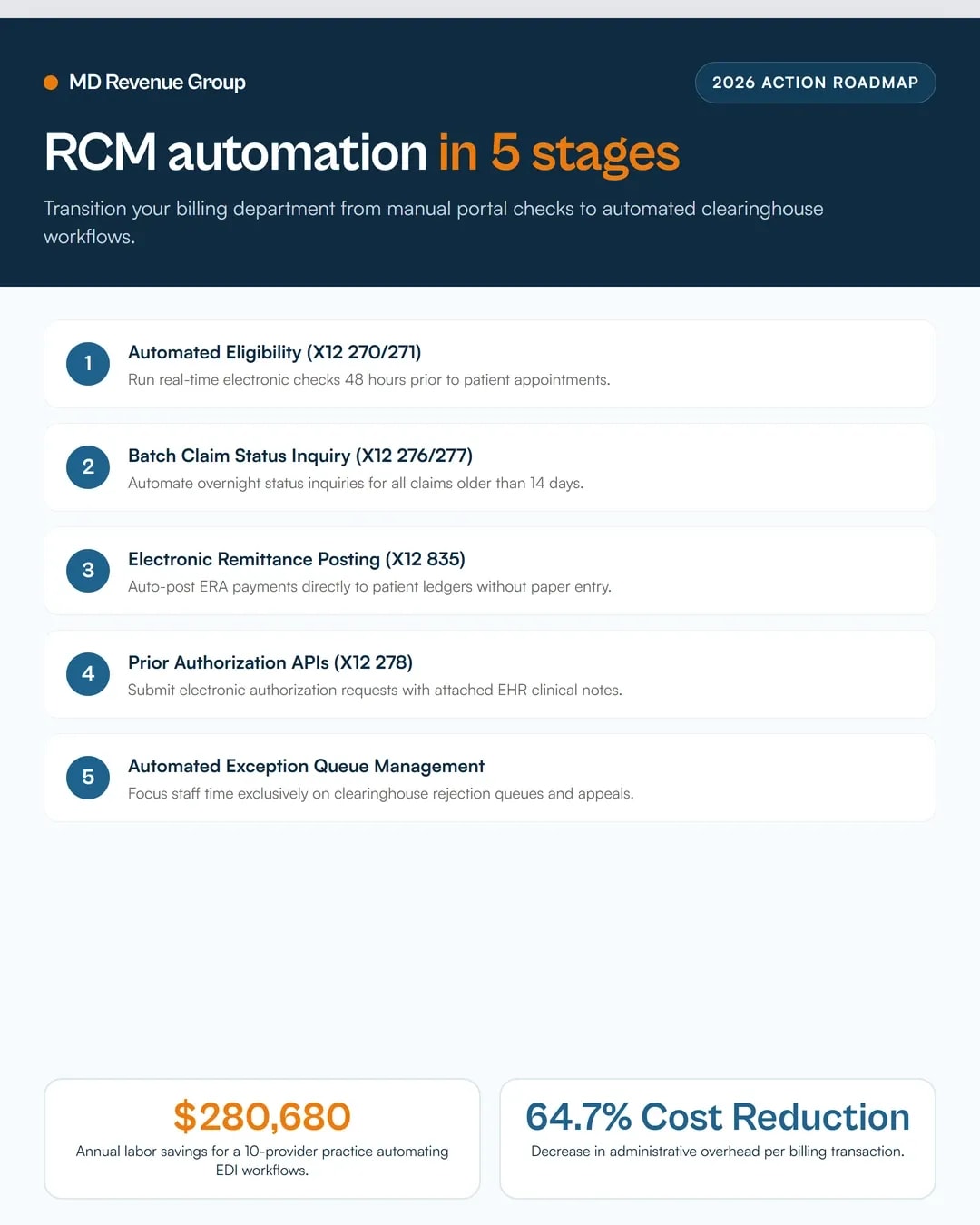
By transitioning from manual portal checks to an automated electronic clearinghouse infrastructure, a 10-provider medical group cuts administrative costs by $280,680 per year (a 64.7% expense reduction).
5-Stage Automation Implementation Roadmap
Transitioning your practice from manual administrative processes to an electronic EDI workflow requires a structured 5-stage plan:
[Stage 1: Verification] ──> [Stage 2: Batch Scrubbing] ──> [Stage 3: Auto-Remittance]
                                                                  │
[Stage 5: Exception Queues] <── [Stage 4: PA Automation] <───────┘- Stage 1: Automated Eligibility Verification (X12 270/271): Configure your EHR or billing software to run real-time eligibility checks 48 hours prior to every patient appointment.
- Stage 2: Batch Claim Status Scrubbing (X12 276/277): Schedule automated night-time claim status inquiries for all claims exceeding 14 days without payer response.
- Stage 3: Electronic Remittance & Payment Auto-Posting (X12 835): Enroll all commercial and government payers in Electronic Remittance Advice (ERA) to auto-post payments directly to patient accounts.
- Stage 4: Prior Authorization API Integration (X12 278): Implement electronic prior authorization tools to submit structured clinical attachments directly from EHR notes.
- Stage 5: Automated Exception Queue Management: Train staff to manage automated clearinghouse rejection queues rather than conducting routine manual follow-up calls.
Groups operating across multiple states, such as Florida group practices, utilize this 5-stage framework to maintain uniform denial rates across diverse regional payer networks.
CAQH Transaction Benchmark Decision Table
Compare operational metrics across key CAQH transaction types to identify high-yield automation targets in your practice.
Transaction Type | HIPAA EDI Standard | National Electronic Adoption % | Average Manual Cost | Average Electronic Cost | Per-Transaction Savings Potential | Primary Labor Bottleneck |
|---|---|---|---|---|---|---|
Eligibility & Verification | X12 270 / 271 | 89% | $8.03 | $2.65 | $5.38 | Manual payer portal log-ins |
Claim Status Inquiry | X12 276 / 277 | 81% | $12.00 | $1.25 | $10.75 | 24-minute call center holds |
Prior Authorization | X12 278 | 40% | $11.44 | $3.82 | $7.62 | Non-standard payer fax forms |
Claim Payment & ERA | X12 835 | 78% | $4.50 | $1.10 | $3.40 | Manual paper check posting |
Claim Attachments | X12 275 | 22% | $9.80 | $3.15 | $6.65 | Mailing medical records by mail/fax |
Vendor Evaluation Scorecard for Medical Billing Outsourcing Companies
When internal staff cannot keep up with administrative workloads, practices evaluate commercial RCM vendors. Use this objective scorecard to grade prospective vendor capabilities.
1. Electronic EDI Capability (Weight: 30%)
- Does the vendor support native X12 270/271, 276/277, and 835 batch integration?
- What percentage of claims drop electronically without manual intervention? (Benchmark: >95%).
2. Clearinghouse & Payer Connectivity (Weight: 25%)
- Does the vendor maintain direct connections with regional commercial payers, Medicare MACs, and Medicaid managed care plans?
- How does the vendor handle behavioral health or specialty carve-out payer routing?
3. Prior Authorization Workflow (Weight: 20%)
- Does the vendor handle front-end prior authorization submissions or merely notify staff when authorization is missing?
- What is their average turnaround time for urgent vs. routine authorization requests?
4. Denial Management SLA (Weight: 15%)
- Does the contract include a guaranteed 48-hour turn-around on clearinghouse rejections?
- Does the vendor provide root-cause denial reporting by reason code and rendering provider?
5. Compliance & Security Controls (Weight: 10%)
- Is the vendor SOC 2 Type II certified and fully compliant with HIPAA Security Rule requirements?
- Are clinical notes and billing files stored in encrypted environments with full audit logging?
Before selecting a vendor, review our detailed guide on questions to ask a medical billing partner to ensure their operational capabilities match your specialty needs.
When Internal Staffing Reaches Capacity
Small-to-mid-size medical practices often struggle to maintain in-house EDI expertise. Staff turnover, changing payer rules, and software update costs frequently stall internal automation initiatives.
Warning signs that internal administrative capacity is failing include:
- AR days rising above 45 days.
- Staff spending more than two hours per day conducting phone claim status checks.
- Prior authorization delays causing appointment cancellations.
- Unposted ERA payments piling up in clearinghouse holding files.
Scheduling a comprehensive medical billing audit identifies exact operational breakdown points, giving practice leaders empirical data to decide between internal software upgrades or external RCM outsourcing.
Frequently Asked Questions
What is the CAQH Index, and why do billing teams use its data?
The CAQH Index is an annual industry report tracking adoption rates, transaction volumes, and administrative costs across healthcare payers and providers. Billing teams use CAQH data to benchmark internal costs against national electronic standards.
How does automated claim status inquiry (X12 276/277) save billing staff time?
Instead of staff spending 24 minutes calling a payer or navigating web portals, automated software sends an electronic X12 276 request in seconds. The payer returns an electronic X12 277 response file detailing exact claim disposition (paid, pending, or denied) directly into the billing software.
What is preventing electronic prior authorization adoption from reaching 90%?
Unlike standard claim forms, prior authorization requests require clinical attachments, medical necessity notes, and chart evidence. Because commercial payers maintain non-standard portal requirements, full electronic X12 278 adoption remains lower than basic claim submission.
How do medical billing outsourcing companies reduce transaction costs?
Outsourcing partners use high-volume clearinghouse subscriptions, automated EDI scrubbing algorithms, and dedicated AR follow-up teams. They process electronic transactions at scale, eliminating the manual labor cost of internal staff phone calls and portal entry.
Capitalize on Your $21 Billion Automation Opportunity
Ready to eliminate manual administrative waste, cut AR days, and automate your revenue cycle? Book a revenue-cycle consultation with MD Revenue Group to evaluate your practice workflow today.
Unfreeze your credentialing pipeline.
Enter your practice details. We will audit your CAQH profiles and payer enrollments to get your providers billing immediately.