
DME Medical Billing Companies: Medicare Revalidation and Documentation Controls for 2026
DMEPOS suppliers revalidate every 3 years. The 2026 revalidation, accreditation, and documentation controls that keep DME payments flowing.
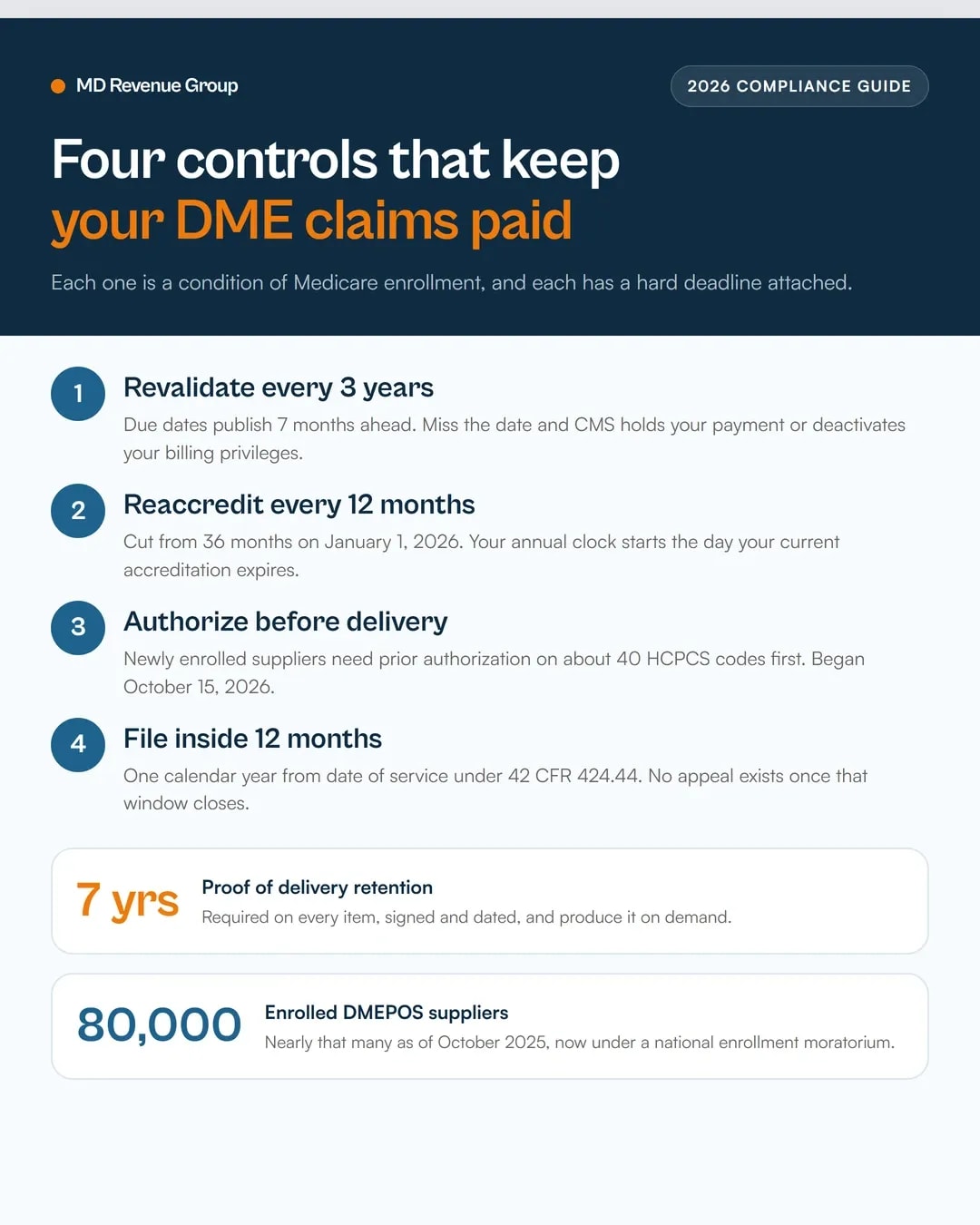
DMEPOS suppliers revalidate their Medicare enrollment every 3 years. Most other providers revalidate every 5. Miss that date and CMS puts a hold on your reimbursement or deactivates your billing privileges outright.
Deactivated means resubmitting a complete enrollment application from scratch, and Medicare pays nothing for services furnished during that blackout.
Three dates are driving DME billing right now. Revalidation due dates publish 7 months ahead of the deadline. Accreditation moved from every 36 months to every 12 months on January 1, 2026. And a probationary prior authorization program for newly enrolled suppliers started October 15, 2026.
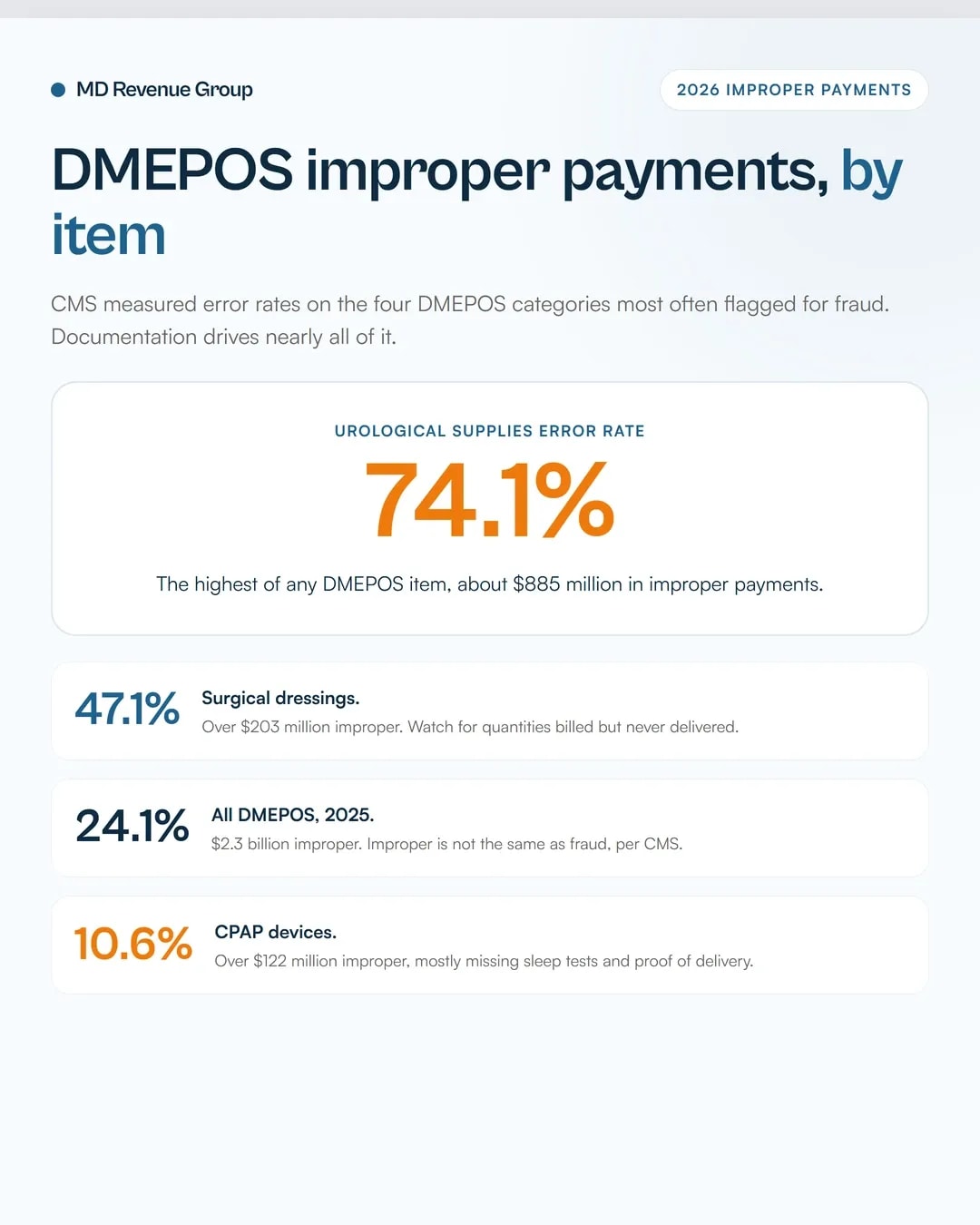
CMS also broke out improper payment rates by DMEPOS item in September 2026. Urological supplies ran a 74.1% error rate. Surgical dressings hit 47.1%. DMEPOS overall carried $2.3 billion in improper payments in 2025, a 24.1% rate.
That last number needs a caveat, and CMS provides it: "The improper payment rate is not a fraud rate. Fraud is one cause of improper payments."
Most of the rest is paperwork.
Key takeaways
- DMEPOS suppliers revalidate every 3 years; CMS publishes due dates 7 months in advance and mails notices 3 to 4 months ahead.
- Accreditation survey and reaccreditation dropped from 36 months to 12 months, effective January 1, 2026.
- Newly enrolled DMEPOS suppliers face a 1-year probationary prior authorization requirement starting October 15, 2026.
- Every DME claim needs a Standard Written Order. Signature stamps are rejected.
- Proof of Delivery is required on all items and kept for 7 years.
- Timely filing is 1 calendar year from date of service under 42 CFR 424.44.
- DMEPOS improper payments hit $2.3 billion (24.1%) in 2025, with urological supplies alone at 74.1%.
What DMEPOS revalidation actually requires
Revalidation is a renewal of your existing enrollment record. You are not reapplying from nothing, unless you miss the date.
The mechanics are simple once you know the timeline CMS publishes:
Milestone | Timing |
|---|---|
Due date posted publicly | 7 months before deadline |
Notice mailed or emailed | 3 to 4 months before deadline |
"In the window" without notice | 3 months before deadline |
Returned as unsolicited | More than 7 months before deadline |
CMS states the consequence plainly: failing to revalidate on time "could result in a hold on your Medicare reimbursement or deactivation of your Medicare billing privileges."
There are no exceptions. CMS says there are no exemptions and no extensions. Your notice or letter will give you enough time.
PECOS is the efficient route. It is paperless, so nothing goes by mail, and it only asks for information relevant to your application type. If you want the control calendar built out ahead of time, our Medicare revalidation control calendar walks through the monthly routine.
One detail catches people. If your due date is more than 7 months away and you submit anyway, CMS returns it. The system treats early submissions as errors, not diligence.
For anyone also handling provider enrollment rather than supplier enrollment, our credentialing services team runs the same deadline tracking.
The accreditation change that started January 1, 2026
This is the change most DME operations have not absorbed yet.
The CY 2026 Home Health Prospective Payment System final rule cut DMEPOS survey and reaccreditation from at least once every 36 months to at least once every 12 months. It applies to all DMEPOS suppliers as a condition of Medicare enrollment, and it sits outside the competitive bidding program.
The transition is not immediate, and that is where practices get confused. Your annual clock starts when your current 3-year accreditation expires.
CMS worked through the example in its own guidance. A supplier accredited for 3 years effective June 1, 2023 hits its expiry on June 1, 2026. That date starts the annual cycle. The supplier then has to be resurveyed and reaccredited at least once by June 1, 2027, again by June 1, 2028, and so on.
New suppliers face a tighter version. Anyone initially accredited on or after the effective date goes annual immediately, with no 3-year runway.
Large chains still get relief. CMS will allow sampling, meaning a percentage of locations can be surveyed rather than every site. Current methodologies continue, and CMS says it will consult stakeholders before shifting the sampling rules.
What the October 2026 probationary prior authorization program changes
CMS announced the Probationary Prior Authorization (PPA) program on September 2, 2026. It takes effect October 15, 2026.
Here is what it does:
- Applies to suppliers newly enrolled on or after October 15, 2026
- Applies to suppliers that complete a 100% change of ownership
- Runs a 1-year probationary period, nationwide, in every state and territory
- Requires a prior authorization request before delivery of 40 specific items: higher-risk orthoses for the spine, knee, ankle-foot, hip, and upper limb, plus two electrical osteogenesis stimulators
The authority is Section 1866(j)(3) of the Social Security Act and 42 CFR 424.527.
Two things about the PPA catch billing teams out. First, it does not replace the existing prior authorization process for certain DMEPOS items. Suppliers in the program still owe you full compliance with the standing PA requirements.
Second, the burden lands before delivery. A supplier that delivers first and requests authorization later has already missed the requirement.
Two operational details matter. The one-year clock starts when the supplier submits its first claim for a listed item, and CMS has published no early-termination mechanism. An affirmed decision on the prior auth does not guarantee payment on the claim.
CMS flagged that it may update the code list if new vulnerabilities surface, so the operational guide is worth bookmarking. Questions go to DMEPOSProbationaryPA@cms.hhs.gov.
Context matters here. If your authorization workflow is already manual, this will expose it fast. Our prior authorization automation failure analysis covers where manual queues break under new program rules.
Which documentation rules trigger DME denials
Every DME claim needs a Standard Written Order meeting CMS requirements. The order has to reach the supplier before the claim goes in, and for some items before delivery.
A compliant SWO carries:
- A general item description, HCPCS code, HCPCS narrative, or brand and model number
- Each separately billed option, accessory, or upgraded feature listed separately
- The dispensed quantity, where applicable
- The treating practitioner's name or NPI, plus a handwritten signature
That last point causes rework constantly. Signature and date stamps are not allowed, with only narrow exceptions.
The governing references are the Medicare Program Integrity Manual, Chapter 3 for signature requirements and Chapter 5 for DMEPOS review considerations. Chapter 5, section 5.3 holds the Master List of items that may require a face-to-face encounter, written order prior to delivery, or prior authorization.
Proof of Delivery is separate from the order, and every supplier handles it wrong at least once. A POD must be a signed and dated document showing the beneficiary's name, the delivery address, a description of the item, and the quantity delivered. Keep it for 7 years. It is required even for items the beneficiary already had from another insurer.
Timely filing closes the loop. Medicare claims must reach the MAC within 1 calendar year (12 months) of the date of service, per 42 CFR 424.44. There is no appeal remedy once that window closes. We have written about how practices lose revenue to this in our Change Healthcare timely filing analysis.
Policy Article A55426 holds the consolidated documentation requirements for claims submitted to DME MACs, and it is the single most useful PDF for a front-desk team to have on file.
Where the improper payments actually sit
CMS published a fraud hot spot on DMEPOS suppliers in September 2026. The per-item numbers are the most useful disclosure in years.
DMEPOS item | Improper payment rate | Improper payment amount |
|---|---|---|
Urological supplies | 74.1% | ~$885 million |
Surgical dressings | 47.1% | Over $203 million |
Glucose monitors | 17.3% | Over $203 million |
CPAP | 10.6% | Over $122 million |
All DMEPOS | 24.1% | $2.3 billion |
Urological supplies had the highest projected improper payments of any DMEPOS item in FY 2025, and the majority of those errors trace to missing or insufficient documentation.
The CPAP error list is a ready-made audit checklist. CMS names the top reasons: no clinical evaluation by the treating practitioner in the record, no indication a sleep test was conducted, missing proof of delivery, additional documentation never received when CMS auditors requested it, a clinical evaluation that omits an obstructive sleep apnea assessment, and a beneficiary already receiving a related device.
For glucose monitors, CMS describes suppliers billing for CGMs patients never received, sometimes without the beneficiary's knowledge, and suppliers accepting kickbacks to bill CGMs for beneficiaries with no diabetes history.
CMS also flags a specific pattern worth watching for in urological supply claims: no prior relationship between the beneficiary and the provider who ordered the items.
At the program level, Medicare FFS improper payments ran 6.55% ($28.83 billion) in FY 2025, the ninth straight year under the 10% statutory threshold. DMEPOS accounted for 7.9% of total improper dollars. We broke that data down in CMS FY 2025 improper payments analysis.
How to route claims to the right DME MAC
Routing errors waste weeks before anyone sees a denial.
Medicare has four DME MAC jurisdictions. Jurisdictions A and D are handled by Noridian Healthcare Solutions. Jurisdictions B and C are handled by CGS Administrators, now branded Cigna Government Services.
Jurisdiction C, run by CGS, covers AL, AR, CO, FL, GA, LA, MS, NM, NC, OK, PR, SC, TN, TX, VI, VA, and WV. Jurisdiction B, also CGS, covers IL, IN, KY, MI, MN, OH, and WI.
If your practice operates in Texas or Florida, your DME claims land with CGS. Our Texas medical billing services and Florida medical billing services pages cover the local specifics.
Routing follows the beneficiary's permanent address, not the supplier's location. A supplier in one state billing a beneficiary in another processes under the beneficiary's DME MAC.
Noridian publishes an annual jurisdiction list of HCPCS codes that are DME-only or jointly DME and Part B. Check it before you build a fee schedule assumption.
How to evaluate a DME billing company should include
DME billing sits in a narrow lane. A general medical billing vendor will get some of this wrong, and the errors show up as recoupments rather than rejections.
Test any candidate on these six things:
- Do they track the 3-year revalidation clock per NPI, with alerts at 7 months and again at 3 months?
- Do they track accreditation expiry against the new annual cycle, using your current expiry date as the start point?
- Do they know the PPA effective date and have the prior auth list loaded before delivery, not after?
- Do they verify SWO signature format and reject stamped signatures at intake?
- Do they retain POD for 7 years and produce it on request without a scramble?
- Do they run the 12-month timely filing clock from date of service on every claim line?
If they cannot answer the accreditation question with your specific expiry date, they are not tracking it.
A broader medical billing audit covers documentation quality across the whole revenue cycle, which matters when DME is one service line among several.
Most practices reach for outside support when revalidation and accreditation deadlines collide with a seasonal volume spike, or when a recoupment notice arrives and nobody can produce the POD. That is a reasonable place to be. Comparing options is worth doing on scope rather than rate alone; our guide to medical billing service costs breaks down how vendors price this work.
Ready to check your DME enrollment status?
If your revalidation date is unclear, your accreditation clock is off, or you cannot produce proof of delivery on demand, those are fixable gaps. We will review your DMEPOS enrollment record, documentation set, and claim routing and show you exactly what is exposed. Request a free revenue audit.
Reviewed for accuracy October 2, 2026. Rule status verified against CMS Revalidations, CMS Fraud Hot Spot: DMEPOS Suppliers (September 2026), CMS Therapy and DMEPOS program pages, the Medicare Program Integrity Manual, and the CY 2026 HH PPS final rule. Competitive Bidding Round 2028 remains scheduled and subject to change. Confirm your specific DMEPOS supplier type, accreditation body, and DME MAC jurisdiction before acting.