
MPPR for Outpatient Therapy: How Therapy Practice Billing Services Manage Same-Day Claim Math
Expert therapy practice billing services unpack CMS MPPR 50% practice expense reductions, same-day claim math, and documentation rules.

MPPR for Outpatient Therapy: How Therapy Practice Billing Services Manage Same-Day Claim Math
Navigating Medicare's Multiple Procedure Payment Reduction (MPPR) rules requires precise claim calculations when billing multiple therapy units on the same date of service. Partnering with specialized therapy practice billing services ensures physical, occupational, and speech therapy practices calculate practice expense reductions correctly, audit same-day code combinations, and safeguard clinic cash flow against automated Medicare edits.
Executive Summary: MPPR Rules and Impact
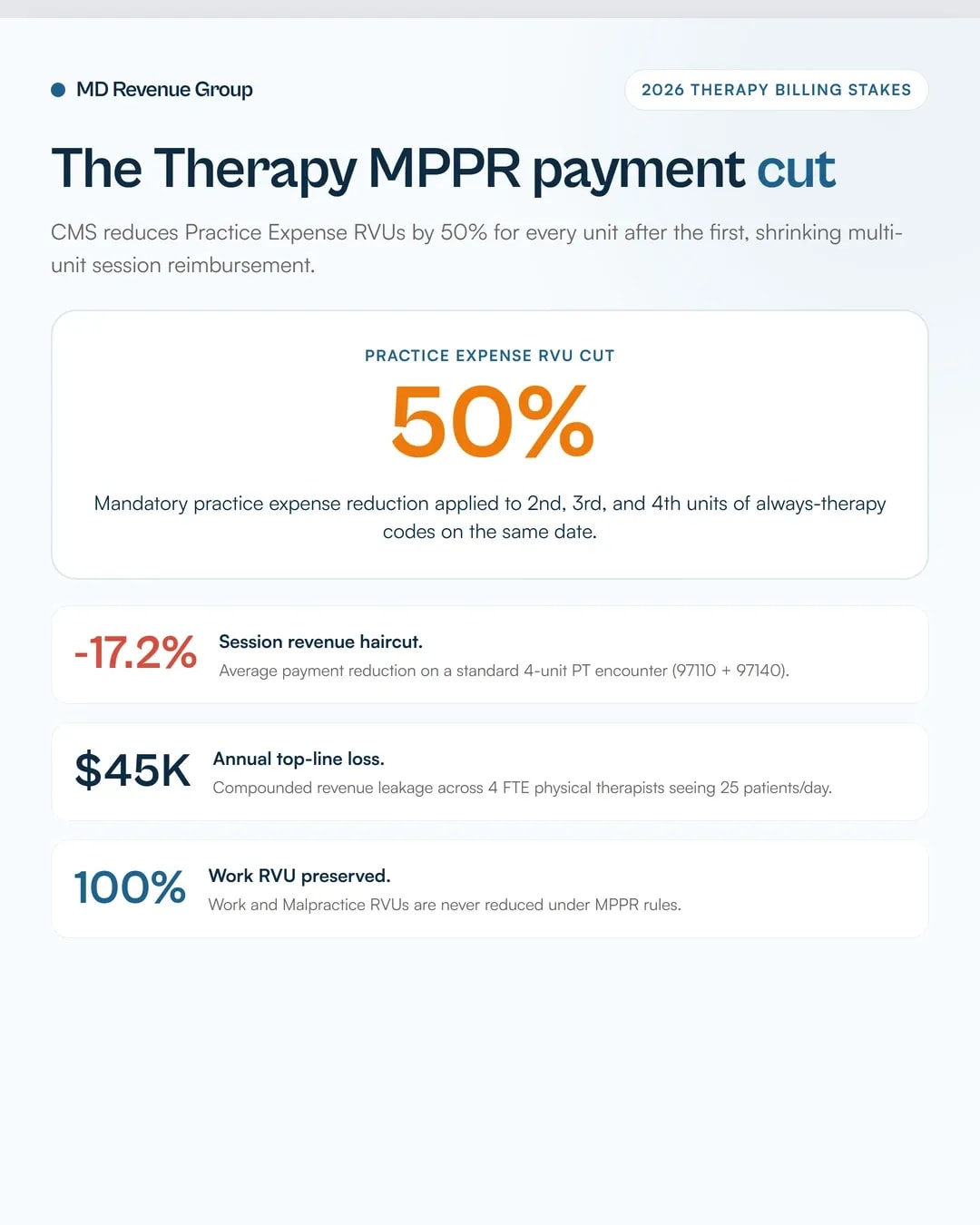
Medicare applies the Multiple Procedure Payment Reduction (MPPR) to the Practice Expense (PE) component of "always therapy" CPT codes furnished to a patient on a single day.
Under CMS Pub 100-04 Chapter 5 Section 20.2, the therapy code or unit with the highest practice expense relative value unit (RVU) is paid at 100% of the Medicare Physician Fee Schedule allowable rate. For all subsequent units or services billed on that same calendar day, CMS reduces the Practice Expense RVU component by 50%.
The Work RVU (wRVU) and Malpractice RVU (mRVU) components are never reduced under MPPR. However, because practice expense represents roughly 45% to 50% of total RVU value for outpatient therapy codes, this 50% PE reduction creates an immediate 12% to 15% reduction in total reimbursement on multi-unit treatment sessions.
Key Takeaways
- 50% PE Cut: Billed on all 2nd, 3rd, and 4th units of "always therapy" codes on the same date of service.
- Highest PE Unit Billed at 100%: Billed order on claims does not matter; Medicare adjudication software automatically identifies and pays full PE on the highest-value code.
- Cross-Discipline Trigger: Applies across PT, OT, and SLP services rendered by the same group practice (same Tax ID) on the same day.
- Work & Malpractice Untouched: wRVU and mRVU values receive 100% reimbursement on every unit.
- $18.40 Loss Per 4-Unit Encounter: Average cash haircut on a standard 1-hour physical therapy session.
- Evaluation Exemption: Initial therapy evaluations (CPT 97161–97163) and re-evaluations (CPT 97164) are exempt from MPPR reductions.
Stop writing off 4.8% of your billing to preventable payer edits.
We review 50 of your recent denied claims against commercial & Medicare payer rules to show exactly which write-offs are legally recoverable.
Find My Recoverable Dollars →Competitor Teardown: Why Standard Guides Fail Therapists
Most billing guides offer generic descriptions of MPPR without showing actual RVU formulas or locality-based dollar calculations.
They tell practice managers that "second units are reduced" but fail to explain how CMS ranks practice expense RVUs when combining therapeutic exercise (CPT 97110) with manual therapy (CPT 97140) or neuromuscular re-education (CPT 97112). They also fail to warn clinics against improper Modifier 59 usage to bypass MPPR edits.
This guide breaks down exact RVU math step-by-step. We provide clear code-level formulas, audit-ready clinical progress notes, and annual revenue leakage models for growing therapy clinics.
Anatomy of the 50% Practice Expense Reduction
To understand MPPR math, you must break every CPT fee schedule rate into its three constituent RVU components multiplied by the Medicare Conversion Factor ($33.40 Non-QP / $33.57 QP in 2026).
Because the Work RVU and Malpractice RVU remain at 100%, clinicians still receive full credit for clinical time and risk. However, administrative overhead, equipment, and facility costs are slashed in half for units two through four.
Clinicians must monitor these payment mechanics alongside therapy caps and threshold audits covered in our 2026 KX modifier threshold guide.
The Always Therapy CPT Code List
CMS designates specific CPT codes as "always therapy" services. MPPR applies to these codes regardless of whether they are billed by a physical therapist, occupational therapist, speech-language pathologist, or physician.
Commonly billed 15-minute timed therapy codes subject to MPPR include:
- CPT 97110: Therapeutic exercise (Strength, endurance, range of motion)
- CPT 97112: Neuromuscular re-education (Balance, coordination, proprioception)
- CPT 97116: Gait training (Includes stair climbing)
- CPT 97140: Manual therapy (Mobilization, manipulation, manual lymphatic drainage)
- CPT 97530: Therapeutic activities (Dynamic activities to improve functional performance)
- CPT 97535: Self-care/home management training
Untimed evaluation codes (CPT 97161, 97162, 97163) and re-evaluations (CPT 97164) are excluded from MPPR. However, if an evaluation is performed on the same day as a treatment unit (such as 97110), MPPR immediately applies to the treatment unit.
Proprietary Calculation: 4-Unit Therapy Session Math
Let's calculate the exact dollar impact of MPPR on a typical 1-hour physical therapy encounter featuring 2 units of CPT 97110 (Therapeutic Exercise) and 2 units of CPT 97140 (Manual Therapy).
Baseline 2026 National Unadjusted Values
- CPT 97110: Work RVU = 0.45 | PE RVU = 0.44 | MP RVU = 0.02 | Total RVU = 0.91
- CPT 97140: Work RVU = 0.43 | PE RVU = 0.38 | MP RVU = 0.02 | Total RVU = 0.83
- 2026 Non-QP Conversion Factor: $33.40
Step-by-Step Claim Math
- Unit 1 (CPT 97110 - Highest PE Code): Billed at 100% full value.
- Unit 2 (CPT 97110 - Second Unit): Billed with 50% PE reduction.
- Unit 3 (CPT 97140 - Third Unit): Billed with 50% PE reduction.
- Unit 4 (CPT 97140 - Fourth Unit): Billed with 50% PE reduction.
Reimbursement Comparison Table
Service Unit | Billed CPT | Full Fee Schedule Rate | MPPR Actual Rate | Net Cash Haircut |
|---|---|---|---|---|
Unit 1 | 97110 | $30.39 | $30.39 | $0.00 (100% PE) |
Unit 2 | 97110 | $30.39 | $23.05 | -$7.34 (-50% PE) |
Unit 3 | 97140 | $27.72 | $21.38 | -$6.34 (-50% PE) |
Unit 4 | 97140 | $27.72 | $21.38 | -$6.34 (-50% PE) |
Total Session | 4 Billed Units | $116.22 | $96.20 | -$20.02 (-17.2%) |
Gross Full Billed Allowance:   $116.22
Actual Billed MPPR Reimbursement: $96.20
Per-Session Loss:              -$20.02 (-17.2%)
---------------------------------------------------
Annual Loss (4 FTEs, 25 pts/day): $45,045 per year
Across 4 full-time physical therapists seeing 25 Medicare patients per day (approximately 2,250 multi-unit encounters per year), MPPR reductions account for $45,045 in annual top-line revenue reduction.
Decision Matrix: MPPR Code Stacking and Discipline Intersections
Planning daily therapy scheduling requires evaluating how code selection impacts total session yield. Billing higher-PE codes first or pairing timed codes strategically optimizes clinical revenue within Medicare guidelines.
Billed Code Mix | Highest PE Code (100% PE) | Billed Subsequent Codes (50% PE) | Effective Session RVU | Revenue Protection Strategy |
|---|---|---|---|---|
2x 97110 + 2x 97140 | CPT 97110 (PE 0.44) | 1x 97110, 2x 97140 | 2.88 RVUs ($96.20) | Standard orthopedic Rehab protocol. |
2x 97112 + 2x 97530 | CPT 97112 (PE 0.48) | 1x 97112, 2x 97530 | 3.12 RVUs ($104.21) | Higher PE yield for neuro patients. |
1x 97162 + 3x 97110 | CPT 97162 (Exempt) | 3x 97110 (All 50% PE) | Eval + 2.07 RVUs | Initial eval session; 97162 unreduced. |
PT 97110 + OT 97535 | CPT 97535 (PE 0.50) | CPT 97110 (50% PE) | Cross-discipline PE rank | Highest PE across both PT & OT wins. |
Cross-Discipline Same-Day Billing Rules
A major source of unexpected denial spikes occurs when a patient sees both a physical therapist and an occupational therapist on the same day within the same practice.
CMS enforces MPPR across all disciplines billed under the same Tax Identification Number (TIN). If a PT renders 2 units of CPT 97110 in the morning and an OT renders 2 units of CPT 97530 in the afternoon, Medicare combines all 4 units into a single daily adjudication queue.
Whichever single unit has the highest PE RVU across both disciplines is paid at 100%. The remaining 3 units, regardless of provider NPI or therapy discipline, receive the 50% PE reduction.
When billing assistant services alongside primary therapists, practices must also comply with the PTA and OTA CQ/CO modifier billing rules to prevent compounding payment reductions.
Audit Risks: Unbundling Modifiers and MAC Review
Some practices attempt to bypass MPPR reductions by attaching Modifier 59 (Distinct procedural service) or X-modifiers (XE, XS, XP, XU) to subsequent therapy units.
This practice is illegal under CMS guidelines. Modifier 59 is designed to unbundle National Correct Coding Initiative (NCCI) PTP edit pairs when distinct anatomical sites or separate sessions occur. It does not exempt a code from statutory MPPR reductions.
Medicare Administrative Contractors (MACs) run automated data algorithms targeting practices with high Modifier 59 utilization on always-therapy codes. Bypassing MPPR triggers mandatory Targeted Probe and Educate (TPE) audits, recoupment demands, and potential False Claims Act liability.
Ensuring your clinical team maintains proper credentials and enrollment is vital before submitting high-volume claims, as outlined in our overview of provider credentialing services.
Literal Documentation Example for Multi-Unit Encounters
To withstand RAC and MAC medical necessity reviews without resorting to improper modifiers, physical therapists must document distinct timed intervals and clinical rationale for each billed code unit.
DOCUMENTATION TEMPLATE: 4-UNIT SAME-DAY THERAPY ENCOUNTER
Patient Name: John Doe | DOB: 04/12/1958 | DOS: 08/25/2026
Provider: Sarah Jenkins, PT, DPT (NPI: 1492038172)
Total Direct One-on-One Timed Minutes: 60 Minutes
13:00 - 13:30 (30 Mins) - CPT 97110 (2 Units):
Therapeutic exercise focused on right quad strengthening and hamstring flexibility. B&B leg press 3x10 @ 50lbs, seated hamstring stretches 4x30s. Patient demonstrated moderate fatigue; required verbal cues for form.
13:30 - 14:00 (30 Mins) - CPT 97140 (2 Units):
Manual therapy applied to right patellofemoral joint. Grade III patellar glides and soft tissue mobilization to tight quad tendon to increase knee flexion past 105 degrees.
Clinical Rationale for Multiple Modalities:
Manual mobilization required immediately prior to functional exercise to diminish joint restriction and permit full range of motion. Services rendered as distinct 15-minute intervals. Total time: 60 minutes.
Omitting start and stop times or failing to state distinct clinical goals for CPT 97110 versus CPT 97140 results in claim denials during post-payment audits.
State-Specific Practice Management Factors
While Medicare MPPR rules apply nationally, state-level commercial payer policies and Workers' Compensation fee schedules dictate how private insurers apply multiple procedure reductions.
Clinicians establishing regional practices in New Jersey physical therapy billing should note that Horizon BCBSNJ and commercial Medicare Advantage plans strictly follow CMS MPPR guidelines on all outpatient therapy claims.
Conversely, multi-site therapy groups expanding in California therapy practice management must review commercial payer contracts individually. Certain California commercial HMO plans enforce custom MPPR structures that reduce both the Work RVU and Practice Expense RVU components if not negotiated out during contracting.
Staying updated on dispute resolution workflows for out-of-network claims also connects with the dispute guidelines in our post on the No Surprises Act IDR dispute workflow.
Frequently Asked Questions
What is MPPR in outpatient therapy billing?
MPPR is Medicare's Multiple Procedure Payment Reduction. It reduces the Practice Expense (PE) RVU component by 50% for all 2nd, 3rd, and 4th units of "always therapy" codes billed on the same date of service.
Does MPPR reduce the therapist's Work RVU?
No. MPPR only reduces the Practice Expense RVU component. The Work RVU (wRVU) and Malpractice RVU (mRVU) are paid at 100% for every unit.
Are therapy evaluations subject to MPPR?
No. Initial therapy evaluations (CPT 97161–97163) and re-evaluations (CPT 97164) are exempt from MPPR reductions.
Can I use Modifier 59 to stop MPPR reductions?
No. Attaching Modifier 59 or X-modifiers to bypass MPPR is improper billing and triggers automated MAC audits and claim recoupments.
Actionable MPPR Compliance Checklist
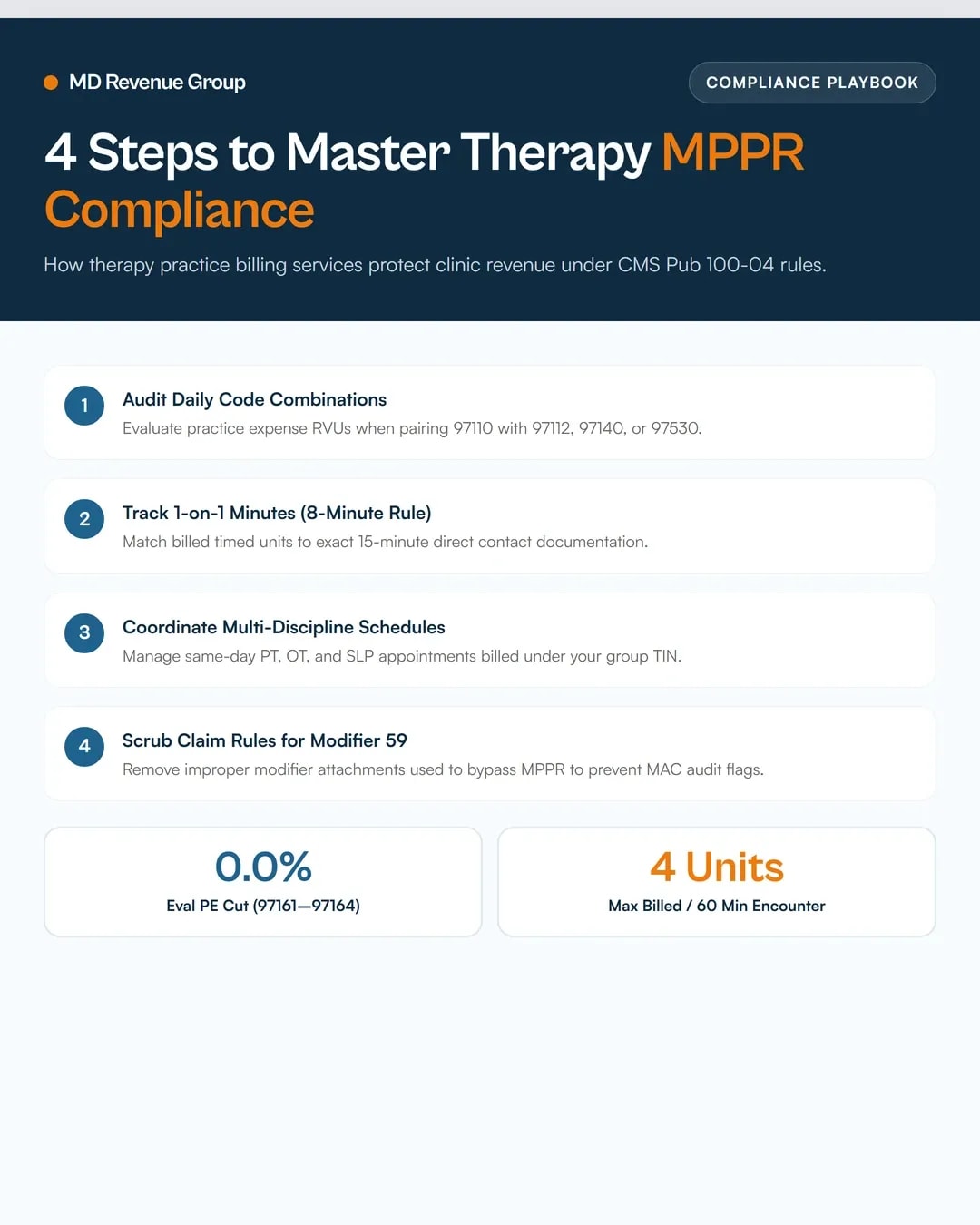
Optimizing your outpatient therapy clinic's revenue cycle while staying fully compliant requires four immediate operational controls:
- Audit Billed Code Combinations: Evaluate daily treatment schedules to ensure therapists pair high-PE codes (like 97112 or 97530) effectively with 97110.
- Track 8-Minute Rule Units: Ensure total billed timed units match direct 1-on-1 treatment minutes per CMS Pub 100-04 guidelines.
- Cross-Reference Multi-Discipline Schedules: Coordinate same-day PT, OT, and SLP appointments to project daily 50% PE reductions across TINs.
- Scrub Claim Scrubbers for Modifier Misuse: Configure clearinghouse rules to strip Modifier 59 from always-therapy codes unless true NCCI unbundling applies.
To audit your therapy clinic's fee schedule performance and eliminate coding leakage, calculate your revenue metrics with our free revenue integrity tool or request a complimentary free audit today.
Recover your denied claims in dollars.
Send us 50 of your recent denied claims. Our certified AAPC/AHIMA billing team will identify every recoverable dollar within 48 hours.