
Behavioral Health Prior Authorization: A 10-Step Workflow for Psychiatric Billing Services
Manage prior authorizations for psychiatric billing services. Reduce CO-197 denials using our 10-step workflow, AMA stats, and CMS-0057-F rules.
Behavioral Health Prior Authorization: A 10-Step Workflow for Psychiatric Billing Services
Navigating prior authorization (PA) requirements in psychiatric billing services consumes an average of 13 staff hours per week per physician, triggering high claim denial rates across commercial and government health plans. Implementing a structured 10-step authorization workflow eliminates administrative bottlenecks, protects cash flow, and ensures full compliance with CMS-0057-F turnaround mandates.
Key Takeaways
- The AMA 2025/2026 Prior Authorization Physician Survey revealed that 40% of medical practices deploy dedicated staff who work exclusively on prior authorization requests.
- Payers denied 14% of Medicaid Managed Care prior authorizations and 18% of ACA Marketplace authorizations in 2025 data releases.
- Effective January 1, 2026, CMS-0057-F mandates 72-hour turnaround times for expedited PA requests and 7 calendar days for standard requests.
- Full FHIR-based Prior Authorization API integration becomes legally mandatory for impacted health plans on January 1, 2027.
- Common CARC denial codes CO-197 (absent authorization) and CO-15 (invalid auth number in Box 23) represent administrative mistakes that clinicians cannot balance-bill to patients.
The Scope of Prior Authorization Friction in Behavioral Health
Prior authorization remains one of the largest financial and operational bottlenecks for practices offering psychiatry medical billing and therapy services.
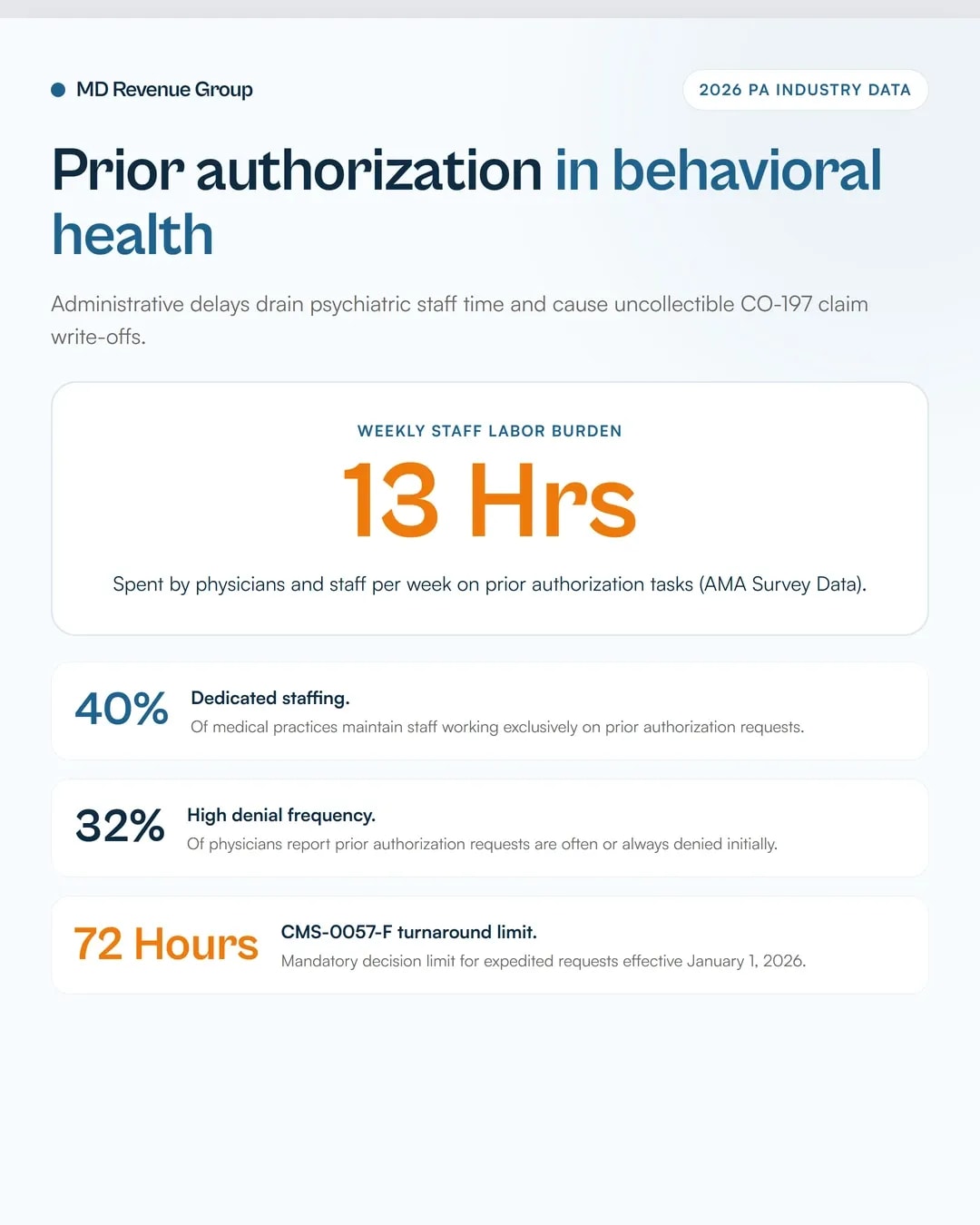
The American Medical Association (AMA) 2025/2026 Prior Authorization Physician Survey documented the administrative burden placed on provider organizations. Physicians and billing staff devote 13 hours every week to completing authorization forms, tracking portal status, and uploading progress notes.
AMA Prior Authorization Survey Highlights:
• 13 Hours/Week: Average time physicians & staff spend on PA tasks
• 40% of Practices: Maintain staff working EXCLUSIVELY on authorizations
• 32% of Physicians: Report PA requests are "often" or "always" denied
• 94% of Physicians: State PA contributes directly to professional burnout
• 12% to 18%: Average insurer-reported PA denial rate across commercial/MA plans
In fact, 32% of surveyed physicians reported that prior authorization requests are often or always denied initially. In behavioral health, these delays interrupt care continuity for patients experiencing acute depressive episodes, severe anxiety, or substance use disorders. When patients face multi-week authorization delays, non-attendance rates spike, leading to missed appointments and uncompensated clinical time.
Regulatory Mandates: CMS-0057-F Turnaround Rules in 2026 and 2027
To curb unreasonable insurer delays, CMS finalized rule CMS-0057-F (Interoperability and Prior Authorization Final Rule). This rule establishes mandatory operational deadlines that every psychiatric billing team must enforce across clinical workflows.
Phase 1: Operational Rules (Effective January 1, 2026)
Impacted payers (Medicare Advantage, Medicaid FFS, Medicaid Managed Care, CHIP, and QHP exchange plans) must comply with strict decision timelines:
- Expedited (Urgent) Requests: Decisions must be returned within 72 hours of submission.
- Standard Requests: Decisions must be returned within 7 calendar days.
- Denial Transparency: Insurers can no longer send generic denial letters. They must provide a specific, clinical, or administrative reason for every rejected request.
- Public Reporting: Payers must publish annual prior authorization approval and denial percentages on their public websites.
Phase 2: Technical API Rules (Effective January 1, 2027)
Payers must launch operational Health Level 7 (HL7) Fast Healthcare Interoperability Resources (FHIR) APIs. This allows electronic health records (EHR) and practice management software to query authorization rules automatically at the point of care.
Practices delivering specialized behavioral health billing services should prepare their EHR vendors now to ensure compatibility with 2027 API standards.
Proprietary Cost-of-Inaction Model: The Financial Drain of Manual Portals
Many psychiatric practices rely on manual faxing and insurer web portals to process authorizations. This manual approach creates severe cash flow drag.
Below is a worked financial impact model for a 4-provider psychiatric practice processing 120 prior authorizations per month, assuming a loaded staff labor rate of $32.00 per hour.
Operational Metric | Manual Portal / Fax Workflow | Automated 10-Step API Workflow | Net Monthly Variance | Annualized Practice Impact |
|---|---|---|---|---|
Staff Labor Hours per PA | 1.8 hours | 0.4 hours | -1.4 hours / PA | -2,016 staff hours / year |
Monthly Staff Labor Cost | $6,912 ($32/hr) | $1,536 ($32/hr) | -$5,376 | -$64,512 / year |
Average Decision Turnaround | 11 calendar days | 3 calendar days | -8 days | 8 days faster access |
Initial PA Denial Rate | 16.5% (20 claims/mo) | 3.5% (4 claims/mo) | -13.0% | 192 fewer denials / yr |
Uncollected Write-Off Risk | $3,600 / month | $720 / month | -$2,880 | +$34,560 recovered cash |
By transitioning from unstructured manual submissions to a standardized workflow, the average group practice saves over $64,000 in administrative labor while protecting more than $34,000 in uncollectible claim write-offs.
If manual portals are exhausting your clinical staff, explore our guide on prior authorization automation failure to identify why basic clearinghouse tools drop the ball.
High-Risk Behavioral Health CPT Codes Requiring Authorization
Not all psychiatric services require pre-approval. However, submitting high-risk codes without verifying plan-specific authorization triggers immediate contractual denials (CO-197).
Behavioral Health CPT Code Risk Matrix:
┌───────────┬─────────────────────────────────────┬───────────────────────────┐
│ CPT Code  │ Service Description                 │ PA Risk Level             │
├───────────┼─────────────────────────────────────┼───────────────────────────┤
│ 90791     │ Psychiatric Diagnostic Evaluation   │ Low (Usually 1st visit)   │
│ 90834     │ Psychotherapy, 45 minutes           │ Moderate (After 12 visits)│
│ 90837     │ Psychotherapy, 60 minutes           │ HIGH (Payer audit target) │
│ 90847     │ Family Psychotherapy with Patient   │ Moderate                  │
│ 96130     │ Psychological Testing, 1st Hour     │ VERY HIGH (Mandatory PA)  │
│ 90870     │ Electroconvulsive Therapy (ECT)     │ CRITICAL (Mandatory PA)   │
└───────────┴─────────────────────────────────────┴───────────────────────────┘
Psychiatrists and clinical psychologists must pay close attention to code 90837 (60-minute psychotherapy). Commercial payers in tri-state markets like medical billing in New Jersey routinely audit 90837 frequency. Payers often enforce hidden medical necessity thresholds after 12 to 20 sessions per calendar year.
When billing psychological testing (96130/96131), insurers require pre-authorization specifying the exact battery of tests, estimated testing hours, and clinical diagnostic necessity before testing begins.
The 10-Step Prior Authorization Workflow Checklist
Follow this 10-step protocol for every new patient intake and recurring treatment cycle to achieve a clean claim rate above 98%.
Step 1: Real-Time Eligibility (RTE) Check at Scheduling
Step 2: Payer PA Matrix Verification
Step 3: Clinical Intake Evidence Assembly (PHQ-9 / GAD-7)
Step 4: ICD-10 to CPT Code Alignment
Step 5: Electronic API Request Submission
Step 6: Unique Tracking Number Log Entry
Step 7: Automated Status Follow-Up (Day 3 & Day 5)
Step 8: Determination Capture & Box 23 Entry
Step 9: Patient Notification & Service Scheduling
Step 10: Post-Rendered Claim Scrubbing
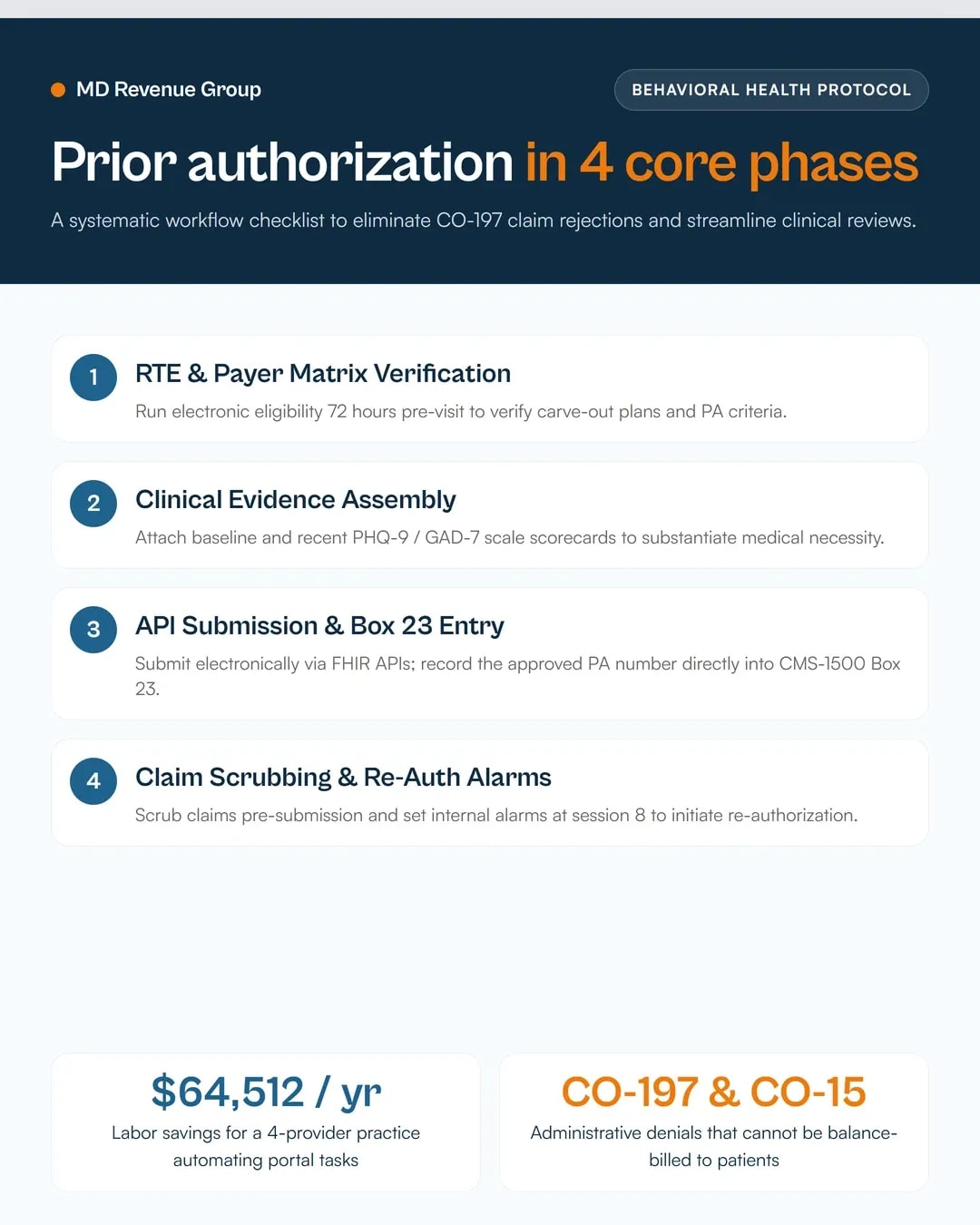
1. Real-Time Eligibility Check at Scheduling
Run electronic eligibility 72 hours before the appointment. Verify active behavioral health coverage, copays, deductibles, and third-party carve-out vendors (e.g., Optum, Beacon/Carelon).
2. Payer PA Matrix Verification
Cross-reference the billed CPT code against a quarterly updated payer matrix. Determine whether the specific policy requires prior authorization, precertification, or concurrent review.
3. Clinical Intake Evidence Assembly
Gather quantitative clinical metrics before filling out authorization forms. Include baseline and recent PHQ-9 (depression), GAD-7 (anxiety), or BAM (addiction) scorecards.
4. ICD-10 to CPT Code Alignment
Verify that the primary ICD-10 diagnosis code supports the requested procedure code. For instance, billing 96130 (psychological testing) for mild stress management without a severe diagnostic basis triggers immediate rejection.
5. Electronic API Request Submission
Submit the request through payer APIs or secure portals. Avoid faxing unless the insurer's portal is offline. Attach the clinical evidence packet directly to the electronic transaction.
6. Unique Tracking Number Log Entry
Log the reference number, submission timestamp, requested date range, authorized unit count, and rendering provider NPI in your practice management system.
7. Automated Status Follow-Up
Track pending requests on day 3 for standard submissions and hour 24 for urgent submissions. If a payer exceeds the CMS-0057-F turnaround limits (7 days standard / 72 hours urgent), escalate immediately to the provider relations manager.
8. Determination Capture and Box 23 Entry
When approved, record the exact prior authorization number. Enter the number directly into Box 23 of the CMS-1500 claim form (or Loop 2300 REF02 on 837P electronic EDI files).
9. Patient Notification and Service Scheduling
Never render authorized services until written approval is secured. If authorized for 10 sessions, configure an internal alarm when the patient completes session 8 to initiate re-authorization.
10. Post-Rendered Claim Scrubbing
Run claims through clearinghouse scrubbers before transmission. Confirm that the service date, rendering provider NPI, CPT code, and units match the stored authorization record exactly.
For an overarching review of denial workflows, read our detailed article on how to reduce claim denials.
CARC Denial Code Mapping: Fixing CO-197, CO-15, and CO-16
When an authorization breakdown occurs, payers send specific Claim Adjustment Reason Codes (CARCs). Understanding these codes prevents repeated billing errors.
CARC Code | Code Definition | Root Cause in Psychiatric Billing | Corrective Action Plan |
|---|---|---|---|
CO-197 | Precertification / authorization / notification absent | Service rendered before securing approval or authorization expired. | Check if retroactive PA is allowed. If denied, file a clinical appeal demonstrating urgent medical necessity. Cannot balance-bill patient. |
CO-15 | Authorization number missing, invalid, or non-matching | PA number omitted from Box 23, or number does not match rendering NPI/CPT. | Verify PA number against approval letter. Correct Box 23 on CMS-1500 form and resubmit as a corrected claim. |
CO-16 | Claim lacks required information | Missing accompanying clinical notes, session start/stop times, or diagnostic scale scores. | Review accompanying RARC (Remark Code). Attach requested documentation or session logs and resubmit promptly. |
CO-50 | Non-covered service; not medically necessary | Payer medical director determined clinical notes do not meet LOCUS / ASAM criteria. | Request a peer-to-peer review within 14 days. Prepare objective scale trends (PHQ-9) and updated treatment plan. |
Practices operating in high-volume areas like medical billing in New York should audit their remittance advice weekly to identify recurring CARC trends across commercial health plans.
Literal Clinical Documentation Examples for Peer-to-Peer Review
If a payer issues a CO-50 medical necessity denial, your medical director or treating psychiatrist must conduct a peer-to-peer review.
Generic clinical statements fail peer-to-peer reviews. Medical directors require objective scale metrics, functional impairments, and failed lower-level interventions.
Generic Script (Peer-to-Peer Rejection)
"The patient is still anxious and needs continued 60-minute therapy sessions weekly to stabilize their mood."
Audit-Proof Peer-to-Peer Evidence Script
"The patient presents with severe recurrent Major Depressive Disorder (ICD-10 F33.2) and generalized anxiety. Baseline PHQ-9 score was 21 (Severe) on May 10, current score is 16 (Moderate-Severe) despite 8 weeks of SSRI optimization and cognitive behavioral therapy. Patient experiences severe functional impairment, including an inability to maintain consistent workplace attendance (2 missed shifts per week). Continued 60-minute weekly psychotherapy (90837) is medically necessary to achieve stabilization before step-down to bi-weekly care."
The structured example cites exact diagnostic codes, objective scale progression, real-world functional impairment, and a clear step-down strategy.
If you are expanding your behavioral health practice, check our comprehensive psychiatric billing services Medicare enrollment guide to navigate provider credentialing.
Frequently Asked Questions
Can a psychiatric practice balance-bill a patient for a CO-197 denial?
No. Under standard commercial and Medicare in-network provider agreements, prior authorization is an administrative obligation of the healthcare provider. If a claim is denied via CO-197 (missing authorization), the provider must write off the contractual allowance and cannot balance-bill the patient.
How does CMS-0057-F impact prior authorization turnaround times in 2026?
Effective January 1, 2026, CMS-0057-F enforces strict maximum turnaround times on impacted payers (Medicare Advantage, Medicaid Managed Care, QHP exchange plans). Insurers must return decisions within 72 hours for expedited (urgent) requests and within 7 calendar days for standard non-urgent requests.
What is the difference between prior authorization and precertification?
Prior authorization evaluates the overall medical necessity of a treatment plan or diagnostic evaluation before services are rendered. Precertification refers specifically to notifying the insurer of an upcoming admission, high-cost procedure, or intensive program (such as IOP or PHP) to verify benefit coverage.
Protect Your Practice From Preventable Denials
Managing prior authorizations requires dedicated time, clinical precision, and technical billing expertise. If authorization delays and claim write-offs are cutting into your practice's margin, our specialized team is here to help.
Request a free revenue audit today to let our certified medical coders evaluate your prior authorization workflows, denial patterns, and clean claim rates.