
Therapy Practice Billing Services: 2026 KX Modifier Thresholds and Medical-Review Readiness
CMS set the 2026 Medicare KX modifier threshold at $2,480 for PT/SLP and OT. Learn how therapy practice billing services prevent claim denials.
Therapy Practice Billing Services: 2026 KX Modifier Thresholds and Medical-Review Readiness
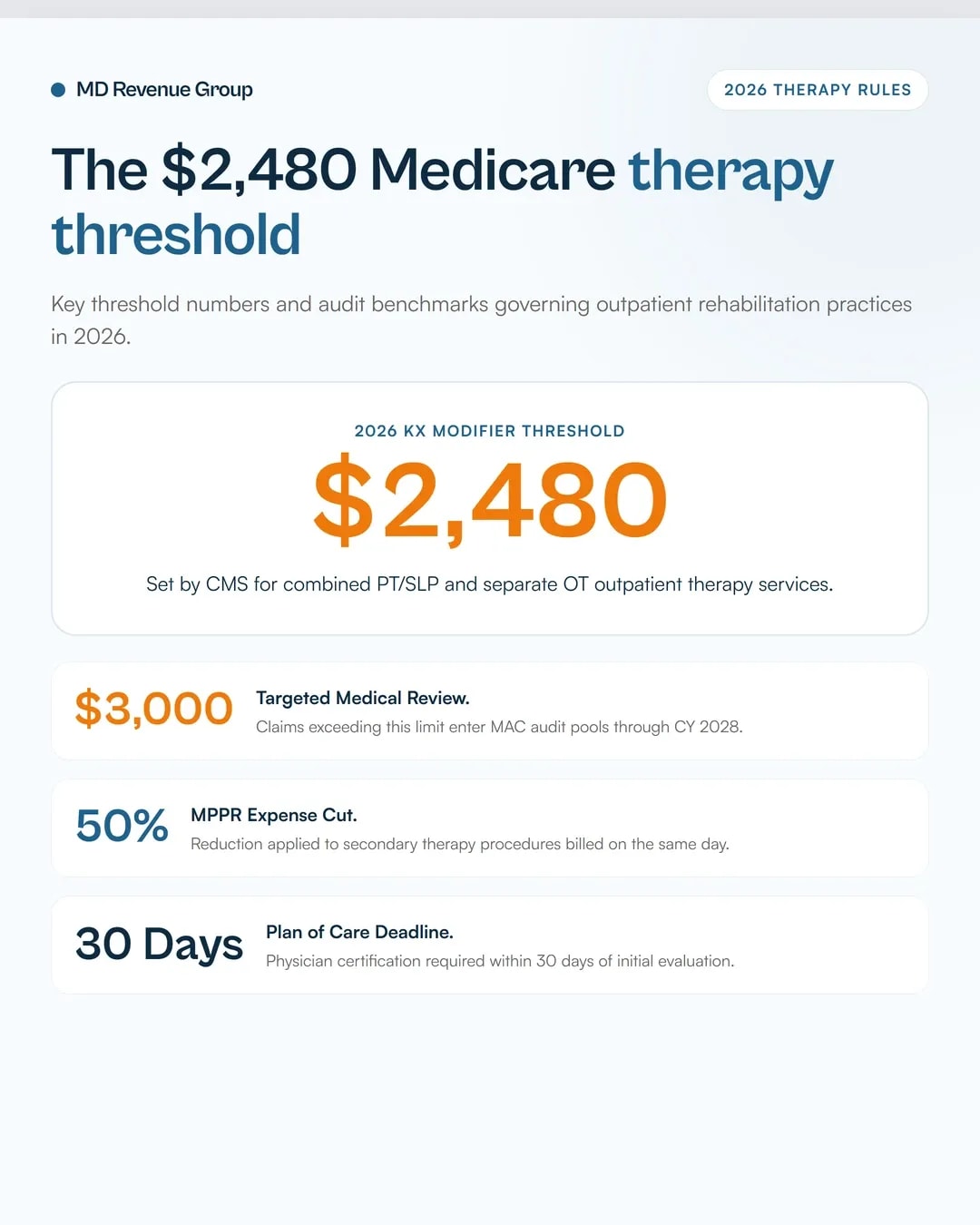
For outpatient physical therapy, occupational therapy, and speech-language pathology practices, managing Medicare Part B reimbursement requires strict compliance with annual billing thresholds. For calendar year 2026, the Centers for Medicare & Medicaid Services (CMS) set the Medicare KX modifier threshold at $2,480 for physical therapy (PT) and speech-language pathology (SLP) combined, and $2,480 separately for occupational therapy (OT). When a patient's annual care exceeds these amounts, practices must append the KX modifier to every subsequent claim line to attest that continued therapy remains medically necessary. In addition, the targeted medical review threshold remains fixed at $3,000 through CY 2028, placing high-volume therapy claims under active audit scrutiny by Medicare Administrative Contractors (MACs).
Partnering with specialized therapy practice billing services allows clinical practice owners to automate threshold tracking, enforce 8-Minute Rule compliance, and eliminate documentation-driven claim rejections. This comprehensive guide outlines 2026 Medicare rules, clinical documentation triggers, and practical workflows for rehabilitation clinics.
Key Takeaways
- 2026 KX Modifier Threshold: $2,480 for combined PT and SLP services, and $2,480 for OT services (indexed up from $2,410 in 2025).
- Targeted Medical Review Threshold: Fixed at $3,000 for PT/SLP combined and $3,000 for OT through CY 2028.
- No Hard Financial Cap: Medicare does not limit necessary therapy care; claims above $2,480 are paid if supported by medical necessity documentation and the KX modifier.
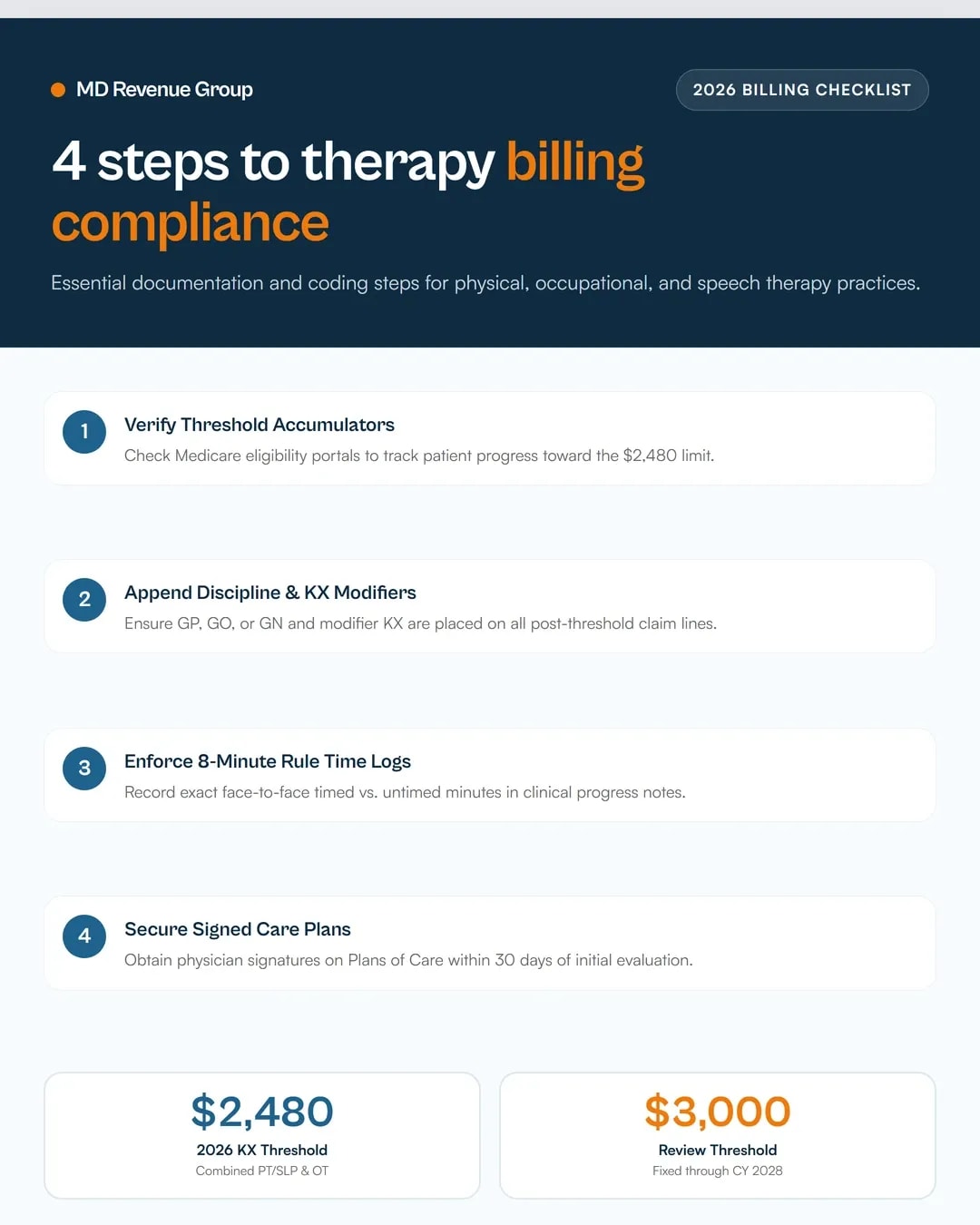
- Therapy Modifiers Are Mandatory: Every line item must include GP (PT), GO (OT), or GN (SLP), along with KX once the threshold is crossed.
- Plan of Care Signatures: Physician or non-physician practitioner (NPP) certification must be obtained within 30 days of the initial evaluation.
Understanding the 2026 Medicare Therapy Cap and Threshold Updates
Outpatient rehabilitation billing operates under rules distinct from standard medical specialties. Following the repeal of the statutory "hard therapy cap" by the Bipartisan Budget Act of 2018, Medicare replaced arbitrary payment limits with an annual threshold system linked to the Medicare Economic Index (MEI).
Find the unbundled units and modifier downcodes payers are stripping.
Payers process high-volume specialty codes differently by region. We review 50 encounters to uncover hidden downcoding and uncollected units.
Audit My Specialty Encounters →2025 vs 2026 Medicare Therapy Threshold Comparison
┌───────────────────────────────────────┬──────────────┬──────────────┐
│ Threshold Type │ CY 2025 │ CY 2026 │
├───────────────────────────────────────┼──────────────┼──────────────┤
│ Combined PT & SLP KX Threshold │ $2,410 │ $2,480 │
│ Occupational Therapy (OT) KX │ $2,410 │ $2,480 │
│ Targeted Medical Review (PT & SLP) │ $3,000 │ $3,000 │
│ Targeted Medical Review (OT) │ $3,000 │ $3,000 │
└───────────────────────────────────────┴──────────────┴──────────────┘The $2,480 threshold applies across all outpatient Part B settings, including private therapy clinics, physician offices, skilled nursing facilities (Part B), home health agencies, and hospital outpatient departments.
Because therapy limits accumulate per beneficiary per calendar year across all treating providers, a patient who received physical therapy at a hospital outpatient department in spring will hit the $2,480 threshold faster when initiating treatment at a private clinic in autumn. Practices utilizing dedicated physical therapy billing services run electronic eligibility checks before the first appointment to verify accumulator balances.
Applying the KX Modifier: Mandatory Billing Rules and Coding Logic
When a patient's accumulated allowed charges reach $2,480, Medicare clearinghouses automatically reject incoming claims unless the KX modifier is attached to every therapy service code.
Medicare Therapy Claim Line Modifier Hierarchy
┌──────────────────┐     ┌──────────────────┐     ┌──────────────────┐
│ Discipline Code  │ ──► │  KX Attestation  │ ──► │ Special Modifiers│
│ GP (PT)          │     │ Appended once    │     │ CQ/CO (Assistant)│
│ GO (OT)          │     │ threshold crossed│     │ 59/XE (Distinct) │
│ GN (SLP)         │     │ ($2,480 allowed) │     │                  │
└──────────────────┘     └──────────────────┘     └──────────────────┘
Critical Rules for Appending Modifier KX
- Attestation of Medical Necessity: By appending modifier KX, the provider explicitly certifies that the patient requires skilled therapy services beyond the baseline threshold and that clinical documentation justifies treatment.
- Line-Item Placement: The KX modifier must be entered on every individual procedure line (such as 97110 or 97140), not just on the claim header.
- Discipline Modifiers First: Modifier KX is appended alongside the mandatory discipline modifier:
- GP for Physical Therapy
- GO for Occupational Therapy
- GN for Speech-Language Pathology
If an occupational therapist fails to attach modifier GO and modifier KX to code 97530 after the patient crosses $2,480, the MAC instantly denies reimbursement. Clinics managing occupational therapy billing configure claim scrubber software to flag charts as soon as beneficiary accumulators touch $2,400.
Targeted Medical Review at $3,000: How MACs Select Claims for Audits
Crossing the $2,480 KX modifier threshold does not trigger automatic manual record audits. However, once a beneficiary's allowed therapy charges exceed $3,000, claims enter the targeted medical review pool managed by Supplemental Medical Review Contractors (SMRCs) and MAC auditors.
Medicare Therapy Threshold Escalation Pathway
┌──────────────────────────────────────────────────────────────────────────┐
│ $0 to $2,479: Standard Part B Billing                                    │
│ Mandatory GP, GO, or GN discipline modifiers required.                   │
└──────────────────────────────────────────────────────────────────────────┘
                                   │
                                   ▼
┌──────────────────────────────────────────────────────────────────────────┐
│ $2,480 to $2,999: KX Modifier Attestation                                │
│ Mandatory KX modifier required on all claim lines; claims paid automatically.│
└──────────────────────────────────────────────────────────────────────────┘
                                   │
                                   ▼
┌──────────────────────────────────────────────────────────────────────────┐
│ $3,000+: Targeted Medical Review (Audit Range through 2028)              │
│ Selected claims subject to Additional Documentation Requests (ADRs).     │
└──────────────────────────────────────────────────────────────────────────┘
Auditors do not review 100% of claims above $3,000. Instead, CMS directs contractors to target review selections using specific risk criteria:
- Provider Outliers: Therapy practices whose billing patterns differ significantly from regional peers (e.g., billing 5 units per patient visit vs. the national average of 3.2 units).
- High Denial Rates: Clinics with previous documentation or coding compliance errors.
- Aberrant Billing for Specific Codes: High utilization of unlisted codes or constant evaluation code billing without corresponding treatment episodes.
When specialized speech-language pathology billing experts monitor claim submissions, they audit high-dollar cases to ensure clinical notes withstand SMRC scrutiny before claims cross the $3,000 mark.
The 8-Minute Rule vs. Multiple Procedure Payment Reduction (MPPR)
Therapy practices face two concurrent payment calculation rules that directly impact daily revenue: CMS's 8-Minute Rule and the Multiple Procedure Payment Reduction (MPPR).
The Federal 8-Minute Rule Breakdown
For time-based CPT codes (such as 97110 Therapeutic Exercise, 97140 Manual Therapy, and 97112 Neuromuscular Re-education), therapists must record total direct face-to-face contact time.
CMS 8-Minute Rule Unit Calculation Table
┌───────────────────────────────────────┬────────────────────┐
│ Total Direct Treatment Time           │ Billable Units     │
├───────────────────────────────────────┼────────────────────┤
│ 0 - 7 minutes                         │ 0 units            │
│ 8 - 22 minutes                        │ 1 unit             │
│ 23 - 37 minutes                       │ 2 units            │
│ 38 - 52 minutes                       │ 3 units            │
│ 53 - 67 minutes                       │ 4 units            │
│ 68 - 82 minutes                       │ 5 units            │
└───────────────────────────────────────┴────────────────────┘
If a physical therapist delivers 20 minutes of therapeutic exercise (97110) and 10 minutes of manual therapy (97140), total direct time equals 30 minutes. According to the 8-Minute Rule table, 30 minutes allows a maximum of 2 billable units. The practice bills 1 unit of 97110 and 1 unit of 97140.
Multiple Procedure Payment Reduction (MPPR) Impact
In addition to unit counting, Medicare applies a 50% Practice Expense (PE) reduction to secondary and subsequent therapy codes billed on the same day. While the primary (highest PE) code receives 100% reimbursement, subsequent codes experience a net 20% to 25% reduction in total payment.
Tracking these complex rules while maintaining high clean claim rate benchmarks requires automated billing tools calibrated to therapy-specific rules.
4 Core Documentation Triggers That Protect Therapy Collections
When a Medicare auditor issues an Additional Documentation Request (ADR) for claims exceeding $2,480, payment integrity hinges on four specific chart elements:
4 Mandatory Medical Record Elements for Therapy Claims
┌──────────────────────────────────────────────────────────────────────────┐
│ 1. Initial Evaluation & Plan of Care (POC)                               │
│    Includes objective baseline metrics, functional goals, and frequency. │
├──────────────────────────────────────────────────────────────────────────┤
│ 2. Timely Physician Certification                                        │
│    Signed and dated by MD/DO/NPP within 30 days of initial evaluation.   │
├──────────────────────────────────────────────────────────────────────────┤
│ 3. 10-Day Progress Reports                                               │
│    Documented by a licensed therapist at least once every 10 treatment days.│
├──────────────────────────────────────────────────────────────────────────┤
│ 4. Daily Treatment Notes with Timestamps                             │
│    Recording total timed minutes, untimed minutes, and skilled interventions.│
└──────────────────────────────────────────────────────────────────────────┘- Signed Plan of Care (POC): The initial evaluation must include a clear care plan signed by a physician or non-physician practitioner within 30 days. Unsigned POCs are the single leading cause of therapy claim clawbacks.
- Objective Functional Goals: Clinical notes must establish measurable, time-bound functional goals (e.g., "Patient will ambulate 150 feet independently without assistive device within 4 weeks").
- 10-Day Progress Notes: A licensed therapist (not an assistant) must write a formal progress note at least once every 10 treatment days or 30 calendar days.
- Justification of Skilled Care: Daily notes must describe why the skills of a qualified therapist were required, rather than describing routine exercises a patient could perform independently.
Therapy practices expanding across state lines must adapt documentation workflows to regional commercial rules. Clinics operating medical billing in New York must track Empire BCBS authorization caps, while practices managing medical billing in Pennsylvania must monitor Highmark therapy pre-certifications alongside Medicare KX thresholds.
Financial Impact Model: Threshold Tracking in a 5-Therapist Clinic
To illustrate the cash-flow impact of threshold errors, consider a 5-therapist outpatient physical therapy practice treating 120 patients per week with an average episode length of 14 visits.
Cash-Flow Risk Analysis: Unmanaged Therapy Thresholds
─────────────────────────────────────────────────────────────────────────────
Active Patients per Month:                             180
Patients Crossing $2,480 KX Threshold Annually (35%):  63 patients
Average Billed Amount per Post-Threshold Visit:        $115
Post-Threshold Visits per Patient (Avg 6 visits):      $690 per patient
Total Revenue at Risk Post-Threshold:                  $43,470
─────────────────────────────────────────────────────────────────────────────
The Cost of Threshold Oversight
If the practice's billing team fails to append modifier KX to post-threshold claims due to manual entry errors:
- Immediate Denial Amount: $43,470 in rejected claims over the course of a year.
- Administrative Clearinghouse Costs: Staff spend 45 minutes per denied claim identifying threshold dates, updating modifiers, and resubmitting claims.
- Cash-Flow Delay: Collections lag by 45 to 60 days, straining practice payroll.
By automating threshold notifications inside their billing software, clinics protect over $43,000 in annual collections while maintaining steady cash flow.
Comparing In-House Billing vs. Specialized Therapy Billing Vendors
Practice administrators frequently decide whether to retain internal billing staff or outsource revenue cycle management to rehabilitation specialists.
Operational Comparison: In-House Billing vs. Specialized Therapy Billing
┌──────────────────────────┬───────────────────────────────┬───────────────────────────────┐
│ Feature                  │ In-House Staff Billing        │ Specialized Therapy Vendor    │
├──────────────────────────┼───────────────────────────────┼───────────────────────────────┤
│ KX Threshold Tracking    │ Manual spreadsheets / basic   │ Automated EHR accumulator sync│
│ 8-Minute Rule Audits     │ Periodic manual spot-checks   │ Daily automated scrubber      │
│ Modifier Application     │ High risk of missed GP/GO/KX  │ 100% rules-based automation   │
│ Denial Management        │ Delayed appeal follow-up      │ Dedicated 48-hour appeal team │
│ Credentialing Overhead   │ Practice manages revalidation │ Full CAQH & PECOS tracking    │
│ Cost Structure           │ Fixed staff salary & benefits │ Percentage of net collections │
└──────────────────────────┴───────────────────────────────┴───────────────────────────────┘
Specialized therapy billing providers focus exclusively on rehabilitation rules, ensuring modifier compliance and preventing threshold-related cash-flow interruptions.
Frequently Asked Questions About Therapy Practice Billing
1. Does the $2,480 KX modifier threshold apply to private commercial insurance plans?
The $2,480 threshold is a specific Medicare Part B rule. However, many Medicare Advantage plans (Part C) and commercial payers adopt similar threshold tracking or require prior authorization once therapy visits exceed a specific limit.
2. Can a physical therapy assistant (PTA) provide care after a patient crosses the $2,480 threshold?
Yes, PTAs and OTAs can continue treating patients above the $2,480 threshold, provided care follows an established Plan of Care. When billing assistant services under Medicare, practices must also append modifier CQ (for PTA) or CO (for OTA) alongside modifier KX.
3. What happens if a physician fails to sign the Plan of Care within 30 days?
If the physician signature is not obtained within 30 days of the initial evaluation, Medicare considers the services uncertified and will deny reimbursement upon audit. Practices must document delayed certification efforts to protect claims.
4. How can a clinic check how much of the $2,480 threshold a new patient has used elsewhere?
Practices can verify beneficiary accumulator balances by requesting a Medicare eligibility report (HIQA/HETS) through their MAC portal or clearinghouse prior to initiating treatment.
Ensure your rehabilitation practice remains compliant and fully reimbursed. Request a customized free revenue audit today to evaluate your documentation readiness and claim submission workflows.
See your specialty billing leaks in dollars.
Get a free 50-claim forensic specialty audit with your exact regional MAC and commercial payer policies applied.