
CQ and CO Modifiers: A Therapy Billing Services Guide for PTA and OTA Claims
Master CQ and CO modifiers for therapy billing services. Learn the 10% de minimis rule, 85% reimbursement reduction, and documentation standards for PTAs and OTAs.
CQ and CO Modifiers: A Therapy Billing Services Guide for PTA and OTA Claims
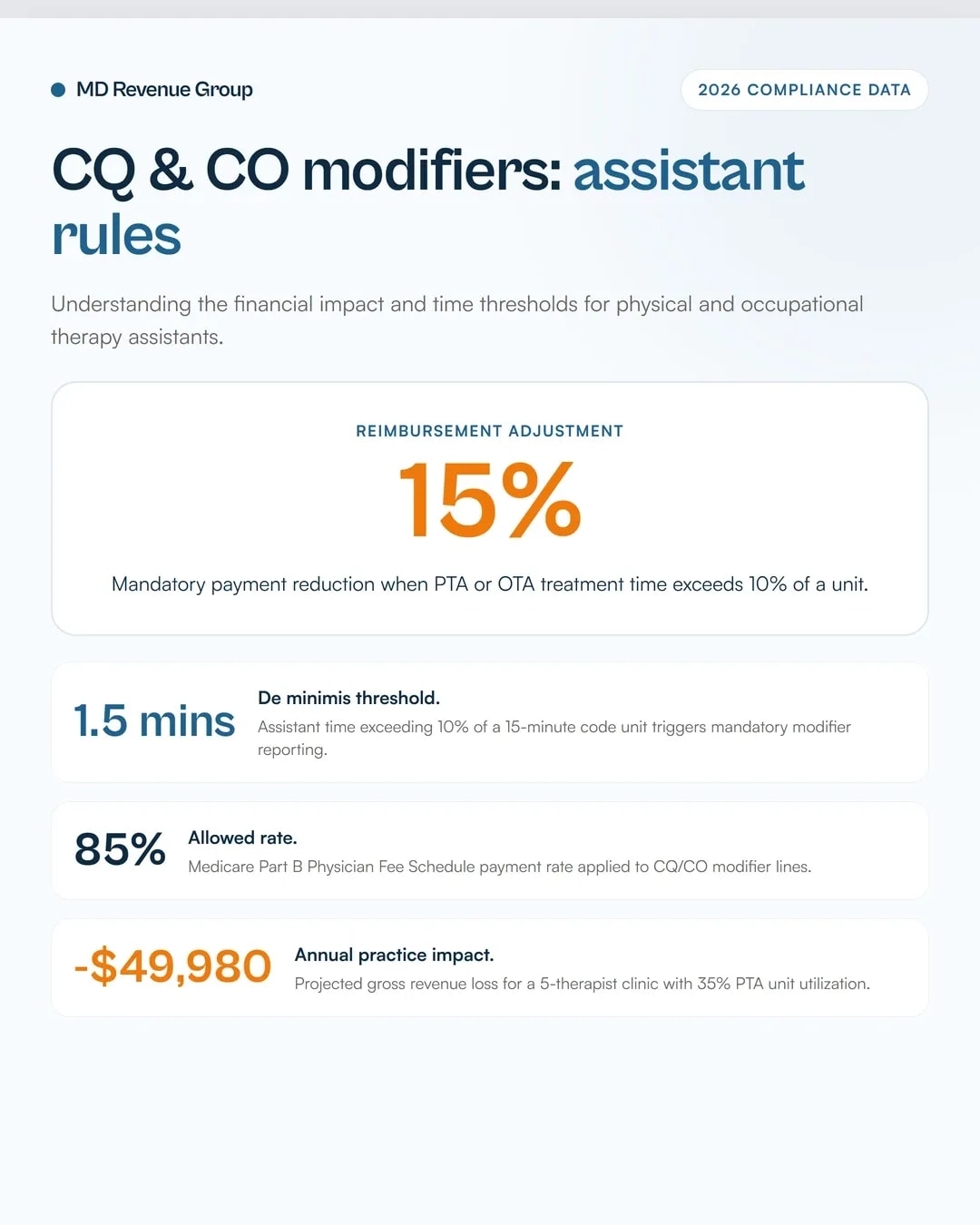
Outpatient physical therapy and occupational therapy practices using therapy billing services must navigate strict CMS modifier rules to maintain compliance and protect practice cash flow. Under Section 53107 of the Bipartisan Budget Act of 2018, Medicare mandates the use of payment modifiers CQ and CO when services are furnished in whole or in part by Physical Therapist Assistants (PTAs) or Occupational Therapy Assistants (OTAs). Appending these modifiers triggers a mandatory 15% payment reduction (reimbursing claims at 85% of the Medicare Physician Fee Schedule allowed amount) whenever assistant treatment time exceeds the 10% de minimis standard.
Key Takeaways for Therapy Practice Administrators
- Mandatory 15% Reduction: Appending modifier CQ (PTA) or CO (OTA) reduces Medicare Part B reimbursement to 85% of the Physician Fee Schedule rate.
- The 10% De Minimis Threshold: Assistant involvement exceeding 1.5 minutes (10%) of a timed 15-minute code requires the assistant modifier on that specific claim line.
- Modifier Stacking Order: CQ and CO modifiers must be appended alongside therapy plan of care modifiers GP (Physical Therapy) or GO (Occupational Therapy) at the line-item level.
- Settings Impacted: Applies to private physical therapy practices, rehabilitation agencies, skilled nursing facilities billing Part B, home health agencies billing Part B, and hospital outpatient therapy departments (HOPDs).
- Critical Exemption: Critical Access Hospitals (CAHs) operating under Part B cost reimbursement are exempt from the CQ/CO 15% payment reduction.
Why CQ and CO Modifiers Impact Outpatient Therapy Revenue
Outpatient therapy clinics rely heavily on licensed assistants to maintain patient volume and provide continuous care. When CMS implemented mandatory claim reporting for modifier CQ (PTA) and modifier CO (OTA), practices faced new operational challenges in tracking clinician minutes.
Stop writing off 4.8% of your billing to preventable payer edits.
We review 50 of your recent denied claims against commercial & Medicare payer rules to show exactly which write-offs are legally recoverable.
Find My Recoverable Dollars →Failing to report required CQ/CO modifiers results in post-payment audits, demand letters for overpayments, and potential False Claims Act liability. Conversely, over-applying assistant modifiers on services performed independently by a physical therapist (PT) or occupational therapist (OT) results in unnecessary revenue leakage. Integrating precise clinical time tracking into comprehensive revenue cycle management workflows keeps therapy practices compliant without sacrificing legitimate earnings.
PTA & OTA REIMBURSEMENT FLOW CHART |
|---|
Therapy Session Delivered -> Check Clinician Type (PT vs. PTA)<br>If PTA/OTA Time > 1.5 Minutes of 15-Min Unit (De Minimis > 10%):<br>-> Append Plan of Care Modifier (GP/GO) + Assistant Modifier (CQ/CO)<br>-> Medicare Reimbursement Adjusted to 85% of Fee Schedule Allowed Rate |
Clinic administrators must audit clinician schedules and EHR documentation workflows to ensure time tracking matches CMS guidelines across all outpatient care settings.
Defining CQ and CO Modifiers and Primary Plan of Care Stacking
CMS defined two specific Level II HCPCS modifiers to identify outpatient therapy assistant services:
- Modifier CQ: Outpatient physical therapy services furnished in whole or in part by a physical therapist assistant.
- Modifier CO: Outpatient occupational therapy services furnished in whole or in part by an occupational therapy assistant.
These modifiers do not replace standard discipline-specific plan of care modifiers. Billers must append CQ or CO in addition to primary modifiers GP (Physical Therapy) or GO (Occupational Therapy).
Service Discipline | Primary Modifier | Assistant Modifier | Correct Line-Item Claim Format |
|---|---|---|---|
Physical Therapy (PTA) | GP | CQ | 97110 GP CQ |
Occupational Therapy (OTA) | GO | CO | 97530 GO CO |
Speech-Language Pathology | GN | N/A (No Speech Assistant Modifier) | 97129 GN |
When submitting claims to Medicare Administrative Contractors (MACs), placing modifiers in the wrong column order can trigger front-end claim clearinghouse rejections. Always list the discipline modifier (GP/GO) in position 1, followed by the assistant modifier (CQ/CO) in position 2.
Therapy practices credentialing new clinical staff through provider credentialing services for physical therapists must verify that PTA and OTA NPI numbers associate correctly with the group enrollment before submitting claims under PT supervision.
Calculating the 10% De Minimis Standard per 15-Minute Unit
CMS established the 10% de minimis standard to determine whether a service unit is furnished "in part" by an assistant. Under 42 CFR 410.59 and 410.60, the 10% threshold applies to each individual 15-minute timed CPT code unit billed on a claim.
10% De Minimis Threshold = 15 Minutes x 10% = 1.5 MinutesIf a PTA or OTA provides more than 1.5 minutes of a 15-minute timed service code, the service is considered furnished in part by the assistant, requiring modifier CQ or CO.
The Three Clinical Scenarios
- Therapist Furnishes Entire Unit: The PT or OT provides the entire 15-minute treatment unit. Assistant modifier is not required. Paid at 100%.
- Assistant Furnishes Entire Unit: The PTA or OTA provides the entire 15-minute treatment unit. Modifier CQ or CO is mandatory. Paid at 85%.
- Split/Shared Unit (PT/OT + PTA/OTA): Both the therapist and assistant treat the patient during the same 15-minute code unit. Modifier rules depend on exact minutes logged by each provider.
SPLIT UNIT MODIFIER DECISION TREE |
|---|
Scenario: PT treats for 9 mins, PTA treats for 6 mins (Total 15 mins)<br>-> PTA Time = 6 mins (Exceeds 1.5 min de minimis threshold)<br>-> Rule: When both treat separately, if PTA time > 1.5 mins AND<br>PT time is less than full unit alone, CQ modifier is REQUIRED.<br>-> Result: Bill 1 Unit of 97110 GP CQ (Paid at 85%) |
When a therapist and assistant provide concurrent treatment together simultaneously, the assistant modifier does not apply because the licensed therapist is actively directing and delivering care during that timeframe.
Interaction Between the 8-Minute Rule and De Minimis Time Logging
Billing timed physical medicine and rehabilitation codes (CPT 97110 through 97546) requires following the Medicare 8-Minute Rule. Billers must determine the total cumulative timed minutes to establish allowable billable units before evaluating assistant modifiers per unit.
MEDICARE 8-MINUTE RULE TIMETABLE |
|---|
8 to 22 Minutes = 1 Billable Unit<br>23 to 37 Minutes = 2 Billable Units<br>38 to 52 Minutes = 3 Billable Units<br>53 to 67 Minutes = 4 Billable Units |
When allocating billable units across multiple CPT codes furnished in a single session, clinicians must log exact start and stop times for both therapist and assistant activities.
Example Therapy Session Breakdown (45 Total Timed Minutes = 3 Billable Units):
CPT 97110 (Therapeutic Exercise): PT treats 14 mins, PTA treats 4 mins (Total 18 mins = 1 Unit)
  -> PTA time (4 mins) > 1.5 mins -> Bill 97110 GP CQCPT 97112 (Neuromuscular Re-ed): PT treats 15 mins (Total 15 mins = 1 Unit)
  -> PTA time = 0 mins -> Bill 97112 GP (Paid at 100%)CPT 97140 (Manual Therapy): PTA treats 12 mins (Total 12 mins = 1 Unit)
  -> PTA time (12 mins) > 1.5 mins -> Bill 97140 GP CQ
Cross-referencing these totals against the 2026 KX modifier threshold guide for therapy practices ensures that therapy clinics track both cumulative annual cap thresholds ($2,480 for CY 2026) and assistant payment adjustments on the same billing statement.
Clinical Documentation Phrasing for Audit Defense
Medicare Administrative Contractors (MACs) and CERT auditors frequently inspect therapy records where modifier CQ or CO was omitted despite PTA/OTA involvement. Clinical documentation must explicitly reflect which provider delivered each portion of the intervention.
Generic phrases like "patient treated by staff" or "assistant assisted with exercise routine" fail during compliance reviews. Clinicians must record literal time allocations and clinical rationale in daily treatment notes.
Mandatory Documentation Elements
- Provider Names & Credentials: Clear identification of PT/OT and PTA/OTA on every note.
- Itemized Minute Allocation: Exact minute breakdown per CPT code per provider.
- Supervision Notes: Documenting that the licensed PT/OT was present on-site (direct supervision) in private practice settings.
LITERAL CLINICAL NOTE DOCUMENTATION EXAMPLES |
|---|
NON-COMPLIANT NOTE:<br>"Patient performed 30 mins therapeutic exercise and manual therapy<br>with PTA under supervision."<br>(Fails: Missing exact per-code minutes and clinician split details)<br>COMPLIANT AUDIT-READY NOTE:<br>"CPT 97110 (Therapeutic Ex): PT Smith treated 10 mins (gait training);<br>PTA Jones treated 10 mins (resistance bands). PTA time = 10 mins<br>(exceeds 1.5 min threshold). Billed 97110 GP CQ. Direct PT<br>supervision maintained in clinic." |
Establishing rigorous note standards protects outpatient clinics against automated downcoding and post-payment audit clawbacks.
Facility Settings and Supervision Rules
The application of modifiers CQ and CO extends across multiple outpatient practice settings, but supervision requirements vary by provider type:
- Private Physical Therapy Practices (PTPTP): Require direct supervision. The supervising physical therapist must be physically present in the office suite and immediately available to provide assistance.
- Hospital Outpatient Therapy Departments (HOPDs): Governed by general supervision rules under Medicare Part B, meaning the physical therapist must maintain overall direction and control but does not need to be physically present in the room during treatment.
- Skilled Nursing Facilities (SNF Part B): Require general supervision for Part B outpatient therapy services provided to residents not under a Part A stay.
Regardless of supervision level, the 15% payment reduction applies equally across private practices, HOPDs, SNFs, and rehab agencies.
Proprietary 5-Therapist Practice Revenue Loss Calculation
To illustrate the financial impact of CQ/CO modifiers on clinic margins, consider an outpatient physical therapy practice with 3 full-time PTs and 2 full-time PTAs processing 28,000 annual timed treatment units.
Practice Operating Profile
- Total Annual Timed Units: 28,000 units
- Average Fee Schedule Allowed Rate per Unit: $34.00
- Baseline Gross Allowed Revenue (100% Rate): 28,000 x 952,000.00
- PTA Unit Utilization: PTAs furnish 35% of total practice units (9,800 units)
- PT Unit Utilization: PTs furnish 65% of total practice units (18,200 units)
Financial Model: Standard 100% Reimbursement vs. 85% PTA Reduction
PROPRIETARY PRACTICE REVENUE IMPACT MODEL
Revenue Category | Baseline (No Reduction) | Actual (15% CQ Reduction) |
|---|---|---|
PT Units (18,200 @ $34.00)<br>PTA Units (9,800 @ $34.00)<br>CQ Modifier Reduction (15%)<br>Net PTA Allowed Revenue | $618,800.00<br>$333,200.00<br>$0.00<br>$333,200.00 | $618,800.00<br>$333,200.00<br>-$49,980.00<br>$283,220.00 |
TOTAL PRACTICE NET ALLOWED<br>ANNUAL REVENUE LOSS | $952,000.00<br>BASELINE | $902,020.00<br>-$49,980.00 |
Applying modifier CQ to 9,800 PTA units results in an annual revenue reduction of $49,980.00.
Margin Protection Strategies
- High-Complexity Case Routing: Route complex evaluations, re-evaluations (CPT 97164), and high-reimbursement procedural codes directly to licensed PTs to preserve 100% rate recovery.
- PTA Group & Concurrent Utilization: Utilize PTAs for group therapy (CPT 97150) where fee schedule rules and assistant differentials align efficiently.
- Strategic Staffing Ratios: Balance PT to PTA staffing ratios so assistant volume stays near 25% to 30% of total practice volume.
Practices implementing these workflows protect operating income while retaining valuable assistant support.
Commercial Payer Adoption Matrix for Assistant Reductions
While CQ and CO modifiers originated under Medicare Part B, commercial managed care payers and Medicare Advantage (MA) plans have widely adopted similar assistant payment reductions.
Payer Name | CQ/CO Modifier Required? | Payment Reduction Applied? | Effective Date / Policy Note |
|---|---|---|---|
Medicare Part B | Yes | Yes (15% Reduction) | Jan 1, 2022 (Mandatory) |
Humana Medicare Advantage | Yes | Yes (15% Reduction) | Adopted CMS policy nationwide |
UnitedHealthcare (Commercial/MA) | Yes | Yes (15% Reduction) | Mandatory across commercial and MA lines |
Aetna Commercial | Yes | Yes (15% Reduction) | Required on all outpatient therapy claims |
Tricare | Yes | Yes (15% Reduction) | Aligned with federal Medicare rules |
State Workers' Compensation | Varies by State | Varies by State | Check regional fee schedule mandates |
Practices billing regional commercial carriers, including those reviewing New Jersey physical therapy billing rules, must verify fee schedules annually. Certain local health plans require modifier placement for tracking purposes but do not enforce the 15% payment cut.
Step-by-Step EMR Billing Setup and Scheduling Controls
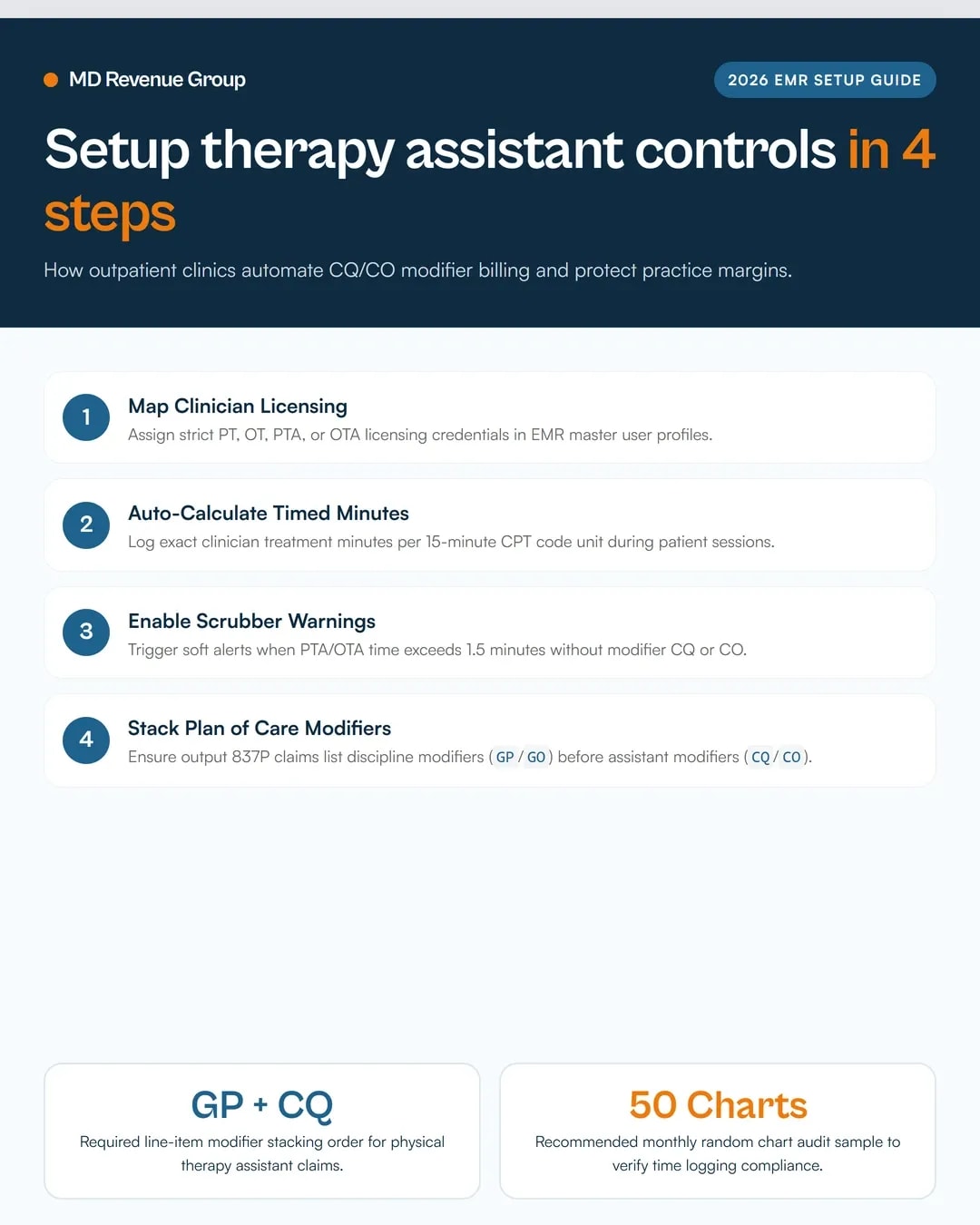
Therapy clinic owners can automate modifier compliance by configuring practice management software and EHR claim scrubbers:
EMR CLAIM SCRUBBER CONFIGURATION LOGIC |
|---|
Step 1: Map Clinician User ID to Licensing Type (PT vs. PTA)<br>Step 2: Auto-Calculate Timed Minutes per CPT Code per User<br>Step 3: Trigger Soft Warning if PTA Time > 1.5 Mins without CQ<br>Step 4: Auto-Append GP + CQ Modifiers on Output 837P Claim File |
Recommended Implementation Steps
- User Profile Mapping: Assign strict clinician credentials (PT, OT, PTA, OTA) in the EMR master user registry.
- Automated De Minimis Rules: Enable automated rule scrubbers that calculate PTA minutes per line item and auto-append CQ or CO.
- Same-Day Modifier Verification: Cross-check same-day therapy billing against same-day therapy modifier guidelines when billing modifier 59 or XE/XU for distinct procedural services.
- Monthly Audit Sampling: Audit 50 random therapy charts monthly to confirm EMR time entries match submitted claim lines.
Many practices choose to outsource therapy billing services to eliminate manual modifier coding errors and improve clean claim submission rates.
Secure Your Therapy Practice Revenue Cycle
Managing CQ/CO modifier compliance, 8-minute rule allocations, and payer-specific fee schedules requires specialized billing expertise. Request a free revenue audit with MD Revenue Group to eliminate billing errors, protect assistant margins, and boost practice collections.
Recover your denied claims in dollars.
Send us 50 of your recent denied claims. Our certified AAPC/AHIMA billing team will identify every recoverable dollar within 48 hours.